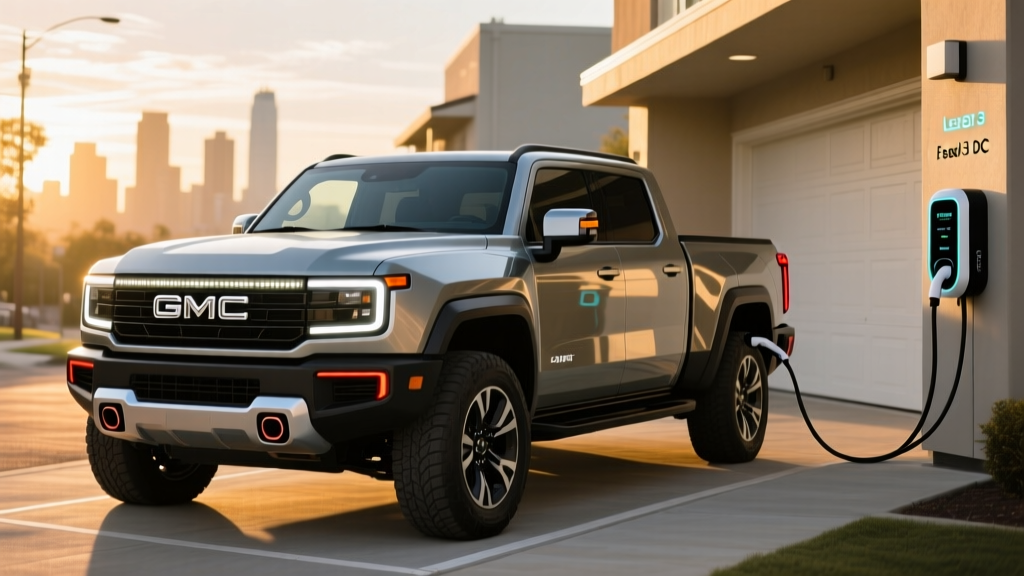
The GMC Hummer EV isn't subtle. At nearly 18 feet long and pushing 9,000 pounds, this electric super-truck exists to demolish the idea that battery-powered vehicles must be sensible. The 2025 GMC Hummer EV pickup truck carries forward with the tri-motor Watts to Freedom Edition and the more accessible dual-motor EV3X and EV2X trims, offering up to 1,000 horsepower alongside an EPA-estimated range that actually makes cross-country road trips feasible. But owning a vehicle this massive, this heavy, and this expensive demands more than brochure specs. This review breaks down exactly what the Hummer EV delivers — and where it falls short — in real-world driving, charging, and ownership economics.
Quick Verdict: Who Should Buy the Hummer EV Pickup?
Choose the Hummer EV if: You need a full-size truck with genuine off-road capability, want 300+ miles of range, can charge at home with a high-amperage Level 2 setup, and have the budget for a $96,000+ vehicle that will never fit in a standard garage.
Look elsewhere if: You prioritize efficiency, need easy urban parking, want access to the full $7,500 federal tax credit, or need a truck primarily for light-duty commuting where a Rivian R1T or Ford F-150 Lightning would cost less and consume fewer electrons.
Range, Battery, and Efficiency
| Specification | EV2X (Dual-Motor) | EV3X (Tri-Motor) |
|---|---|---|
| EPA Estimated Range | ~314 miles (est.) | ~292 miles (est.) |
| Battery Capacity (Usable) | ~212.7 kWh (Ultium, NMC) | ~212.7 kWh (Ultium, NMC) |
| Battery Chemistry | NMC (Nickel Manganese Cobalt) | NMC (Nickel Manganese Cobalt) |
| Efficiency (MPGe Combined) | ~47 MPGe | ~43 MPGe |
| Energy Consumption | ~72 kWh/100 mi | ~78 kWh/100 mi |
| Drivetrain | AWD (Dual-Motor) | AWD (Tri-Motor, e4WD) |
GMC's Ultium battery platform underpins the Hummer EV with one of the largest battery packs ever fitted to a production vehicle. At roughly 212.7 kWh of usable capacity using NMC chemistry, it dwarfs the Ford F-150 Lightning's extended-range pack (131 kWh) and even edges past the Rivian R1T's Max Pack (149 kWh). GM chose NMC over LFP to maximize energy density — critical when you're trying to push a 9,045-pound truck past 300 miles.
Real-World Range Reality: The EPA estimates up to 314 miles for the dual-motor EV2X, but expect 240–270 miles on highway road trips at 70–80 mph, where aerodynamic drag on this brick-shaped truck hits efficiency hard. In cold weather (below 32°F), range drops an additional 15–25%, meaning a winter highway drive could net you 190–220 miles between charges. City driving with regenerative braking recovers more energy, often matching or exceeding the EPA sticker.
The efficiency numbers tell the real story: at roughly 72–78 kWh per 100 miles, the Hummer EV consumes about 2.5 times the energy per mile of a Tesla Model Y. That's the physics of moving 9,000 pounds. If you're paying $0.15/kWh at home, that's roughly $0.11–$0.12 per mile — still cheaper than gasoline at $3.50/gallon and 14 MPG (the Hummer's gas predecessor), but noticeably more expensive per mile than lighter EVs.
Charging Speed: DC Fast and Home Level 2
| Charging Level | Power / Rate | Speed | Notes |
|---|---|---|---|
| DC Fast Charge (Peak) | Up to 350 kW (800V architecture) | 10–80% in ~30 minutes | Requires compatible 350 kW station; charge curve tapers significantly above 80% |
| DC Fast Charge (Typical 150 kW station) | ~150 kW sustained | ~10–80% in ~50 minutes | More common at Electrify America / EVgo corridors |
| Level 2 Home (48A / 11.5 kW) | 11.5 kW | ~16–18 miles per hour of charging | Full charge in ~18–20 hours; requires 60A circuit |
| Level 2 Home (80A / 19.2 kW) | 19.2 kW | ~27–30 miles per hour of charging | Full charge in ~11–12 hours; requires 100A circuit and heavy-gauge wiring |
| Level 1 (120V Standard Outlet) | ~1.4 kW | ~2 miles per hour | Effectively unusable for a 212 kWh battery; would take 150+ hours |
The Hummer EV's 800-volt architecture is its charging ace. On a 350 kW-capable DC fast charger (like Electrify America's newest stations), the truck can accept peak rates up to 350 kW, adding roughly 100 miles of range in about 10 minutes. However, the charge curve matters enormously here: peak rates are sustained only between roughly 10–40% State of Charge. Above 60%, the rate tapers progressively, and above 80%, charging slows to a crawl to protect the massive battery pack. Plan your road-trip stops around 10–80% top-ups for the fastest turnaround.
Home charging is where the Hummer EV demands serious infrastructure. With a 212 kWh battery, a standard 48-amp Level 2 charger (11.5 kW) needs nearly 20 hours for a full charge — adequate if you drive 50–80 miles daily and top up overnight. But if you drain the pack on a towing weekend, you'll want an 80-amp Level 2 station delivering 19.2 kW, cutting a full charge to about 12 hours. This requires a dedicated 100-amp circuit, which may necessitate a panel upgrade (many homes have only 100A or 150A total service). Budget $1,500–$3,500 for professional Level 2 installation, and potentially $2,000–$5,000 more if your electrical panel needs upgrading. Consult a licensed electrician before committing.
Performance: 1,000 HP and Watts to Freedom
| Performance Metric | EV2X (Dual-Motor) | EV3X (Tri-Motor) | Edition 1 / Watts to Freedom |
|---|---|---|---|
| Horsepower | 625 hp | 830 hp | 1,000 hp |
| Torque (lb-ft) | 7,400 lb-ft (wheel) | 11,500 lb-ft (wheel) | 12,000 lb-ft (wheel) |
| 0–60 mph | ~4.5 seconds | ~3.5 seconds | ~3.0 seconds |
| Top Speed | ~106 mph | ~106 mph | ~106 mph |
| Towing Capacity (max) | 7,500 lbs | 7,500 lbs | 7,500 lbs |
| Payload Capacity | ~1,300 lbs | ~1,300 lbs | ~1,300 lbs |
The tri-motor EV3X and Edition 1 models deliver the kind of acceleration that rewrites what a full-size truck can do. The Watts to Freedom mode (activated via a dedicated button that lowers the adaptive air suspension, stiffens the dampers, and unleashes maximum torque) launches this 9,000-pound behemoth to 60 mph in approximately 3.0 seconds — territory occupied by sports cars, not pickups. The dual-motor EV2X still delivers a very quick 4.5-second run, which is more than sufficient for any real-world scenario.
Off-road, the Hummer EV justifies its heritage. The available Extract Mode raises the air suspension by nearly 6 inches for 15.9 inches of ground clearance, while four-wheel steering enables a crab-walking "CrabWalk" mode (diagonal movement at low speeds) and a remarkably tight turning circle for a truck this long. Approach, departure, and breakover angles are competitive with purpose-built off-roaders. Underbody armor and 35-inch Goodyear Wrangler Territory MT tires come standard on EV3X trims.
Pricing, Trims, and Federal Tax Credit Eligibility
| Trim Level | Base MSRP | Estimated Federal Credit (§30D) | Effective Price |
|---|---|---|---|
| EV2X (Dual-Motor) | ~$96,550 | $0 (exceeds MSRP cap) | ~$96,550 |
| EV3X (Tri-Motor) | ~$104,550 | $0 (exceeds MSRP cap) | ~$104,550 |
| Edition 1 (Tri-Motor, Fully Loaded) | ~$112,550 | $0 (exceeds MSRP cap) | ~$112,550 |
Here's the hard truth about the federal EV tax credit and the Hummer EV: it does not qualify. Under IRS §30D rules, new electric pickup trucks must have an MSRP at or below $80,000 to be eligible for the up-to-$7,500 credit. Every 2025 Hummer EV trim starts well above that threshold. Additionally, buyers must meet adjusted gross income caps ($150,000 single / $300,000 joint), and the vehicle's battery components and critical minerals must meet domestic-sourcing requirements that shift annually. Even if the Hummer EV were priced under the cap, its battery sourcing may not meet 2025 critical-mineral thresholds. Always consult a tax professional and check fueleconomy.gov for the latest eligibility data before purchasing.
At the dealership, expect destination charges (~$1,995), potential dealer markups on high-demand trims, and options packages that can push a loaded EV3X past $120,000. The Hummer EV is a premium, low-volume product, and pricing reflects that.
Interior, Tech, and Daily Livability
Inside, the Hummer EV shares much of its architecture with the Cadillac Escalade IQ and Chevrolet Silverado EV, built on GM's Ultium platform. The centerpiece is a 13.4-inch diagonal infotainment touchscreen running Google Built-In (Google Maps, Google Assistant, Play Store apps), supplemented by a 12.3-inch driver information cluster. An available head-up display projects navigation and speed data onto the windshield.
Cargo and passenger dimensions:
- Bed length: 5 feet (standard for the crew-cab-only configuration)
- Front trunk (e-trunk/frunk): ~11.3 cubic feet — one of the largest in any EV, thanks to the absence of an engine
- Rear-seat legroom: ~43.4 inches — generous for adults on long trips
- Cab width: ~80+ inches (excluding mirrors) — tight for standard parking spaces (typically 96 inches wide)
- Vehicle length: ~216.8 inches — will not fit in many residential garages (standard 20-foot garage = 240 inches, but depth is consumed by the 5-foot bed and overhangs)
The Infinity Roof is a standout: modular sky panels remove to create an open-air experience, though reinstallation requires two people and careful alignment. The MultiPro tailgate offers six configurations including a step-in mode. Trailering tech includes integrated trailer brake control, Hitch View cameras, and GM's Super Cruise hands-free driving system for compatible highways.
Super Cruise Is Not Self-Driving: GM's Super Cruise is an SAE Level 2 driver-assistance system. It handles steering, acceleration, and braking on pre-mapped divided highways, but the driver must remain attentive and keep eyes on the road (monitored via an infrared camera on the steering column). It does not navigate city streets, construction zones, or unmapped roads. You are always the responsible driver.
Warranty, Battery Longevity, and Ownership Costs
| Coverage | Term |
|---|---|
| Basic Vehicle Warranty | 3 years / 36,000 miles |
| Powertrain Warranty | 5 years / 60,000 miles |
| Battery Pack Warranty | 8 years / 100,000 miles (minimum 70% capacity retention) |
| Roadside Assistance | 5 years / 60,000 miles |
GMC backs the Ultium battery with the industry-standard 8-year/100,000-mile warranty, guaranteeing that the pack will retain at least 70% of its original capacity during that period. Given the NMC chemistry and the massive thermal management system (liquid cooling across all modules), real-world degradation should be modest — likely 8–12% over the first 100,000 miles based on data from other large-format NMC packs. A full battery replacement, should it ever be needed out of warranty, is estimated at $20,000–$30,000+ given the pack's enormous size, though module-level repairs may reduce that cost.
Insurance premiums run significantly higher than average for full-size trucks — expect $2,500–$4,000+ annually depending on your profile, driven by the vehicle's repair costs, high value, and performance capability. Get quotes before purchasing.
Pros and Cons
Pros
- 314-mile EPA range is legitimate for a truck this size — road-trip viable with planning
- 350 kW DC fast-charging on 800V architecture; 10–80% in ~30 min at compatible stations
- Up to 1,000 hp and 3.0-second 0–60 in Watts to Freedom mode — absurdly quick
- CrabWalk, Extract Mode, and four-wheel steering give genuine off-road differentiation
- Massive frunk (11.3 cu ft) and MultiPro tailgate add real utility
- Super Cruise enables hands-free highway driving on 400,000+ miles of mapped roads
- Quiet, refined ride quality on pavement despite the massive tires and weight
Cons
- Does NOT qualify for the $7,500 federal EV tax credit (MSRP far exceeds $80K cap)
- 72–78 kWh/100 mi efficiency means high electricity costs per mile vs. lighter EVs
- Home charging requires serious electrical infrastructure; 20-hour charge on 48A Level 2
- Too large for most standard garages, tight urban parking, and many drive-throughs
- 7,500-lb towing capacity trails heavy-duty gas trucks (Ford F-250: 15,000+ lbs)
- Starting near $97K, with loaded models exceeding $120K — premium pricing
- Only a 5-foot bed limits utility for contractors or long-haul cargo
How It Compares: Hummer EV vs. Rivian R1T vs. Ford F-150 Lightning
| Metric | 2025 GMC Hummer EV (EV2X) | 2025 Rivian R1T (Dual-Motor Max) | 2025 Ford F-150 Lightning (Ext. Range) |
|---|---|---|---|
| EPA Range | ~314 mi | ~352 mi | ~320 mi |
| Battery (kWh) | ~212.7 | ~149 | ~131 |
| 0–60 mph | ~4.5 sec | ~3.5 sec (Dual-Max) | ~4.0 sec |
| Max DC Charge | 350 kW | ~220 kW | ~150 kW |
| Starting MSRP | ~$96,550 | ~$89,800 | ~$62,000 |
| Federal Tax Credit | No (MSRP cap) | No (MSRP cap on Max) | Yes (select trims under $80K) |
| Towing Capacity | 7,500 lbs | 11,000 lbs | 10,000 lbs |
| Bed Length | 5 ft | 4.5 ft (standard) / Gear Tunnel | 5.5 ft |
The Hummer EV wins on sheer spectacle, off-road hardware, and DC charging speed. The Rivian R1T offers a more refined on-road experience, better range efficiency, and a more usable gear-tunnel storage system. The Ford F-150 Lightning is the value pick — thousands less, qualifies for the tax credit on lower trims, and fits in a normal garage. If you need a truck for actual daily work, the Lightning or R1T are more practical. If you want a conversation-starting off-road weapon with road-trip range, the Hummer EV stands alone.
Frequently Asked Questions
What is the real-world range of the 2025 GMC Hummer EV pickup truck?
The EPA estimates up to 314 miles for the dual-motor EV2X and around 292 miles for the tri-motor EV3X. In real-world highway driving at 70–80 mph, expect 240–270 miles. In freezing temperatures, that drops to roughly 190–220 miles. City driving with regenerative braking often matches or exceeds the EPA estimate.
How fast does the Hummer EV charge at home and on the road?
On a 350 kW DC fast charger, the Hummer EV charges from 10–80% in approximately 30 minutes thanks to its 800V architecture. At home on a 48-amp Level 2 charger (11.5 kW), expect about 16–18 miles of range per hour of charging, meaning a full charge takes roughly 18–20 hours. An 80-amp Level 2 station (19.2 kW) cuts that to about 12 hours.
Does the 2025 Hummer EV qualify for the federal EV tax credit?
No. Under IRS §30D rules, electric pickup trucks must have an MSRP at or below $80,000 to qualify for the up-to-$7,500 federal tax credit. Every Hummer EV trim starts above $96,000, making it ineligible regardless of buyer income or battery sourcing. Always verify current rules with a tax professional.
How much does it cost to charge the Hummer EV?
At the national average residential electricity rate of ~$0.16/kWh, a full charge of the 212.7 kWh battery costs approximately $34. At the truck's real-world efficiency of ~72 kWh/100 miles, that's about $0.11–$0.12 per mile. DC fast charging at public stations ($0.35–$0.50/kWh) pushes the cost to $0.25–$0.36 per mile.
Can the Hummer EV fit in a standard home garage?
Often, no. At 216.8 inches long and over 86 inches wide (excluding mirrors), the Hummer EV exceeds the usable dimensions of many standard single-car and even some two-car garages. Measure your garage depth (including any shelving or water heaters) carefully before purchasing. A minimum 22-foot-deep garage is recommended.
Is the Hummer EV worth buying over the Rivian R1T or F-150 Lightning?
It depends on your priorities. If you want maximum off-road capability, the most powerful truck on the market, and don't mind the $100K+ price tag, the Hummer EV is unmatched. If you need towing capacity, practical daily use, or tax-credit eligibility, the Rivian R1T or Ford F-150 Lightning are more rational choices at significantly lower cost.