Quick Verdict: The Accessible Electric Mustang
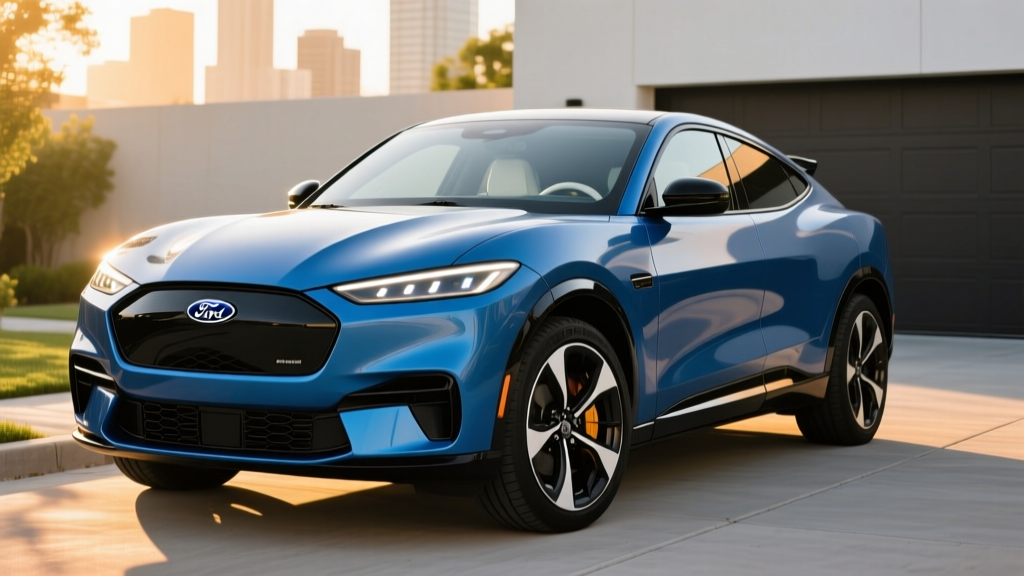
The 2025 Ford Mustang Mach-E Select is the entry point into Ford's electric crossover lineup, and it's a compelling one. With a starting MSRP of $39,995 before destination, an EPA-estimated 250 miles of range, and Ford's adoption of the NACS charging standard, the Select trim delivers practical electrification without the premium price of higher trims. It's not the longest-range or fastest-charging EV in its class, but its combination of usable space, composed ride, and BlueCruise availability make it a serious contender for buyers transitioning from gas crossovers.
| Spec | Value |
|---|---|
| EPA Range (RWD) | 250 miles |
| Battery (usable) | 70 kWh, LFP chemistry |
| Drivetrain | RWD (single motor) / AWD available |
| Horsepower | 266 hp (RWD) / 325 hp (AWD eAWD) |
| 0–60 mph | ~5.8 sec (RWD) / ~5.1 sec (AWD) |
| Max DC Fast Charge | 150 kW peak |
| 10–80% DC Charge | ~26 minutes |
| Level 2 Home Charging | 10.5 kW (~30 mi/hr) |
| EPA Efficiency (RWD) | 101 MPGe combined / 33 kWh/100mi |
| Cargo Volume | 29.7 cu ft (rear up) / 59.7 cu ft (rear folded) |
| Front Trunk (Frunk) | 4.7 cu ft |
| Base MSRP (RWD) | $39,995 + $1,995 destination |
| Battery Warranty | 8 years / 100,000 miles |
Range and Efficiency: EPA Sticker vs. Real-World Driving
The rear-wheel-drive Mach-E Select carries Ford's 70 kWh Standard Range battery pack, which uses lithium iron phosphate (LFP) chemistry. The EPA rates it at 250 miles of combined range, with efficiency rated at 101 MPGe combined (110 city / 92 highway) according to fueleconomy.gov.
EPA: 250 miles combined. In real-world highway driving at 70–75 mph, expect approximately 220–235 miles before needing to charge. In sub-freezing temperatures (below 32°F), range can drop to 175–200 miles depending on cabin heating use and whether you precondition. City driving with regenerative braking can push range close to or slightly above the EPA figure, around 255–265 miles in mild weather.
The LFP chemistry is a deliberate trade-off. LFP cells sacrifice some energy density compared to NMC (nickel manganese cobalt), which is why the Standard Range pack tops out at 250 miles rather than the 320 miles available on Extended Range trims with NMC packs. But LFP gains important practical advantages: longer cycle life, greater thermal stability, and the ability to regularly charge to 100% without accelerating degradation. For daily commuters who plug in at home every night, that 100% daily charge is a non-issue and the longevity benefit is substantial.
Efficiency in mixed driving hovers around 33 kWh per 100 miles, which is competitive but not class-leading. The Hyundai Ioniq 5 achieves roughly 30 kWh/100mi, while the Tesla Model Y comes in around 28 kWh/100mi. The Mach-E's slightly higher consumption reflects its heavier curb weight and less aggressive aero tuning.
Charging Speed: DC Fast, Level 2, and NACS Access
Ford's 2025 model year marks a pivotal shift: the Mach-E now ships with a native NACS (North American Charging Standard) charge port, replacing the previous CCS1 connector. This grants the Mach-E direct access to Tesla's Supercharger network — over 19,000 stalls in North America — without an adapter. For owners who road-trip, this is the single biggest charging-infrastructure advantage any non-Tesla EV currently offers.
| Level | Power | Speed | Notes |
|---|---|---|---|
| Level 1 (120V) | 1.2 kW | ~3 mi/hr | Emergency/trickle only |
| Level 2 (240V home) | 10.5 kW | ~30 mi/hr | Full charge in ~7 hours |
| DC Fast Charge | 150 kW peak | ~10–80% in 26 min | Tapers above 80% |
The 150 kW peak DC fast-charge rate is the Select's most visible limitation versus rivals. The Hyundai Ioniq 5 peaks at 240 kW on 800V architecture (10–80% in ~18 minutes), and even the Kia EV6 manages 233 kW. Ford's 70 kWh LFP pack charges at a more conservative rate, and the charge curve tapers noticeably above 60% state of charge. On a road trip, you'll spend roughly 26 minutes at a DC fast charger to go from 10% to 80%, and pulling into a second charger for another 10–80% top-up will feel longer because of the taper and the smaller pack size requiring more frequent stops.
At home on a Level 2 wall connector or hardwired EVSE delivering 10.5 kW (48 amps on a 60-amp circuit), the Mach-E Select replenishes roughly 30 miles of range per hour. A full 0–100% charge takes about 7 hours, easily achievable overnight. Ford includes a mobile charge cord with the vehicle that can handle both 120V (Level 1) and 240V (Level 2, at a reduced 32-amp / 7.7 kW rate) for flexible plug-in options, though a dedicated home Level 2 station is strongly recommended for daily use.
Performance and Drivetrain
The Select trim's single rear-mounted motor produces 266 horsepower and 317 lb-ft of torque, propelling the RWD model to 60 mph in approximately 5.8 seconds. That's brisk enough for confident highway merging and genuinely fun in a way that the Mustang badge promises. The optional eAWD dual-motor setup bumps output to 325 hp and drops the 0–60 time to roughly 5.1 seconds, at the cost of some range (the AWD Select is EPA-rated at approximately 230 miles).
Ride quality is a Mach-E strength. The suspension tuning is composed and slightly firm, absorbing highway imperfections without the floatiness that plagues some electric crossovers. Steering is well-weighted, and the low center of gravity from the floor-mounted battery pack keeps body roll minimal through corners. One-pedal driving mode is available and provides strong regenerative braking, though it doesn't quite bring the vehicle to a complete stop in all conditions — you'll still use the friction brake pedal at times.
The Mach-E Select is not a towing vehicle. Ford rates it at 1,500 pounds maximum with the proper equipment, which is enough for a small utility trailer but not a camper or boat. Buyers needing tow capacity should look at the Extended Range AWD models (rated up to 2,600 lb) or consider a truck-based EV.
Interior, Cargo, and Technology
Inside, the 2025 Mach-E Select features Ford's SYNC 4A infotainment system anchored by a large 15.5-inch vertically oriented touchscreen. The interface is responsive, supports wireless Apple CarPlay and Android Auto, and includes built-in navigation with EV-aware route planning that factors in charging stops. A 10.2-inch digital instrument cluster sits behind the steering wheel, and a rotary gear dial frees up center-console storage.
Passenger space is generous for a midsize crossover. Front-seat legroom measures 43.3 inches, with 38.1 inches in the rear — enough for adults on longer trips without complaint. The flat floor (no transmission tunnel) helps rear-seat comfort. Cargo volume behind the second row is 29.7 cubic feet, expanding to 59.7 cubic feet with the rear seats folded. The front trunk (frunk) adds 4.7 cubic feet — small but useful for charging cables or a bag of groceries, and it features a drain plug for use as a cooler at tailgates.
Standard driver-assistance technology includes Ford Co-Pilot360 2.0: automatic emergency braking with pedestrian detection, blind-spot monitoring, lane-keeping assist, rear cross-traffic alert, and adaptive cruise control with stop-and-go. The available BlueCruise system enables hands-free highway driving on pre-mapped divided highways — this is an SAE Level 2 system, meaning the driver must remain attentive and eyes on the road at all times (monitored by an infrared driver-facing camera). BlueCruise is offered as a 90-day free trial on the Select, after which it requires a paid subscription (~$75/month or $800/year).
Ford BlueCruise and Co-Pilot360 are SAE Level 2 driver-assistance systems. They do NOT make the vehicle self-driving. The driver must remain engaged, monitor the road, and be prepared to take over at any moment. BlueCruise operates only on pre-qualified sections of divided highways and will disengage in construction zones, complex interchanges, or adverse weather.
Pricing, Trims, and Federal Tax Credit Eligibility
The 2025 Mach-E Select starts at $39,995 MSRP for the RWD model, plus a $1,995 destination charge, bringing the sticker to $41,990. Adding eAWD costs approximately $3,000, pushing the AWD Select to roughly $44,990 before options. Ford offers the Select in a limited palette of exterior colors and standard 18-inch wheels; premium packages (panoramic glass roof, upgraded audio, BlueCruise subscription) are available à la carte or in bundles.
| Configuration | MSRP + Dest. | Max §30D Credit | Est. Net Price |
|---|---|---|---|
| Select RWD | $41,990 | Up to $7,500 | ~$34,490 |
| Select eAWD | $44,990 | Up to $7,500 | ~$37,490 |
Regarding the federal EV tax credit under IRS §30D: the Mach-E Select's MSRP is well below the $80,000 cap for SUVs/crossovers, so it clears the price threshold. However, eligibility for the full $7,500 depends on several factors that change periodically and vary by buyer:
- Buyer income caps: Modified adjusted gross income must not exceed $150,000 (single), $225,000 (head of household), or $300,000 (joint filers).
- Battery component and critical mineral sourcing: The credit splits into two halves ($3,750 each) based on battery component manufacturing and critical mineral sourcing requirements. Vehicles with LFP batteries sourced from supply chains that include Chinese-processed minerals may qualify for only $3,750 or none at all, depending on current-year rules.
- Point-of-sale transfer: As of 2024, eligible buyers can transfer the credit to the dealer at purchase, receiving it as an immediate price reduction rather than waiting to claim it on their tax return.
Always verify current eligibility on IRS.gov and confirm with your dealer and tax professional before purchasing. Ford's LFP battery sourcing for the Standard Range pack has been a point of uncertainty under evolving critical-mineral rules, and the qualifying credit amount can shift with supply-chain changes.
Ownership Costs and Warranty
Ford backs the Mach-E's high-voltage battery and electric powertrain components with an 8-year / 100,000-mile warranty (whichever comes first), which is standard across the industry. The battery warranty guarantees that the pack will retain at least 70% of its original capacity during that period. LFP chemistry's slower degradation curve suggests most owners will comfortably exceed that threshold, with industry data showing LFP packs typically retaining 90%+ capacity after 100,000 miles of normal use.
The bumper-to-bumper limited warranty covers 3 years / 36,000 miles. Maintenance costs are minimal compared to gas vehicles — no oil changes, no spark plugs, no transmission fluid. Brake pad life is extended significantly by regenerative braking; many EV owners report original brake pads lasting 80,000+ miles. Expect to spend primarily on tire rotation, cabin air filter replacement, and windshield washer fluid.
Insurance premiums for the Mach-E Select tend to run 15–25% higher than a comparably priced gas crossover, reflecting EV repair costs and parts pricing. Average annual premiums fall in the $1,600–$2,100 range depending on driver profile and state, according to industry estimates. Shopping multiple insurers is recommended — some carriers offer dedicated EV discounts.
How It Compares: Mach-E Select vs. the Competition
The Mach-E Select's most direct competitors are the Hyundai Ioniq 5 SE Standard Range (~$42,000, 220 mi EPA, 240 kW DC charging), the Tesla Model Y RWD (~$44,990, 320 mi EPA, 250 kW peak on V3 Superchargers), and the Kia EV6 Wind RWD (~$42,600, 232 mi EPA, 233 kW DC charging).
The Ioniq 5 and EV6 charge significantly faster on DC — roughly 8 minutes quicker from 10–80% — which matters on road trips. The Model Y offers substantially more range (70 miles more EPA) and access to the same Supercharger network the Mach-E now shares via NACS. Where the Mach-E wins is ride comfort (smoother and quieter than the Ioniq 5), interior material quality at this price point, and the availability of BlueCruise for hands-free highway miles, which neither Hyundai nor Kia currently match in sophistication.
Cargo space is competitive: the Mach-E's 29.7 cu ft is slightly less than the Model Y (30.2 cu ft) but more than the Ioniq 5 (27.2 cu ft). The Mach-E's frunk is smaller than the Ioniq 5's (8.5 cu ft) but larger than the Model Y's minimal front storage.
- Native NACS port — direct Tesla Supercharger access
- LFP battery supports daily 100% charging without degradation worry
- Composed ride quality and confident handling
- Generous rear-seat legroom (38.1 in)
- SYNC 4A with large 15.5-inch screen is intuitive
- BlueCruise hands-free highway driving available
- Frunk with drain plug — practical for tailgating
- 150 kW DC peak charge rate trails Ioniq 5/EV6 significantly
- 250-mile EPA range is the lowest in the class for base trims
- BlueCruise requires paid subscription after trial
- Towing limited to 1,500 lb on Select trim
- Insurance premiums higher than gas equivalents
- LFP tax credit eligibility uncertain under current sourcing rules
Who Should Buy the 2025 Mach-E Select?
- You commute 30–60 miles round-trip and charge at home nightly
- You value ride comfort and cabin quietness over maximum range
- You want Supercharger access for occasional road trips
- You prefer Ford's dealer network and service infrastructure
- Daily 100% charging on an LFP pack fits your routine
- You regularly drive 250+ miles between charges (consider Extended Range or Model Y)
- Fast DC charging on road trips is a top priority (Ioniq 5 / EV6)
- You need towing capacity above 1,500 lb
- You want the lowest possible insurance costs
Frequently Asked Questions
What is the real-world range of the 2025 Mach-E Select?
The EPA rates the RWD Select at 250 miles combined. In real-world highway driving at 70+ mph, expect 220–235 miles. In cold weather (below freezing), plan for 175–200 miles depending on conditions. City driving with regen braking can push slightly past the EPA number in mild weather.
How fast does the Mach-E Select charge?
On DC fast charging, it peaks at 150 kW and charges from 10–80% in approximately 26 minutes. At home on a Level 2 charger (10.5 kW), it adds about 30 miles of range per hour, with a full charge taking roughly 7 hours. Level 1 (120V) adds about 3 miles per hour and is suitable only for emergencies or very low-mileage days.
Does the 2025 Mach-E Select qualify for the $7,500 federal EV tax credit?
It can, but eligibility depends on the buyer's income (must be below IRS thresholds), the vehicle's battery component and critical-mineral sourcing (which varies by production batch), and current-year IRS rules. The MSRP is well under the $80,000 SUV cap. Verify eligibility at IRS.gov and with your tax professional before purchase. The credit can be transferred to the dealer at point of sale for an immediate price reduction.
Is the Mach-E Select worth buying over the Ioniq 5 or Model Y?
It depends on priorities. If ride comfort, cabin quality, and hands-free driving tech matter most, the Mach-E Select is excellent. If maximum range and fastest DC charging are paramount, the Model Y and Ioniq 5 have clear advantages. The Mach-E's NACS access narrows the Supercharger gap with Tesla, and its LFP battery longevity is a genuine ownership benefit for high-mileage daily drivers.
What is the battery warranty on the Mach-E?
Ford covers the high-voltage battery and electric drivetrain components for 8 years or 100,000 miles, whichever comes first. The warranty guarantees at least 70% battery capacity retention during that period. LFP chemistry's robust cycle life suggests most packs will exceed this threshold comfortably under normal use.
Can I charge the Mach-E Select at Tesla Superchargers?
Yes. The 2025 Mach-E ships with a native NACS charge port, allowing direct plug-in at Tesla Supercharger stalls without an adapter. Use the FordPass app or the vehicle's built-in navigation to locate and activate Supercharger sessions.