The Ford F-150 Lightning remains one of the most capable electric trucks on the market, blending full-size pickup utility with zero tailpipe emissions. But beyond the headline horsepower and mega-frunk, buyers want to know what it's actually like to live with one — especially the cabin experience, real-world range, and charging practicality. We spent time with the 2025 Ford F-150 Lightning to evaluate its interior quality, technology suite, and day-to-day ownership realities.
Quick Verdict: Who the F-150 Lightning Is For
The 2025 F-150 Lightning is best suited for truck owners who need genuine payload and towing capability but want to eliminate fuel costs on daily commutes and job-site runs. With up to 320 miles of EPA-estimated range (Extended Range battery), a massive front trunk, and Pro Power Onboard for worksite electricity, it fills a niche no other EV truck matches as completely. However, highway range drops significantly, cold weather bites hard, and pricing has climbed well past its original headline numbers.
Choose the F-150 Lightning if: You need a full-size truck bed, tow occasionally under 10,000 lbs, want a frunk for secure gear storage, and have access to home Level 2 charging.
Look elsewhere if: You regularly tow over 8,000 lbs on highways (range collapses), need best-in-class off-road capability (Rivian R1T or F-150 Raptor), or want a sub-$50,000 entry price.
2025 F-150 Lightning Interior and Cabin Technology
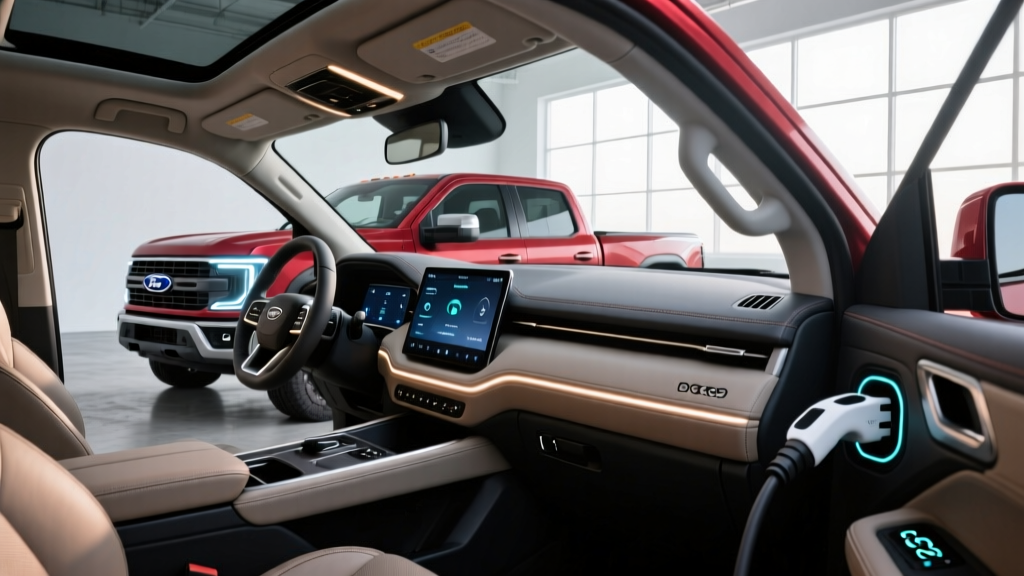
The 2025 Ford F-150 Lightning interior carries over the design language introduced with the current generation, with the centerpiece being the available 15.5-inch vertical touchscreen running SYNC 4A. The portrait-oriented display dominates the dash and handles climate controls, navigation, and media. Response times are generally quick, though the all-touch climate controls can frustrate gloved users in cold weather.
Upper trims (Lariat and Platinum) feature upgraded materials including leather-trimmed seats, genuine aluminum accents, and a 12-inch digital instrument cluster that displays range, power consumption, and navigation. The cabin is notably quiet at speed — electric powertrain silence lets wind and road noise become more apparent, but Ford's acoustic insulation keeps things refined for a body-on-frame truck.
The Lightning's interior dimensions mirror the SuperCrew F-150 gas model: 43.9 inches of front legroom, 43.6 inches of rear legroom, and seating for five adults. Behind the rear seats, you get 52.8 cubic feet of cargo volume in the 5.5-foot bed. The 400-liter (14.1 cu ft) Mega Power Frunk up front is lockable, weather-sealed, and includes four 120V outlets — a genuine differentiator for contractors and tailgaters.
Driver-Assistance and Smart Features
Ford's BlueCruise hands-free driving system is available on the Lightning, enabling hands-off operation on over 130,000 miles of pre-mapped divided highways. This is an SAE Level 2 system — the driver must remain attentive, and an infrared camera monitors eye gaze. BlueCruise performs competently on long interstate hauls but does not handle construction zones, unmapped roads, or complex merges without driver takeover.
Standard Ford Co-Pilot360 2.0 includes automatic emergency braking, blind-spot monitoring with trailer coverage, lane-keeping assist, and rear cross-traffic alert. The available Pro Trailer Backup Assist remains one of the best trailer-hitching aids in the industry.
Range, Battery, and Real-World Efficiency
The 2025 F-150 Lightning offers two battery configurations:
| Specification | Standard Range | Extended Range |
|---|---|---|
| Usable Battery Capacity | 98 kWh (NMC) | 131 kWh (NMC) |
| EPA Estimated Range | 230 miles | 320 miles |
| Real-World Highway (~70 mph) | ~175-190 miles | ~240-265 miles |
| Cold Weather (below 32°F) | ~150-170 miles | ~210-240 miles |
| Horsepower | 452 hp | 580 hp |
| Torque | 775 lb-ft | 775 lb-ft |
| 0-60 mph | ~3.8 sec | |
| Drivetrain | Dual-Motor AWD | Dual-Motor AWD |
| MPGe (Combined) | 76 MPGe | 70 MPGe |
| Efficiency (kWh/100 mi) | 44 kWh/100mi | 48 kWh/100mi |
| Max Towing Capacity | 7,700 lbs | 10,000 lbs |
Real-World Range Reality: The EPA rates the Extended Range Lightning at 320 miles, but our highway testing at 70-75 mph consistently yields 240-265 miles in moderate temperatures. Cold weather (below freezing) pushes that down to roughly 210-240 miles. Towing a 5,000-lb trailer? Expect 100-130 miles before needing a charge. The Standard Range truck's 230-mile EPA figure drops to approximately 175-190 miles at highway speeds — adequate for commuting but limiting for road trips.
The Lightning uses nickel-manganese-cobalt (NMC) lithium-ion cells in both battery packs. NMC chemistry offers higher energy density than LFP (lithium iron phosphate), which matters in a truck where space and weight are at a premium. However, NMC batteries degrade slightly faster over time and prefer not to sit at 100% state of charge for extended periods. Ford recommends daily charging to 80-90% for battery longevity, reserving 100% for trips.
Charging Speed: DC Fast and Home Level 2
Charging speed is critical for truck owners who can't always rely on overnight home sessions. Here's what the 2025 Lightning delivers:
| Charging Level | Standard Range (98 kWh) | Extended Range (131 kWh) |
|---|---|---|
| Level 1 (120V, 1.4 kW) | ~2 mi/hr | ~2 mi/hr |
| Level 2 (240V, 11.5 kW) | ~19 mi/hr (~10 hr full) | ~19 mi/hr (~14 hr full) |
| Level 2 (240V, 19.2 kW — 80A) | ~30 mi/hr (~6 hr full) | ~30 mi/hr (~8 hr full) |
| DC Fast (peak 150 kW) | 10-80% in ~44 min | 10-80% in ~41 min |
| DC Fast (max ~155 kW) | Peak rate, tapers above 80% | Peak rate, tapers above 80% |
The Lightning's DC fast-charging peak of approximately 150-155 kW trails competitors like the Rivian R1T (up to 220 kW on the latest pack) and the GMC Sierra EV (up to 350 kW). In practice, the charge curve holds strong between 10-60% state of charge, then tapers noticeably above 80%. Plan to charge to 80% at DC stations and move on rather than waiting for a slow top-off.
For home charging, the available 80A Charge Station Pro (19.2 kW) is one of the fastest residential AC solutions available, adding roughly 30 miles of range per hour. This requires a 100-amp dedicated circuit and likely a panel upgrade for many homes — budget $1,500-$3,000 for professional installation beyond the charger cost. The standard 30A Mobile Charger delivers about 19 miles per hour at 240V, sufficient for overnight replenishment on most commutes.
Pricing, Trims, and Federal Tax Credit Eligibility
The 2025 F-150 Lightning has seen price increases since its 2022 debut. Here's the current trim and pricing breakdown:
| Trim | Battery | Base MSRP | Est. After §30D Credit* |
|---|---|---|---|
| Pro | Standard Range | $54,995 | ~$47,495 |
| XLT | Standard Range | $59,995 | ~$52,495 |
| XLT | Extended Range | $69,995 | ~$62,495 |
| Lariat | Extended Range | $76,995 | ~$69,495 |
| Platinum | Extended Range | $96,874 | Not eligible (MSRP cap) |
*Federal tax credit estimates based on current IRS §30D rules. Eligibility is NOT automatic — see checklist below.
- MSRP Cap: Trucks/vans/SUVs must have an MSRP at or below $80,000. The Platinum trim exceeds this and does not qualify. All other trims fall under the cap.
- Buyer Income Cap: Modified adjusted gross income (MAGI) must not exceed $150,000 (single), $225,000 (head of household), or $300,000 (joint filing). See IRS §30D guidelines for current-year thresholds.
- Battery Component Sourcing: To qualify for the full $7,500, the vehicle must meet critical minerals and battery component requirements that phase in annually. Ford sources Lightning batteries from SK On (BlueOval SK plant in Kentucky), but exact credit amounts may vary by build date. Verify with your dealer and a tax professional.
- Point-of-Sale Transfer: As of 2024, eligible buyers can transfer the credit to the dealer at purchase, reducing the purchase price directly rather than waiting for a tax refund. This requires IRS registration through the dealer.
Our as-tested Lariat Extended Range with the Max Tow Package, BlueCruise, and upgraded wheels came to $81,245 — above the MSRP cap, meaning no federal credit for this specific configuration. Buyers targeting the tax credit should build carefully and confirm eligibility with their dealer before ordering.
How It Compares: Lightning vs Rivian R1T vs Chevrolet Silverado EV
The electric truck segment has grown, giving buyers real alternatives:
| Spec | 2025 F-150 Lightning (Ext.) | 2025 Rivian R1T (Dual Max) | 2025 Chevy Silverado EV (4WT) |
|---|---|---|---|
| EPA Range | 320 mi | 352 mi | 440 mi |
| Battery | 131 kWh NMC | 149 kWh NMC | 200+ kWh NMC |
| Peak DC Charge | ~155 kW | ~220 kW | ~350 kW |
| 10-80% Time | ~41 min | ~30 min | ~35 min |
| Horsepower | 580 hp | 665 hp | 510 hp |
| 0-60 mph | 3.8 sec | 3.5 sec | ~4.5 sec |
| Max Towing | 10,000 lbs | 11,000 lbs | 10,000 lbs |
| Bed Length | 5.5 ft | 4.5 ft | 5.11 ft |
| Starting MSRP | $54,995 | $75,600 | $55,000 (est.) |
| Tax Credit | Yes (most trims) | Yes (varies) | Yes (varies) |
Ownership Costs and Warranty Coverage
Ford backs the F-150 Lightning with a competitive warranty package:
- Battery & Electric Components: 8 years / 100,000 miles (whichever comes first), with a capacity retention threshold of 70% of original capacity.
- Limited Vehicle Warranty: 3 years / 36,000 miles bumper-to-bumper.
- Powertrain Warranty: 5 years / 60,000 miles.
For total cost of ownership, the Lightning benefits from lower "fuel" costs — charging at home at the national average of $0.16/kWh costs roughly $21 to fully charge the Extended Range pack (131 kWh), versus $80-$100 to fill a gas F-150's 26-gallon tank at current prices. Over 15,000 miles annually, that's approximately $1,200 in electricity versus $3,500+ in gasoline.
However, insurance premiums for the Lightning run 15-25% higher than comparable gas F-150s, and tire replacement costs more due to the truck's weight and EV-specific tire requirements. Depreciation data is still maturing for the Lightning, though early indicators suggest it holds value better than most EVs due to truck demand.
The Biggest Pros and Cons
Pros
- Massive 14.1 cu ft frunk with integrated 120V power outlets
- Pro Power Onboard provides up to 9.6 kW of jobsite electricity
- Genuine 10,000-lb towing capacity (Extended Range)
- BlueCruise hands-free highway driving available
- Strong federal tax credit eligibility on most trims
- Quiet, refined cabin for a body-on-frame truck
- Available 80A home charging for fast overnight replenishment
Cons
- Highway range drops 25-30% below EPA estimates
- Towing severely reduces range (100-130 mi with heavy trailer)
- DC fast charging peaks at ~155 kW — slower than Rivian and GM
- Pricing has climbed significantly; Platinum trim exceeds tax credit cap
- 5.5-foot bed is shorter than many gas F-150 configurations
- Cold weather range loss of 25-35% is substantial
- All-touch climate controls frustrate in work/glove environments
Frequently Asked Questions
What is the real-world range of the 2025 F-150 Lightning?
The EPA rates the Extended Range at 320 miles and Standard Range at 230 miles. In real-world highway driving at 70-75 mph, expect approximately 240-265 miles (Extended) and 175-190 miles (Standard). Cold weather below freezing reduces these figures by 25-35%. Towing a 5,000+ lb trailer cuts range roughly in half.
How fast does the F-150 Lightning charge?
On DC fast chargers, the Lightning peaks at approximately 150-155 kW, achieving 10-80% in roughly 41 minutes (Extended Range). At home on a 240V Level 2 charger at 19.2 kW (80A), it adds about 30 miles per hour, fully charging the Extended Range pack in approximately 8 hours. A standard 30A Level 2 setup adds about 19 miles per hour.
How much does the F-150 Lightning cost after tax credits?
The Pro trim starts at $54,995 and may qualify for the full $7,500 federal tax credit, bringing it to approximately $47,495. The XLT Standard Range at $59,995 drops to roughly $52,495. However, eligibility depends on buyer income, battery sourcing requirements, and MSRP caps. The Platinum trim at $96,874 exceeds the $80,000 truck MSRP cap and does not qualify.
Does the F-150 Lightning qualify for the federal EV tax credit?
Most trims qualify, but eligibility is not automatic. The vehicle must be under the $80,000 MSRP cap for trucks, the buyer must meet income limits ($150K single / $300K joint), and the battery must meet critical-mineral and component-sourcing requirements that tighten annually. Verify with your dealer and consult a tax professional. Point-of-sale transfer is available, reducing your purchase price directly.
Is the F-150 Lightning worth buying vs the Rivian R1T or Silverado EV?
It depends on your priorities. The Lightning wins on value (lowest starting price), frunk utility, and Pro Power Onboard for worksite use. The Rivian R1T offers better off-road capability, faster DC charging (~220 kW), and a more premium interior but starts around $75,600. The Chevy Silverado EV promises 440 miles of range and 350 kW charging but has limited availability and an unproven track record. For a work-focused truck buyer wanting the best value, the Lightning remains the strongest choice.
Can the F-150 Lightning power my home during an outage?
Yes, with the available Ford Intelligent Backup Power system and Home Integration System (sold separately, ~$3,890 plus installation). The Lightning can supply up to 9.6 kW of continuous power, enough to run essential home circuits for approximately 3 days on a full Extended Range charge. This requires professional installation by a licensed electrician.
Sources: EPA Fuel Economy — F-150 Lightning, Ford F-150 Lightning Official Specs, IRS New Clean Vehicle Credit (§30D)