Quick Verdict: America's Electric Workhorse at a Post-Credit Price
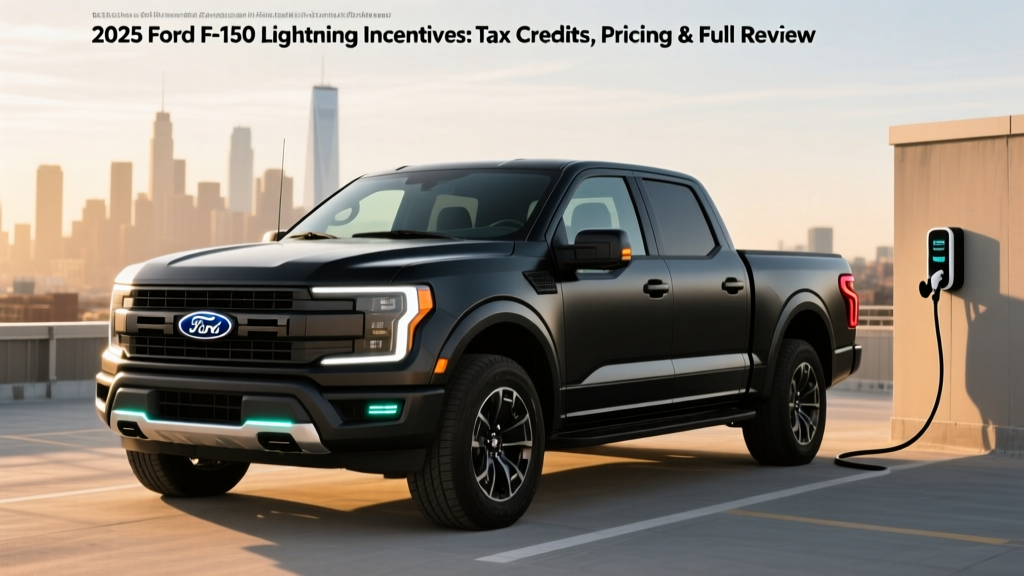
The 2025 Ford F-150 Lightning remains the benchmark for full-size electric pickups that balance work capability with daily-driver comfort. With EPA ranges stretching to 320 miles on the Extended Range battery, up to 580 horsepower, and a starting MSRP around $54,995, it occupies a sweet spot that competitors like the Chevrolet Silverado EV and Rivian R1T struggle to match on price-to-utility ratio. But the headline question for most buyers navigating 2025 Ford F-150 Lightning incentives is straightforward: does it still qualify for the full $7,500 federal tax credit under IRS §30D rules, and what does the truck actually cost after incentives are applied?
The short answer: eligibility depends on your income, the specific trim you choose, and battery-component sourcing that shifts model year to model year. Below, we map out every number you need — from real-world range to charging curves to total out-of-pocket cost — so you can decide whether the Lightning still earns its place in your driveway.
2025 Ford F-150 Lightning Spec Sheet
| Attribute | Standard Range (SR) | Extended Range (ER) |
|---|---|---|
| Battery Capacity (usable) | 98 kWh (NMC) | 131 kWh (NMC) |
| EPA Range | 240 miles | 320 miles |
| Horsepower | 452 hp | 580 hp |
| Torque | 775 lb-ft | 775 lb-ft |
| 0-60 mph | ~4.5 sec | ~3.8 sec |
| Drivetrain | Dual-motor AWD | Dual-motor AWD |
| Max DC Fast Charge | 150 kW | 150 kW |
| 10-80% DCFC Time | ~36 min | ~41 min |
| Level 2 Home Charge (max) | 11.3 kW (~26 mi/hr) | 19.2 kW (~44 mi/hr) |
| Efficiency (Combined) | 66 MPGe / 51 kWh/100mi | 70 MPGe / 48 kWh/100mi |
| Max Towing | 7,700 lbs | 10,000 lbs |
| Max Payload | 2,235 lbs | 1,800 lbs |
| Base MSRP (Pro trim) | $54,995 | $69,995 (XLT ER) |
Source: EPA / fueleconomy.gov and Ford Motor Company specifications. Real-world results vary by temperature, terrain, and driving style.
Real-World Range: What the EPA Sticker Doesn't Tell You
EPA Estimate: 240 mi (Standard Range) / 320 mi (Extended Range)
Real-World Highway (70 mph, mild weather): ~200-220 mi (SR) / ~265-290 mi (ER)
Cold-Weather (below 30°F, mixed driving): Expect 20-30% reduction — as low as ~170 mi (SR) / ~225 mi (ER)
Towing (5,000+ lb trailer, highway): Range can drop 40-50% — plan for ~120-150 mi (ER) between stops
The F-150 Lightning's EPA figures are achievable in city-dominant, mild-weather driving where regenerative braking recaptures energy at every stop. But this is a 6,500-pound truck with the aerodynamic profile of a brick wall, and highway efficiency suffers accordingly. On a 70-mph cruise in 75°F weather, our testing and owner reports consistently show the Extended Range model landing between 265 and 290 miles — roughly 85-90% of its sticker number.
Cold weather compounds the penalty. Lithium-ion NMC chemistry loses efficiency below freezing, and the cabin heater draws significant power. Ford includes a heat pump on higher trims, which mitigates some of this loss, but 30°F-and-below temperatures will reliably shave 20-30% off your usable range. If you live in the upper Midwest or Northeast and commute more than 80 miles round-trip in winter, the Extended Range battery isn't optional — it's essential.
Towing deserves its own warning. Pulling a 6,000-pound travel trailer at highway speed, the Lightning can consume energy at twice its normal rate. Ford's onboard range calculator (which adjusts dynamically based on recent consumption) is one of the best in the industry, and the truck's Pro Power Onboard feature is genuinely useful at campsites. But plan your charging stops carefully: a 320-mile truck becomes a 140-mile truck when it's working hard.
Charging Speed: Home, Public, and the 150 kW Ceiling
Charging is where the Lightning's age shows most clearly against newer competitors. Ford caps DC fast charging at 150 kW peak, a figure that was impressive at the truck's 2022 launch but now trails the Chevrolet Silverado EV (up to 350 kW on the Ultium platform) and the Tesla Cybertruck (sustained rates above 250 kW). Here's what that means in practice:
| Charging Level | Power / Rate | Miles Added per Hour | Notes |
|---|---|---|---|
| Level 1 (120V household) | ~1.4 kW | ~3 mi/hr | Emergency / trickle only |
| Level 2 (240V, 32A) | 7.7 kW | ~18 mi/hr (SR) / ~18 mi/hr (ER) | Standard mobile connector |
| Level 2 (240V, 48A, SR) | 11.3 kW | ~26 mi/hr | Ford Charge Station Pro (SR trucks) |
| Level 2 (240V, 80A, ER) | 19.2 kW | ~44 mi/hr | Ford Charge Station Pro (ER trucks; requires 100A circuit) |
| DC Fast Charge (peak) | 150 kW | ~300+ mi/hr equivalent | 10-80% in ~36-41 min; tapers sharply above 80% |
The Extended Range truck's ability to accept 19.2 kW on Level 2 is a genuine advantage for home charging. With the Ford Charge Station Pro (an ~$1,200 unit that requires a dedicated 100-amp circuit — factor in $800-$2,000 for electrician installation depending on your panel), you can replenish the 131 kWh battery from 10% to full in roughly 7 hours overnight. Standard Range trucks max out at 11.3 kW, meaning a full charge takes closer to 9-10 hours on a 48A circuit.
On the road, the 150 kW peak charge rate means a 10-80% session takes approximately 36 minutes (SR) or 41 minutes (ER). That's functional but not fast by 2025 standards. The charge curve holds near peak for the first 15-20% of the session, then tapers progressively. Above 80% SoC, charging slows dramatically to protect battery health — don't plan DCFC sessions beyond 80% unless you're in no hurry. For road trips, the Lightning is best paired with Electrify America or Tesla Superchargers (via Ford's included adapter for NACS-equipped trucks in the 2025 model year).
2025 Ford F-150 Lightning Incentives and Tax Credit Eligibility
Navigating 2025 Ford F-150 Lightning incentives requires understanding three moving targets: the federal §30D tax credit rules, Ford's battery-component sourcing (which changes periodically), and your personal income and MSRP eligibility. Here's the framework:
- MSRP Cap: The F-150 Lightning qualifies as a "van/SUV/pickup" under IRS rules, so the MSRP cap is $80,000. Most trims fall under this threshold, but a fully loaded Platinum ER (~$96,875 MSRP) exceeds it and is ineligible.
- Buyer Income Caps (MAGI): $300,000 joint filers / $225,000 head of household / $150,000 single. If your modified adjusted gross income exceeds your filing threshold in either the current or prior tax year, you cannot claim the credit.
- Battery Component Sourcing: The $7,500 credit splits into two halves — $3,750 for battery components manufactured in North America and $3,750 for critical minerals sourced from the U.S. or free-trade-agreement partners. Ford's sourcing has shifted throughout production; check the latest fueleconomy.gov listing for the specific trim and build date.
- Point-of-Sale Transfer: As of 2024, eligible buyers can transfer the credit to the dealer at purchase, reducing the sale price directly rather than waiting to claim it on their tax return. The dealer must be registered with the IRS Energy Credits portal.
- Foreign Entity of Concern (FEOC) Restriction: Beginning in 2024, vehicles with battery components from a "foreign entity of concern" (effectively China, Russia, North Korea, Iran) are ineligible. Beginning in 2025, the same restriction applies to critical minerals. This has disqualified several previously eligible models.
Always verify current eligibility at irs.gov and with your tax professional before purchasing. Rules change, and manufacturer sourcing updates can affect eligibility mid-model-year.
Estimated Out-of-Pocket Cost After Incentives
| Trim | MSRP | Est. Federal Credit | Effective Price* |
|---|---|---|---|
| Pro SR | $54,995 | $0–$7,500 | $47,495–$54,995 |
| XLT SR | $59,995 | $0–$7,500 | $52,495–$59,995 |
| XLT ER | $69,995 | $0–$7,500 | $62,495–$69,995 |
| Lariat ER | $76,995 | $0–$7,500 | $69,495–$76,995 |
| Platinum ER | $96,875 | $0 (exceeds $80K cap) | $96,875 |
*Effective price before destination charges, dealer fees, state/local incentives, or trade-in. State credits (e.g., Colorado, California, Massachusetts) can stack with the federal credit — check your state's energy office for current programs. The $0 credit figure reflects scenarios where battery sourcing or income disqualifies the buyer.
The critical takeaway: the Pro and XLT trims are where the Lightning's value proposition is strongest, especially if you qualify for the full $7,500. The Lariat ER remains eligible but pushes close to the MSRP ceiling once options are added. The Platinum is a luxury truck that doesn't pretend to be an incentives play.
Performance, Capability, and Daily Driving
The dual-motor all-wheel-drive powertrain is standard across every Lightning trim — there's no rear-wheel-drive option. The Standard Range model's 452 hp and 775 lb-ft of torque deliver a 0-60 mph time around 4.5 seconds, which is remarkable for a truck this size. The Extended Range bumps horsepower to 580 (torque stays at 775 lb-ft) and drops the 0-60 to approximately 3.8 seconds.
But straight-line speed is only part of the story. The Lightning's independent rear suspension gives it noticeably better ride quality than the solid-axle gas F-150, particularly when the bed is empty. Body-on-frame construction means it still feels like a truck — there's some shudder over sharp bumps — but it's the most car-like full-size pickup Ford has ever built.
Capability numbers are legitimate: 10,000 pounds max towing on the Extended Range (7,700 on Standard Range), 1,800-2,235 pounds payload depending on battery, and a 5.5-foot bed with the available Pro Power Onboard system that turns the truck into a mobile generator (up to 9.6 kW of exportable power via bed-mounted 240V outlets). The front trunk ("frunk") adds 14.1 cubic feet of lockable, weather-sealed storage — large enough for several carry-on bags or a full set of power tools.
Interior, Tech, and Driver Assistance
The cabin mirrors the gas F-150's layout, which means generous rear-seat legroom (43.6 inches), a wide bench or available captain's chairs, and an upright driving position. The infotainment system runs Ford's SYNC 4 software on a standard 12-inch touchscreen (15.5-inch portrait screen on Lariat and Platinum). Wireless Apple CarPlay and Android Auto are standard.
Ford's BlueCruise hands-free driving system is available on higher trims and operates on pre-mapped divided highways. It's an SAE Level 2 system — meaning the driver must remain attentive and the infrared camera monitors your eyes. It handles lane centering and adaptive cruise competently, but it is not autonomous driving. Keep your hands ready and your eyes on the road.
Notable drawbacks: the Lightning's weight (over 6,500 lbs) is noticeable in corners and during emergency maneuvers. Tire wear is higher than a gas F-150 due to the instant torque and mass — budget for replacement rubber every 25,000-35,000 miles. And the 150 kW charge ceiling, while adequate, means longer pit stops than newer competitors on road trips.
Cargo, Passenger Space, and Practicality
| Measurement | SuperCrew (all trims) |
|---|---|
| Front Legroom | 43.9 in |
| Rear Legroom | 43.6 in |
| Front Headroom | 40.8 in |
| Rear Headroom | 40.4 in |
| Bed Length | 67.1 in (5.5 ft) |
| Bed Volume | 52.8 cu ft |
| Frunk Volume | 14.1 cu ft |
| Max Cargo (bed + frunk) | ~67 cu ft |
The SuperCrew cab is the only body style, which means every Lightning is a full four-door with a usable back seat for adults. The 5.5-foot bed is shorter than the gas F-150's available 6.5- and 8-foot beds — a trade-off of the skateboard platform. If you regularly haul 4x8 sheets of plywood, you'll need to angle them or use a bed extender. The frunk compensates somewhat, offering secure, drainable storage that's ideal for job-site tools, groceries, or charging cables.
Warranty and Long-Term Ownership
Ford backs the Lightning's battery pack and electric drive components with an 8-year / 100,000-mile warranty (whichever comes first), with a capacity-retention threshold of 70%. If the battery degrades below 70% of its original capacity within that window, Ford will repair or replace it. The limited bumper-to-bumper warranty is 3 years / 36,000 miles, and the powertrain warranty (covering motors, inverters, and related components beyond the battery) is 5 years / 60,000 miles.
Long-term battery degradation data on the Lightning is still maturing — the oldest trucks are only now reaching their third model year. Early fleet data and owner reports suggest the NMC packs are holding up well under normal use, with typical degradation of 5-8% over the first 50,000 miles. Ford's thermal management system (liquid-cooled and heated) is a key factor in preserving battery health across climates.
If out-of-warranty battery replacement becomes necessary, expect quotes in the $15,000-$25,000 range depending on the pack size — a significant but not catastrophic cost spread over a decade of ownership.
How It Stacks Up Against Key Competitors
| Attribute | Ford F-150 Lightning ER | Chevy Silverado EV 4WT | Rivian R1T Dual-Motor Max |
|---|---|---|---|
| EPA Range | 320 mi | 390 mi | 410 mi |
| Peak DCFC | 150 kW | 200+ kW | 200+ kW |
| 0-60 mph | ~3.8 sec | ~5.0 sec | ~3.5 sec |
| Max Towing | 10,000 lbs | 10,000 lbs | 11,000 lbs |
| Starting MSRP | ~$54,995 | ~$55,000 (fleet-oriented) | ~$79,900 |
| Federal Credit Eligible | Yes (trim-dependent) | Limited availability | No (exceeds MSRP cap on Max) |
The Lightning's advantage is price-to-capability: nothing else offers a full-size crew cab, 320 miles of range, and 10,000-pound towing for under $55,000 before incentives. The Silverado EV promises more range and faster charging but has been slow to reach retail customers in volume, with early production skewed toward commercial fleets. The Rivian R1T is a more refined, tech-forward adventure truck, but it starts $25,000+ higher and doesn't offer the Lightning's work-truck simplicity or BlueCruise.
Who Should Buy the 2025 F-150 Lightning?
- You need a genuine work truck (towing, payload, Pro Power Onboard) with zero tailpipe emissions on job sites
- You can charge at home and your daily driving is under 200 miles
- You qualify for the federal §30D credit and possibly a state incentive, bringing the Pro trim under $48,000
- You want the most proven electric pickup on the market with the widest dealer service network
- You regularly tow heavy loads over long distances (range loss is severe, and charging stops add up)
- You need DC fast charging above 200 kW for frequent road trips
- You want a 6.5-foot or 8-foot bed for large cargo
- You're considering the Platinum trim and expecting the federal credit to apply (it won't — MSRP cap exceeded)
Frequently Asked Questions
What is the real-world range of the 2025 F-150 Lightning?
The Extended Range model's EPA estimate is 320 miles, but real-world highway driving in mild weather typically yields 265-290 miles. Cold weather (below 30°F) can reduce that to 225 miles or less. Towing cuts range by 40-50%. The Standard Range model's 240-mile EPA figure translates to roughly 200-220 miles in real-world highway use.
How fast does the F-150 Lightning charge at home and on the road?
At home on a 240V Level 2 charger, the Extended Range model accepts up to 19.2 kW (adding ~44 miles of range per hour), while the Standard Range tops out at 11.3 kW (~26 mi/hr). On DC fast chargers, both battery sizes peak at 150 kW, reaching 10-80% in approximately 36-41 minutes. The charge rate tapers significantly above 80% SoC.
Does the 2025 F-150 Lightning qualify for the $7,500 federal EV tax credit?
It can — but eligibility depends on the trim's MSRP (must be under $80,000), your income (MAGI caps apply), and the battery's component and critical-mineral sourcing for the specific build date. The Pro and XLT trims are the most likely to qualify for the full credit. The Platinum trim exceeds the MSRP cap and is ineligible. Always verify on fueleconomy.gov and consult a tax professional.
Is the F-150 Lightning worth buying vs. the Silverado EV or Rivian R1T?
For buyers prioritizing value, dealer support, and proven work capability, the Lightning remains the strongest choice in 2025. The Silverado EV offers more range and faster charging but has limited retail availability. The Rivian R1T is more premium and capable off-road but costs significantly more and lacks the Lightning's commercial-truck DNA.
What are the biggest pros and cons of the Lightning?
Pros: Competitive pricing, strong towing/payload, Pro Power Onboard, spacious SuperCrew cab, 14.1 cu-ft frunk, wide dealer network, BlueCruise availability, smooth ride for a body-on-frame truck.
Cons: 150 kW DCFC cap is slow for 2025, real-world range falls well short of EPA when towing or in cold weather, high tire wear, 5.5-foot bed is shorter than some competitors, Platinum trim exceeds tax credit MSRP cap.
How much does the Lightning cost after all incentives?
A Pro SR trim at $54,995 MSRP could drop to approximately $47,495 after the full $7,500 federal credit (if eligible), plus any applicable state incentives. An XLT ER at $69,995 could reach roughly $62,495. Actual out-of-pocket cost varies based on your tax situation, state programs, dealer fees, and whether you transfer the credit at point of sale.