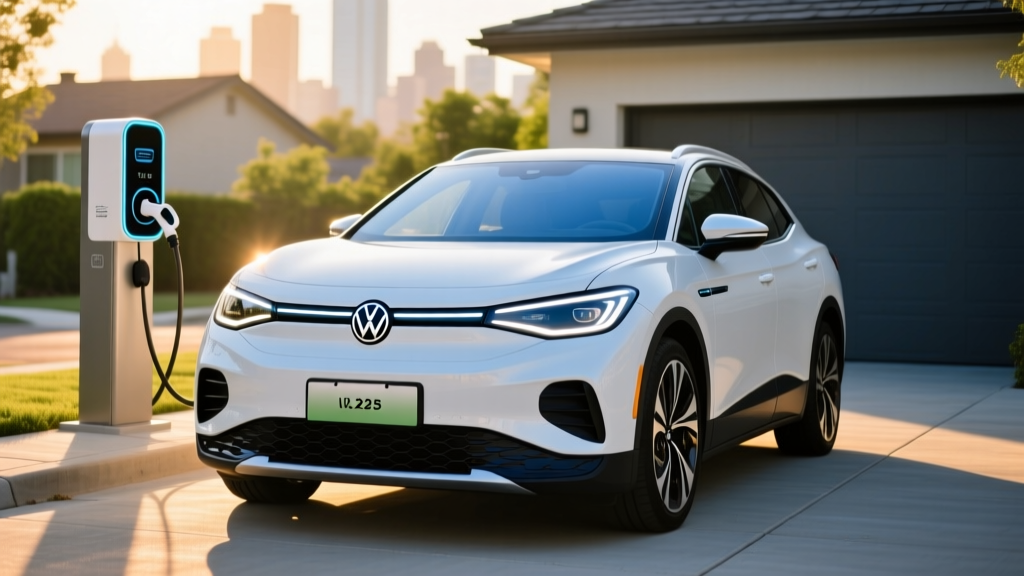
The Volkswagen ID.4 AWD occupies a specific niche in the compact electric SUV segment: a dual-motor, all-weather daily driver with mainstream pricing, a comfortable ride, and one of the best battery warranties in the business. For 2026, VW has refined the infotainment system, bumped charging speeds on the Pro S Plus trim, and maintained aggressive pricing that makes the ID.4 AWD a compelling lease candidate — especially when stacking dealer incentives with the federal §30D tax credit.
If you're researching an ID.4 AWD lease, you need more than the brochure numbers. Below is a data-driven breakdown of real-world range, charging behavior, total lease cost, tax-credit mechanics, and how the ID.4 AWD stacks up against the Hyundai Ioniq 5 AWD, Toyota bZ4X, and Subaru Solterra.
2026 VW ID.4 AWD: Core Specifications at a Glance
| Spec | AWD Pro | AWD Pro S | AWD Pro S Plus |
|---|---|---|---|
| Base MSRP (incl. destination) | $47,790 | $51,590 | $55,790 |
| EPA Range | 263 mi | 263 mi | 263 mi |
| Battery (usable / gross) | 82 kWh / 91 kWh | 82 kWh / 91 kWh | 82 kWh / 91 kWh |
| Battery Chemistry | NMC (Nickel Manganese Cobalt) | NMC | NMC |
| Drivetrain | Dual-motor AWD | Dual-motor AWD | Dual-motor AWD |
| Horsepower / Torque | 295 hp / 339 lb-ft | 295 hp / 339 lb-ft | 295 hp / 339 lb-ft |
| 0–60 mph | 5.4 sec | 5.4 sec | 5.4 sec |
| Max DC Fast Charge | 135 kW | 135 kW | 175 kW |
| Level 2 Charge Rate | 11 kW (≈37 mi/hr) | 11 kW (≈37 mi/hr) | 11 kW (≈37 mi/hr) |
| MPGe (city / hwy / combined) | 104 / 93 / 99 | 104 / 93 / 99 | 104 / 93 / 99 |
| Energy Consumption | 34 kWh/100 mi | 34 kWh/100 mi | 34 kWh/100 mi |
| Cargo Volume (rear seats up / down) | 30.3 / 64.2 cu ft | 30.3 / 64.2 cu ft | 30.3 / 64.2 cu ft |
| Rear Legroom | 37.6 in | 37.6 in | 37.6 in |
| Battery Warranty | 8 yr / 100,000 mi | 8 yr / 100,000 mi | 8 yr / 100,000 mi |
Real-World Range: What the EPA Number Doesn't Tell You
Real-World Expectation: ~220–245 mi on mixed highway/city driving at 70 mph; ~185–210 mi in sub-30°F winter conditions with cabin heat. City-only driving in mild weather can push 270+ mi thanks to regenerative braking.
The ID.4 AWD's 263-mile EPA rating sits in the middle of the compact EV SUV class — behind the Hyundai Ioniq 5 AWD (290 mi with the 84 kWh pack) but ahead of the Subaru Solterra (222 mi). The AWD dual-motor system adds roughly 20 miles of range penalty versus the RWD ID.4 Pro (283 mi EPA).
In practice, the ID.4 AWD's efficiency of 34 kWh/100 miles means you'll see the battery deplete faster on sustained highway runs above 75 mph. On a 200-mile highway trip at 70 mph in 55°F weather, expect to arrive with roughly 15–18% state of charge remaining — adequate, but not generous. Cold weather hits NMC packs harder: at 15°F with the heat pump running, plan for a 25–30% range reduction. The ID.4's standard heat pump (added for the 2025 refresh) helps, but physics still governs.
For context on EPA testing methodology and how it compares to real-world driving, see the EPA's fueleconomy.gov guide for EV owners.
Charging Speed: DC Fast Charging and Home Level 2
| Charging Level | Power | Speed / Time | Notes |
|---|---|---|---|
| Level 1 (120V household) | ~1.4 kW | ~4–5 mi/hr | Emergency/trickle only; full charge in ~60 hrs |
| Level 2 (240V home/public) | 11 kW (48A) | ~37 mi/hr; 0–100% in ~8.5 hrs | Requires 60A circuit; NEMA 14-50 or hardwired |
| DC Fast (Pro / Pro S) | 135 kW peak | 10–80% in ~30 min | CCS1 connector; tapers above 80% SoC |
| DC Fast (Pro S Plus) | 175 kW peak | 10–80% in ~25 min | Upgraded thermal mgmt; sustained peak to ~55% SoC |
The charging story for the ID.4 AWD is a tale of two trims. The Pro and Pro S trims cap DC fast charging at 135 kW — adequate but not class-leading. The Pro S Plus bumps that to 175 kW, shaving roughly 5 minutes off the 10–80% session. For lessees who road-trip regularly, that upgrade is the strongest argument for stepping up to the top trim.
On the charge curve: the 175 kW peak on the Pro S Plus holds from roughly 10% to 55% state of charge, then tapers to ~80 kW through 70%, and drops further to ~40 kW past 80%. If you're charging at an Electrify America 350 kW station, the ID.4 won't bottleneck the stall — but you won't use anywhere near the station's full capacity. The CCS1 connector is standard across all trims; VW does not offer NACS natively on the 2026 ID.4, though a CCS-to-NACS adapter (such as the VW-approved Lectron or A2Z adapter) enables Tesla Supercharger access at V3 stalls (150 kW max with adapter).
Home Level 2 charging at 11 kW is competitive. An overnight session from 20% to full takes about 7 hours — easily within a standard sleep cycle. Installation of a 60-amp dedicated circuit with a hardwired Level 2 charger (like the ChargePoint Home Flex or Emporia Level 2) typically runs $800–$1,500 depending on panel proximity, per licensed electrician quotes.
Lease Pricing, Monthly Cost, and Federal Tax Credit Eligibility
Leasing the ID.4 AWD in 2026 is where the math gets interesting. VW has historically offered aggressive lease cash (dealer incentives applied at signing) on the ID.4, and when combined with the federal §30D tax credit — which can now be transferred to the dealer as a point-of-sale reduction under the 2024+ IRS rules — the effective monthly cost drops substantially.
| Cost Factor | AWD Pro | AWD Pro S | AWD Pro S Plus |
|---|---|---|---|
| MSRP | $47,790 | $51,590 | $55,790 |
| Typical VW Lease Cash (varies by region) | −$5,000 to −$7,500 | −$5,000 to −$7,500 | −$5,000 to −$7,500 |
| Federal §30D Credit (if eligible, point-of-sale) | Up to −$7,500 | Up to −$7,500 | Up to −$7,500 |
| Estimated Effective Cap Cost | ~$32,790–$35,290 | ~$36,590–$39,090 | ~$40,790–$43,290 |
| Est. Monthly Payment (w/ $3,000 down, 36 mo) | ~$325–$395 | ~$385–$455 | ~$440–$520 |
Note: Lease payments vary by region, dealer, credit tier, residual value, and money factor. The figures above are estimates based on typical 2026 VW lease programs. Always confirm current incentives with your local dealer.
Does the ID.4 AWD Qualify for the $7,500 Federal Tax Credit?
The 2026 VW ID.4 is assembled in Chattanooga, Tennessee, which satisfies the North American final-assembly requirement under IRS §30D rules. However, eligibility for the full $7,500 credit depends on three moving targets:
- Battery component sourcing: A percentage of battery components must be manufactured or assembled in North America. VW has shifted significant cell production to U.S. and allied-nation suppliers, but the exact qualifying percentage can change model year to model year.
- Critical minerals sourcing: A percentage of critical minerals must be sourced from the U.S. or a free-trade-agreement country. NMC chemistry relies on nickel, manganese, and cobalt — all subject to sourcing scrutiny.
- Buyer income caps: Modified adjusted gross income must not exceed $150,000 (single), $225,000 (head of household), or $300,000 (joint filers).
- MSRP cap: The ID.4 is classified as an SUV, so the MSRP cap is $80,000 — all trims clear this easily.
When leasing (as opposed to buying), there's an important nuance: the §30D credit technically goes to the lessor (VW Credit, Inc.), not the lessee. However, VW has consistently passed this benefit through as a capitalized-cost reduction, effectively lowering your monthly payment. This is a standard practice across the industry and is one reason leasing can sometimes be more financially advantageous than purchasing for EVs with uncertain credit eligibility.
Performance, Efficiency, and Daily Driving
The dual-motor AWD powertrain produces 295 horsepower and 339 lb-ft of torque, delivering a 5.4-second 0–60 mph time. That's brisk enough for confident highway merging and passing — roughly on par with a Toyota RAV4 Hybrid in acceleration feel, but with the instant torque delivery that makes EVs feel quicker than their numbers suggest.
The AWD system uses an asynchronous front motor and a permanent-magnet rear motor. Under light-load cruising, the front motor decouples entirely to reduce drag and improve efficiency. When traction is needed — rain, snow, hard acceleration — the front motor engages in milliseconds. There's no mechanical linkage between the axles; torque distribution is handled electronically.
Ride quality is a genuine strength. The ID.4 AWD rides on VW's MEB platform with a multi-link rear suspension, and the tuning prioritizes comfort over sportiness. Road noise is well-isolated at highway speeds. The turning circle of 36.4 feet is tight for an AWD SUV, making parking-lot maneuvers easy.
Efficiency at 99 MPGe combined (34 kWh/100 mi) is middle-of-the-pack. For comparison, the Hyundai Ioniq 5 AWD achieves 110 MPGe combined with its more efficient 84 kWh pack, while the Subaru Solterra (which shares a platform with the Toyota bZ4X) rates at 102 MPGe combined. At the U.S. average electricity price of ~$0.17/kWh, the ID.4 AWD costs roughly $5.78 per 100 miles to charge at home — compared to ~$12–$14 per 100 miles in a 28-MPG gas SUV at $3.50/gallon.
Interior, Cargo, and Technology
The ID.4's cabin is spacious and functional if somewhat plain in design. The 12.9-inch infotainment touchscreen (upgraded from 12 inches for 2025) runs VW's latest software with improved responsiveness and a more logical menu structure. Wireless Apple CarPlay and Android Auto are standard. The digital instrument cluster is compact but legible, mounted behind the steering wheel.
Cargo space is a strong suit: 30.3 cubic feet behind the second row and 64.2 cubic feet with the rear seats folded — competitive with the RAV4 and significantly more than the Hyundai Ioniq 5's 27.2 cu ft. Rear legroom at 37.6 inches is generous for adults on longer trips.
Notable tech features include:
- IQ.DRIVE suite: Adaptive cruise control with stop-and-go, lane-centering assist, front assist with automatic emergency braking, blind-spot monitor, rear traffic alert. This is an SAE Level 2 driver-assist system — you must keep hands on the wheel and eyes on the road at all times.
- Park Assist Plus: Automated parking with memory function for repeated parking spots (Pro S Plus).
- Head-up display with AR navigation: Projects turn-by-turn directions into the windshield field of view (Pro S and above).
- Preconditioning: Scheduled departure climate and battery preconditioning, which warms the battery for faster DC charging in cold weather — a critical feature for winter road-trippers.
Drawbacks worth noting: the ID.4 still lacks a front trunk (frunk), which is unusual in the segment. The capacitive-touch steering wheel controls remain divisive — they're less intuitive than physical buttons, especially with gloves on. And while the infotainment has improved, it still lags behind the speed and polish of Hyundai's system or Tesla's interface.
How the ID.4 AWD Compares to Key Competitors
| Attribute | VW ID.4 AWD | Hyundai Ioniq 5 AWD | Subaru Solterra | Toyota bZ4X AWD |
|---|---|---|---|---|
| EPA Range | 263 mi | 290 mi | 222 mi | 228 mi |
| Battery (usable kWh) | 82 kWh | 84 kWh | 71.4 kWh | 71.4 kWh |
| Peak DC Charge | 135–175 kW | 240 kW (w/ NACS) | 100 kW | 100 kW |
| 0–60 mph | 5.4 sec | 5.1 sec | 6.5 sec | 6.5 sec |
| Cargo (rear up) | 30.3 cu ft | 27.2 cu ft | 23.8 cu ft | 27.7 cu ft |
| Base MSRP (AWD) | $47,790 | $50,400 | $44,995 | $46,700 |
| Battery Warranty | 8 yr / 100k mi | 10 yr / 100k mi | 8 yr / 100k mi | 10 yr / 100k mi |
The ID.4 AWD wins on cargo space and pricing (especially after incentives) but gives up range and charging speed to the Ioniq 5. The Solterra and bZ4X, while cheaper at MSRP, suffer from significantly lower range and slower DC charging — a meaningful disadvantage for anyone who road-trips more than a couple of times per year.
Pros and Cons
Pros
- Class-leading cargo volume (30.3 cu ft)
- Competitive pricing after VW lease cash + §30D credit
- Comfortable, quiet ride quality
- Standard heat pump for cold-weather efficiency
- Strong battery warranty (8 yr/100k mi, 70% capacity retention guarantee)
- U.S.-assembled (Chattanooga, TN) — simplifies §30D eligibility
- Tight turning radius for an AWD SUV
Cons
- No front trunk (frunk)
- Range trails Ioniq 5 AWD by 27 miles
- Pro/Pro S DC charging capped at 135 kW
- Capacitive steering wheel controls are polarizing
- Infotainment still less intuitive than top competitors
- No native NACS port (adapter required for Superchargers)
- Energy consumption higher than class leaders
Who Should Lease the ID.4 AWD?
- You need maximum cargo space in a compact EV SUV and value practicality over sporty dynamics.
- You live in a region with cold winters and want AWD traction plus a heat pump for efficiency.
- Your commute is under 80 miles round-trip and you can charge at home nightly.
- You want to leverage VW's aggressive lease incentives and the point-of-sale §30D credit to minimize monthly cost.
- You value a comfortable, quiet ride over track-ready performance.
- You road-trip frequently and need maximum range and fastest possible DC charging (consider the Ioniq 5 AWD or Tesla Model Y).
- You want native NACS / Supercharger access without an adapter.
- You prioritize cutting-edge infotainment and driver-assist technology.
Frequently Asked Questions
What is the real-world range of the 2026 ID.4 AWD?
The EPA rates the ID.4 AWD at 263 miles. In real-world mixed driving at highway speeds, expect 220–245 miles in mild weather and 185–210 miles in freezing conditions. City-only driving with regenerative braking can yield 270+ miles.
How fast does the ID.4 AWD charge at home and on the road?
At home on a Level 2 (240V, 48A) charger, the ID.4 AWD charges at 11 kW, adding roughly 37 miles of range per hour — a full charge in about 8.5 hours. On DC fast chargers, the Pro and Pro S trims peak at 135 kW (10–80% in ~30 minutes), while the Pro S Plus peaks at 175 kW (10–80% in ~25 minutes).
How much does a 2026 ID.4 AWD lease cost per month?
With VW lease cash ($5,000–$7,500 depending on region) and the federal §30D credit ($7,500 if eligible, passed through as a cap-cost reduction), an ID.4 AWD Pro lease can land in the $325–$395/month range with $3,000 due at signing on a 36-month term. Actual payments vary by dealer, credit tier, and regional incentives.
Does the 2026 ID.4 AWD qualify for the federal EV tax credit?
The ID.4 is assembled in Chattanooga, TN, meeting the North American final-assembly requirement. Full $7,500 credit eligibility depends on battery-component and critical-minerals sourcing percentages, which VW has worked to satisfy but which should be confirmed at the time of purchase/lease via the IRS clean vehicle credit page. Buyer income caps apply ($150K single / $300K joint). When leasing, the credit goes to the lessor but is typically passed through as a lower cap cost.
Is the ID.4 AWD worth it over the Hyundai Ioniq 5 AWD or Tesla Model Y?
It depends on your priorities. The Ioniq 5 AWD offers more range (290 mi) and faster charging (240 kW with NACS), but at a higher base price and with less cargo space. The Tesla Model Y Long Range AWD dominates range (320+ mi) and Supercharger access, but has a firmer ride and higher insurance costs. The ID.4 AWD's sweet spot is value: strong cargo capacity, comfortable ride, and aggressive lease pricing that can make it the most affordable option in the segment after incentives.
What is the ID.4 AWD's battery warranty?
VW covers the ID.4's high-voltage battery for 8 years or 100,000 miles, whichever comes first, guaranteeing at least 70% capacity retention. If the battery falls below 70% state of health within that window, VW will repair or replace it. The limited vehicle warranty is 4 years / 50,000 miles.