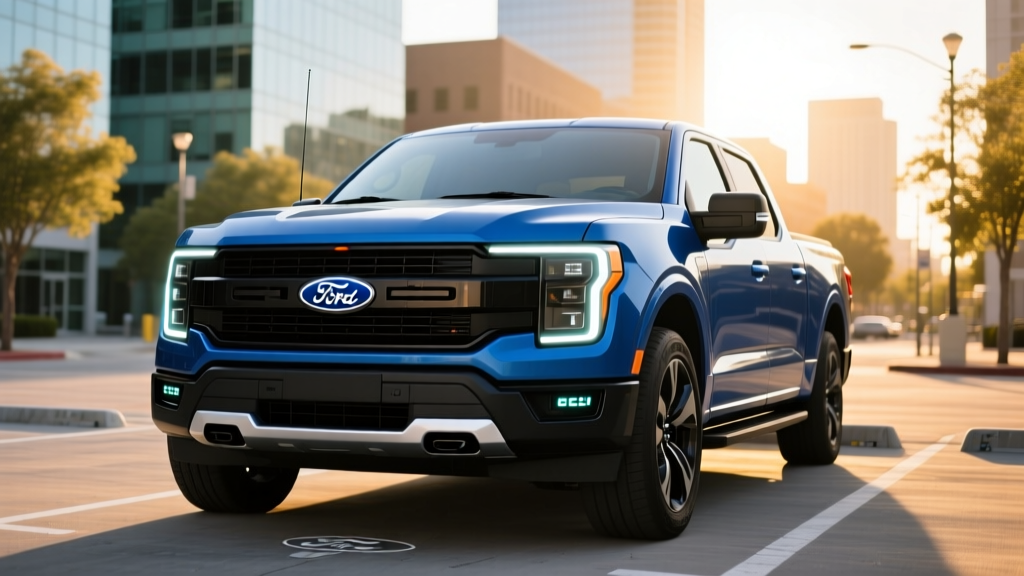
The Flash trim arrived for the 2024 model year as Ford's answer to a clear market gap: buyers who wanted a full-size electric pickup with serious capability but didn't need—or want to pay for—the Platinum's luxury markup. The 2025 Ford F-150 Lightning Flash carries that formula forward, slotting between the XLT and Lariat in price while borrowing heavily from the Lariat's tech and comfort playbook. If you're cross-shopping electric trucks and keep landing on the Flash, this review breaks down every number that matters—from real-world range to charging curves to what you'll actually pay after incentives.
Quick Verdict: Who Should Buy the Lightning Flash
The 2025 Lightning Flash is the trim for buyers who want the Extended Range battery (320 miles EPA) without stepping up to Lariat or Platinum pricing. It pairs a 131 kWh usable battery pack with Ford's dual-motor all-wheel-drive system, producing 563 horsepower and 775 lb-ft of torque. The trade-off is that the Standard Range battery is not available on the Flash—you're committed to the larger, heavier pack and its $59,995 starting price (before destination). For a homeowner with Level 2 charging and a daily commute under 200 miles, the Flash occupies a practical sweet spot. For frequent long-haul towers or those in extreme cold climates, the real-world range picture is more complicated, which we'll break down below.
Range, Efficiency & Real-World Expectations
The EPA rates the 2025 F-150 Lightning Flash with the Extended Range battery at 320 miles of combined range. Efficiency comes in at 70 MPGe combined, or roughly 48 kWh per 100 miles—a figure that reflects the aerodynamic penalty of a full-size pickup, even one with a flat underbody and active grille shutters.
EPA vs. Real-World Range: What to Actually Expect
EPA Combined: 320 miles
Highway (70-80 mph, moderate temps): ~260–280 miles
Cold weather (below 30°F, highway): ~210–240 miles
Loaded/towing (5,000+ lb trailer): ~140–180 miles
The Lightning's efficiency drops significantly at sustained highway speeds. On a 75-mph interstate run in 65°F conditions, expect to use roughly 52–55 kWh/100 mi, cutting effective range to around 260 miles. In sub-freezing temperatures, battery chemistry and cabin heating demands can reduce range by 25–35%. If you're planning a 300-mile highway trip in January, you'll need a charging stop.
Ford's onboard navigation includes range prediction that factors in terrain, temperature, and driving style, and it's generally accurate within 5–8% once the system has calibrated to your driving habits over a few hundred miles. The truck's heat pump—standard on all 2025 Lightning trims—helps mitigate cold-weather losses compared to resistive heating, but physics still wins in deep cold.
Battery, Chemistry & Degradation
The Extended Range Lightning uses a 131 kWh usable lithium-ion battery pack with NMC (nickel manganese cobalt) chemistry. This is a liquid-cooled pack managed by Ford's thermal management system, which actively conditions the battery during charging, driving, and while parked in extreme temperatures.
| Specification | Value |
|---|---|
| EPA Range (Extended Range) | 320 miles |
| Battery Capacity (Usable) | 131 kWh |
| Battery Chemistry | NMC (Nickel Manganese Cobalt) |
| Drivetrain | Dual-motor AWD |
| Horsepower | 563 HP |
| Torque | 775 lb-ft |
| 0–60 mph | ~3.8 seconds |
| Max Towing Capacity | 10,000 lbs (w/ Max Trailer Tow Pkg) |
| Payload Capacity | ~1,800 lbs |
| Efficiency (Combined) | 70 MPGe / 48 kWh/100 mi |
| Base MSRP (before destination) | $59,995 |
| Battery Warranty | 8 years / 100,000 miles |
NMC chemistry offers higher energy density than LFP (lithium iron phosphate), which is why the Lightning achieves 320 miles in a package that already weighs over 6,500 pounds. The trade-off is that NMC packs are more sensitive to sustained high states of charge. Ford recommends daily charging to 80–90% and saving 100% for trips—following this guidance will help the battery retain capacity over the long term. Based on data from 2022–2024 Lightning owners tracked on fueleconomy.gov and owner forums, NMC Lightning packs are showing approximately 5–8% degradation over the first 50,000 miles, which is in line with industry averages for liquid-cooled NMC packs.
Ford's battery warranty covers the pack for 8 years or 100,000 miles, whichever comes first, against defects and capacity loss below 70% of original capacity. This aligns with the industry standard and is backed by federal emissions warranty requirements.
Charging Speed: DC Fast, Level 2 & Home Setup
The Lightning Flash supports DC fast charging at a peak rate of 150 kW on the Extended Range battery. That's modest compared to the 250–350 kW peak rates of some passenger EVs, but it's a function of the pack's architecture and the thermal demands of a 131 kWh battery. Here's what the charge curve actually looks like:
| Charging Level | Power / Rate | Speed (Miles Added) | Notes |
|---|---|---|---|
| Level 1 (120V, 12A) | ~1.4 kW | ~2 mi/hr | Emergency/trickle only; included mobile cord |
| Level 2 (240V, 48A) | 11.5 kW | ~20 mi/hr | Requires hardwired Ford Charge Station Pro or equivalent |
| Level 2 (240V, 32A) | 7.7 kW | ~13 mi/hr | Standard mobile cord on 240V outlet |
| DC Fast Charge | Peak 150 kW | ~170 mi in 30 min | 10–80% in ~41 min; tapers significantly above 80% |
Real-world DC fast charging note: The Lightning hits its 150 kW peak only between roughly 15–45% state of charge. Above 60%, the rate begins tapering, and above 80% it drops sharply to protect the NMC cells. Plan your road-trip stops around 10–80% charges (about 41 minutes at a 150+ kW station) rather than trying to fill to 100% on DC, which adds significant time for minimal range gain.
For home charging, the Ford Charge Station Pro (an 80A capable unit, delivering 48A continuous on a 60A circuit) adds approximately 20 miles of range per hour, meaning a full 0–100% charge takes roughly 16 hours on the Extended Range pack. Most owners who plug in nightly after a typical 40–60 mile commute will wake up fully topped off. Installation of a hardwired Level 2 station typically runs $800–$2,000 depending on panel capacity and conduit run length—budget for a licensed electrician to assess whether your panel has the headroom for a 60A circuit.
The Lightning uses the CCS1 connector for DC fast charging and J1772 for Level 2. Ford has announced that future Lightning models will transition to the NACS (Tesla-style) connector, but the 2025 model year retains CCS1. Adapters are available for accessing Tesla Superchargers where permitted by Tesla's network policies.
Performance & Driving Dynamics
The dual-motor AWD powertrain in the Lightning Flash produces 563 horsepower and 775 lb-ft of torque, launching the truck from 0–60 mph in approximately 3.8 seconds. That's supercar territory in a vehicle that weighs over three tons—a fact that never stops being surprising on first drive.
The truck rides on Ford's independent rear suspension (a first for the F-150 line), which improves ride quality and handling over the solid rear axle of the gas F-150. The low center of gravity from the floor-mounted battery pack reduces body roll noticeably for a full-size pickup. Steering is precise if numb, and the regenerative braking system offers a one-pedal driving mode that can bring the truck to a complete stop without touching the brake pedal—useful in stop-and-go traffic and a feature many Lightning owners say they can't live without once experienced.
Drive modes include Normal, Sport, Off-Road, and Tow/Haul, each adjusting throttle mapping, regen strength, and suspension damping (on trims equipped with adaptive dampers). The Flash trim does not include the adaptive damping system found on the Platinum, so ride quality is fixed but well-tuned for daily driving.
Interior, Cargo & Technology
The Flash trim borrows the Lariat's interior appointments: leather-trimmed seats, a 12-inch digital instrument cluster, and Ford's SYNC 4A infotainment system displayed on a 12-inch touchscreen (the larger 15.5-inch vertical screen is reserved for the Platinum). Wireless Apple CarPlay and Android Auto are standard, as is a 12-speaker B&O sound system.
Key interior dimensions:
- Front legroom: 43.9 inches
- Rear legroom: 41.2 inches (SuperCrew cab)
- Front headroom: 40.8 inches
- Rear cargo bed length: 67.1 inches (5.5-foot bed)
- Mega Power Frunk volume: 14.1 cu ft (400 lb payload capacity)
- Max cargo volume (bed): 52.8 cu ft
The Mega Power Frunk (front trunk) remains one of the Lightning's signature features. With 14.1 cubic feet of lockable, drainable, and weatherproof storage, it replaces the engine bay with practical cargo space—ideal for groceries, tools, or gear you want to keep secure and out of the bed. The frunk also includes two 120V outlets and four USB-C ports, plus LED lighting.
The Pro Power Onboard system is standard on the Flash in the 2.4 kW configuration, with an available upgrade to 9.6 kW (which adds 240V outlets in the bed). The 9.6 kW option can power job-site tools, a small camper, or serve as a home backup power source when paired with the Ford Intelligent Backup Power system and a compatible home transfer switch (sold separately, requires professional installation).
On the driver-assistance front, the Flash includes Ford's Co-Pilot360 2.0 suite: adaptive cruise control with stop-and-go, lane centering, evasive steering assist, blind-spot monitoring with trailer coverage, and rear brake assist. Available BlueCruise (Ford's hands-on-wheel-capable Level 2 system) enables hands-free driving on pre-mapped divided highways—currently covering over 130,000 miles of road in North America. BlueCruise requires an active subscription after the initial trial period (typically 90 days free, then approximately $75/month or $800/year).
⚠️ BlueCruise Is Not Self-Driving
BlueCruise is an SAE Level 2 driver-assistance system. Despite the "hands-free" branding, the driver must remain attentive, and the system monitors driver gaze via an infrared camera. BlueCruise will disengage and bring the vehicle to a stop if the driver does not respond to alerts. It does not handle construction zones, unmapped roads, or complex urban environments. You are always the responsible driver.
Pricing, Trims & Federal Tax Credit Eligibility
The 2025 Ford F-150 Lightning Flash starts at $59,995 (before the $1,995 destination charge), bringing the total to $61,990 out the door before options or incentives. Key options include the 9.6 kW Pro Power Onboard upgrade (~$1,500), BlueCruise Equipped package, and the Max Trailer Tow Package.
| Item | Amount |
|---|---|
| Base MSRP (Flash Extended Range) | $59,995 |
| Destination & Delivery | $1,995 |
| Typical As-Tested (w/ popular options) | $64,500–$67,000 |
| Federal §30D Tax Credit (max, if eligible) | Up to $7,500 |
| Effective Price (after max credit) | From ~$54,490 |
Federal tax credit eligibility (IRS §30D): The F-150 Lightning has appeared on the IRS's list of qualifying vehicles, but eligibility for the full $7,500 credit depends on multiple factors that change frequently:
- MSRP cap: The vehicle must have an MSRP at or below $80,000 for trucks/vans/SUVs. The Flash qualifies at $59,995 base.
- Buyer income cap: Modified adjusted gross income must not exceed $150,000 (single), $225,000 (head of household), or $300,000 (joint filers).
- Battery sourcing: A percentage of critical minerals and battery components must be sourced from the U.S. or free-trade-agreement countries. These thresholds increase annually, and vehicles that qualified in prior years may lose partial or full credit eligibility. Always verify current eligibility on IRS.gov before purchasing.
- Point-of-sale transfer: As of 2024, buyers can transfer the credit to the dealer at point of sale, reducing the purchase price directly rather than waiting to claim it on their tax return.
Check the latest qualifying vehicle list at fueleconomy.gov before committing to a purchase. State and local incentives may stack on top of the federal credit—check your state's energy office or DMV for current programs.
Towing, Payload & Work Capability
The Lightning Flash with the Extended Range battery and available Max Trailer Tow Package is rated for up to 10,000 pounds of towing capacity. Without the Max Trailer Tow Package, the rating drops to approximately 7,700 pounds. Payload capacity sits around 1,800 pounds in the bed.
The onboard scales feature (available on the Flash) estimates payload weight via suspension sensors and displays it in the SYNC touchscreen and via the FordPass app—genuinely useful for contractors and weekend warriors alike. The truck also includes a trailer reverse guidance system and Pro Trailer Backup Assist, which simplifies the often-frustrating process of hitching and backing a trailer.
The towing range reality check: Pulling a 7,000–10,000 lb trailer at highway speeds will cut the Lightning's range roughly in half, to approximately 140–180 miles depending on trailer profile, wind, and terrain. This makes the Lightning viable for towing to nearby job sites or campgrounds but impractical for long-distance towing without careful route planning around DC fast chargers—and many chargers are not designed to accommodate a truck with an attached trailer, meaning you may need to unhitch to charge.
Pros, Cons & Competitive Comparison
Pros
- 320-mile EPA range is competitive for a full-size electric truck
- Mega Power Frunk (14.1 cu ft) adds genuine utility
- Pro Power Onboard turns the truck into a mobile generator
- 563 HP / 3.8-sec 0–60 in a full-size pickup
- Independent rear suspension delivers superior ride quality
- BlueCruise hands-free highway driving on 130,000+ miles of road
- CCS1 compatibility with Electrify America, EVgo, and growing networks
Cons
- 150 kW peak DC charge rate is slow vs. rivals (Rivian R1T peaks at 220+ kW)
- Extended Range battery required on Flash—no cheaper Standard Range option
- Towing slashes range to ~150 miles, limiting long-haul utility
- Highway real-world range falls well short of 320-mile EPA sticker
- BlueCruise subscription cost adds up after the trial period
- CCS1 connector may require an adapter for Tesla Supercharger access
- Heavy vehicle weight (~6,700 lbs) increases tire wear and energy consumption
Versus key competitors: The Rivian R1T Dual-Motor starts around $69,900, offers faster DC charging (220 kW peak), and delivers more adventurous off-road capability, but it has a smaller bed and no frunk comparable to the Lightning's. The Chevrolet Silverado EV (4WT and RST trims) targets similar buyers but with different body configurations and GM's Ultium platform. The Lightning's advantages remain its frunk, Pro Power Onboard, and the familiarity of the F-150 platform for service and parts. If you need the fastest road-trip charging and best off-road chops, look at Rivian. If you want the most practical work-truck features and the broadest dealer network, the Lightning Flash holds its ground.
Warranty & Ownership Costs
Ford backs the 2025 Lightning Flash with:
- Basic warranty: 3 years / 36,000 miles
- Powertrain warranty: 5 years / 60,000 miles
- Battery warranty: 8 years / 100,000 miles (covers defects and capacity below 70%)
- Corrosion perforation: 5 years / unlimited miles
Insurance premiums for the Lightning run 15–30% higher than a comparably equipped gas F-150, driven by the higher repair costs of battery-electric vehicles and the vehicle's replacement value. Get quotes from your insurer before purchasing—some carriers offer EV-specific discounts.
Maintenance costs are significantly lower than a gas F-150: no oil changes, no transmission fluid, no spark plugs, no exhaust system. Expect to replace cabin air filters, wiper blades, brake fluid (regen braking extends pad life dramatically), and tires. The Lightning's weight is hard on tires—budget for replacement every 25,000–35,000 miles depending on driving style.
Charging at home at the U.S. average electricity rate of ~$0.16/kWh, fully charging the 131 kWh Extended Range battery costs approximately $21. That translates to roughly $0.065 per mile—compared to approximately $0.14–$0.18 per mile for a gas F-150 at $3.50/gallon and 18 MPG combined. Over 15,000 miles per year, home charging saves approximately $1,100–$1,700 in fuel costs versus the gas equivalent.
Frequently Asked Questions
What is the real-world range of the 2025 F-150 Lightning Flash?
The EPA rates the Extended Range Lightning Flash at 320 miles combined. In real-world highway driving at 70–80 mph in moderate temperatures, expect approximately 260–280 miles. In cold weather (below 30°F), highway range can drop to 210–240 miles. Towing a heavy trailer reduces range further, to roughly 140–180 miles.
How fast does the Lightning Flash charge at home and on the road?
On a Level 2 home charger at 48A (11.5 kW), the Lightning Flash adds about 20 miles of range per hour, fully charging the 131 kWh battery in roughly 16 hours. On a DC fast charger, the peak rate is 150 kW, with a 10–80% charge taking approximately 41 minutes. Charging slows significantly above 80% to protect battery health.
How much does the 2025 Lightning Flash cost after tax credits?
The base MSRP is $59,995 plus $1,995 destination ($61,990 total). If you qualify for the full $7,500 federal §30D tax credit, the effective price drops to approximately $54,490. Eligibility depends on your income, the vehicle's battery sourcing compliance, and MSRP caps. Verify current eligibility on IRS.gov before purchasing.
Is the F-150 Lightning Flash worth buying over the Rivian R1T or Silverado EV?
The Lightning Flash is worth serious consideration if you value the F-150 dealer network, the Mega Power Frunk, Pro Power Onboard for job-site or home backup use, and a proven full-size truck platform. The Rivian R1T charges faster and offers more off-road capability but starts at a higher price with a smaller bed. The Silverado EV is a newer entry with different packaging. Your best choice depends on whether work utility (Lightning), adventure capability (Rivian), or platform preference (Chevy) matters most.
Does the 2025 Lightning Flash qualify for the $7,500 federal EV tax credit?
The F-150 Lightning has been listed as a qualifying vehicle under IRS §30D, but the full credit depends on battery critical-mineral and component sourcing requirements that tighten each year. It also requires the buyer to meet income caps ($150K single / $300K joint) and the vehicle to stay under the $80K MSRP cap for trucks. Always check the current fueleconomy.gov qualifying list and consult a tax professional before relying on the credit.
Can I use the Lightning to power my home during an outage?
Yes, with the available 9.6 kW Pro Power Onboard upgrade and the Ford Intelligent Backup Power system (which includes a home transfer switch, professionally installed). The Lightning can power essential home circuits for approximately 3 days on a full charge, depending on household load. This setup requires a separate investment in the transfer switch and installation, typically $3,000–$5,000 total.
Sources: EPA range and efficiency data via fueleconomy.gov; federal tax credit rules via IRS.gov §30D; vehicle specifications from Ford Motor Company press materials and NHTSA filings. Pricing and incentive eligibility are subject to change—verify at time of purchase.