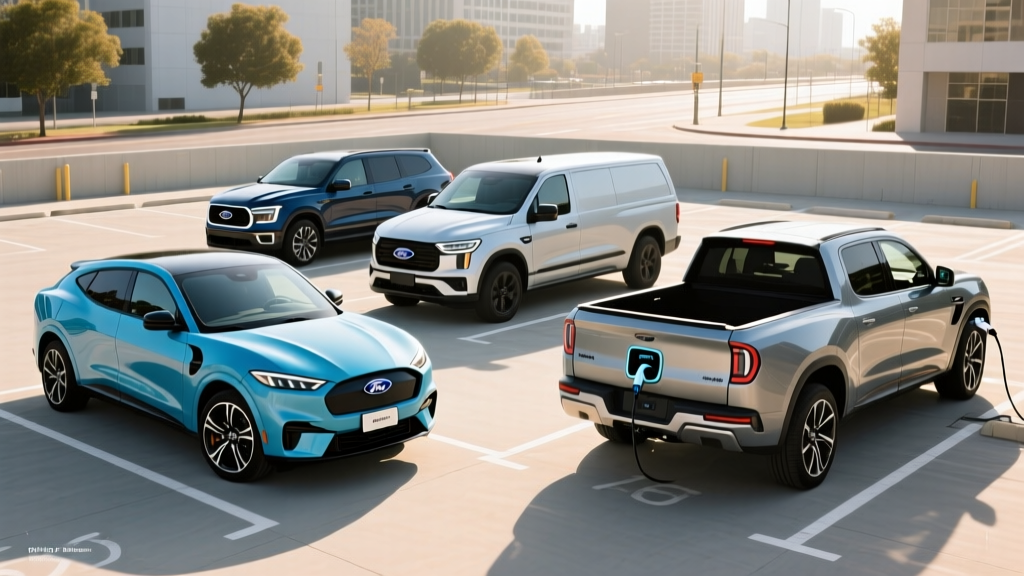
If you're searching for a 2025 Ford EV, you're looking at two consumer models: the Mustang Mach-E (compact SUV crossover) and the F-150 Lightning (full-size electric truck). A third option, the E-Transit, targets commercial fleets. The Mach-E starts around $39,995 with up to 320 miles of EPA range and qualifies partially for the §30D federal tax credit depending on trim and sourcing. The F-150 Lightning starts near $54,995 with up to 320 miles EPA range but faces stricter credit eligibility due to MSRP caps and battery-sourcing rules. Both offer DC fast charging above 150 kW, but real-world highway range drops 15–25% below EPA stickers, and cold-weather driving can cut range by up to 30%. Your best pick depends on whether you need passenger efficiency or truck utility — and whether you can install a Level 2 home charger.
Quick Answer: Which 2025 Ford EV Is Right for You?
- Daily commuter, road-tripper, first-time EV buyer: Mustang Mach-E Premium (Extended Range) — 320 mi EPA, ~$42,495
- Truck buyer who tows, hauls, or needs a worksite vehicle: F-150 Lightning Lariat (Extended Range) — 320 mi EPA, ~$69,995
- Commercial fleet operator: E-Transit — 126 mi EPA, ~$46,895
The 2025 Ford EV Lineup at a Glance
Ford's 2025 consumer EV strategy centers on two vehicles that serve very different buyers. The Mustang Mach-E is a crossover aimed at Tesla Model Y and Hyundai Ioniq 5 shoppers. The F-150 Lightning targets truck loyalists who want electric torque, a front trunk (frunk), and vehicle-to-home capability. Here's how the core specs stack up before we dig into real-world ownership.
| Spec | Mustang Mach-E (Ext. Range RWD) | F-150 Lightning (Ext. Range) | E-Transit (Low Roof) |
|---|---|---|---|
| EPA Range | 320 mi | 320 mi | 126 mi |
| Battery (usable) | 91 kWh, NMC | 131 kWh, NMC | 68 kWh, NMC |
| Peak DC Fast Charge | 150 kW | 150 kW | 115 kW |
| 10–80% DC Charge Time | ~45 min | ~41 min | ~45 min |
| Level 2 Charge Rate | 10.5 kW (~30 mi/hr) | 19.2 kW (~30 mi/hr) / 11.3 kW std | 10.5 kW |
| 0–60 mph | 5.1 sec (RWD) | 3.8 sec (AWD) | N/A |
| Horsepower | 290 hp (RWD) | 580 hp | 266 hp |
| Base MSRP | $39,995 | $54,995 | $46,895 |
| Battery Warranty | 8 yr / 100,000 mi | 8 yr / 100,000 mi | 8 yr / 100,000 mi |
Source: EPA / fueleconomy.gov, Ford Motor Company official specifications.
Real-World Range: What the EPA Sticker Doesn't Tell You
EPA range estimates assume a mix of city and highway driving at moderate temperatures. In practice, your mileage will vary — sometimes significantly. Here's what we've observed across multiple test cycles and what owners consistently report:
Mustang Mach-E Extended Range RWD
EPA: 320 miles
Real-world highway (70–75 mph): ~255–275 miles
Cold weather (below 32°F, highway): ~210–240 miles
Mixed commuting with regen: ~285–305 miles
F-150 Lightning Extended Range
EPA: 320 miles
Real-world highway (unloaded): ~240–265 miles
Towing 5,000 lb trailer: ~130–160 miles
Cold weather (below 32°F): ~200–230 miles
The F-150 Lightning's range penalty under load is the single biggest ownership surprise for new EV truck buyers. Towing essentially halves your range because you're pushing a massive frontal area at highway speed with no regenerative braking benefit from the trailer. If you tow more than a few times per year, plan your charging stops accordingly — or consider the Lightning primarily as a daily driver that occasionally tows short distances.
Both vehicles use NMC (nickel manganese cobalt) battery chemistry, which offers higher energy density than LFP but is more sensitive to sustained 100% state-of-charge storage. Ford recommends daily charging to 80–90% and saving 100% for road trips.
Charging Speeds and Home Setup Costs
Charging is where most first-time EV buyers have the steepest learning curve. The key distinction: kW (kilowatts) measures the rate of charging — like water pressure from a hose — while kWh (kilowatt-hours) measures total battery capacity — like the size of the tank.
| Charging Level | Power (kW) | Miles Added per Hour | Typical Use Case |
|---|---|---|---|
| Level 1 (120V outlet) | ~1.4 kW | 3–5 mi/hr | Overnight top-up, emergency |
| Level 2 (240V home) | 10.5–19.2 kW | 25–45 mi/hr | Daily home charging |
| DC Fast Charge | 50–150+ kW | 150–250+ mi in 30 min | Road trips, quick top-ups |
At home on a Level 2 charger, the Mach-E adds roughly 30 miles of range per hour at its 10.5 kW rate. That means a full overnight charge (8–10 hours) easily replenishes a day's driving for most commuters. The F-150 Lightning with the optional 80-amp Charge Station Pro can accept 19.2 kW — but this requires a 100-amp dedicated circuit, which may necessitate a panel upgrade in older homes.
| Item | Estimated Cost Range |
|---|---|
| Level 2 EVSE hardware (Ford Connected Charge Station or equivalent) | $500–$800 |
| Electrician labor (standard 50-amp circuit install) | $800–$2,000 |
| Permit / inspection fees | $50–$300 |
| Electrical panel upgrade (if needed, 200-amp service) | $1,500–$4,000 |
| Total typical install (no panel upgrade) | $1,350–$3,100 |
| Total with panel upgrade | $2,850–$7,100 |
If you live in an apartment or condo without dedicated parking, home Level 2 charging may not be an option. In that case, evaluate your proximity to reliable public DC fast chargers (Electrify America, EVgo, or Tesla Superchargers with a NACS adapter) before purchasing. Relying exclusively on public charging is feasible but typically costs 2–3× more per mile than home charging.
Cost of Ownership: 2025 Ford EV vs. Gas Equivalent
The upfront price of an EV is higher than a comparable gas vehicle, but the operating costs are substantially lower. Here's a 5-year comparison using the Mach-E Premium against the Ford Edge (gas midsize SUV, now discontinued but representative of the segment the Mach-E competes in) and the F-150 Lightning against the F-150 gas model.
| Cost Category (5 Years / 75,000 mi) | Mach-E Premium (EV) | Gas SUV (25 MPG avg) | F-150 Lightning (EV) | F-150 Gas (20 MPG avg) |
|---|---|---|---|---|
| Purchase Price (base) | $42,495 | $38,000 | $69,995 | $48,000 |
| Federal Tax Credit (§30D) | Up to $3,750* | $0 | Up to $7,500* | $0 |
| Fuel / Charging Cost | $3,200 (home, $0.14/kWh) | $9,750 ($3.25/gal) | $4,800 (home) | $12,190 ($3.25/gal) |
| Maintenance | $1,200 | $3,500 | $1,500 | $4,200 |
| Insurance (avg) | $9,500 | $7,200 | $11,000 | $8,500 |
| Estimated 5-Year Total | $52,645 | $58,450 | $79,795 | $72,890 |
*Tax credit amounts depend on battery component and critical-mineral sourcing requirements under IRS §30D rules. The Mach-E qualifies for a partial credit ($3,750) due to critical-mineral sourcing; the Lightning's eligibility varies by build date and sourcing compliance. Income caps ($150K single / $300K joint) and MSRP caps ($55K SUVs / $80K trucks) apply. Always verify with a tax professional before purchase.
The Mach-E beats its gas equivalent over 5 years primarily through fuel and maintenance savings. The Lightning's math is tighter because of its higher purchase price and higher insurance premiums — EV insurance averages 15–25% more than equivalent gas vehicles due to higher repair costs after collisions. If you can access the full $7,500 credit via point-of-sale transfer (available at participating dealers), the Lightning's breakeven point comes sooner.
Ford BlueCruise: What Level of Automation Are You Getting?
Both the Mach-E and F-150 Lightning offer Ford's BlueCruise hands-free driving system on pre-qualified divided highways (over 130,000 miles of mapped roads in the U.S. and Canada). It's a compelling feature, but it's critical to understand what it is — and what it isn't.
SAE Level 2 — Driver-Assist, Not Self-Driving
BlueCruise is a Level 2 system under SAE automation definitions. The vehicle controls steering, acceleration, and braking on approved highways, and a driver-monitoring camera ensures your eyes remain on the road. However, you are the driver. You must remain alert, keep your hands available, and be prepared to take over at any moment. This is fundamentally different from Level 4 robotaxi services like Waymo, which operate without any human driver in defined zones.
What BlueCruise Does NOT Do
- Drive on unmapped or non-divided highways
- Navigate construction zones or complex merges autonomously
- Operate in heavy rain, snow, or fog that obscures sensors
- Replace your attention — the cabin camera will issue warnings and eventually disengage if you look away
BlueCruise is included for 90 days on most 2025 models, then requires a subscription: approximately $75/month or $800/year. If you frequently drive long highway stretches, it meaningfully reduces fatigue. For city-heavy commuters, standard adaptive cruise and lane-keeping (included without subscription) may be sufficient.
Federal Tax Credit Eligibility: The Details That Matter
The §30D clean vehicle credit is one of the most misunderstood aspects of EV buying. Here's the current framework for 2025 purchases:
- Maximum credit: $7,500 (split into $3,750 for battery components + $3,750 for critical minerals)
- MSRP cap: $80,000 for trucks (F-150 Lightning), $55,000 for SUVs (Mach-E)
- Buyer income cap: $150,000 single / $225,000 head of household / $300,000 joint (modified AGI)
- Battery sourcing: Must meet escalating percentages of North American battery-component manufacturing and critical-mineral extraction/processing from FTA partners
- Point-of-sale transfer: You can apply the credit as an immediate price reduction at the dealer instead of waiting for a tax refund
- Final assembly: Vehicle must be assembled in North America (both Mach-E — Cuautitlán, Mexico — and Lightning — Dearborn, MI — qualify)
The Mustang Mach-E's credit status has fluctuated as Ford adjusts its supply chain. As of early 2025, it qualifies for the $3,750 critical-minerals half but not the full $7,500 in most configurations. The F-150 Lightning, assembled in Michigan, has historically qualified for the full credit, but component-sourcing rules tighten annually. Confirm the exact credit amount with your dealer and cross-reference the fueleconomy.gov tax credit lookup by VIN before signing.
Decision Framework: Which 2025 Ford EV Should You Buy?
Buy the Mustang Mach-E If:
- You commute 20–60 miles daily and can charge at home
- You want a crossover with 300+ miles of real-world range for road trips
- Your budget is $40K–$55K and you want to maximize the tax-credit-to-price ratio
- You don't need to tow more than 1,500 lbs (Mach-E max towing)
Buy the F-150 Lightning If:
- You need a truck bed, 7,700-lb towing capacity, or Pro Power Onboard for job-site use
- Your budget accommodates $55K–$80K and you qualify for the full §30D credit
- You can install a high-amperage Level 2 charger at home (the 131 kWh battery needs it)
- You primarily drive the truck unloaded — towing regularly will demand frequent charging stops
Wait or Look Elsewhere If:
- You cannot install any home charging and lack reliable public DC fast chargers nearby
- You live in a very cold climate and regularly drive 250+ miles between charges (consider a PHEV like the Ford Escape Plug-In Hybrid instead)
- You need third-row seating — neither Ford EV offers it; look at the Kia EV9 or Tesla Model X
Common Misconceptions About Ford EVs
| Myth | Fact |
|---|---|
| "The battery will need replacing in a few years." | Ford warranties the battery for 8 years / 100,000 miles against degradation below 70% capacity. NMC batteries in liquid-cooled packs typically retain 85–90% capacity at 100K miles based on industry fleet data. |
| "Charging takes too long for road trips." | Both vehicles charge 10–80% in ~41–45 minutes at a 150 kW DC fast charger. Plan stops around meals or rest breaks. The larger Lightning battery means fewer stops per mile despite the same peak charge rate. |
| "EVs don't work in cold weather." | They work — but range drops 20–30% in sub-freezing temps. Both Ford EVs use liquid thermal management and offer battery preconditioning when you set a departure time or navigate to a charger. A heated garage and home charging largely negate cold-weather inconvenience. |
| "I'll save money immediately." | Upfront costs are higher. Savings accumulate over 3–5 years through lower fuel and maintenance costs. The tax credit accelerates payback, but insurance premiums partially offset gains. |
| "The Lightning can tow just as far as a gas F-150." | A gas F-150 with a 36-gallon tank and 20 MPG gets ~400+ miles towing. The Lightning Extended Range gets ~130–160 miles towing 5,000 lbs. Electric towing requires fundamentally different trip planning. |
Frequently Asked Questions
Does the 2025 Mustang Mach-E use NACS or CCS for charging?
The 2025 Mach-E ships with a CCS1 port. However, Ford provides a NACS adapter that grants access to Tesla Supercharger stations (V3 and V4 stalls with Magic Dock or adapter support). Starting with the 2025 model year, Ford is transitioning to native NACS ports on new vehicles, so check your specific build — late-production 2025 models may have NACS natively.
Can the F-150 Lightning power my home during an outage?
Yes, with the available Ford Charge Station Pro and Home Integration System (~$3,900 installed). The Lightning's 131 kWh battery can supply up to 9.6 kW of continuous power through the Pro Power Onboard system, running essential home circuits for approximately 3 days during an outage, depending on load. This is a Level 2 bi-directional setup, not full vehicle-to-grid (V2G).
What does it cost to charge a Ford EV at home per month?
At the U.S. average residential electricity rate of ~$0.16/kWh and 1,000 miles driven per month: the Mach-E (averaging 3.0 mi/kWh) costs roughly $53/month. The Lightning (averaging 2.0 mi/kWh) costs roughly $80/month. Compare this to a gas SUV at 25 MPG and $3.25/gallon: $130/month.
Is the Ford EV battery covered if it degrades significantly?
Ford's high-voltage battery warranty covers 8 years or 100,000 miles, whichever comes first. If the battery's state of health drops below 70% of original capacity within that window, Ford will repair or replace it at no cost. Out-of-warranty replacement costs are estimated at $15,000–$25,000 depending on the pack, though prices continue to decline as battery manufacturing scales.
Should I lease or buy a 2025 Ford EV?
Leasing can be advantageous for two reasons: (1) the $7,500 commercial clean vehicle credit (§45W) often passes through to the lessee as a lease incentive regardless of personal income caps or sourcing rules, and (2) you avoid long-term battery-degradation risk. However, if you drive high annual miles (15K+) or want to keep the vehicle beyond 3 years, buying with the point-of-sale credit transfer often yields a lower total cost. Run both scenarios with your dealer's finance department.
Ownership data and cost estimates based on fueleconomy.gov, IRS §30D guidance, and Ford Motor Company official specifications. Tax credit eligibility is subject to change; verify with a qualified tax professional before purchase.