Quick Verdict: The 2025 Ford E-Transit in One Paragraph
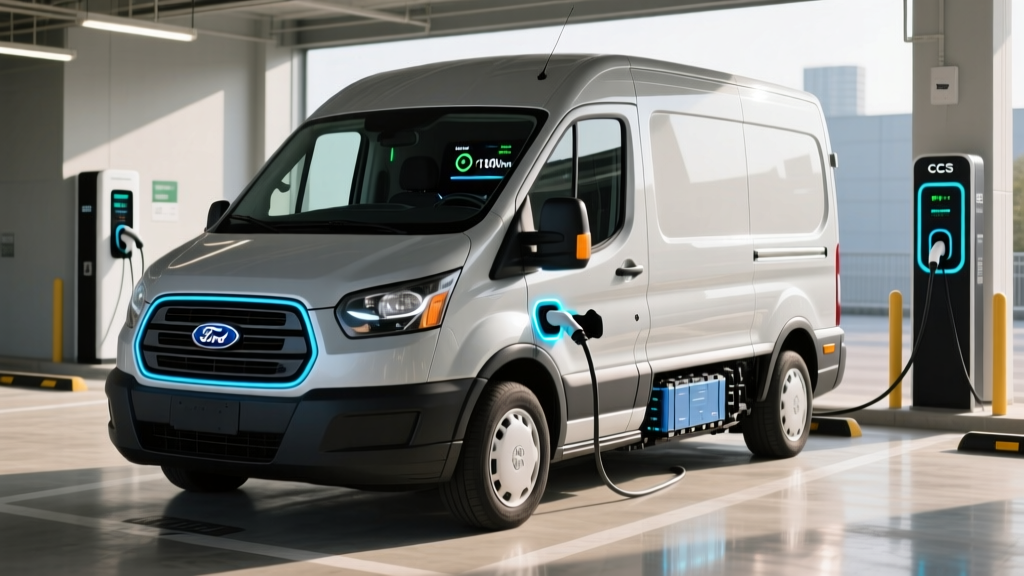
The 2025 Ford E-Transit is not built for road trips — it's built for the last 100 miles of a delivery route. With an EPA-estimated 126 miles of range on the low-roof cargo van, a 68 kWh usable LFP battery, and a starting MSRP of $51,995 before incentives, Ford's electric work van targets commercial fleets and owner-operators who return to a depot every night. Its strongest selling point isn't range; it's the Pro Power Onboard system that turns the van into a mobile generator, plus access to Ford Pro's telematics and fleet-management ecosystem. If your daily route stays under 90 miles round-trip and you can install Level 2 charging at your warehouse, the E-Transit eliminates fuel and maintenance costs that crush margins on gas Transit vans. If you need intercity capability or tow heavy, look elsewhere.
2025 Ford E-Transit Spec Sheet
| Specification | 2025 Ford E-Transit (Low-Roof Cargo Van) |
|---|---|
| EPA Range | 126 miles (low-roof cargo); 108–116 mi (medium/high roof & cutaway) |
| Battery (usable) | 68 kWh, LFP (lithium iron phosphate) |
| Motor Output | 266 hp (198 kW), 317 lb-ft torque |
| Drivetrain | Rear-wheel drive (single motor) |
| 0–60 mph | ~8.0 seconds (unladen, estimated) |
| Top Speed | 75 mph (electronically limited) |
| Max DC Fast Charge | 115 kW (CCS1) |
| 10–80% DC Charge Time | ~45 minutes |
| Level 2 AC Charge Rate | 10.5 kW onboard charger |
| Level 2 Miles per Hour | ~20–24 miles of range per hour |
| EPA Efficiency | ~2.0 kWh/mile (~50 MPGe combined) |
| Max Payload | 3,880 lbs (cargo van) |
| Cargo Volume | 246.7 cu ft (low-roof, 148" WB); up to 487.3 cu ft (high-roof, 148" WB) |
| Base MSRP | $51,995 (T-150 low-roof cargo, 130" WB) |
| Battery/Powertrain Warranty | 8 years / 100,000 miles |
| Federal Tax Credit (§30D) | Up to $7,500 (commercial clean vehicle credit §45W may also apply) |
Range and Efficiency: Real-World vs. EPA Sticker
EPA Estimated: 126 miles (low-roof cargo van, 130" wheelbase)
Real-World Expectation: 95–110 miles in mixed city/highway driving with moderate payload; 75–90 miles in cold weather (below 32°F) or at sustained highway speeds above 65 mph.
The E-Transit's 126-mile EPA figure applies specifically to the lightest configuration: the T-150 low-roof cargo van on the 130-inch wheelbase. Step up to a medium-roof or high-roof variant, add the extended 148-inch wheelbase, or spec a cutaway chassis, and the EPA number drops to between 108 and 116 miles due to increased weight and aerodynamic drag.
In fleet testing and owner reports, real-world range consistently lands 10–20% below the EPA sticker. A fully loaded E-Transit (2,000+ lbs of cargo) running stop-and-go urban delivery routes in moderate temperatures typically returns 95 to 110 miles. Highway driving at 70 mph pushes consumption to roughly 2.3–2.5 kWh/mile, cutting range further. Cold weather is the biggest variable: LFP batteries suffer more capacity loss at freezing temperatures than NMC chemistries, and without a heat pump (the E-Transit uses resistive cabin heating), winter range can drop to 75–90 miles.
Efficiency sits around 2.0 kWh per mile in mixed driving, which translates to roughly 50 MPGe combined per fueleconomy.gov. That's typical for a full-size electric van — the Rivian EDV (Amazon's delivery van) posts similar numbers, while the smaller BrightDrop Zevo 400 achieves slightly better efficiency due to its lighter curb weight.
For context, most urban delivery routes average 60–85 miles per day according to Ford Pro's telematics data. If that matches your operation, the E-Transit's range is sufficient — but it leaves very little buffer for detours, extreme weather, or unexpected second shifts.
Charging: DC Fast, Level 2, and Depot Setup
| Charging Level | Power | Connector | 10–80% Time | Miles Added per Hour |
|---|---|---|---|---|
| Level 1 (120V) | ~1.4 kW | J1772 | N/A (overnight ~15–20 mi) | ~2–3 mi/hr |
| Level 2 (240V, 48A) | 10.5 kW (onboard max) | J1772 | ~6.5 hours (0–100%) | ~20–24 mi/hr |
| DC Fast Charge | 115 kW peak | CCS1 | ~45 minutes | ~150+ mi/hr (peak) |
The E-Transit charges via CCS1 (the standard Combined Charging System connector used by most non-Tesla EVs in North America). Ford has not adopted NACS for the E-Transit as of the 2025 model year, though adapters may become available as the industry transitions.
At a DC fast charger, the E-Transit peaks at 115 kW. That's modest compared to passenger EVs like the Hyundai Ioniq 5 (240 kW) or Ford F-150 Lightning (230 kW), but it's competitive for a commercial van class. The 10–80% session takes approximately 45 minutes. The charge curve is relatively flat between 15% and 60% SoC, then tapers significantly above 80% — a characteristic of LFP chemistry, which requires slower charging near full to protect cell longevity. Plan on 45 minutes for a meaningful top-up, not a quick 15-minute stop.
For fleet operations, Level 2 depot charging is the primary strategy. The onboard charger accepts up to 10.5 kW, meaning a full 0–100% charge takes roughly 8 hours on a 48-amp Level 2 station. Most fleet operators plug in at end-of-shift and have a full battery by morning. Ford Pro offers the Ford Pro Intelligence charging management software to schedule and optimize charging across multiple vehicles, reducing peak-demand charges from your utility.
Home install for a single Level 2 charger typically costs $800–$2,500 (equipment plus electrician), but fleet depot installations with multiple chargers, load management systems, and potential panel upgrades run $5,000–$25,000+ depending on site electrical capacity. The IRS §30C Alternative Fuel Vehicle Refueling Property Credit covers up to 30% of charging equipment installation costs (max $100,000 for commercial property), which significantly offsets depot buildout expenses.
Performance, Payload, and Cargo Capability
The E-Transit uses a single rear-mounted electric motor producing 266 horsepower and 317 lb-ft of torque. That's adequate for urban driving — the instant torque delivery makes the van feel responsive off the line, even when loaded. The 0–60 mph time of approximately 8.0 seconds (unladen) isn't quick by passenger-EV standards, but it's perfectly functional for merging onto highways and navigating city traffic.
Where the E-Transit earns its keep is payload. The cargo van variant supports up to 3,880 lbs of payload — comparable to the gas-powered Transit 250. The battery pack is mounted under the floor, preserving the full cargo area. Ford offers three roof heights (low, medium, high) and two wheelbase lengths (130" and 148"), giving cargo volumes from 246.7 cu ft (low-roof, short wheelbase) up to 487.3 cu ft (high-roof, long wheelbase). The load floor height of 26.1 inches is low for the class, easing loading and unloading.
The cutaway variant — popular for upfits like box trucks, shuttle buses, and service bodies — maintains the same powertrain but trades enclosed cargo for a bare chassis. Maximum towing is rated at 3,500 lbs with the optional tow package, which is modest; if you need to tow a heavy trailer daily, the gas Transit or F-150 Lightning may serve better.
The E-Transit's top speed is electronically limited to 75 mph. This is intentional: fleet managers can set speed limiters to reduce energy consumption and improve safety. It also reflects the van's aerodynamic profile, which becomes highly inefficient above highway speeds.
Tech, Driver Assists, and Pro Power Onboard
The 2025 E-Transit comes with Ford's SYNC 4 infotainment system on a 12-inch touchscreen, including wireless Apple CarPlay and Android Auto, built-in navigation with EV-aware routing (which factors in charge station locations), and a Wi-Fi hotspot powered by FordPass Connect. The interface is straightforward — commercial buyers don't want fussy menus, and SYNC 4 delivers.
The standout feature is Pro Power Onboard, available in 2.4 kW and 7.2 kW output levels. This system turns the E-Transit's battery into a mobile power source via bed-mounted and interior 120V/240V outlets. Contractors can run power tools, lighting, and equipment directly from the van at a job site without a separate generator. The 7.2 kW version can simultaneously power a chop saw, a job-site radio, and battery chargers — a genuine differentiator versus the gas Transit, which requires an idling engine or a towed generator for site power.
Driver-assistance technology includes Ford Co-Pilot360 as standard: automatic emergency braking with pedestrian detection, lane-keeping assist, blind-spot monitoring, rear cross-traffic alert, and a rearview camera. The available Co-Pilot360 Assist package adds adaptive cruise control with stop-and-go, lane-centering, and evasive steering assist. These are SAE Level 2 driver-assist features — the driver must remain attentive and keep hands on the wheel at all times. There is no hands-free or eyes-off autonomous capability here.
Ford Pro's telematics platform (available via subscription) provides real-time vehicle location, battery state of charge, driver behavior scoring, maintenance alerts, and route optimization. For fleet managers overseeing 5 to 500 vans, this software layer is often the deciding factor — it's deeply integrated and eliminates the need for third-party fleet-tracking hardware.
Pricing, Trim Levels, and Tax Credit Eligibility
| Configuration | Base MSRP | Est. After §30D / §45W Credit |
|---|---|---|
| T-150 Low-Roof Cargo, 130" WB | $51,995 | ~$44,495 |
| T-250 Medium-Roof Cargo, 148" WB | $54,495 | ~$46,995 |
| T-350 High-Roof Cargo, 148" WB | $56,995 | ~$49,495 |
| T-350 Cutaway, 138" WB | $49,995 | ~$42,495 |
The E-Transit's MSRP positions it roughly $12,000–$15,000 above an equivalently configured gas Transit, a premium that fleet buyers evaluate on a total-cost-of-ownership basis rather than sticker price alone.
Tax credit eligibility requires careful navigation. For commercial and fleet buyers, the E-Transit typically qualifies under the §45W Commercial Clean Vehicle Credit, which provides up to $7,500 for vehicles under 14,000 lbs GVWR. Unlike the consumer §30D credit, §45W has no MSRP cap and no buyer income limit — but the vehicle must be used for business purposes and the credit is claimed by the business entity, not an individual.
Individual owner-operators purchasing the E-Transit for personal business use may qualify under §30D instead, subject to the following requirements (per current IRS guidelines):
- MSRP cap: Vans fall under the $80,000 cap for SUVs/pickups/vans (the E-Transit clears this easily)
- Buyer income cap: $150,000 single / $300,000 joint modified AGI
- Battery sourcing: Critical minerals and battery component requirements phase in annually — verify current-year compliance on the IRS qualified vehicles list
- Point-of-sale transfer: Eligible buyers can transfer the credit to the dealer at purchase, reducing the out-of-pocket price immediately
- VIN verification: Confirm your specific E-Transit VIN appears on the IRS qualified list before finalizing purchase
Tax rules evolve frequently. Consult a tax professional and verify your vehicle's eligibility on the IRS qualified-vehicles database before relying on credit projections.
Competitor Comparison: E-Transit vs. BrightDrop Zevo and Rivian EDV
The E-Transit doesn't operate in a vacuum, though its competitive set is narrow. Here's how it stacks up against the closest alternatives in the electric commercial van space:
| Attribute | 2025 Ford E-Transit | BrightDrop Zevo 600 | Rivian EDV (Amazon fleet) |
|---|---|---|---|
| EPA Range | 126 mi | ~160 mi (est.) | ~150 mi (est.) |
| Battery | 68 kWh LFP | ~120 kWh NMC | ~115 kWh (est.) |
| Max DC Charge | 115 kW | ~150 kW | Not publicly sold |
| Cargo Volume | Up to 487 cu ft | Up to 615 cu ft | ~660 cu ft |
| Base Price | $51,995 | ~$75,000+ | Fleet-only (Amazon) |
| Pro Power Onboard | Yes (up to 7.2 kW) | No | No |
| Publicly Available | Yes | Limited | No |
The E-Transit wins on availability and price. It's the only electric full-size van you can walk into a dealership and order today at a sub-$55,000 starting point. The BrightDrop Zevo 600 (formerly GM's EV delivery van) offers more range and cargo space but costs significantly more and has limited production. The Rivian EDV is purpose-built for Amazon and not available to the general public or competing fleets.
Choose the Ford E-Transit if:
- Your daily routes average under 90 miles round-trip
- You need Pro Power Onboard for job-site electricity
- You're already in the Ford Pro ecosystem (telematics, service network)
- Budget is a primary constraint and you want the lowest entry price
- You need a cutaway chassis for custom upfits
Look elsewhere if:
- Your routes regularly exceed 120 miles or include highway-heavy segments
- You operate in extreme cold climates without heated depot parking
- You need to tow more than 3,500 lbs daily
- You require all-wheel drive (not offered on E-Transit)
Warranty, Ownership Costs, and Long-Term Outlook
Ford backs the E-Transit's battery pack and electric powertrain components with an 8-year / 100,000-mile warranty, covering defects and capacity loss below 70% of original capacity. The bumper-to-bumper warranty is 3 years / 36,000 miles, which is standard for commercial vehicles but shorter than some passenger EVs. Ford Pro also offers extended service plans tailored to fleet duty cycles.
The LFP battery chemistry is a deliberate choice for commercial service. LFP cells tolerate more charge cycles (typically 3,000–5,000 full cycles before 80% capacity retention) compared to NMC (1,000–2,000 cycles), making them ideal for daily charge-discharge patterns. The trade-off is lower energy density (hence the 126-mile range from a 68 kWh pack) and greater cold-weather sensitivity.
Operating cost savings are where the E-Transit makes its case. At a national average commercial electricity rate of $0.12/kWh, fully charging the 68 kWh battery costs approximately $8.16. A gas Transit 250 getting 15 MPG combined at $3.50/gallon spends roughly $23.33 to cover the same 100 miles. Over a 25,000-mile annual fleet schedule, that's a fuel savings of approximately $3,800 per van per year — before accounting for reduced maintenance (no oil changes, fewer brake replacements thanks to regenerative braking, no transmission service).
Insurance costs for commercial EVs tend to run 10–20% higher than gas equivalents due to repair complexity and parts costs. Get fleet quotes before committing.
Pros and Cons
Pros
- Pro Power Onboard (up to 7.2 kW) eliminates job-site generators
- Lowest MSRP in the full-size electric van class
- LFP battery offers excellent cycle life for daily fleet use
- Ford Pro telematics integration is best-in-class for fleet management
- Full cargo floor preserved — battery under floor, no intrusion
- Eligible for §45W commercial clean vehicle credit (up to $7,500)
- Extensive Ford commercial dealer and service network
- Instant torque improves drivability in stop-and-go urban routes
Cons
- 126-mile EPA range is limiting; real-world often 95–110 miles
- No AWD option — problematic for snow-belt fleets
- Cold-weather range loss is significant (LFP + resistive heating)
- 115 kW DC fast charge is slow vs. passenger EVs
- CCS1 connector only; no NACS support for Tesla Supercharger access
- 75 mph top speed limiter may frustrate some highway drivers
- Upfront price premium of $12,000–$15,000 over gas Transit
- Resistive cabin heater draws significant battery in winter
Frequently Asked Questions
What is the real-world range of the 2025 Ford E-Transit?
In mixed urban delivery driving with moderate payload, expect 95–110 miles from a full charge. Highway driving at 70 mph or cold weather below freezing can reduce that to 75–90 miles. The 126-mile EPA estimate applies to the lightest low-roof configuration under ideal conditions.
How fast does the E-Transit charge at home and on DC fast chargers?
On a Level 2 home or depot charger (240V, 48A), the E-Transit charges at 10.5 kW, adding roughly 20–24 miles of range per hour. A full 0–100% charge takes about 8 hours. On a DC fast charger, it peaks at 115 kW and reaches 10–80% in approximately 45 minutes.
Does the 2025 Ford E-Transit qualify for the federal EV tax credit?
Yes, but the applicable credit depends on the buyer. Commercial and fleet purchases typically qualify under §45W (Commercial Clean Vehicle Credit, up to $7,500 with no MSRP or income cap). Individual buyers may qualify under §30D, subject to income limits ($150K single / $300K joint), MSRP caps ($80K for vans), and battery-sourcing requirements. Always verify your VIN on the IRS qualified-vehicle list and consult a tax professional.
Is the E-Transit worth buying versus a gas-powered Ford Transit?
If your daily routes stay under 90–100 miles and you have depot charging, the E-Transit pays for its price premium through fuel and maintenance savings within 3–5 years of fleet operation. If your routes are longer, unpredictable, or highway-heavy, the gas Transit remains more practical. The Pro Power Onboard feature alone may justify the E-Transit for contractors who need job-site power.
Can I tow with the 2025 E-Transit?
Yes, with the optional tow package, the E-Transit is rated for up to 3,500 lbs. That's sufficient for a light utility trailer but significantly less than the gas Transit (up to 6,900 lbs) or the F-150 Lightning (up to 10,000 lbs). Heavy towing also dramatically reduces range.
Does the E-Transit have all-wheel drive?
No. The 2025 E-Transit is rear-wheel drive only. This is a notable gap for fleets operating in snow-prone regions. Ford has not announced an AWD variant.
What happens if the battery degrades?
Ford's 8-year/100,000-mile battery warranty covers capacity loss below 70% of original. LFP chemistry is designed for 3,000+ charge cycles, which translates to roughly 300,000+ miles before significant degradation in normal fleet use. Out-of-warranty battery replacement costs are estimated at $15,000–$22,000 based on current commercial EV service pricing, though costs are expected to decline over the vehicle's lifetime.