Quick Verdict: The Workhorse That Knows Its Route
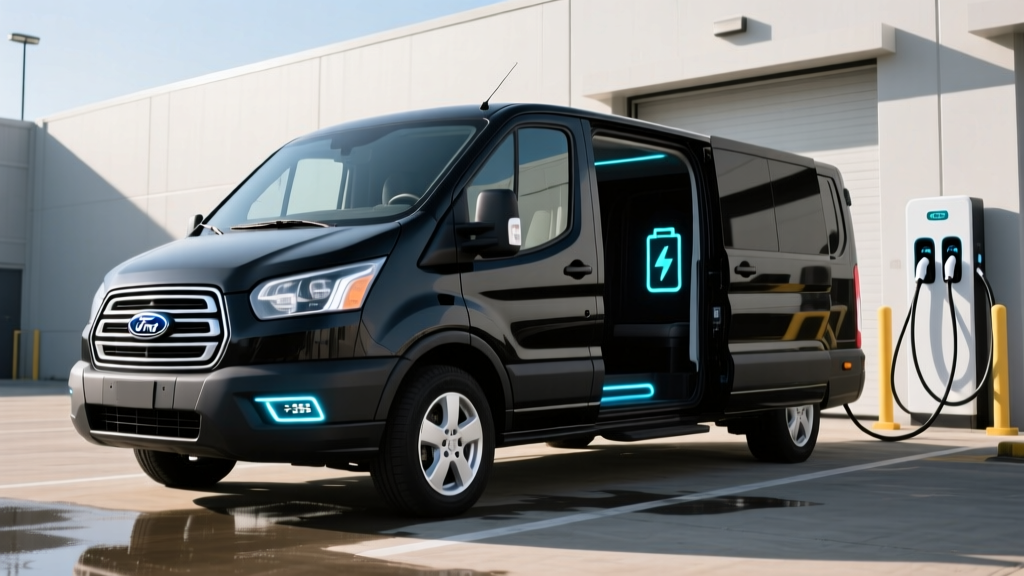
The 2025 Ford E-Transit Chassis T-350 isn't trying to win a drag race or cross the country on a single charge. It's a purpose-built commercial electric platform designed for last-mile delivery, upfit-ready vocational work, and predictable daily routes. With 126 miles of EPA-estimated range, a 68 kWh usable lithium-ion battery, and Ford Pro's commercial ecosystem behind it, the E-Transit Chassis T-350 makes a compelling case for fleet operators who can charge at the depot and stay within a defined service area.
But the math only works if your routes cooperate. This is a vehicle where honest range expectations and charging infrastructure planning aren't optional — they're the entire purchase decision.
Range, Efficiency, and the Real-World Reality Check
Real-World Expectation: Plan for 90–110 miles in mixed urban/suburban delivery use with moderate payload. Highway driving at 65+ mph drops range to approximately 80–95 miles. In cold weather (below 32°F), expect a 20–30% reduction, bringing usable range to roughly 70–90 miles without preconditioning. Cabin heating and heavy cargo loads compound losses.
Why it matters: The E-Transit Chassis T-350 is EPA-rated significantly lower than the low-roof cargo van variant (which achieves up to 126 miles as well, depending on wheelbase). Chassis cab and cutaway configurations carry more aerodynamic penalty once upfitted with boxes or utility bodies, and real-world fleet data from fueleconomy.gov confirms that stop-and-go delivery routes with frequent idling and HVAC use will test the lower end of the range envelope.
The E-Transit's efficiency lands around 2.0–2.2 kWh per mile in typical delivery use, translating to roughly 45–50 MPGe combined. That's not impressive by passenger-EV standards, but commercial vehicles are measured differently — the relevant metric is cost per mile, and at $0.12/kWh national average electricity rates, you're looking at approximately $0.24–$0.26 per mile in energy cost versus $0.45–$0.55 per mile for a comparable gas-powered Transit at 14 MPG and $3.50/gallon.
Battery Chemistry, Capacity, and Longevity
| Specification | Detail |
|---|---|
| Usable Battery Capacity | 68 kWh |
| Chemistry | NMC (Nickel Manganese Cobalt) lithium-ion |
| Thermal Management | Liquid-cooled and heated |
| Battery Warranty | 8 years / 100,000 miles (minimum 70% capacity retention) |
| Estimated Replacement Cost | $15,000–$22,000 (out of warranty, based on current commercial EV battery pricing) |
Ford uses NMC chemistry in the E-Transit rather than LFP (lithium iron phosphate). NMC offers higher energy density — important in a commercial platform where packaging the battery beneath the chassis without compromising ground clearance or upfit space is critical. The trade-off is that NMC cells degrade slightly faster than LFP under high-cycle, high-depth-of-discharge use. Fleet operators running two full cycles per day should monitor State of Health (SoH) through Ford Pro's telematics platform and plan for gradual range reduction of approximately 1.5–2.5% per year under typical commercial use patterns.
The liquid thermal management system is essential for this application. Unlike passenger EVs that sit in a garage, commercial chassis vehicles face ambient extremes and sustained high-load operation. The active heating and cooling system maintains cell temperature between optimal operating thresholds, preserving both range and long-term battery health. Preconditioning the battery while still plugged in at the depot — a feature accessible through the FordPass app — can recover 10–15 miles of range on cold mornings that would otherwise be lost to cabin and battery heating.
Charging Speed: Depot, DC Fast, and the Curve Reality
| Charging Level | Power | Rate / Time | Best Use Case |
|---|---|---|---|
| Level 1 (120V) | ~1.4 kW | ~3 miles/hr (not practical for fleet) | Emergency/trickle only |
| Level 2 (240V AC) | Up to 10.5 kW (48A) | ~22 miles/hr; 0–100% in ~8 hours | Overnight depot charging |
| DC Fast Charge | Peak 115 kW | 15–80% in ~45 minutes | Mid-shift top-up, opportunity charging |
The 115 kW peak DC fast-charge rate is the E-Transit's most debated specification. By 2025 passenger-EV standards — where Hyundai Ioniq 5 and Tesla platforms pull 250+ kW — it sounds modest. But context matters. A commercial chassis vehicle doesn't typically need a 10–80% charge in 18 minutes. It needs a full overnight charge at the depot, and the 10.5 kW Level 2 rate delivers that in roughly 8 hours on a standard 48-amp commercial Level 2 station.
The DC fast-charge capability exists for opportunity charging: a 20-minute stop at an Electrify America or EVgo station during a driver's lunch break can add roughly 35–45 miles of range, enough to extend a route or handle an unexpected detour. The charge curve is relatively flat between 15–60% SoC before tapering noticeably above 80%. Ford's CCS1 connector is the standard for North American commercial vehicles, though the industry's shift toward NACS means fleet operators planning infrastructure in 2025–2026 should consider adapter availability and future-proofing.
For depot installation, budget approximately $2,500–$5,500 per Level 2 charging station (equipment + electrician + permit for a single 48A circuit), with potential panel-upgrade costs of $2,000–$5,000 if your facility's electrical service needs expansion. Ford Pro offers charging infrastructure consulting and partnerships with providers like EV Connect and ChargePoint for multi-vehicle fleet deployments.
Performance, Powertrain, and Drivability
| Metric | Specification |
|---|---|
| Motor Type | Single permanent-magnet synchronous (rear axle) |
| Horsepower | 266 hp (198 kW) |
| Torque | 317 lb-ft |
| 0–60 mph | ~8.5 seconds (unloaded chassis cab) |
| Drivetrain | Rear-wheel drive |
| Top Speed | Electronically limited to ~75 mph |
| Max Payload (Chassis Cab) | ~3,880 lbs (varies by wheelbase/upfit) |
| GVWR | 9,500 lbs (T-350) |
The 266-horsepower rear-mounted motor delivers brisk low-end torque that makes the E-Transit Chassis T-350 surprisingly responsive in urban environments. Off the line, electric torque delivery eliminates the lag and gear-hunting of a gas Transit's 3.5L V6 and 10-speed automatic. Merging onto highways and navigating loaded intersections is genuinely easier in the electric variant, especially when carrying 2,000–3,000 lbs of payload.
The trade-off is highway performance. The single-speed transmission and 75-mph electronic limiter mean the E-Transit is optimized for surface streets and suburban arterials, not interstate cruising at 80 mph. The regenerative braking system offers adjustable levels, including a one-pedal-driving mode that recaptures energy effectively in stop-and-go delivery environments. Brake wear reduction is a real cost savings — fleet operators report extending brake pad replacement intervals by 40–60% compared to gas-powered Transits thanks to regen handling the majority of deceleration events.
Pricing, Tax Credits, and Total Cost of Ownership
| Configuration | Base MSRP | After §30D Credit* |
|---|---|---|
| T-350 Chassis Cab 138" WB | ~$52,500 | ~$45,000 |
| T-350 Chassis Cab 156" WB | ~$54,000 | ~$46,500 |
| T-350 Cutaway 138" WB | ~$53,500 | ~$46,000 |
| T-350 Cutaway 156" WB | ~$55,000 | ~$47,500 |
*Federal §30D tax credit eligibility requires meeting all current-year IRS requirements. The E-Transit's MSRP falls well below the $80,000 commercial vehicle cap. However, the full $7,500 credit depends on battery component and critical mineral sourcing requirements that shift annually. Commercial fleet buyers purchasing through a business entity may alternatively qualify for the Commercial Clean Vehicle Credit (§45W), which offers up to $7,500 for vehicles under 14,000 lbs GVWR. Consult a tax professional for entity-specific eligibility. Income caps apply to individual buyers under §30D; business buyers follow different rules under §45W.
The total cost of ownership equation is where the E-Transit Chassis T-350 makes its strongest argument. Over a 5-year / 75,000-mile ownership period:
- Fuel savings: ~$11,000–$14,000 versus a gas Transit (at $3.50/gal, 14 MPG combined vs. $0.12/kWh electricity)
- Maintenance savings: ~$3,500–$5,000 (no oil changes, reduced brake wear, fewer moving parts)
- Insurance premium increase: ~$800–$1,500 over 5 years (commercial EV insurance remains elevated)
- Depreciation: Higher uncertainty — commercial EV residual values are still establishing, though Ford Pro's certified pre-owned and remarketing programs provide some structure
Net savings typically reach $10,000–$16,000 over five years for a high-utilization fleet vehicle, with the breakeven point arriving around month 28–36 depending on route length, electricity rates, and whether the full tax credit is captured.
Tech, Driver Assists, and Fleet Integration
The E-Transit Chassis T-350 comes equipped with Ford's SYNC 4 infotainment system on a 12-inch touchscreen, including wireless Apple CarPlay and Android Auto, built-in navigation with EV-aware routing (factoring in charge levels and station locations), and Ford Power-Up over-the-air software updates. For fleet managers, the critical technology isn't the touchscreen — it's Ford Pro Telematics, a subscription-based platform that provides real-time vehicle location, battery state of charge monitoring, driver behavior scoring, geofencing alerts, and scheduled charging management.
Driver-assistance features include Ford Co-Pilot360 as standard: automatic emergency braking with pedestrian detection, lane-keeping assist, blind-spot monitoring (critical on a long-wheelbase chassis vehicle), and a rearview camera. Available upgrades include adaptive cruise control with stop-and-go and reverse brake assist. These are SAE Level 2 driver-assist systems — the driver must remain fully engaged at all times. There is no hands-off or eyes-off capability.
A standout feature for commercial buyers is Pro Power Onboard — available as a 2.4 kW or 7.2 kW mobile power export system that turns the E-Transit's battery into a job-site generator. For upfitters building service bodies with electric tool requirements, this eliminates the need for a separate gasoline generator and provides clean, silent power for equipment like compressors, lifts, and power tools.
Pros, Cons, and Who Should Buy
✓ Pros
- Significantly lower cost per mile vs. gas Transit (~$0.25/mi vs. ~$0.50/mi energy)
- Strong low-end torque improves urban drivability with payload
- Reduced maintenance (no oil, fewer brake jobs, no transmission fluid)
- Pro Power Onboard eliminates separate job-site generators
- Ford Pro telematics and dealer network provide fleet support infrastructure
- Quiet operation benefits residential delivery routes and early-morning service calls
- Qualifies for federal commercial EV tax credits (§45W or §30D)
✗ Cons
- 126-mile EPA range severely limits route flexibility — not viable for long-haul or inter-city use
- Cold-weather range loss of 20–30% can disrupt tight delivery schedules
- 115 kW peak DC fast charge means 45-minute stops for meaningful range recovery
- Higher upfront cost than gas Transit (~$15,000–$18,000 premium before credits)
- Depot charging infrastructure investment required ($2,500–$5,500+ per station)
- 75-mph speed limiter and single-speed transmission limit highway utility
- Residual value uncertainty for commercial EVs remains a fleet-budget risk
Who Should Buy the E-Transit Chassis T-350
Choose the E-Transit Chassis T-350 if: Your fleet operates predictable daily routes under 90 miles, you have depot charging access (or can install it), your vehicles return to base nightly, you operate in urban/suburban environments, and you want to reduce per-mile operating costs over a 5+ year ownership horizon. Ideal for last-mile delivery, HVAC/plumbing service, municipal fleets, and campus/logistics operations.
Look elsewhere if: Your routes regularly exceed 100 miles, you operate in extreme cold climates without preconditioning infrastructure, you need highway-speed inter-city capability, or your fleet lacks the capital for depot charging installation. Consider the gas-powered Transit, a diesel Sprinter, or wait for next-generation commercial EVs with 200+ mile range and faster charging.
Competitive Landscape: E-Transit vs. the Alternatives
The E-Transit Chassis T-350 occupies a narrow competitive space. The BrightDrop Zevo 600 (formerly BrightDrop EV600) offers a larger 165 kWh battery and approximately 250 miles of range, but at a significantly higher price point (~$85,000+) and with a longer order wait time. BrightDrop targets larger parcel delivery fleets with longer routes. The Mercedes-Benz eSprinter offers a chassis cab variant with approximately 200 miles of range (113 kWh battery) and DC fast charging up to 115 kW, but commands a ~$10,000–$15,000 premium over the E-Transit. The Rivian EDV (Electric Delivery Van) is built exclusively for Amazon and is not available to general fleet buyers.
For most small-to-mid-size fleet operators, the E-Transit Chassis T-350's combination of Ford's dealer and service network, Ford Pro telematics integration, Pro Power Onboard capability, and relatively accessible pricing makes it the default choice — provided the range limitation is acceptable for your operation. The competing platforms offer more range but at costs that extend the payback period by 12–24 months.
Frequently Asked Questions
What is the real-world range of the 2025 Ford E-Transit Chassis T-350?
The EPA rates the E-Transit Chassis T-350 at 126 miles. In real-world delivery use with payload and HVAC operation, plan for 90–110 miles. Highway driving and cold weather reduce this further to 70–95 miles. Always plan routes with a 15–20% buffer below your expected range.
How fast does the E-Transit charge at home and on DC fast chargers?
On a 48-amp Level 2 home/depot charger (10.5 kW), a full 0–100% charge takes approximately 8 hours. On a DC fast charger, the E-Transit peaks at 115 kW and charges from 15–80% in approximately 45 minutes. The charge rate tapers significantly above 80% SoC.
Does the 2025 E-Transit qualify for the federal EV tax credit?
The E-Transit qualifies for federal tax credits, but the specific credit depends on buyer type. Individual buyers may qualify for up to $7,500 under IRS §30D, subject to income caps and battery sourcing requirements. Commercial/business buyers may qualify for up to $7,500 under the §45W Commercial Clean Vehicle Credit. The E-Transit's MSRP is well below the $80,000 cap for vans/pickups. Always verify current-year eligibility with a tax professional.
Is the E-Transit Chassis T-350 worth buying over a gas-powered Transit?
If your daily routes stay under 90–100 miles and you can install depot charging, the E-Transit typically breaks even on its price premium within 28–36 months through fuel and maintenance savings. Over 5 years, net savings of $10,000–$16,000 are achievable. If your routes exceed the range envelope or you lack charging infrastructure, the gas Transit remains the practical choice.
What is the battery warranty on the E-Transit?
Ford covers the E-Transit's high-voltage battery for 8 years or 100,000 miles, whichever comes first. The warranty guarantees minimum 70% capacity retention. If the battery degrades below that threshold within the warranty period, Ford will repair or replace it at no cost.
Can I upfit the E-Transit Chassis with a utility body or box?
Yes — the chassis cab and cutaway configurations are specifically designed for upfitting. Ford works with certified upfitters (Adrian Steel, Knapheide, Morgan Olson, and others) to ensure compatibility. The key consideration is that added weight and aerodynamic drag from upfit bodies will reduce range below the 126-mile EPA estimate. Discuss expected range impact with your upfitter before specifying.
Does the E-Transit have AWD?
No. The 2025 E-Transit is rear-wheel drive only. Ford has not announced an AWD variant. For fleets operating in snow-belt regions, winter tires and the vehicle's traction control system compensate, but the lack of AWD is a legitimate limitation for some vocational applications.