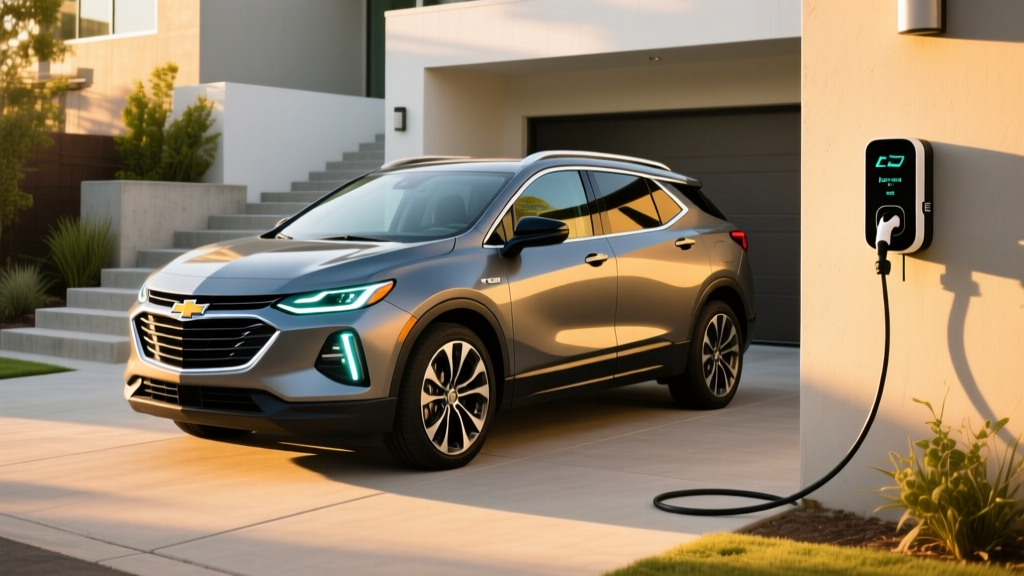
The 2025 Chevrolet Equinox EV has become one of the most searched affordable electric SUVs, and for good reason: GM priced it aggressively, and lease deals have made it even more attainable. But a low monthly payment is only the beginning of the ownership equation. Before you sign, you need to know what this SUV actually costs to drive, charge, insure, and eventually sell over five years.
This analysis treats the Equinox EV not as a showroom brochure but as a real-world financial commitment. We'll walk through the math on federal tax credits, per-mile energy costs, maintenance savings, insurance premiums, and the depreciation curve that defines your true cost of ownership. Whether you're eyeing a 2LT lease or weighing a purchase, the numbers below will tell you whether the deal holds up.
2025 Equinox EV Lease Deals: What You're Actually Signing
As of early 2026, the 2025 Chevy Equinox EV is available in three primary trims with the following MSRPs before any incentives:
- 2LT (FWD): ~$33,600 MSRP — EPA-estimated 319 miles of range
- 3LT (FWD): ~$38,200 MSRP — EPA-estimated 319 miles of range
- RS (AWD): ~$43,400 MSRP — EPA-estimated 285 miles of range
Lease deals on the 2LT have appeared as low as $299–$349/month with $2,500–$3,999 due at signing on 36-month terms, depending on regional incentives and dealer markups. The critical advantage of leasing: under IRS §30D rules, the $7,500 federal tax credit can be applied as a capitalized-cost reduction on a lease regardless of your personal income, because the leasing company (the legal owner) claims the credit and passes it through. This effectively sidesteps the income caps that restrict purchase buyers.
Federal Tax Credit: Do You Actually Qualify?
The federal clean vehicle credit under IRS §30D offers up to $7,500, but eligibility is a three-part test. Here's the current checklist for the 2025 Equinox EV:
- Income caps (purchase only): Modified AGI must not exceed $150,000 (single), $225,000 (head of household), or $300,000 (joint filers). Lease transactions bypass this cap.
- MSRP cap: The vehicle must have an MSRP at or below $80,000 for SUVs. All Equinox EV trims clear this easily.
- Battery sourcing requirements: $3,750 of the credit requires critical minerals sourced from the US or FTA partners; another $3,750 requires battery components manufactured or assembled in North America. The Equinox EV's Ultium battery is assembled in the US, and GM has been working to meet both thresholds. However, sourcing rules tighten annually — verify current-year compliance on the DOE/IRS qualified vehicle list.
- Point-of-sale transfer: Since 2024, you can transfer the credit to the dealer at purchase, reducing your out-of-pocket cost immediately rather than waiting for tax season.
- Lease advantage: On a lease, the lessor claims the credit and typically applies it as a cap-cost reduction, lowering your monthly payment. Income caps do not apply to you personally in this structure.
The bottom line: if you lease, the full $7,500 is highly likely to reduce your effective cost. If you purchase, you need to verify both your income eligibility and the specific build's battery-sourcing compliance for the current tax year.
Five-Year Total Cost of Ownership: The Full Picture
Below is a five-year TCO model for a 2025 Equinox EV 2LT (FWD) driven 12,000 miles/year, compared against a similarly priced gas compact SUV (averaging 28 MPG combined). Assumes home Level 2 charging at $0.14/kWh average and gas at $3.40/gallon.
| Category | Equinox EV 2LT | Gas SUV (28 MPG) |
|---|---|---|
| Purchase / Cap Cost (after $7,500 credit) | $26,100 (effective) | $33,600 |
| Energy / Fuel (5 yrs, 60K miles) | $2,520 | $7,286 |
| Maintenance (5 yrs) | $900 | $3,200 |
| Insurance (5 yrs) | $9,750 | $7,500 |
| Depreciation (est. 5-yr) | $14,500 | $13,440 |
| Total 5-Year Cost | $53,770 | $65,026 |
The Equinox EV comes out approximately $11,200 ahead over five years in this model, driven largely by the federal credit and fuel savings. But note the two areas where the EV costs more: insurance and depreciation. Those are real expenses that lease deals can partially mask but not eliminate.
Charging vs. Gas: The Per-Mile Math
The Equinox EV's efficiency hovers around 3.0–3.4 miles per kWh depending on driving conditions. At a national average residential electricity rate of $0.14/kWh:
| Energy Source | Rate | Efficiency | Cost Per Mile |
|---|---|---|---|
| Home Level 2 Charging | $0.14/kWh | 3.2 mi/kWh | $0.044 |
| Public DC Fast Charging | $0.35/kWh (avg) | 3.2 mi/kWh | $0.109 |
| Gasoline (28 MPG SUV) | $3.40/gallon | 28 MPG | $0.121 |
At home, you're paying roughly 4.4 cents per mile — less than half the cost of gas. Even at a public DC fast charger, you're slightly ahead of gasoline. Over 60,000 miles, home charging saves about $4,700 compared to gas. The caveat: if you rely exclusively on expensive public fast-charging networks like Electrify America or EVgo at peak rates ($0.43–$0.56/kWh in some markets), your savings shrink or disappear entirely. Home charging access is the single biggest variable in EV economics.
The Equinox EV supports up to 150 kW peak DC fast charging, delivering a 10–80% charge in approximately 30 minutes. On Level 2 (11.5 kW onboard charger), a full charge takes roughly 9.5 hours — practical for overnight home charging.
Maintenance Savings: Where EVs Quietly Win
Electric motors have roughly 20 moving parts versus 2,000+ in an internal combustion engine. That translates to real savings:
| Service Item | Equinox EV | Gas SUV |
|---|---|---|
| Oil Changes | Never ($0) | ~$400/5 yrs |
| Brake Pads | 60K+ mi life (regen braking) | 30–40K mi replacement (~$500) |
| Transmission Fluid | Never | ~$200 at 60K mi |
| Air Filters (engine) | N/A | ~$120/5 yrs |
| Coolant / Spark Plugs | Minimal / N/A | ~$350 combined |
| Tire Rotation / Cabin Filter | ~$300/5 yrs | ~$300/5 yrs |
| Estimated 5-Yr Total | ~$900 | ~$3,200 |
Regenerative braking is the hidden hero here. Because the electric motor slows the vehicle and recaptures energy, friction brakes see dramatically less use. Many EV owners report original brake pads at 80,000+ miles. The Equinox EV also benefits from GM's 8-year/100,000-mile battery and powertrain warranty, which covers the Ultium pack against defects and excessive degradation (typically defined as falling below 60–70% state of health).
Insurance: The Cost Nobody Advertises
EV insurance premiums are typically 15–25% higher than comparable gas vehicles. For the Equinox EV, expect annual premiums in the $1,700–$2,200 range depending on your state, driving record, and coverage levels — versus $1,300–$1,700 for a gas equivalent. The reasons are structural:
- Higher repair costs: Battery pack replacement, specialized high-voltage components, and limited collision-repair networks drive up claim payouts.
- Higher vehicle value: Even after incentives, the insured value reflects MSRP, not your net cost.
- Specialized labor: Fewer body shops are certified for high-voltage EV repairs, increasing labor rates.
Before committing, get a quote from your current insurer and at least two competitors. Some carriers (like State Farm and Progressive) have narrowed the EV insurance gap, while others still price EVs at a steep premium. If the gap exceeds 30%, it may be worth shopping specifically for EV-friendly insurers.
Depreciation and Resale Value: The EV Wildcard
EV depreciation has been volatile. In 2023–2024, Tesla price cuts and rapid market expansion hammered used EV values across the board. The Equinox EV, being newer and priced lower, faces a different dynamic:
- Affordable entry price means less absolute dollar depreciation compared to luxury EVs.
- 300+ mile range positions it well in the used market, where sub-200-mile EVs are increasingly undesirable.
- GM brand recognition and a widespread dealer network support resale confidence.
- Risk factors: Continued battery cost declines, potential tariff shifts, and new competing models could compress used values further.
Current projections estimate the Equinox EV retaining roughly 45–55% of its post-incentive value after five years, which translates to $14,000–$17,000 in depreciation from an effective $26,100 purchase. If you lease, depreciation is the leasing company's problem — you're locked into the residual value set at signing, which is another reason leases can be attractive in uncertain markets.
Lease vs. Buy: Decision Framework for the Equinox EV
Choose a lease if:
- Your income exceeds the §30D caps ($150K single / $300K joint) — leasing bypasses them
- You want to avoid depreciation risk in a volatile EV resale market
- You prefer lower monthly payments and plan to upgrade in 3 years
- You're uncertain about long-term charging access or battery longevity
Choose to buy if:
- You qualify for the full $7,500 federal credit and can apply it at point of sale
- You plan to keep the vehicle 7+ years (amortizing the higher upfront cost)
- You have reliable home Level 2 charging and drive under 15,000 miles/year
- Your state offers additional purchase incentives not available on leases
Frequently Asked Questions
How much does it really cost to own a 2025 Equinox EV over 5 years?
Our model estimates approximately $53,770 over five years for a 2LT FWD, including purchase (after the $7,500 credit), home charging, maintenance, insurance, and depreciation. This is roughly $11,000 less than a comparable gas SUV — but the savings depend heavily on your electricity rates, insurance premiums, and whether you qualify for the full federal credit.
Can I get the $7,500 tax credit if I lease the Equinox EV?
Yes, effectively. On a lease, the leasing company claims the credit and typically applies it as a capitalized-cost reduction, lowering your monthly payment. Your personal income does not need to fall under the §30D caps in a lease structure. Confirm with the dealer that the credit is being passed through as a cap-cost reduction before signing.
How much do I save on fuel and maintenance with the Equinox EV?
Charging at home at $0.14/kWh costs roughly $0.044/mile versus $0.121/mile for gas — saving about $4,700 over 60,000 miles. Maintenance savings add another $2,300 over five years, thanks to no oil changes, minimal brake wear from regenerative braking, and fewer mechanical components. Combined savings: approximately $7,000.
Are EVs more expensive to insure than gas cars?
Yes, typically 15–25% more. For the Equinox EV, expect $1,700–$2,200/year versus $1,300–$1,700 for a gas equivalent. Higher repair costs, specialized labor, and insured value based on pre-incentive MSRP all contribute. Always get quotes before purchasing.
How well does the Equinox EV hold its value?
Current projections estimate 45–55% value retention after five years from the effective purchase price. The 319-mile EPA range and GM dealer network support resale, but EV market volatility, declining battery costs, and new competition remain risk factors. Leasing transfers this depreciation risk to the lessor.
What is the Equinox EV's real-world range versus the EPA estimate?
The EPA rates the FWD model at 319 miles. Real-world highway driving at 70+ mph yields approximately 255–275 miles. In cold weather (below 30°F), expect 220–245 miles. The 85 kWh Ultium NMC battery provides good thermal management, but physics dictates range loss at high speeds and low temperatures.
Does the Equinox EV qualify for state incentives too?
It depends on your state. California, Colorado, Massachusetts, New York, and others offer additional credits ranging from $1,000 to $7,500, often with their own income requirements. Utility companies may also offer $500–$1,500 for home charger installation. Check the AFDC database for your specific location.