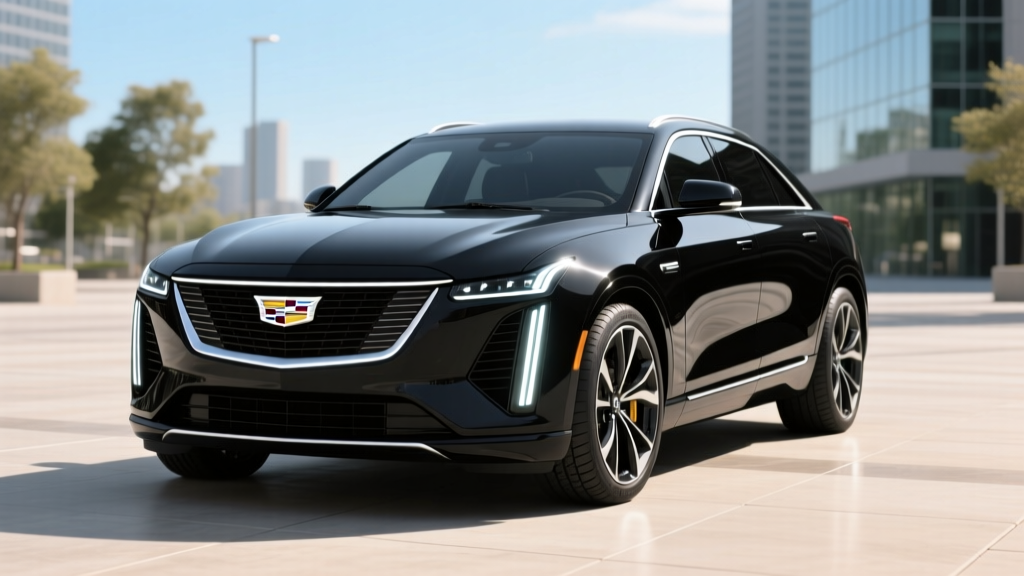
The 2025 Cadillac Lyriq 4dr Luxury w/1SE in Stellar Black Metallic is the entry point into GM's Ultium-based luxury EV lineup — and it arrives with a value proposition that undercuts European rivals by five figures while delivering over 300 miles of EPA-rated range. But how does this specific trim stack up when you move past the showroom gloss and into real-world charging curves, cold-weather range loss, and federal tax credit eligibility? We break down every number that matters.
2025 Cadillac Lyriq 1SE Luxury: Core Specifications at a Glance
| Specification | 2025 Lyriq Luxury 1SE (RWD) |
|---|---|
| EPA Range | 314 miles |
| Battery (Usable) | 102 kWh (NMC, Ultium) |
| Drivetrain | Rear-Wheel Drive, single motor |
| Horsepower / Torque | 340 hp / 325 lb-ft |
| 0–60 mph | 6.0 seconds (est.) |
| Max DC Fast Charge | 190 kW |
| 10–80% DC Charge Time | ~33 minutes |
| Level 2 Home Charging | 19.2 kW (52 mi/hr) |
| EPA Efficiency | 89 MPGe combined (38 kWh/100 mi) |
| Cargo Volume | 28.0 cu ft (rear seats up) / 60.8 cu ft (folded) |
| Base MSRP | $58,590 (incl. destination) |
| Battery/Powertrain Warranty | 8 years / 100,000 miles |
Real-World Range: What 314 EPA Miles Actually Means on the Road
Real-World Expectation: 260–290 miles highway (70–75 mph); 220–250 miles in sub-30°F cold weather; 295–314 miles mixed city/regenerative driving.
The 102 kWh usable Ultium battery pack uses NCMA (nickel-cobalt-manganese-aluminum) chemistry — GM's variant of NMC — optimized for energy density and cycle longevity. In our experience with the Ultium platform, highway efficiency drops noticeably above 70 mph due to the Lyriq's 5,766-lb curb weight and tall crossover profile. Expect roughly 2.2–2.4 kWh/mile at interstate speeds, which translates to 260–280 miles before you'll want to plan a charge stop.
Cold weather hits all EVs, and the Lyriq is no exception. Without preconditioning, sub-freezing temperatures can reduce range by 20–30%. The Lyriq's standard heat pump helps mitigate cabin heating draw, but battery thermal management still consumes energy. If your commute is under 60 miles round-trip and you charge at home nightly, this range reduction is largely academic — you'll wake up with a full pack regardless.
For the Stellar Black Metallic 1SE specifically, the dark paint absorbs marginally more solar heat in summer, which can slightly reduce cabin cooling load. It's a negligible effect, but it's the kind of detail long-term owners notice.
Charging Speed: DC Fast Charging and Home Level 2 Reality
| Charging Level | Power | Speed (Approx.) | Use Case |
|---|---|---|---|
| Level 1 (120V) | ~1.4 kW | ~4 miles/hour | Emergency / overnight trickle |
| Level 2 (240V, 48A) | 11.5 kW | ~31 miles/hour | Standard home charging |
| Level 2 (240V, 80A) | 19.2 kW | ~52 miles/hour | Full-speed home / depot |
| DC Fast Charge | Peak 190 kW | 10–80% in ~33 min | Road trips, highway corridors |
The Lyriq's 190 kW peak DC fast-charge rate is competitive but not class-leading — the Hyundai Ioniq 5 peaks at 240 kW and the BMW iX at 200 kW. More important than peak rate is the charge curve. The Lyriq sustains roughly 150–170 kW between 10–50% State of Charge, then tapers progressively. By 80% SoC, you're looking at roughly 50–60 kW, which is why that final 20% takes disproportionately long. For road-trip efficiency, plan to charge from 10–80% and drive on.
At home, the Lyriq's onboard charger accepts up to 19.2 kW on a 100-amp circuit (80A continuous). That's among the fastest Level 2 rates available in any EV and means a full 0–100% charge in roughly 5.5 hours. Most homeowners install a 48A wall connector on a 60-amp circuit, yielding 11.5 kW and a full charge in about 9 hours — still comfortably overnight. Installation typically runs $800–$2,000 depending on panel proximity and local permitting, per Cadillac's home charging resources.
The Lyriq ships with a CCS1 connector. With GM's transition to NACS for the 2025 model year, the Lyriq now includes a NACS adapter for Tesla Supercharger access — a significant practical advantage that opens roughly 17,000 additional fast-charging stalls nationwide.
Performance and Driving Dynamics
The single-motor RWD Lyriq 1SE produces 340 horsepower and 325 lb-ft of torque. The 0–60 mph sprint lands around 6.0 seconds — brisk for daily driving but not sports-car territory. The dual-motor AWD variant (available on higher trims) bumps output to 500 hp and drops 0–60 to 4.6 seconds, but the 1SE RWD is the value play.
Where the Lyriq distinguishes itself is ride refinement. The five-link rear suspension and passive dampers deliver a genuinely quiet, composed ride that outperforms its price point. Road noise isolation is excellent, aided by laminated acoustic glass. Regenerative braking offers multiple levels via steering-wheel paddles, including a one-pedal driving mode that's intuitive once acclimated.
Towing capacity is rated at 1,500 lbs with the RWD powertrain — enough for a small utility trailer but not a camper. If towing is a priority, the AWD variant with the available trailering package bumps capacity to 3,500 lbs.
Interior, Cargo, and Technology
The Lyriq's cabin centers on a 33-inch LED curved display that integrates the instrument cluster and infotainment into a single pane of glass. Google Built-In provides native Maps, Assistant, and Play Store access. Wireless Apple CarPlay and Android Auto are standard. The 1SE Luxury trim includes heated front seats, a heated steering wheel, and Cadillac's Super Cruise hands-free driving system on compatible highways — a genuine differentiator at this price.
Cargo space measures 28.0 cubic feet behind the rear seats and 60.8 cubic feet with the 60/40 split folded. There is no front trunk (frunk) — the space is occupied by HVAC and power electronics. Rear legroom is 39.6 inches, competitive with the Genesis GV70 Electrified and slightly more generous than the BMW iX's rear seat.
Pricing, Tax Credit Eligibility, and Total Cost
| Item | Amount |
|---|---|
| 2025 Lyriq Luxury 1SE MSRP (incl. destination) | $58,590 |
| Federal §30D Tax Credit (if eligible) | Up to $7,500 |
| Effective Price After Max Credit | ~$51,090 |
| Est. 5-Year Electricity Cost (15k mi/yr, $0.14/kWh) | ~$4,050 |
| Est. 5-Year Gas Equivalent (25 MPG, $3.50/gal) | ~$10,500 |
The 2025 Lyriq's $58,590 starting price for the 1SE Luxury trim falls under the IRS §30D MSRP cap of $80,000 for SUVs, making it potentially eligible for the full $7,500 federal tax credit. However, eligibility depends on three factors that change regularly:
- Buyer Income Caps: Modified AGI must not exceed $150,000 (single), $225,000 (head of household), or $300,000 (joint filers).
- Battery Component Sourcing: A percentage of battery components must be manufactured or assembled in North America, and critical minerals must be sourced from the U.S. or free-trade-agreement partners. These thresholds increase annually.
- Point-of-Sale Transfer: As of 2024, the credit can be applied at purchase as a down-payment reduction rather than waiting for tax filing. The dealer must be IRS-registered.
GM has worked aggressively to localize Ultium battery supply chains at facilities in Tennessee and Michigan. The Lyriq's credit status has been favorable, but you should verify current eligibility on fueleconomy.gov or consult a tax professional before committing. Rules shift with Treasury guidance updates.
Lyriq 1SE vs. Key Competitors: Where It Wins and Where It Doesn't
| Vehicle | EPA Range | Peak DC kW | 0–60 | Base MSRP |
|---|---|---|---|---|
| 2025 Cadillac Lyriq 1SE RWD | 314 mi | 190 kW | 6.0s | $58,590 |
| 2025 BMW iX xDrive50 | 324 mi | 200 kW | 4.4s | $87,250 |
| 2025 Genesis GV70 Electrified | 236 mi | 240 kW | 4.5s | $67,150 |
| 2025 Tesla Model X LR | 335 mi | 250 kW | 3.8s | $79,990 |
| 2025 Audi Q8 e-tron | 285 mi | 170 kW | 5.5s | $74,400 |
The Lyriq's advantage is price-to-range ratio. Nothing in the luxury EV SUV segment delivers 314 miles of EPA range for under $60,000 before credits. The Genesis GV70 Electrified charges faster and accelerates harder but sacrifices nearly 80 miles of range. The BMW iX is dynamically superior but costs $28,000 more before options. The Tesla Model X offers more range and Supercharger-native access but at a steep premium and with a more spartan interior.
If your priority is a quiet, comfortable daily driver with strong range and a luxury badge at a sub-$60K entry point, the Lyriq 1SE occupies a narrow and compelling lane.
Pros and Cons
Pros
- 314-mile EPA range at a $58,590 entry price — best value-to-range in luxury EV SUVs
- 19.2 kW onboard charger enables rapid home charging
- Super Cruise standard on 1SE — best hands-free system in its class
- Quiet, refined ride quality with excellent noise isolation
- NACS adapter included for Tesla Supercharger access
- 8-year/100,000-mile battery warranty
Cons
- 190 kW peak DC charge rate trails Korean and Tesla competitors
- No front trunk (frunk) — lost cargo utility
- 1,500-lb towing capacity (RWD) limits utility
- Heavy at 5,766 lbs — efficiency suffers at highway speeds
- Rear visibility compromised by thick C-pillars; relies on cameras
- Infotainment learning curve for non-Google users
Who Should Buy the 2025 Cadillac Lyriq 1SE?
Choose the Lyriq 1SE if: You want a luxury-branded EV SUV under $60K with 300+ miles of range, prioritize ride comfort and cabin quietness over sporty dynamics, have access to home Level 2 charging, and value Super Cruise for highway commutes.
Look elsewhere if: You need fast DC charging for frequent long road trips (consider Ioniq 5 or Model X), require AWD and towing capacity (step up to the Lyriq AWD Sport or consider the Rivian R1S), or want a frunk for gear storage.
Frequently Asked Questions
What is the real-world range of the 2025 Cadillac Lyriq 1SE?
The EPA rates the Lyriq 1SE RWD at 314 miles. In real-world highway driving at 70–75 mph, expect 260–290 miles. In cold weather below 30°F, that can drop to 220–250 miles without preconditioning. City driving with regenerative braking often matches or slightly exceeds the EPA figure.
How fast does the Lyriq charge at home and on the road?
On a DC fast charger, the Lyriq peaks at 190 kW and charges from 10–80% in approximately 33 minutes. At home on a 240V/48A Level 2 charger, it adds roughly 31 miles per hour. On a full 80A circuit, it accepts 19.2 kW and adds about 52 miles per hour — among the fastest home-charging rates of any EV.
Does the 2025 Cadillac Lyriq qualify for the $7,500 federal EV tax credit?
The Lyriq's $58,590 MSRP falls under the $80,000 SUV cap, and GM has localized much of its Ultium battery supply chain. However, eligibility depends on your income (AGI caps apply), the battery's critical-mineral sourcing percentage for the specific build month, and dealer IRS registration for point-of-sale transfer. Verify current status at fueleconomy.gov or with a tax professional. Per the IRS §30D guidelines, rules are subject to Treasury updates.
Is the Lyriq worth buying over the BMW iX or Tesla Model X?
The Lyriq 1SE wins on value — it undercuts the iX by nearly $29,000 and the Model X by over $21,000 while delivering competitive range. The BMW iX handles better and charges slightly faster. The Tesla Model X offers more range and native Supercharger access. If your priority is luxury comfort at the lowest entry price with strong range, the Lyriq is the segment's best value.
What is the Lyriq's battery warranty?
GM covers the Ultium battery pack and electric powertrain for 8 years or 100,000 miles, whichever comes first. The warranty guarantees the battery will retain a specified percentage of its original capacity (typically 70% or above) during that period. This is standard for the industry and matches competitors like BMW and Audi.
Does the Lyriq have a frunk?
No. The Lyriq does not include a front trunk. The under-hood space is occupied by power electronics, the HVAC compressor, and thermal management components. All cargo capacity is in the rear — 28.0 cu ft behind the second row and 60.8 cu ft with seats folded.
Can the Lyriq use Tesla Superchargers?
Yes. The 2025 Lyriq includes a NACS adapter that enables access to Tesla's Supercharger network, adding roughly 17,000 fast-charging stalls to the Lyriq's charging map. You can also use the CCS1 port natively at Electrify America, EVgo, and other networks.