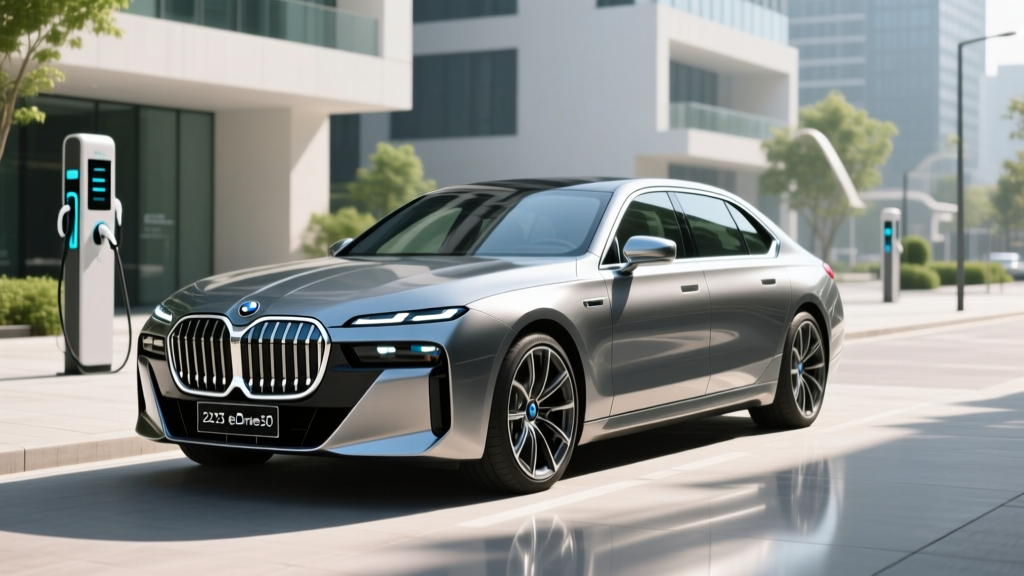
The 2025 BMW i7 eDrive50 is the quiet, refined entry point into BMW's all-electric flagship sedan lineup. While the dual-motor xDrive50 and the performance-tuned M70 grab headlines with 600-plus horsepower, the rear-wheel-drive eDrive50 makes a compelling case as the smart-money choice for luxury EV buyers who prioritize range and ride comfort over neck-snapping acceleration. With an EPA-estimated 318 miles of range, a usable 101.7 kWh battery, and BMW's hallmark interior craftsmanship, this is a luxury barge built for effortless highway cruising rather than stoplight sprints.
But at a starting MSRP over $106,000, the eDrive50 faces stiff competition from the Mercedes-Benz EQS 450+, the Tesla Model S Long Range, and even its own AWD sibling. Below, we break down every number that matters — from real-world range expectations and charging-curve behavior to federal tax credit eligibility — so you can decide if this is the right full-size electric sedan for your driveway.
2025 BMW i7 eDrive50 Specifications at a Glance
| Specification | 2025 BMW i7 eDrive50 |
|---|---|
| Drivetrain | Rear-Wheel Drive (single motor) |
| Horsepower | 449 hp |
| Torque | 479 lb-ft |
| 0–60 mph | 5.5 seconds (BMW est.) |
| Battery (usable) | 101.7 kWh, NMC (nickel manganese cobalt) |
| EPA Range | 318 miles (with 19" wheels) |
| EPA Efficiency | 82 MPGe combined / 41 kWh/100 mi |
| Max DC Fast Charge | 195 kW (CCS1) |
| 10–80% DC Charge Time | ~34 minutes |
| Level 2 Charge Rate | 11 kW (~30 mi/hr) |
| Base MSRP | $106,695 (+ $995 destination) |
| Federal Tax Credit (§30D) | Up to $7,500 — subject to sourcing & income rules |
| Battery Warranty | 8 years / 100,000 miles |
| Vehicle Warranty | 4 years / 50,000 miles |
Range and Efficiency: EPA Sticker vs. the Real World
EPA Estimated Range: 318 miles (19" Aero wheels)
Real-World Expectation: Expect roughly 270–295 miles on mixed highway driving at 70–75 mph. In cold weather (below 32°F), plan for 225–260 miles depending on cabin heating demand and whether you precondition the battery.
The i7 eDrive50's 318-mile EPA rating is achieved on the 19-inch Aero wheel package. If you opt for the available 20-inch, 21-inch, or 22-inch wheels, that figure drops — BMW rates the 21-inch configuration at approximately 298 miles. For a sedan of this size and weight (roughly 5,800 lbs curb weight), 318 miles is genuinely competitive, trailing the Mercedes EQS 450+ (390 miles on its best configuration) but handily beating the Tesla Model S Long Range's 402-mile rating only when you factor in the BMW's superior interior quality and ride refinement.
Efficiency lands at 82 MPGe combined, which translates to about 41 kWh per 100 miles according to fueleconomy.gov. In practical terms, that means a full home charge at the U.S. average electricity rate of ~$0.16/kWh costs roughly $16.30 — versus $55–$65 to fill a comparably sized gasoline 7 Series with premium fuel.
Highway efficiency takes a meaningful hit in the i7, as it does in all large sedans. Aerodynamic drag scales with the square of speed, and at 80 mph you can expect consumption to climb to 45–48 kWh/100 mi, which trims effective range to around 240–260 miles before you need to stop. This is physics, not a BMW shortcoming — but it matters if you regularly drive I-70 or I-10 at freeway speeds.
Charging Speed: DC Fast Charging and Home Level 2
The i7 eDrive50 uses a CCS1 connector for DC fast charging (NACS adapter available for Tesla Supercharger access) and a J1772 inlet for Level 2 AC charging. Here is what the numbers look like in practice:
| Charging Level | Power / Rate | Speed (miles added) | Notes |
|---|---|---|---|
| Level 1 (120V household) | ~1.4 kW | ~3–4 mi/hr | Emergency/trickle only; ~80+ hrs for full charge |
| Level 2 (240V home) | 11 kW (48A) | ~30 mi/hr | 0–100% in ~9.5 hours; ideal overnight charge |
| DC Fast Charge | Peak 195 kW | ~185 mi in 10 min (peak) | 10–80% in ~34 min; tapers significantly above 80% |
Charging-curve reality check: The 195 kW peak rate is achieved between roughly 10–30% state of charge (SoC) when the battery is properly preconditioned. From 30–60%, expect sustained rates of 140–160 kW. Above 80%, the curve drops steeply to protect the NMC cells — from 80–100%, you are looking at an additional 40–50 minutes on a fast charger. For road-trip efficiency, plan your stops around 10–80% windows and skip the temptation to top off to 100% at a DC station.
For home charging, the i7's onboard charger supports up to 11 kW (48 amps on a 240V/60A circuit). A full charge from empty takes about 9.5 hours — easily achievable overnight. BMW includes the Flexible Fast Charger cable with the vehicle, which can handle Level 1 (120V) and Level 2 (240V) with the appropriate adapter. For dedicated home wall-box installations, budget $500–$800 for a quality Level 2 EVSE (ChargePoint Home Flex, Emporia Vue, or BMW's own Wallbox) plus $800–$2,500 for electrician labor depending on panel proximity and local permit requirements. If your home has a 100-amp electrical panel, a $1,500–$3,000 panel upgrade to 200 amps may be necessary.
Performance and Driving Dynamics
The single rear-mounted electric motor produces 449 horsepower and 479 lb-ft of torque, delivering a BMW-estimated 0–60 mph time of 5.5 seconds. That is quick by any sedan standard and more than adequate for merging, passing, and general daily driving. The instant torque delivery from standstill gives the eDrive50 a responsive, effortless character around town that belies its substantial curb weight.
Where the eDrive50 truly shines is ride quality. Standard two-axle air suspension with adaptive dampers absorbs road imperfections with the kind of composed isolation that defines the 7 Series lineage. Rear-axle steering (standard on the i7) shrinks the car's turning circle to a manageable 41.0 feet and adds surprising agility in parking lots and tight urban corners.
The trade-off versus the xDrive50 (dual-motor AWD, 536 hp, 4.5 seconds to 60) is traction in adverse weather and raw acceleration. If you live in a region with significant snow or frequently drive mountain passes, the AWD xDrive50 is worth the $4,000 premium and the ~30-mile range sacrifice. For dry-climate commuters and highway cruisers, the RWD eDrive50 is the more efficient, range-maximized pick.
Interior, Cargo, and Technology
The i7 cabin is a showcase for BMW's current luxury ethos: a curved display panel merges a 12.3-inch digital instrument cluster with a 14.9-inch central touchscreen running BMW iDrive 8.5. The system supports wireless Apple CarPlay and Android Auto, 5G connectivity, and over-the-air updates. Voice control via the BMW Intelligent Personal Assistant handles navigation, climate, and media with above-average accuracy.
Available highlights include:
- Theater Screen: A 31.3-inch 8K rear-seat entertainment display that deploys from the headliner — a $3,600 option that transforms the rear cabin into a mobile cinema.
- Executive Lounge Seating: Rear seats with power recline, massage, and heated/cooled surfaces with optional automatic doors.
- Bowers & Wilkins Diamond Surround Sound: A 1,965-watt, 4D audio system with 36 speakers.
- Sky Lounge panoramic roof: LED-illuminated glass roof with selectable ambient lighting patterns.
Passenger space is generous for front occupants, with 42.3 inches of front legroom. Rear legroom measures 41.7 inches — limousine-class by any standard. However, the battery pack raises the floor slightly, so rear passengers may notice a less natural seating position compared to the gasoline 7 Series.
Cargo capacity is the i7's most notable compromise: just 17.7 cubic feet of trunk space. There is no frunk (front trunk), and the trunk opening is relatively narrow due to the sedan body style. For a vehicle over 17 feet long, this is modest. If cargo versatility is a priority, BMW's own iX SUV offers 35.5 cu ft behind the rear seats.
Pricing, Trims, and Federal Tax Credit Eligibility
The 2025 BMW i7 eDrive50 carries a base MSRP of $106,695 including destination. Well-equipped examples with the Premium Package, Theater Screen, and 21-inch wheels easily reach $120,000–$130,000 before incentives.
| Trim / Configuration | MSRP | Est. After §30D Credit |
|---|---|---|
| eDrive50 (base, 19" wheels) | $106,695 | ~$99,195 (if eligible) |
| eDrive50 w/ Premium + Executive | ~$118,000 | ~$110,500 (if eligible) |
| xDrive50 AWD (base) | $120,695 | ~$113,195 (if eligible) |
| i7 M70 (performance) | $168,495 | Ineligible (above MSRP cap) |
Federal tax credit (§30D) eligibility for the i7 eDrive50 is complex and not guaranteed for every buyer. The vehicle falls under the IRS sedan MSRP cap of $55,000 — wait, no: the i7's MSRP exceeds $55,000 significantly. Under current IRS §30D rules, the sedan MSRP cap is $55,000, which means the i7 eDrive50 at $106,695 does not qualify for the new-vehicle federal tax credit.
This is a critical point that many luxury EV shoppers miss: the §30D MSRP cap for sedans is $55,000 (vans, SUVs, and trucks have an $80,000 cap). Since the i7 is classified as a sedan by the IRS, it exceeds the cap and is ineligible for the $7,500 new-vehicle credit regardless of battery sourcing or buyer income.
Buyer income caps also apply to §30D: adjusted gross income cannot exceed $300,000 (joint filers), $225,000 (head of household), or $150,000 (single). Even if the MSRP cap were met, high-income buyers would be excluded.
Some buyers may offset cost through state-level incentives (California's CVRP, Colorado's innovative motor vehicle credit, or utility-company rebates), dealer discounts, or favorable lease structures that pass through the commercial clean vehicle credit (§45W) — a loophole where the leasing company claims the credit and reduces the lease payment. Always consult a tax professional and check irs.gov for the latest rules before purchasing.
Driver Assistance and Safety
SAE Automation Level: The BMW i7's Driving Assistant Professional is a Level 2 driver-assistance system. The driver must remain fully engaged, hands on or near the wheel, and eyes on the road at all times. This is not self-driving.
The i7 comes standard with BMW's Driving Assistant, which includes adaptive cruise control with stop-and-go, lane-keeping assist, front collision warning with automatic emergency braking, blind-spot monitoring, and rear cross-traffic alert. The optional Driving Assistant Professional package adds Highway Assistant (hands-free driving up to 85 mph on divided highways, with eye-monitoring via an interior camera), automatic lane-change assist, and evasion assist.
Highway Assistant is impressive in practice — it tracks lanes confidently, manages speed in traffic, and handles gentle curves without drama. But it requires continuous driver attention. The eye-monitoring camera will issue escalating warnings and eventually disengage the system if you look away. This is a mature, well-calibrated Level 2 system, but it does not replace the driver.
Safety ratings from NHTSA and IIHS for the 2025 i7 were pending at time of publication. The previous-generation 7 Series earned top marks in European NCAP testing, and the i7's rigid aluminum-steel-carbon fiber body structure, eight airbags, and comprehensive active-safety suite suggest strong U.S. ratings once finalized.
Pros, Cons, and the Competition
Pros
- Class-leading ride comfort with standard air suspension and rear-axle steering
- 318-mile EPA range is excellent for a 5,800-lb luxury sedan
- Quiet, exquisitely finished cabin with available Theater Screen
- 11 kW Level 2 onboard charger enables fast home charging (~9.5 hrs full)
- Generous rear-seat legroom (41.7 in) with available Executive Lounge
- Strong 0–60 time (5.5 sec) from a single-motor RWD powertrain
Cons
- Base MSRP of $106,695 exceeds the §30D sedan cap — no federal tax credit
- 17.7 cu ft trunk is small for the segment; no frunk
- 195 kW peak DC charge rate trails Hyundai/Kia's 800V platforms (350 kW)
- DC charge curve tapers sharply above 80% SoC
- Heavy at ~5,800 lbs — efficiency drops noticeably at sustained highway speeds
- High option costs can push as-tested price past $130,000
Key competitors in the full-size luxury EV sedan space include:
- Mercedes-Benz EQS 450+ — 390-mile EPA range, 355 hp, ~$105,550 MSRP. More range, less engaging to drive, polarizing exterior design.
- Tesla Model S Long Range — 402-mile EPA range, 670 hp (dual-motor AWD), ~$79,990 MSRP. Significantly cheaper, more range, but interior quality and ride refinement lag far behind the BMW.
- Lucid Air Pure — 419-mile EPA range, 430 hp, ~$77,900 MSRP. Class-leading range and efficiency, smaller dealer/service footprint.
Choose the BMW i7 eDrive50 if: You want the most refined, quietest ride in the segment; you value BMW's dealer and service network; rear-seat luxury is a priority; and you accept that range-per-dollar trails Tesla and Lucid.
Look elsewhere if: Maximum range is your top priority (Lucid Air or EQS 450+), you need federal tax credit eligibility (Tesla Model S falls under the MSRP cap for sedans at $55K... actually no — the Model S also exceeds $55K. In that case, consider the BMW i5 eDrive40 at ~$67,795, which also exceeds the cap, or the Tesla Model 3 Performance at ~$54,990, which does qualify), or you need serious cargo versatility (BMW iX or Mercedes EQS SUV).
Who the 2025 BMW i7 eDrive50 Is For
This car is built for a specific buyer: someone who wants a full-size luxury sedan with a premium badge, exceptional ride quality, and enough electric range for daily commuting and occasional 200–250-mile road trips without range stress. It suits executives who are chauffeured or who regularly carry rear-seat passengers, professionals with home charging access, and buyers upgrading from a gasoline 7 Series or Mercedes S-Class who want to electrify without sacrificing comfort.
It is not the right choice if you need maximum cargo space (get an SUV), if you want the absolute longest range per dollar (Lucid Air Pure wins), or if federal tax credit eligibility is a dealbreaker (no sedan over $55,000 MSRP qualifies under current §30D rules).
Frequently Asked Questions
What is the real-world range of the 2025 BMW i7 eDrive50?
The EPA rates the eDrive50 at 318 miles with 19-inch wheels. In real-world mixed driving at highway speeds (70–75 mph), expect 270–295 miles. In cold weather below freezing, plan for 225–260 miles, especially if you rely on resistive cabin heating. Preconditioning the battery and cabin while plugged in helps recover some of that cold-weather loss.
How fast does the i7 eDrive50 charge at home and on the road?
At home on a 240V Level 2 charger, the i7 accepts up to 11 kW, adding roughly 30 miles of range per hour and achieving a full charge in about 9.5 hours. On DC fast chargers, it peaks at 195 kW, reaching 10–80% in approximately 34 minutes. Above 80%, charging slows dramatically — avoid topping off at DC stations when possible.
Does the 2025 BMW i7 eDrive50 qualify for the $7,500 federal EV tax credit?
No. Under current IRS §30D rules, the new-vehicle credit has a $55,000 MSRP cap for sedans. The i7 eDrive50 starts at $106,695, which disqualifies it regardless of battery sourcing or buyer income. Some buyers may access savings through state incentives, utility rebates, or lease structures that utilize the commercial clean vehicle credit (§45W). Always verify current rules at irs.gov.
Is the BMW i7 eDrive50 worth buying over the Mercedes EQS or Tesla Model S?
It depends on your priorities. The i7 offers the best ride quality, cabin materials, and rear-seat experience in the segment. The EQS 450+ delivers more range (390 miles EPA) at a similar price. The Tesla Model S and Lucid Air Pure offer far more range and performance for less money but cannot match the BMW's luxury execution. If interior refinement and ride comfort are paramount, the i7 is the strongest choice.
What battery chemistry does the i7 eDrive50 use, and how long will it last?
The i7 uses an NMC (nickel manganese cobalt) lithium-ion battery pack with 101.7 kWh of usable capacity. NMC offers high energy density, which is essential for achieving 318 miles in a sedan form factor. BMW covers the battery with an 8-year/100,000-mile warranty guaranteeing a minimum of 70% capacity retention. Based on industry data for modern NMC packs with active thermal management, expect 85–92% capacity retention at 100,000 miles under normal use. Avoid routine DC fast charging above 80% and try to keep daily SoC between 20–80% for maximum longevity.
Does the i7 have a front trunk (frunk)?
No. The i7 does not offer a frunk. All cargo space is in the rear trunk, which provides 17.7 cubic feet. This is a common limitation in EVs built on modified platforms that were originally designed for internal-combustion powertrains.