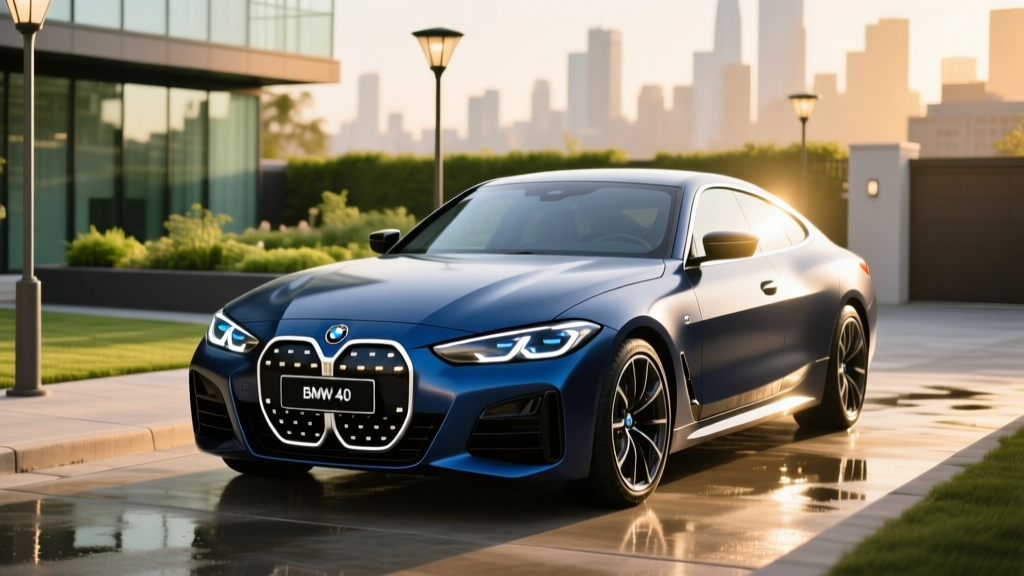
The 2025 BMW i4 xDrive40 occupies a specific niche in the EV sedan market: a premium all-wheel-drive gran coupe that prioritizes driving dynamics and build quality over outright range-per-dollar. Built on BMW's CLAR platform alongside the 4 Series Gran Coupe, the i4 xDrive40 trades the dedicated-EV skateboard architecture of competitors for something that feels unmistakably like a BMW first and an electric car second. For the 2025 model year, BMW introduced the xDrive40 trim, slotting between the rear-drive eDrive40 and the high-performance M50, bringing dual-motor all-wheel drive with a more accessible price point than the M50.
After spending time with the i4 lineup's specs, charging behavior, and ownership economics, here's what buyers need to know before signing the paperwork.
2025 BMW i4 xDrive40: Key Specifications at a Glance
| Specification | Value |
|---|---|
| EPA Estimated Range | 277 miles (19" wheels) / 307 miles (18" wheels) |
| Battery (Usable / Gross) | 81.5 kWh usable / 83.9 kWh gross |
| Battery Chemistry | NMC (Nickel Manganese Cobalt) |
| Drivetrain | Dual-motor AWD (xDrive) |
| Horsepower | 402 hp (combined) |
| Torque | 433 lb-ft |
| 0–60 mph | 4.6 seconds |
| Max DC Fast Charge Rate | 205 kW (peak) |
| 10–80% DC Fast Charge Time | ~31 minutes |
| Level 2 Home Charge Rate | 11 kW (AC) |
| MPGe (Combined) | 98 MPGe (19" wheels) |
| Energy Consumption | 34 kWh/100 mi |
| Base MSRP (xDrive40) | $57,975 (incl. destination) |
| Battery Warranty | 8 years / 100,000 miles |
Real-World Range: What the EPA Number Doesn't Tell You
The EPA rates the 2025 BMW i4 xDrive40 at 277 miles with the available 19-inch aerodynamic wheels and 307 miles with the standard 18-inch wheel and tire package, according to fueleconomy.gov. That 30-mile gap between wheel options is substantial and worth considering at order time — it's one of the larger wheel-size penalties in the segment.
EPA Sticker: 277–307 miles (depending on wheel size)
Highway Driving (70+ mph): Expect ~230–260 miles. The i4's gran coupe shape produces more drag than a dedicated EV platform like the Hyundai Ioniq 6.
Cold Weather (below 32°F): Range drops 20–30%, yielding roughly 195–245 miles depending on cabin heating usage and whether you precondition.
Mixed Commuting (city/suburban): Closest to EPA figures — regenerative braking recovers energy effectively in stop-and-go traffic.
The i4 xDrive40's NMC battery provides 81.5 kWh of usable capacity. BMW's thermal management system includes a heat pump (standard on 2025 models), which mitigates cold-weather losses compared to resistive heating. However, the CLAR platform — shared with ICE vehicles — means the battery pack sits in a floor tunnel and rear subframe area rather than a flat skateboard layout. This packaging choice slightly reduces total battery volume compared to purpose-built EVs in this price range, which is why the i4's range falls short of rivals like the Tesla Model 3 Long Range AWD (363 miles EPA) or the Hyundai Ioniq 6 SEL AWD (290 miles EPA).
For daily commuting under 60 miles round-trip, the i4 xDrive40's range is more than adequate. For road trips exceeding 250 miles between charging stops, you'll want to plan carefully, especially in winter or at sustained highway speeds.
Charging Speed and Infrastructure: DC Fast, Level 2, and Connector Details
Charging is where the i4 xDrive40 performs competently but not class-leading. Here's the full breakdown:
| Charge Level | Power (kW) | Miles Added per Hour | Time (10–80%) |
|---|---|---|---|
| Level 1 (120V household) | ~1.4 kW | ~4 mi/hr | N/A (full charge: ~60+ hrs) |
| Level 2 (240V home/public) | 11 kW (max) | ~32 mi/hr | ~8.25 hours (0–100%) |
| DC Fast Charge (CCS) | 205 kW (peak) | ~195 mi in 31 min | ~31 minutes (10–80%) |
The 205 kW peak DC fast-charge rate is respectable for a 400-volt architecture, but it's important to understand the charge curve. The i4 reaches peak rate only in a narrow state-of-charge window (roughly 10–30% SoC at optimal battery temperature). Above 50% SoC, the rate tapers significantly — you'll see ~120 kW by 60% and ~50 kW by 80%. This is typical behavior for NMC chemistry, but it means the advertised 31-minute 10–80% time requires preconditioning the battery and arriving at the charger at a low state of charge.
BMW uses the CCS1 connector for DC fast charging in North America. The i4 does not natively support the Tesla NACS connector. However, BMW has confirmed that adapters for Tesla Supercharger access are available, and future BMW EVs will transition to NACS. For 2025, plan on using Electrify America, EVgo, ChargePoint, and other CCS-equipped networks for road trips.
For home charging, the 11 kW onboard AC charger is a strong point. On a 48-amp Level 2 home charger (hardwired, 240V), you'll add approximately 32 miles of range per hour, fully replenishing the battery overnight in about 8–9 hours. This is competitive with the segment. Note that a NEMA 14-50 outlet on a 40-amp circuit will deliver about 9.6 kW, adding roughly 28 miles per hour — still sufficient for overnight charging for most owners.
Performance and Driving Dynamics: Where the i4 Earns Its Badge
The xDrive40's dual-motor all-wheel-drive system produces 402 horsepower and 433 lb-ft of torque, launching the i4 from 0–60 mph in 4.6 seconds. That puts it in quick territory — not supercar-quick like the i4 M50 (3.7 seconds), but meaningfully faster than most buyers will ever need.
What separates the i4 from rivals is not straight-line speed but chassis tuning. The CLAR platform gives BMW engineers a familiar starting point, and the result is a sedan that communicates through the steering wheel in a way most EVs — particularly those on dedicated skateboard platforms — do not. The adaptive M suspension (available on the xDrive40) provides a firm but controlled ride, and the low center of gravity from the floor-mounted battery keeps body roll minimal through corners.
Regenerative braking offers multiple modes: adaptive (which uses radar and navigation data to modulate regen based on traffic and upcoming turns), high (near one-pedal driving), and low (coasting). The adaptive mode is particularly well-executed and reduces the need to toggle settings manually during mixed driving.
The trade-off for this driving engagement is efficiency. At 34 kWh/100 miles (combined), the i4 xDrive40 is thirstier than the Tesla Model 3 LR AWD (~25 kWh/100 mi) or the Ioniq 6 (~27 kWh/100 mi). You're paying for the driving experience in electrons as well as dollars.
Interior, Cargo, and Technology
The i4 xDrive40's cabin is where BMW's premium positioning is most evident. The BMW Curved Display — a 12.3-inch instrument cluster merged with a 14.9-inch infotainment touchscreen running iDrive 8.5 — dominates the dashboard. Wireless Apple CarPlay and Android Auto are standard. The system is responsive, though the reliance on touchscreen controls for climate functions draws criticism from owners who preferred the previous generation's physical buttons.
Passenger and Cargo Dimensions:
- Front legroom: 42.0 inches
- Rear legroom: 35.0 inches (tighter than a Model 3's 35.3 inches, and the gran coupe roofline cuts headroom for taller rear passengers)
- Cargo volume (rear seats up): 16.6 cu ft (hatchback-style liftgate improves usability over a traditional trunk)
- Cargo volume (rear seats folded): 45.6 cu ft
- No front trunk (frunk) — the CLAR platform's ICE-shared architecture leaves no room under the hood
The hatchback liftgate is a practical advantage over the Tesla Model 3's conventional trunk opening, making it easier to load bulky items despite the similar total cargo volume.
Driver Assistance: The i4 xDrive40 comes standard with BMW's Active Driving Assistant, which includes adaptive cruise control with stop-and-go, lane-keeping assist, blind-spot monitoring, and front collision warning with automatic emergency braking. The available Driving Assistance Professional Package adds Highway Assistant — BMW's hands-free driving feature at speeds up to 85 mph on divided highways (eyes-on, SAE Level 2). This is competitive with GM's Super Cruise and Ford's BlueCruise in capability, though BMW's system requires less frequent steering-wheel confirmation touches.
Pricing, Trims, and Federal Tax Credit Eligibility
The 2025 BMW i4 xDrive40 starts at $57,975 including destination. That's a significant sum, but it positions the xDrive40 roughly $10,000 below the i4 M50 while adding AWD capability the eDrive40 lacks.
| Trim | Drivetrain | HP | EPA Range | MSRP (incl. dest.) |
|---|---|---|---|---|
| eDrive40 | RWD (single motor) | 335 hp | 307 mi | $52,675 |
| xDrive40 | AWD (dual motor) | 402 hp | 277–307 mi | $57,975 |
| M50 | AWD (dual motor) | 536 hp | 245–270 mi | $70,975 |
Popular options on the xDrive40 include the Premium Package ($2,500: heated seats, heated steering wheel, head-up display), the M Sport Package ($2,950: sport suspension, exterior trim, wheels), and the Driving Assistance Professional Package ($1,700). A well-equipped xDrive40 can easily reach $65,000–$68,000.
Federal Tax Credit: Does the i4 xDrive40 Qualify?
Under current IRS §30D rules, the BMW i4 xDrive40 faces challenges in qualifying for the full $7,500 federal EV tax credit. The critical-minerals and battery-component sourcing requirements have tightened significantly since 2023, and BMW's supply chain for the i4's NMC battery cells (sourced from CATL and Samsung SDI) has struggled to meet the domestic-content thresholds.
- Vehicle MSRP cap: Sedans must be ≤ $55,000. The i4 xDrive40 at $57,975 exceeds the cap and is ineligible on price alone.
- Buyer income cap: AGI ≤ $150,000 (single) / $300,000 (joint) — applies regardless of vehicle.
- Battery sourcing: Critical minerals and component sourcing must meet escalating domestic/FSA-partner thresholds. BMW's i4 battery has not consistently met these requirements.
- Point-of-sale transfer: If eligible, the credit can be transferred to the dealer at purchase for an immediate price reduction.
State and local incentives may still apply. California's CVRP, Colorado's state credit, and various utility rebates can offset $1,000–$5,000 depending on your jurisdiction. Check your state's energy office and local utility for current programs.
Pros, Cons, and the Verdict
- Best-in-class driving dynamics for an EV sedan
- Premium interior materials and build quality
- Hatchback liftgate adds cargo versatility
- 11 kW Level 2 charging is fast for overnight home replenishment
- Heat pump standard (improves cold-weather range)
- Competitive 0–60 time with dual-motor AWD
- Range trails key competitors (Model 3, Ioniq 6)
- No front trunk (frunk)
- CCS-only charging (no native NACS/Supercharger access)
- Rear seat headroom limited by coupe roofline
- Does not qualify for $7,500 federal tax credit
- Efficiency (kWh/100 mi) is below segment leaders
- Touchscreen-dependent climate controls
Who Should Buy the 2025 BMW i4 xDrive40?
- You prioritize driving engagement and chassis feel over maximum range
- You want a premium-badge EV with a traditional luxury sedan interior
- Your daily commute is under 80 miles round-trip and you can charge at home
- You value the hatchback liftgate for practicality
- You live in a region with mild winters (or have access to Level 2 charging to offset cold-weather range loss)
- Maximum range-per-dollar is your top priority (Tesla Model 3 LR AWD, Hyundai Ioniq 6)
- You need frequent Tesla Supercharger access for road trips
- Rear-seat passenger comfort for adults is essential (consider the BMW i5 or Tesla Model S)
- Federal tax credit eligibility is a dealbreaker for your budget
How It Stacks Up Against Key Competitors
| Spec | BMW i4 xDrive40 | Tesla Model 3 LR AWD | Hyundai Ioniq 6 SEL AWD |
|---|---|---|---|
| EPA Range | 277–307 mi | 363 mi | 290 mi |
| Battery (kWh usable) | 81.5 | ~75 | 77.4 |
| Horsepower | 402 hp | 346 hp | 320 hp |
| 0–60 mph | 4.6 sec | 4.2 sec | 5.1 sec |
| Max DC Charge (kW) | 205 | 250 | 240 |
| 10–80% Time | ~31 min | ~25 min | ~18 min |
| Base MSRP | $57,975 | $47,240 | $46,700 |
| Federal Tax Credit | Not eligible | Up to $7,500 | Up to $7,500 |
| Connector | CCS1 | NACS (native) | CCS1 (NACS adapter avail.) |
The numbers tell a clear story: the i4 xDrive40 costs more, goes less far, and charges slower than both the Model 3 LR AWD and the Ioniq 6. What it offers in return is build quality, material luxury, and driving refinement that neither competitor fully matches. The choice comes down to whether those intangibles are worth the $10,000–$15,000 premium and the range trade-off.
Frequently Asked Questions
What is the real-world range of the 2025 BMW i4 xDrive40?
Expect 230–260 miles in real-world highway driving (70+ mph) and close to the EPA-rated 277–307 miles in mixed city/suburban use. In cold weather below freezing, plan for 195–245 miles depending on cabin heating and preconditioning habits. The 18-inch wheel option adds meaningful range over the 19-inch package.
How fast does the i4 xDrive40 charge at home and on the road?
On a 48-amp Level 2 home charger, the i4 adds about 32 miles of range per hour, fully charging overnight in roughly 8–9 hours. On a DC fast charger, it peaks at 205 kW and charges from 10–80% in approximately 31 minutes with a preconditioned battery. Real-world road-trip charging stops (arriving at 15–20% SoC) will take about 30–35 minutes to reach 80%.
Does the 2025 BMW i4 xDrive40 qualify for the $7,500 federal EV tax credit?
No. As of 2025, the i4 xDrive40 exceeds the $55,000 MSRP cap for sedans under IRS §30D rules. Additionally, its battery sourcing has not consistently met the critical-minerals and domestic-component requirements. State incentives may still apply — check your local programs. Always verify current eligibility at fueleconomy.gov and consult a tax professional.
Is the BMW i4 xDrive40 worth buying over a Tesla Model 3 or Hyundai Ioniq 6?
If driving dynamics, interior quality, and brand prestige are your top priorities, yes — the i4 delivers a more engaging and refined experience. If range, charging speed, and value dominate your decision, the Model 3 LR AWD (363 miles, Supercharger network, ~$11,000 less) or the Ioniq 6 (fastest 10–80% charging in the segment, ~$11,000 less, tax-credit eligible) are more practical choices.
What's the biggest drawback of the i4 xDrive40?
The combination of below-average range (for the price), no frunk, CCS-only charging (no native Tesla Supercharger access), and federal tax credit ineligibility makes the i4 xDrive40 a choice driven by emotion and driving feel rather than spec-sheet rationality. That's fine — but go in with eyes open about the trade-offs.
How long will the i4's battery last?
BMW warranties the high-voltage battery for 8 years or 100,000 miles against capacity loss below 70% of original. NMC chemistry in BMW's thermal-managed pack should retain 85–90% capacity after 100,000 miles based on fleet data from earlier i4 models. Battery replacement, if needed out of warranty, is estimated at $15,000–$20,000 — a figure worth considering for long-term ownership planning.