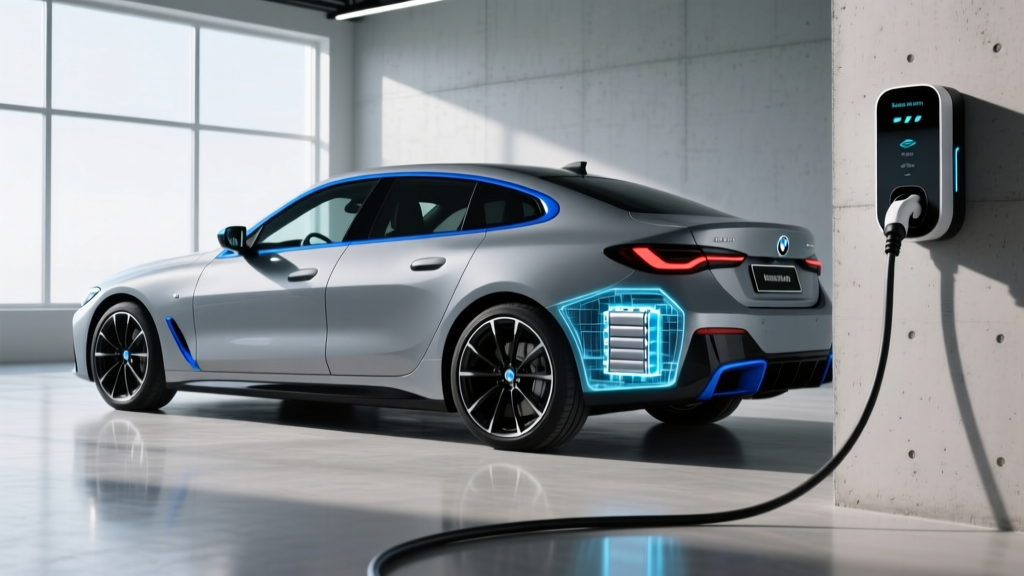
If you have been searching for 2025 BMW i4 eDrive40 lease deals, you are likely weighing whether BMW's electric gran coupe delivers enough range, charging speed, and luxury to justify its premium positioning — or whether a rival like the Tesla Model 3, Hyundai Ioniq 6, or Mercedes EQB makes more financial sense. The i4 eDrive40 occupies a specific niche: a rear-wheel-drive electric sport sedan that looks and drives like a conventional BMW 4 Series Gran Coupe, but with a 81.5 kWh battery pack and up to 301 miles of EPA-estimated range.
Below, we cover every number that matters — from real-world range and DC fast-charging curves to lease economics, §30D tax credit eligibility, and ownership practicalities — so you can decide whether the i4 eDrive40 is the right electrified vehicle for your garage.
2025 BMW i4 eDrive40 at a Glance: Core Specifications
| Attribute | Value |
|---|---|
| EPA Range | 301 miles (19" wheels) / 282 miles (20" wheels) |
| Battery (usable) | 81.5 kWh, NMC (nickel-manganese-cobalt) |
| Drivetrain | Rear-wheel drive (single motor) |
| Horsepower / Torque | 335 hp / 317 lb-ft |
| 0–60 mph | 5.5 seconds |
| Max DC Fast Charge | 205 kW (CCS1) |
| 10–80% DC Charge Time | ~31 minutes |
| Level 2 AC Charge Rate | 11 kW (~30 miles/hr) |
| EPA Efficiency | 97 MPGe combined / 34 kWh/100 mi |
| Cargo Volume | 16.6 cu ft (rear seats up) / 45.2 cu ft (folded) |
| Base MSRP | $57,900 (before destination) |
| Battery Warranty | 8 years / 100,000 miles |
Real-World Range: What the EPA Sticker Doesn't Tell You
EPA Estimate: 301 miles (eDrive40 with 19" aero wheels)
Real-World Highway (70–75 mph, mild weather): ~260–280 miles
Real-World Highway (cold weather, below 32°F): ~210–240 miles
Mixed Commuting (city + suburban): ~280–300 miles
The i4 eDrive40's 301-mile EPA rating applies specifically to the model equipped with 19-inch wheels. Opt for the available 20-inch M sport wheels, and that drops to 282 miles — a meaningful 19-mile difference driven by increased rolling resistance and aerodynamic drag.
In real-world highway driving at sustained speeds of 70–75 mph, expect to see roughly 260–280 miles before needing to charge in moderate temperatures (55–80°F). The i4's heat pump — standard on all 2025 i4 models — helps manage cabin energy consumption in cooler weather, but lithium-ion chemistry inherently loses capacity and efficiency in cold conditions. In winter highway testing at temperatures below freezing, range typically falls to the 210–240 mile band. That is still sufficient for most commutes, but plan road trips accordingly.
The i4 eDrive40's efficiency rating of 97 MPGe combined (34 kWh per 100 miles) is competitive for the luxury EV sedan segment, though the Hyundai Ioniq 6 SE Long Range achieves 140 MPGe combined thanks to its lower curb weight and slipperier aerodynamics. Per fueleconomy.gov, the i4 eDrive40's energy consumption translates to roughly $0.11–$0.14 per mile at the national average electricity rate of $0.17/kWh — about one-third the per-mile fuel cost of a comparable gasoline 4 Series.
Charging Speed: DC Fast Charging and Home Level 2
Charging speed is where the i4 eDrive40's 81.5 kWh NMC battery and 205 kW peak DC fast-charge capability define your ownership experience. Here is the breakdown across all three charging levels:
| Charging Level | Power / Voltage | Miles Added per Hour | Notes |
|---|---|---|---|
| Level 1 (120V household) | ~1.4 kW | ~4 miles/hr | Emergency/trickle only; not practical for daily use |
| Level 2 (240V home/public) | Up to 11 kW | ~30 miles/hr | Full charge in ~8.5 hours (0–100%) |
| DC Fast Charge (CCS1) | Peak 205 kW | Up to ~180 miles in 10 min | 10–80% in ~31 min; tapers significantly above 80% |
A critical detail many spec sheets gloss over: the 205 kW peak charge rate is not sustained across the entire session. The i4's charge curve peaks around 205 kW between roughly 10–30% state of charge, then progressively tapers. By 60% SoC, you are typically seeing 120–140 kW, and above 80%, the rate drops sharply to protect battery longevity. That 31-minute 10–80% time assumes optimal conditions — a capable 350 kW CCS station (such as Electrify America or EVgo), battery preconditioning activated via navigation routing, and moderate ambient temperatures.
For home charging, the i4's 11 kW onboard charger is a strong point. With a 48-amp Level 2 wallbox (such as a ChargePoint Home Flex or BMW's own Wallbox), you will add roughly 30 miles of range per hour, fully replenishing the battery overnight in about 8.5 hours. Most owners who charge at home will rarely, if ever, need DC fast charging except on road trips.
One connector note: the 2025 i4 uses the CCS1 connector standard. BMW has confirmed that future models will transition to NACS (Tesla's connector), and adapters are available for accessing Tesla Supercharger V3 stations that offer Magic Dock CCS compatibility. Check the BMW USA EV page for the latest network compatibility updates.
Performance and Driving Dynamics
The eDrive40's single rear-mounted electric motor produces 335 horsepower and 317 lb-ft of torque, propelling the i4 from 0–60 mph in 5.5 seconds. That is brisk enough for confident highway merging and passing, though it trails the dual-motor i4 M50 (536 hp, 3.7 seconds to 60) and the Tesla Model 3 Performance (3.1 seconds).
Where the i4 eDrive40 earns its BMW badge is chassis tuning. The CLAR platform — shared with the gasoline 4 Series — gives the i4 a low center of gravity (battery pack mounted beneath the floor), near-50/50 weight distribution, and adaptive M suspension on available M Sport packages. Steering is precise, body roll is well-controlled, and the regenerative braking system offers both a traditional coasting mode and an adaptive one-pedal driving mode that varies regen intensity based on traffic ahead.
The drivetrain is rear-wheel drive only. If you need all-wheel drive, you must step up to the i4 xDrive40 (dual motor, 469 hp) or the i4 M50.
Pricing, Lease Deals, and Federal Tax Credit Eligibility
The 2025 BMW i4 eDrive40 starts at $57,900 (plus $1,175 destination), and a well-equipped model with the Premium Package, M Sport Package, and 20-inch wheels can push the as-tested price past $68,000.
| Item | Amount |
|---|---|
| Base MSRP (eDrive40) | $57,900 |
| Destination Charge | $1,175 |
| Typical Well-Equipped Price | $63,000–$68,000 |
| Federal §30D Tax Credit (max) | Up to $7,500 (see eligibility below) |
| Typical 36-Month Lease (36k mi) | $550–$750/month (varies by region, incentives, and money down) |
Does the i4 eDrive40 Qualify for the $7,500 Federal Tax Credit?
This is where lease deals gain their appeal. Under current IRS §30D rules, the i4 eDrive40 faces several eligibility hurdles for the full $7,500 credit:
- MSRP Cap: Sedans must have an MSRP at or below $55,000 to qualify. The i4 eDrive40's $57,900 base price exceeds this cap, meaning it does not qualify for the §30D new-vehicle purchase credit.
- Buyer Income Cap: AGI must not exceed $150,000 (single) / $300,000 (joint). Even if the MSRP qualified, income limits still apply.
- Battery Sourcing Requirements: Critical minerals and battery component sourcing must meet phased-in thresholds that tighten annually through 2032.
However — the lease loophole: When you lease rather than purchase, the §30D credit is claimed by the leasing company (the legal owner), and BMW Financial Services has historically passed the credit's value through as a lease cash incentive (sometimes called "lease cash" or "EV lease bonus"). This has made BMW EV lease deals disproportionately attractive compared to purchasing. Lease cash amounts vary monthly and by region — check with your local BMW dealer for current offers.
For buyers who want to own rather than lease, the i4 does not currently qualify for the federal purchase credit due to the MSRP cap. Some state-level incentives (such as California's CVRP or Colorado's state EV credit) may still apply — check your state's energy office for current programs.
Interior, Technology, and Practicality
The i4's cabin uses BMW's Curved Display layout: a 12.3-inch digital instrument cluster merges with a 14.9-inch central touchscreen running BMW iDrive 8.5 (updated for 2025). The system supports wireless Apple CarPlay and Android Auto, over-the-air updates, and BMW's Intelligent Personal Assistant voice control. The available Harman Kardon surround sound system (16 speakers) and the optional BMW IconicSounds Electric (composed by Hans Zimmer) are standout touches.
Driver-assistance technology includes standard Active Driving Assistant (forward collision warning, automatic emergency braking, lane departure warning, blind-spot monitoring) and available Driving Assistance Professional Package, which adds adaptive cruise control with stop-and-go, lane-keeping assist, and automatic lane change on highways. This is a SAE Level 2 system — the driver must remain engaged and hands on or near the wheel at all times.
Practicality is a mixed story. The i4 is a liftback (gran coupe), which gives it a wide cargo opening and 16.6 cubic feet of space behind the rear seats — expandable to 45.2 cu ft with the 40/20/40 split rear seats folded. That is competitive with the Tesla Model 3's trunk (23 cu ft, though the Model 3 is a traditional sedan, not a liftback). Rear-seat legroom measures 35.1 inches — adequate for adults on shorter trips but tighter than a full-size sedan. The i4 has no front trunk (frunk), as the CLAR platform was designed to accommodate both ICE and EV powertrains.
Warranty and Long-Term Ownership
BMW covers the i4 eDrive40 with the following warranty structure:
- Basic Vehicle Warranty: 4 years / 50,000 miles
- Battery & Electric Powertrain: 8 years / 100,000 miles (covers battery capacity below 70% of original)
- Corrosion Perforation: 12 years / unlimited miles
- Complimentary Maintenance: 3 years / 36,000 miles (covers scheduled service items)
The 70% capacity retention threshold over 8 years is industry-standard and aligns with competitors like Mercedes-Benz, Audi, and Tesla. NMC battery chemistry in the i4 has shown strong real-world longevity data from European-market i4s (on sale since 2021), with most vehicles retaining 90%+ capacity after 60,000 miles of mixed use. BMW's thermal management system — liquid-cooled with a heat pump — plays a key role in minimizing degradation.
Pros and Cons
- Up to 301 miles EPA range; strong real-world efficiency
- 205 kW DC fast charging with usable charge curve
- BMW driving dynamics — RWD balance, precise steering
- Liftback cargo versatility (16.6 cu ft + fold-flat rear seats)
- iDrive 8.5 is responsive with wireless CarPlay/Android Auto
- Lease cash incentive can offset MSRP cap issue
- Heat pump standard (efficient cold-weather cabin heating)
- MSRP exceeds $55K §30D cap — no federal purchase credit
- No frunk (front trunk) — CLAR platform limitation
- Rear legroom tight for taller passengers (35.1 in)
- CCS1 connector; NACS adapter needed for Tesla Superchargers
- Options packages push price quickly past $65K
- Less efficient than Hyundai Ioniq 6 or Tesla Model 3
- Regen braking not as aggressive as one-pedal competitors
How the i4 eDrive40 Stacks Up Against Key Rivals
| Spec | 2025 BMW i4 eDrive40 | 2025 Tesla Model 3 LR RWD | 2025 Hyundai Ioniq 6 SEL |
|---|---|---|---|
| EPA Range | 301 mi | 363 mi | 361 mi |
| Battery | 81.5 kWh NMC | ~75 kWh NMC | 77.4 kWh NMC |
| Peak DC Charge | 205 kW | 250 kW | 235 kW |
| 0–60 mph | 5.5 sec | 5.8 sec | 6.1 sec |
| Horsepower | 335 hp | 271 hp | 225 hp |
| Base MSRP | $57,900 | $44,130 | $42,600 |
| Federal Credit Eligible? | No (MSRP cap) | Yes (up to $7,500) | Yes (up to $7,500) |
| Connector | CCS1 | NACS | CCS1 |
The i4 eDrive40 commands a significant price premium over both the Model 3 and Ioniq 6, and neither rival faces the §30D MSRP cap problem. What you are paying for with the BMW is build quality, cabin materials, chassis refinement, and the brand cachet — intangibles that matter to luxury sedan buyers but do not show up on a spec sheet. If pure value and range-per-dollar are your priorities, the Ioniq 6 or Model 3 win decisively. If you want an EV that feels like a premium European sport sedan first and an electric car second, the i4 is the strongest candidate in this segment.
Who Should Lease the 2025 BMW i4 eDrive40?
- Luxury commuters who want BMW driving dynamics and don't need 350+ miles of range
- Lease-focused buyers who can benefit from BMW lease cash incentives (bypassing the MSRP cap issue)
- Home chargers with Level 2 access who will rarely rely on DC fast charging
- Drivers who value liftback cargo versatility over SUV styling
- You need maximum range per dollar (consider Ioniq 6 or Model 3 Long Range)
- You want to purchase and claim the §30D credit directly (the i4 doesn't qualify)
- You regularly carry four adults on long trips (rear legroom is tight)
- You want access to the Tesla Supercharger network without an adapter
Frequently Asked Questions
What is the real-world range of the 2025 BMW i4 eDrive40?
The EPA rates the i4 eDrive40 at 301 miles with 19-inch wheels. In real-world highway driving at moderate temperatures, expect 260–280 miles. In cold weather (below 32°F), highway range drops to roughly 210–240 miles. City and suburban driving with regenerative braking can get you closer to the EPA figure.
How fast does the i4 eDrive40 charge at home and on the road?
At home on a Level 2 (240V, 48-amp) charger, the i4 adds about 30 miles of range per hour, with a full 0–100% charge taking approximately 8.5 hours. On a DC fast charger, it peaks at 205 kW and charges from 10–80% in about 31 minutes under optimal conditions. Expect slower speeds if the battery is cold or the station is power-sharing.
How much does the i4 eDrive40 cost after tax credits?
The base MSRP is $57,900. Because this exceeds the §30D sedan MSRP cap of $55,000, the i4 eDrive40 does not qualify for the federal purchase tax credit. However, leasing may allow you to benefit from BMW's lease cash incentive (which passes through the commercial credit), potentially reducing monthly payments by $50–$150/month depending on the offer. Check with your dealer for current lease cash amounts.
Does the i4 eDrive40 qualify for the federal EV tax credit?
Not for direct purchase — the MSRP exceeds the $55,000 cap for sedans under IRS §30D rules. Lease customers may indirectly benefit if BMW Financial Services passes the commercial clean vehicle credit through as a lease incentive. State-level credits may still apply; consult your state energy office or a tax professional for specifics.
Is the BMW i4 eDrive40 worth it over a Tesla Model 3 or Hyundai Ioniq 6?
It depends on priorities. The Model 3 and Ioniq 6 offer more range, faster charging, and lower prices — and both qualify for the federal credit on purchase. The i4 eDrive40 wins on cabin quality, driving refinement, liftback practicality, and brand prestige. If you value the driving experience and luxury materials over spec-sheet dominance, the i4 justifies its premium. If range-per-dollar and tax-credit eligibility are paramount, the rivals are stronger choices.
What are the biggest drawbacks of the i4 eDrive40?
The most significant drawbacks are the MSRP cap disqualification from the federal purchase credit, the lack of a front trunk, tight rear-seat legroom for taller passengers, and the CCS1 connector (requiring an adapter for Tesla Supercharger access). Options also escalate the price quickly past $65,000.