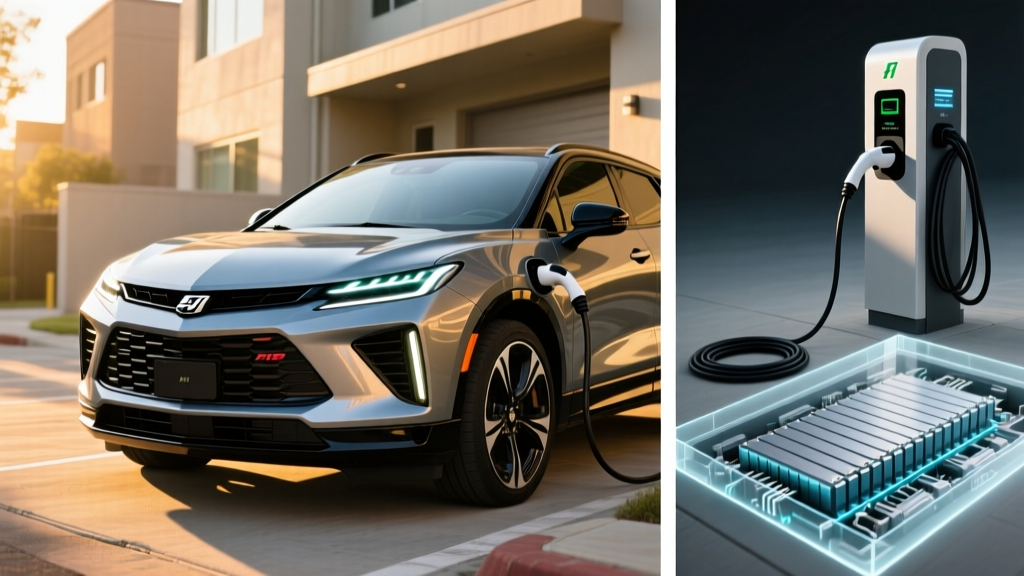
The 2025 Chevrolet Blazer EV RS arrives as a midsize electric crossover that splits the difference between the compact Equinox EV and the full-size Silverado EV in Chevy's lineup. Built on GM's Ultium platform, the RS trim is the sport-oriented option—blacked-out styling, larger wheels, and available all-wheel drive with up to 557 horsepower in the SS-adjacent configuration. But styling alone doesn't sell EVs in 2025. Buyers need to know real-world range, how quickly it charges on a road trip, and whether the federal tax credit actually applies. Here's our data-driven breakdown after spending time with the specs, the EPA numbers, and the ownership math.
2025 Blazer EV RS at a Glance: Key Specifications
| Attribute | RS RWD | RS AWD |
|---|---|---|
| EPA Range | 324 miles | 279 miles |
| Battery (usable) | 102 kWh (est.) | 102 kWh (est.) |
| Battery Chemistry | NMC (Ultium) | NMC (Ultium) |
| Horsepower | 340 hp | 557 hp (combined) |
| 0–60 mph | ~7.0 sec | ~4.0 sec |
| Drivetrain | Rear-Wheel Drive | Dual-Motor AWD |
| Max DC Fast Charge | 190 kW | 190 kW |
| Level 2 Home Charging | 11.5 kW (~35 mi/hr) | 11.5 kW (~35 mi/hr) |
| MPGe (combined) | 87 MPGe | 84 MPGe |
| Base MSRP | $47,400 | $50,400 |
| Battery Warranty | 8 yr / 100,000 mi | 8 yr / 100,000 mi |
Real-World Range vs. the EPA Sticker
RS RWD: EPA 324 miles. Expect ~280–300 miles in mixed real-world driving; ~250–270 miles at sustained 75 mph highway speeds; as low as ~220–240 miles in freezing temperatures with cabin heat.
RS AWD: EPA 279 miles. Expect ~240–260 miles mixed; ~210–230 miles highway; ~180–200 miles in cold weather.
The Blazer EV RS uses GM's Ultium battery architecture with an estimated 102 kWh of usable capacity. The NMC (nickel manganese cobalt) chemistry prioritizes energy density over the cycle-life longevity of LFP (lithium iron phosphate) cells—meaning you get more range per pound, but you'll want to avoid routinely charging to 100% or sitting at low states of charge for extended periods. GM recommends a daily charge limit of 80–90% for battery longevity, reserving 100% for road trips.
The 45-mile range gap between the RWD and AWD RS trims is substantial. The AWD's dual-motor setup adds weight, rolling resistance from wider tires, and the parasitic drag of a second motor. If your commute is under 40 miles round-trip and you rarely see snow, the RWD is the efficiency play. If you need all-weather traction or want the 4.0-second 0–60 time, the AWD's range penalty is the cost of admission.
For context, the EPA's testing cycle includes a mix of city and highway driving at moderate temperatures. Sustained 75+ mph highway driving, roof-rack cargo carriers, and towing all reduce range further. The Blazer EV RS is rated to tow up to 1,500 pounds—expect a 30–40% range reduction when towing near that limit.
Charging Speed: DC Fast Charging and Home Level 2
| Charging Level | Power / Rate | Time / Range Added |
|---|---|---|
| Level 1 (120V household) | ~1.4 kW | ~4 miles per hour |
| Level 2 (240V home/public) | 11.5 kW | ~35 miles per hour; full charge ~9 hrs |
| DC Fast Charge (peak) | 190 kW | 10–80% in ~30 minutes |
| DC Fast (sustained avg.) | ~130–150 kW | Expect ~170–190 miles added in 30 min |
The Blazer EV RS peaks at 190 kW on a DC fast charger with a CCS1 connector. That peak rate holds roughly between 10% and 35% state of charge, then tapers progressively—a typical NMC charge curve. By 80%, charging power drops to approximately 50–60 kW, which is why the 10–80% time of roughly 30 minutes is the metric that matters, not the peak number.
For road trips, plan around 25–30 minute stops at Electrify America, EVgo, or other 150+ kW stations. The Blazer EV does not currently support NACS (Tesla's connector) natively, though GM has committed to NACS adoption across its lineup. Check whether your model year includes a NACS port or requires an adapter for Supercharger access—this is evolving through 2025 and into 2026.
At home on a Level 2 charger (240V, 48-amp circuit), the 11.5 kW onboard charger adds roughly 35 miles of range per hour. A full charge from near-empty takes about 9 hours—overnight charging easily tops you up. Installation of a Level 2 home charger typically costs $800–$2,000 depending on whether your electrical panel needs an upgrade. A licensed electrician should evaluate your panel capacity before committing to a 48-amp circuit; a 60-amp breaker is standard for this setup.
Performance and Driving Dynamics
The RS RWD delivers 340 horsepower and a 0–60 time around 7.0 seconds—adequate for merging and passing, though not thrilling. The RS AWD's 557 combined horsepower drops the 0–60 to approximately 4.0 seconds, putting it in the territory of performance crossovers like the Ford Mustang Mach-E GT.
The Ultium platform places the battery pack low in the chassis, giving the Blazer EV a low center of gravity that limits body roll through corners. The ride quality is firm but compliant—GM tuned the RS for a sportier feel than the LT trim, with thicker stabilizer bars and sport-tuned dampers. Regenerative braking is adjustable via steering-wheel paddles, and one-pedal driving mode is available for city commuting.
Notably absent: adaptive cruise control with stop-and-go was delayed on early 2024 Blazer EVs due to software issues. For 2025, GM has restored the Super Cruise hands-free driving feature on equipped models—a Level 2 SAE driver-assistance system that operates on pre-mapped divided highways. Super Cruise is not autonomous driving; you must remain attentive and ready to take over immediately.
Super Cruise is a hands-free but eyes-on driver-assistance system. The vehicle handles steering, acceleration, and braking on compatible highways, but the driver must remain alert. A camera monitors driver attention. This is not Level 4 autonomous driving—you are the responsible operator at all times.
Interior, Cargo, and Technology
The Blazer EV RS seats five with a crossover-coupe roofline that trades some rear headroom for styling. Key interior dimensions:
- Front legroom: 43.1 inches
- Rear legroom: 38.4 inches
- Cargo (behind rear seats): ~27.5 cu ft
- Cargo (rear seats folded): ~57.0 cu ft
- Frunk: Not available (no front trunk)
The cabin is dominated by a 17.7-inch diagonal infotainment touchscreen running Google Built-In, which includes Google Maps navigation, Google Assistant voice control, and access to the Play Store for apps. An 11-inch digital instrument cluster faces the driver. Wireless Apple CarPlay and Android Auto are standard, along with a wireless charging pad.
The RS trim adds ventilated front seats, a heated steering wheel, Bose premium audio, and unique RS interior trim with contrast stitching. Build quality is solid but not luxury-grade—hard plastics appear on the lower door panels and center console sides, which is typical for this price point.
The cargo area is competitive with rivals like the Hyundai Ioniq 5 (27.2 cu ft rear / 59.3 cu ft folded) but trails the Tesla Model Y's more boxy cargo hold. The absence of a frunk is a missed opportunity for secure, weatherproof storage of charging cables or groceries.
Pricing, Trims, and Federal Tax Credit Eligibility
| Trim | Drivetrain | Base MSRP | Est. As-Tested* |
|---|---|---|---|
| LT | FWD | $44,600 | $47,000–$50,000 |
| RS | RWD | $47,400 | $50,000–$55,000 |
| RS | AWD | $50,400 | $54,000–$59,000 |
| SS | AWD | $60,900 | $63,000+ |
*As-tested pricing reflects common option packages including Super Cruise, panoramic sunroof, and premium paint. Destination charge additional (~$1,395).
The Blazer EV qualifies as an SUV under IRS §30D tax credit rules, which sets the MSRP cap at $80,000 for SUVs—all Blazer EV trims clear that threshold. However, eligibility for the full $7,500 credit depends on three factors that change frequently:
- Buyer income caps: AGI ≤ $150,000 (single), ≤ $225,000 (head of household), ≤ $300,000 (joint)
- MSRP cap: ≤ $80,000 for SUVs (all Blazer EV trims qualify)
- Battery component sourcing: Must meet increasing domestic-content thresholds for battery components and critical minerals—these requirements tighten annually
- Point-of-sale transfer: Eligible buyers can transfer the credit to the dealer at purchase, reducing the out-of-pocket price immediately
- FEOC restriction: Vehicles with battery components from a "foreign entity of concern" may be disqualified—verify current eligibility on IRS.gov before purchasing
The Blazer EV's battery sourcing has been a moving target as GM reshuffles its Ultium supply chain. As of early 2025, some configurations qualify for the full $7,500, while others may receive $3,750 or none depending on the specific battery pack's mineral and component origin. Always verify the VIN-specific eligibility with your dealer and cross-check against the IRS qualified vehicles list before signing. Consult a tax professional for your personal situation.
Pros, Cons, and Who Should Buy the Blazer EV RS
- Up to 324 miles EPA range (RWD) is competitive in the midsize segment
- Available Super Cruise hands-free highway driving
- 557 hp AWD performance in RS AWD / SS trims
- Large 17.7" infotainment screen with Google Built-In
- Comfortable ride quality with sport tuning on RS
- GM's 8-year/100,000-mile battery warranty
- No frunk (front trunk) — lost storage opportunity
- 190 kW peak DC charging trails Hyundai/Kia's 800V architecture (~240 kW)
- AWD range drops to 279 miles — tight for road trips without planning
- Early software reliability concerns (2024 model year launch issues)
- NACS connector adoption still in transition — adapter may be needed for Superchargers
- Tax credit eligibility uncertain due to evolving battery-sourcing rules
Choose the RS RWD if: You commute 30–60 miles daily, want maximum range (324 mi), and don't need AWD. Best value in the RS lineup.
Choose the RS AWD if: You live in a snow-belt state, want the 4.0-second 0–60 thrill, and can accept 279 miles of range with road-trip planning.
Look elsewhere if: You need the fastest possible DC charging (Hyundai Ioniq 5 / Kia EV6 at 800V), require three rows (Kia EV9), or want guaranteed Tesla Supercharger access without an adapter.
How It Compares to Key Competitors
The Blazer EV RS competes in a crowded midsize EV crossover segment. The Ford Mustang Mach-E (EPA up to 320 mi, starting ~$42,995) offers similar range with a more engaging driving feel and BlueCruise hands-free capability. The Hyundai Ioniq 5 (EPA up to 305 mi, starting ~$42,450) charges significantly faster at 800V architecture—10–80% in ~18 minutes vs. the Blazer's ~30. The Tesla Model Y (EPA up to 320 mi, starting ~$44,990) offers the Supercharger network advantage and more cargo space, though its minimalist interior and panel-gap consistency remain divisive.
The Blazer EV RS's advantage is its combination of American-market sizing, available Super Cruise, and a familiar crossover aesthetic that doesn't scream "futuristic EV." For buyers transitioning from a gas-powered Blazer or similar midsize SUV, the learning curve is minimal. For EV veterans who prioritize charging speed above all, the Ioniq 5 or EV6 remain the benchmarks.
Frequently Asked Questions
What is the real-world range of the 2025 Blazer EV RS?
The RS RWD achieves an EPA-estimated 324 miles, but expect 280–300 miles in real-world mixed driving and 250–270 miles at sustained highway speeds. The AWD drops to 279 miles EPA, with roughly 240–260 miles real-world. Cold weather (below 32°F) can reduce range by 20–30% due to battery resistance and cabin heating demands.
How fast does the Blazer EV RS charge at home and on the road?
At home on a 240V Level 2 charger, the Blazer EV RS charges at 11.5 kW, adding about 35 miles per hour—a full overnight charge. On DC fast chargers, it peaks at 190 kW and achieves a 10–80% charge in approximately 30 minutes. The charge curve tapers significantly above 80%, so avoid charging past 80% on road trips unless necessary.
Does the 2025 Blazer EV RS qualify for the $7,500 federal tax credit?
It may, depending on battery sourcing, your income, and the MSRP of your specific configuration. The Blazer EV's MSRP is under the $80,000 SUV cap, but the critical-minerals and battery-component requirements under §30D are tightening annually and have disqualified some GM configurations in prior years. Verify VIN-level eligibility on IRS.gov and with your dealer before purchasing. A tax professional can confirm your personal eligibility.
Is the Blazer EV RS worth buying over the Mustang Mach-E or Ioniq 5?
The Blazer EV RS is competitive on range and performance, and it wins on available Super Cruise hands-free driving. However, the Ioniq 5 charges faster (18 min vs. 30 min, 10–80%), the Mach-E has a more engaging chassis, and the Model Y offers the Supercharger network. Choose the Blazer EV RS if you prefer its styling, want Super Cruise, and value the GM dealer network for service.
What is the Blazer EV battery warranty?
GM covers the Ultium battery pack for 8 years or 100,000 miles (whichever comes first), with a capacity-retention threshold typically set at 60% of original capacity. The powertrain is also covered for 8 years/100,000 miles. The bumper-to-bumper warranty is 3 years/36,000 miles.
Does the Blazer EV RS have a front trunk (frunk)?
No. The 2025 Blazer EV does not offer a front trunk. The space under the hood houses electrical components. This is a notable omission compared to the Ford Mustang Mach-E and Tesla Model Y, both of which offer small front storage areas.