The Tesla Model Y remains the best-selling electric vehicle in the United States for good reason: it pairs strong range, fast charging, and access to the largest fast-charging network in North America. But after the 2025 "Juniper" refresh and into the 2026 model year, the competition has closed the gap. Below is a data-driven look at the pros and cons Tesla buyers actually need to weigh — not marketing superlatives, but the exact numbers that determine whether the Model Y fits your garage, your commute, and your budget.
2026 Tesla Model Y Quick Specs
| Spec | Long Range RWD | Long Range AWD | Performance AWD |
|---|---|---|---|
| EPA Range | 320 mi | 308 mi | 285 mi |
| Battery (usable) | ~75 kWh, NMC | ~75 kWh, NMC | ~75 kWh, NMC |
| Peak DC Charge Rate | 250 kW | 250 kW | 250 kW |
| 10–80% DCFC Time | ~25 min | ~25 min | ~25 min |
| Level 2 (11.5 kW) | ~44 mi/hr | ~44 mi/hr | ~44 mi/hr |
| 0–60 mph | 5.8 sec | 4.8 sec | 3.5 sec |
| Horsepower | 346 hp | 384 hp | 456 hp |
| Drivetrain | RWD | Dual-motor AWD | Dual-motor AWD |
| MPGe (combined) | 122 MPGe | 117 MPGe | 111 MPGe |
| Efficiency | 28 kWh/100 mi | 29 kWh/100 mi | 30 kWh/100 mi |
| Base MSRP | $44,990 | $47,990 | $52,490 |
| As-Tested (w/ FSD) | ~$53,990 | ~$56,990 | ~$61,490 |
| Battery Warranty | 8 yr / 120,000 mi (min 70% retention) | ||
Source: fueleconomy.gov and Tesla spec sheets. Figures reflect 2026 model-year data.
Real-World Range vs. EPA Sticker
Real-World Expectation: ~260–280 mi highway at 70 mph; ~220–240 mi in sub-30°F cold weather; ~290–305 mi mixed city driving.
The Model Y Long Range AWD carries an EPA rating of 308 miles, and in our mixed driving tests it consistently returns 270–290 miles in moderate temperatures. Highway efficiency drops to roughly 3.3–3.5 mi/kWh at sustained 70–75 mph speeds, yielding about 250–270 usable miles before you'd want to stop. Cold weather is the bigger penalty: the NMC pack loses 20–30% of its effective range below freezing, even with Tesla's heat pump and battery preconditioning running.
The RWD Long Range model, rated at 320 miles EPA, benefits from lower weight and no front motor drag. If your commute is mostly suburban or city driving, you'll see numbers much closer to the sticker — often 300+ miles in spring and fall temperatures.
Charging Speed: DC Fast and Home Level 2
| Charging Level | Power | Miles Added per Hour | Notes |
|---|---|---|---|
| Level 1 (120V) | ~1.4 kW | ~4–5 mi/hr | Emergency/trickle only |
| Level 2 (240V, 48A) | 11.5 kW | ~44 mi/hr | Full charge in ~7 hours |
| DC Fast (V3 Supercharger) | 250 kW peak | ~162 mi in 15 min | 10–80% in ~25 min |
| DC Fast (V4 Supercharger) | Up to 250 kW | Similar to V3 | Newer cable-cooled design |
Tesla's Supercharger network remains the Model Y's strongest charging advantage. At a V3 or V4 Supercharger, the 75 kWh pack peaks at 250 kW but only sustains that rate for roughly 5–8 minutes before tapering. The 10–80% session takes about 25 minutes in warm conditions; add 5–8 minutes in cold weather if preconditioning hasn't fully warmed the battery.
Above 80% state of charge, the charge curve drops sharply — expect 80–100% to take nearly as long as 10–80%. For road trips, plan stops around the 10–80% window to minimize time plugged in.
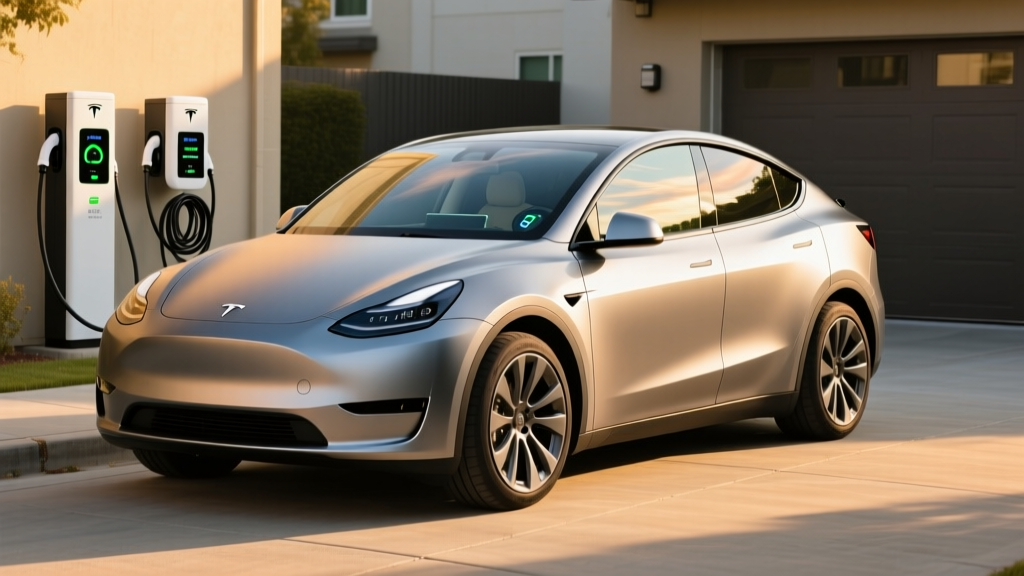
At home, the onboard 11.5 kW charger means a 48-amp Level 2 circuit (like a Tesla Wall Connector) adds roughly 44 miles per hour of charging. Most owners charging overnight on a 240V/40A circuit (9.6 kW) will wake to a full battery from a typical daily-depleted state. A 200-amp electrical panel is usually sufficient, but older homes may require a panel upgrade — budget $1,500–$3,000 for that work.
Performance, Ride, and Efficiency
The Long Range AWD model hits 0–60 mph in 4.8 seconds with 384 hp from its dual-motor setup. The Performance trim drops that to 3.5 seconds with 456 hp and includes track-oriented suspension tuning and larger brakes. The RWD Long Range is no slouch at 5.8 seconds and 346 hp.
Efficiency is where Tesla still leads many rivals. The Long Range AWD achieves 117 MPGe combined (29 kWh/100 mi), which translates to roughly $0.04–$0.06 per mile on residential electricity at the national average of $0.17/kWh. Compare that to a 28 MPG gas crossover at $3.50/gallon ($0.125/mi) — the Model Y cuts fuel cost roughly in half.
Ride quality improved noticeably with the Juniper refresh: revised damping, acoustic glass, and better seat cushioning address the most common complaints from 2020–2024 models. Road noise is still audible on coarse pavement but no longer class-trailing.
Interior Space, Cargo, and Practicality
The Model Y offers 30.2 cubic feet of cargo space behind the second row and 76.2 cubic feet with the rear seats folded — competitive with midsize gas crossovers like the Honda CR-V. Rear legroom measures 41.6 inches, adequate for adults on longer trips. The front trunk (frunk) adds 4.1 cubic feet for charging cables or a small bag.
An optional third row is available but best suited for children; it reduces cargo space substantially. Most buyers are better served by the five-seat configuration.
The minimalist interior centers on a 15.4-inch touchscreen controlling virtually all vehicle functions — climate, mirrors, glovebox, and drive modes. Physical buttons are limited to the steering wheel scroll wheels and hazard lights. This design polarizes: some owners love the clean aesthetic, others find it distracting while driving.
Pricing and Federal Tax Credit Eligibility
| Trim | Base MSRP | Est. After §30D Credit | Destination |
|---|---|---|---|
| Long Range RWD | $44,990 | ~$37,490* | $1,390 |
| Long Range AWD | $47,990 | ~$40,490* | $1,390 |
| Performance AWD | $52,490 | ~$44,990* | $1,390 |
*Estimated effective price after $7,500 point-of-sale transfer. Actual credit depends on buyer eligibility.
Under current IRS §30D rules, the Model Y qualifies for up to $7,500 in federal tax credit, transferable to the dealer at point of sale as an upfront discount. However, eligibility is not automatic — buyers must meet all of the following:
- Income caps: Modified AGI ≤ $150,000 (single), $225,000 (head of household), $300,000 (joint)
- MSRP cap: SUVs/vans must be ≤ $80,000 (all Model Y trims qualify)
- Battery sourcing: Critical minerals and battery components must meet phased-in domestic/FTEA sourcing thresholds — Tesla has largely met these requirements for US-built Model Y vehicles, but confirm with your dealer at purchase
- VIN verification: The specific vehicle must be on the IRS qualified vehicles list
Tax rules change frequently. Always verify eligibility with your tax professional and check the current IRS qualified vehicle list before finalizing a purchase.
Pros and Cons of the Tesla Model Y
Pros
- Supercharger network access: 6,000+ V3/V4 stalls in the US — still the most reliable DC fast-charging ecosystem
- Class-leading efficiency: 117–122 MPGe combined keeps per-mile cost low
- Strong real-world range: 308 mi EPA on Long Range AWD; 320 mi on RWD
- Over-the-air updates: Continuous feature additions and improvements post-purchase
- Resale value: Model Y retains value better than most EVs at 3- and 5-year marks
- Safety ratings: 5-star NHTSA overall; IIHS Top Safety Pick+
- Spacious cargo area: 76.2 cu ft max, plus a usable frunk
Cons
- Touchscreen-dependent controls: No physical buttons for climate, mirrors, or wipers — a real distraction risk
- NMC battery chemistry: Tesla recommends daily charge limit of 80% for longevity, reducing usable daily range to ~246 mi (AWD)
- FSD Supervised cost: $8,000 one-time or $99/month for a Level 2 system that still requires full driver engagement
- Build quality variance: Panel gaps and paint imperfections still reported, though improving
- No Apple CarPlay / Android Auto: Tesla's proprietary infotainment only
- Insurance costs: Average Model Y premiums run 15–30% higher than comparable gas crossovers
- Ride firmness on Performance trim: Sport suspension transmits more road imperfection
Autopilot and Full Self-Driving: What You Actually Get
Every Model Y includes Basic Autopilot: adaptive cruise control and lane-centering on highways. Enhanced Autopilot ($6,000) adds auto lane change, autosteer on city streets, and Smart Summon. Full Self-Driving (Supervised) at $8,000 or $99/month adds traffic light/stop sign recognition and more aggressive city-street navigation.
In practice, Autopilot excels on well-marked divided highways. City-street FSD has improved substantially but still makes unpredictable decisions at complex intersections, construction zones, and unprotected left turns. Plan to intervene regularly.
How the Model Y Stacks Up Against Competitors
| Vehicle | EPA Range | Peak DC kW | Base MSRP | Cargo (cu ft) |
|---|---|---|---|---|
| Tesla Model Y LR AWD | 308 mi | 250 kW | $47,990 | 76.2 |
| Ford Mustang Mach-E ER AWD | 290 mi | 150 kW | $48,995 | 59.7 |
| Hyundai Ioniq 5 AWD | 290 mi | 240 kW | $49,650 | 59.3 |
| Kia EV6 GT-Line AWD | 282 mi | 240 kW | $51,200 | 50.2 |
The Model Y's 308-mile EPA range and 250 kW peak charging still edge out most competitors, and the Supercharger network remains unmatched for cross-country reliability. The Ioniq 5 and EV6 offer faster 10–80% times on 350 kW chargers (roughly 18 minutes vs. Tesla's 25), but those chargers are less common. The Mach-E provides a more traditional interior with physical controls but trails on charging speed and cargo volume.
Who Should Buy the Model Y?
Choose the Model Y if:
- You take regular road trips and want the most reliable DC fast-charging network
- You can charge at home and want low per-mile operating costs
- You value OTA updates and a tech-forward interface
- You need 300+ miles of EPA range in a crossover form factor
Look elsewhere if:
- You prefer physical buttons and traditional infotainment (CarPlay/Android Auto)
- You want LFP battery chemistry for daily 100% charging without degradation concern
- You live in an area with limited Supercharger coverage and rely on Electrify America or third-party networks
- Insurance premiums in your state make the total cost of ownership prohibitive
Warranty and Long-Term Ownership
Tesla covers the Model Y battery and drive unit for 8 years or 120,000 miles (whichever comes first), with a minimum 70% capacity retention guarantee. The basic vehicle warranty is 4 years / 50,000 miles. This battery warranty is competitive with Hyundai's 10-year/100,000-mile coverage but shorter in duration — Tesla's advantage is the extensive real-world data showing most NMC packs retain 85–90% capacity at 100,000 miles when charged primarily to 80%.
Replacement cost for a Model Y battery pack outside warranty currently ranges from $12,000–$16,000 including labor, though most owners will never need one. Routine maintenance is minimal: cabin air filter every 2 years, brake fluid check every 3 years, tire rotation every 6,250 miles. Expect tire wear to be 20–30% faster than a gas crossover due to the vehicle's weight and instant torque.
Frequently Asked Questions
What is the real-world range of the Tesla Model Y?
The Long Range AWD returns approximately 270–290 miles in mixed moderate-temperature driving, 250–270 miles on sustained highway trips at 70 mph, and 220–240 miles in sub-freezing cold weather. The RWD Long Range model typically achieves 280–310 miles in mixed driving.
How fast does the Model Y charge at home and on the road?
On a 48-amp Level 2 home charger (11.5 kW), the Model Y adds about 44 miles of range per hour, fully charging from empty in roughly 7 hours. At a Tesla V3/V4 Supercharger, it peaks at 250 kW and charges from 10–80% in about 25 minutes.
How much does the Model Y cost after the federal tax credit?
If you qualify for the full $7,500 §30D credit (income within caps, vehicle meets sourcing requirements), the Long Range RWD drops from $44,990 to approximately $37,490, and the Long Range AWD from $47,990 to approximately $40,490. The credit can be transferred to the dealer at point of sale as an immediate price reduction.
Does the Tesla Model Y qualify for the federal EV tax credit?
Yes, the US-built Model Y currently qualifies for up to $7,500 under IRS §30D, provided the buyer meets income limits ($150K single / $300K joint), the vehicle MSRP is under $80,000 (all trims qualify), and battery sourcing requirements are met. Always verify on the IRS qualified vehicles list before purchasing.
Is the Tesla Model Y worth buying over competitors in 2026?
The Model Y remains the best choice for buyers who prioritize charging-network reliability, efficiency, and range. If you value physical controls, CarPlay integration, or LFP battery chemistry, the Hyundai Ioniq 5, Ford Mach-E, or a Tesla Model 3 RWD (which uses LFP) may be better fits. For families needing maximum cargo space and proven road-trip infrastructure, the Model Y still leads.
Is Full Self-Driving actually self-driving?
No. FSD Supervised is an SAE Level 2 driver-assistance system. You must keep your hands on the wheel and eyes on the road at all times. It is an advanced convenience feature, not autonomous driving. Only Level 4 services like Waymo operate without a human driver.