The 2025 Audi Q6 e-tron arrives as Audi's first vehicle on the new Premium Platform Electric (PPE) architecture co-developed with Porsche. It slots between the Q4 e-tron and the larger Q8 e-tron, targeting luxury-compact-EV buyers who want a tech-forward cabin, rapid DC charging, and genuine daily usability. After spending time with the specs, charging data, and real-world driving dynamics, here is the comprehensive breakdown every prospective buyer needs.
EPA Estimated: 321 miles (Q6 e-tron Premium Plus RWD, 100 kWh battery)
Real-World Expectation: ~265–290 miles in mixed highway driving at 70+ mph; ~220–240 miles in freezing temperatures with cabin heat. AWD trims see roughly 10–15 miles less. The Q6 e-tron's heat pump (standard) mitigates cold-weather loss better than many competitors, but physics still applies — expect 20–30% range reduction in sustained sub-30°F highway driving.
Range, Battery, and Efficiency
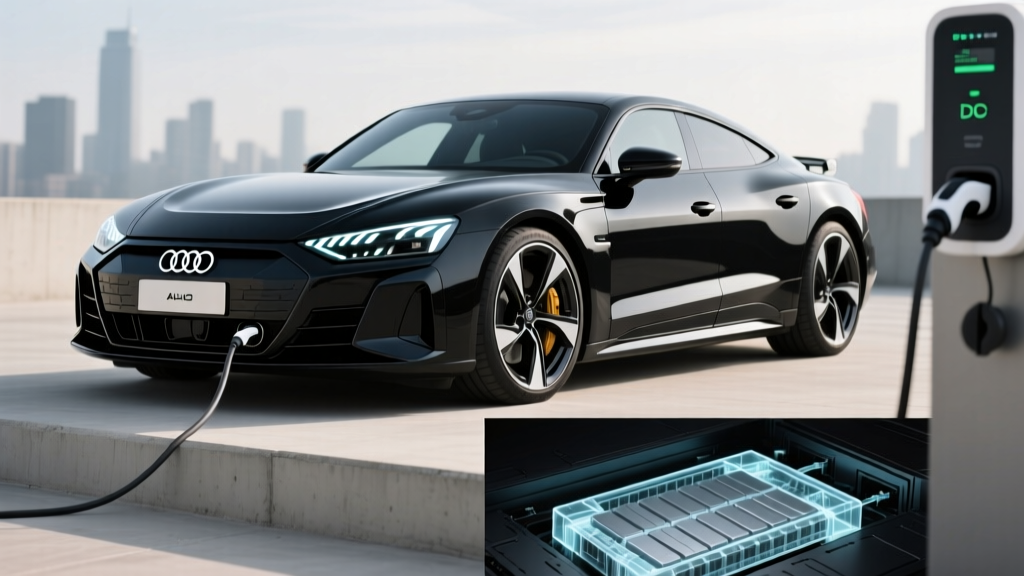
The 2025 Q6 e-tron uses a 100 kWh gross battery pack (approximately 94.9 kWh usable) with NMC (nickel manganese cobalt) chemistry. Audi has not offered an LFP variant for this model year, which aligns with the luxury segment's preference for energy density over cycle-life maximization.
Efficiency varies by drivetrain. The rear-wheel-drive (RWD) model achieves an EPA-estimated 105 MPGe combined, translating to roughly 32 kWh/100 mi. The quattro all-wheel-drive variant drops to approximately 96 MPGe combined (~35 kWh/100 mi). These figures place the Q6 e-tron squarely in the competitive middle — slightly behind the Tesla Model Y's efficiency but ahead of the BMW iX in its class.
| Spec | Q6 e-tron (RWD) | Q6 e-tron quattro (AWD) | SQ6 e-tron (AWD) |
|---|---|---|---|
| Battery (gross / usable) | 100 kWh / ~94.9 kWh | 100 kWh / ~94.9 kWh | 100 kWh / ~94.9 kWh |
| Chemistry | NMC | NMC | NMC |
| EPA Range | 321 mi | 308 mi | 294 mi |
| MPGe (combined) | 105 MPGe | 96 MPGe | 91 MPGe |
| Horsepower | 335 hp | 456 hp | 543 hp (launch control) |
| 0–60 mph | 5.8 sec | 4.9 sec | 4.3 sec |
| Drivetrain | RWD | Dual-motor AWD | Dual-motor AWD |
| Top Speed | 130 mph | 130 mph | 143 mph |
| Max DC Charge Rate | 270 kW | 270 kW | 270 kW |
| 10–80% DC Time | ~21 min | ~21 min | ~21 min |
| Level 2 Rate | 11.5 kW | 11.5 kW | 11.5 kW |
Charging Speed and Infrastructure
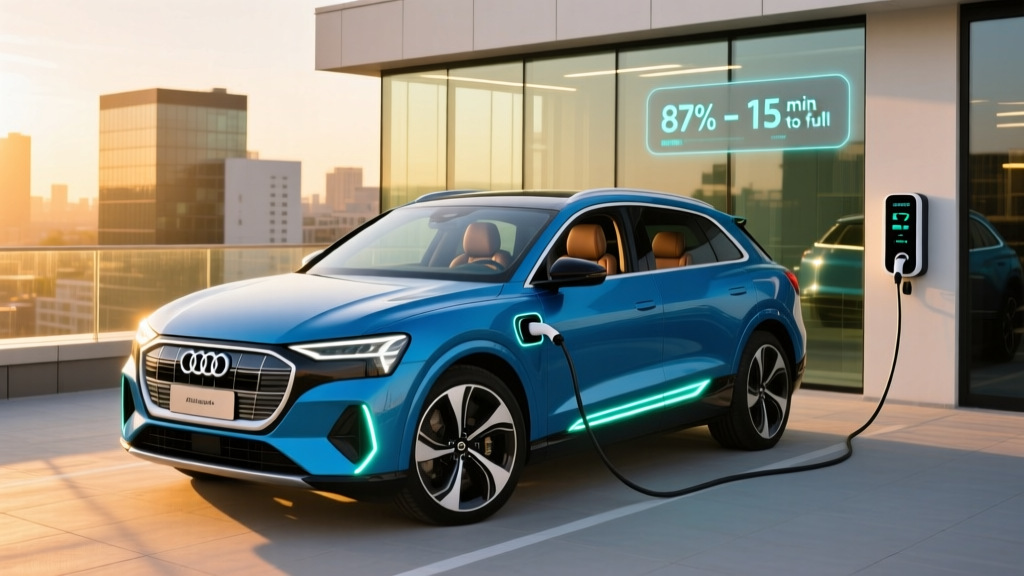
The Q6 e-tron's headline charging figure is its 270 kW peak DC fast-charge rate, enabled by the PPE platform's 800-volt architecture. On a sufficiently powerful charger (350 kW Electrify America or equivalent), the Q6 e-tron can add 160 miles of range in approximately 10 minutes and charge from 10% to 80% in about 21 minutes.
However, real-world charging curves matter more than peak numbers. The Q6 e-tron sustains above 200 kW through roughly 50% state of charge (SoC), then tapers progressively. From 80–100%, charging slows dramatically — a characteristic of NMC chemistry and battery-protection algorithms. For road trips, plan your stops around the 10–80% window for maximum time efficiency.
| Level | Power / Voltage | Speed (approx.) | Best Use Case |
|---|---|---|---|
| Level 1 (120V household) | ~1.4 kW | ~4–5 mi/hr | Emergency / overnight trickle |
| Level 2 (240V home) | 11.5 kW max | ~35–38 mi/hr | Daily home charging |
| DC Fast Charge | 270 kW peak (800V) | ~160 mi in 10 min | Road trips, quick top-ups |
At home on a Level 2 wall connector (48-amp circuit recommended), a full overnight charge from 20% to 100% takes roughly 8–9 hours. Buyers should budget for a professional 240V/60-amp circuit installation — expect $800–$2,500 depending on panel proximity and local permitting. If your home electrical panel is at capacity, a panel upgrade can add $1,500–$3,000.
The Q6 e-tron ships with a CCS1 connector in North America. Audi has confirmed that future models will adopt NACS (Tesla's connector), but for 2025, CCS1 remains the standard. A NACS-to-CCS adapter is available for Tesla Supercharger access where permitted.
Performance and Driving Dynamics
The standard Q6 e-tron RWD delivers 335 horsepower and a 5.8-second 0–60 mph time — adequate for daily driving but not thrilling. The quattro dual-motor variant is the sweet spot, with 456 hp and a 4.9-second 0–60. The performance-oriented SQ6 e-tron pushes 543 hp (with launch control engaged) and hits 60 mph in 4.3 seconds.
Ride quality benefits from Audi's standard adaptive air suspension on higher trims, which adjusts damping and ride height based on driving mode. The Q6 e-tron feels planted in corners for its 5,000+ lb curb weight, though it's tuned more for comfort than sportiness. Regenerative braking offers multiple levels selectable via steering-wheel paddles, and a one-pedal-driving mode is available but not as aggressive as BMW's iX implementation.
Towing capacity is rated at 4,400 lbs (braked) for quattro trims — sufficient for a small boat trailer or lightweight camper, though this is an area where the Rivian R1S and Ford F-150 Lightning far exceed it.
Interior, Technology, and Cargo
Audi's new MMI infotainment system debuts in the Q6 e-tron, featuring a 14.5-inch curved OLED touchscreen as the primary display, a 10.9-inch front passenger screen (optional), and an 11.9-inch digital instrument cluster. The system runs on a new software architecture that supports over-the-air updates, improved voice recognition, and an augmented-reality head-up display that overlays navigation instructions onto the windshield view.
Driver assistance comes via Audi's adaptive cruise assist (SAE Level 2), which includes lane-centering, stop-and-go cruise, and intersection assist. This is not a hands-free system — the driver must maintain contact with the steering wheel. Audi has not yet launched a hands-free highway driving feature comparable to GM's Super Cruise or Ford's BlueCruise in the U.S. market.
Cargo space measures 28.7 cubic feet behind the rear seats and 60.5 cubic feet with the rear seats folded. There is no front trunk (frunk) — the space under the hood houses HVAC and power-electronics components. Rear legroom is a generous 38.1 inches, making this a comfortable family hauler for adults in all seating positions.
Pricing, Trims, and Federal Tax Credit
The 2025 Q6 e-tron lineup starts at $63,800 MSRP (Premium Plus RWD) and climbs to approximately $72,200 for the SQ6 e-tron Prestige before options and destination charges ($1,195 destination).
| Trim | MSRP (incl. destination) | Est. After §30D Credit* |
|---|---|---|
| Q6 e-tron Premium Plus (RWD) | $64,995 | ~$57,495 |
| Q6 e-tron Prestige (RWD) | $68,995 | ~$61,495 |
| Q6 e-tron Premium Plus quattro | $67,795 | ~$60,295 |
| Q6 e-tron Prestige quattro | $71,795 | ~$64,295 |
| SQ6 e-tron Premium Plus | $73,395 | ~$65,895 |
| SQ6 e-tron Prestige | $76,895 | ~$69,395 |
*Tax credit estimates assume full $7,500 eligibility under IRS §30D. Eligibility depends on multiple factors:
- MSRP cap: SUVs must be under $80,000 MSRP — all Q6 e-tron trims qualify.
- Buyer income cap: Modified AGI must not exceed $150,000 (single), $225,000 (head of household), or $300,000 (joint). Exceed these thresholds and the credit phases out to $0.
- Battery sourcing: The credit splits into two $3,750 halves — one for critical-mineral sourcing and one for battery-component manufacturing. Audi has indicated the Q6 e-tron's supply chain meets at least partial requirements, but final certification depends on the specific battery batch and model year. Always verify eligibility at fueleconomy.gov before purchasing.
- Point-of-sale transfer: As of 2024, buyers can transfer the credit to the dealer for an immediate price reduction at purchase rather than claiming it on their tax return.
State and local incentives may further reduce cost. California's CVRP, Colorado's innovative motor vehicle credit, and various utility rebates can stack on top of federal credits. Consult your tax professional and state agency for current amounts.
Warranty and Long-Term Ownership
Audi covers the Q6 e-tron's battery and drive unit with an 8-year/100,000-mile warranty, guaranteeing a minimum of 70% battery capacity retention over that period. The limited vehicle warranty runs 4 years/50,000 miles, which is competitive with BMW and Mercedes but shorter than Hyundai/Kia's 5-year/60,000-mile bumper-to-bumper coverage.
Based on NMC degradation data from similar Volkswagen Group EVs (e.g., the Porsche Taycan and Audi e-tron GT), expect approximately 8–12% capacity loss over 5 years or 75,000 miles under normal use patterns. Avoiding routine 100% charges and frequent DC fast charging in extreme heat will help preserve long-term state of health (SoH).
If out-of-warranty battery replacement becomes necessary, expect costs in the range of $15,000–$22,000 for the pack alone, plus labor. However, module-level repair (replacing individual degraded modules rather than the entire pack) may be available through specialized EV service centers at significantly lower cost.
Pros, Cons, and Who Should Buy
- 270 kW DC fast charging — among the fastest in the luxury compact SUV segment
- Refined ride quality with adaptive air suspension
- Excellent cabin materials and build quality
- Strong rear-seat legroom (38.1 in)
- 800V architecture future-proofs charging speed
- Heat pump standard for cold-climate efficiency
- No frunk — missed opportunity for additional cargo
- Infotainment learning curve; touch-heavy controls
- No hands-free highway driving feature (yet)
- Higher starting price than Tesla Model Y or Hyundai Ioniq 5
- CCS1 connector in a transitioning market (NACS adoption pending)
- Efficiency slightly behind class leaders
Best for: Luxury-oriented buyers who prioritize build quality, fast road-trip charging, and a premium cabin over maximum range-per-dollar. The Q6 e-tron suits daily commuters with home charging access, families needing comfortable rear seating, and road-trippers willing to plan around the 300-mile real-world range envelope.
Consider alternatives if: You need maximum cargo space (BMW iX), hands-free driving (Cadillac Lyriq with Super Cruise), the lowest cost per mile of range (Tesla Model Y), or a frunk for gear storage (Rivian R1S).
Frequently Asked Questions
What is the real-world range of the 2025 Audi Q6 e-tron?
The EPA rates the RWD model at 321 miles, but real-world highway driving at 70+ mph yields approximately 265–290 miles. In cold weather (below 30°F), expect 220–240 miles. The standard heat pump helps, but sustained cold and high speeds are the biggest range killers for any EV.
How fast does the Q6 e-tron charge at home and on the road?
On a DC fast charger, it peaks at 270 kW and charges 10–80% in about 21 minutes. At home on a Level 2 (240V/48A) charger, it accepts up to 11.5 kW, adding roughly 35–38 miles of range per hour — a full overnight charge takes about 8–9 hours from 20%.
Does the 2025 Q6 e-tron qualify for the $7,500 federal EV tax credit?
It is eligible, provided the buyer meets IRS §30D income limits (under $300K joint / $150K single), the MSRP is under $80,000 (all trims qualify), and the battery meets critical-mineral and component-sourcing requirements. Verify current eligibility on fueleconomy.gov before purchase, as sourcing certifications can change by production batch.
Is the Q6 e-tron worth buying over the BMW iX or Tesla Model Y?
If you value Audi's build quality, 270 kW charging, and the PPE platform's refinement, yes. The BMW iX offers more cargo space and a slightly more engaging drive. The Tesla Model Y delivers better efficiency and Supercharger access but can't match the Q6's interior luxury. It's a segment where personal preference on brand and cabin experience matters as much as specs.
What connector does the Q6 e-tron use, and can it charge at Tesla Superchargers?
The 2025 Q6 e-tron uses CCS1. Tesla Supercharger access is possible with a NACS-to-CCS adapter where Tesla has opened its network to non-Tesla vehicles. Audi has indicated future models will adopt NACS natively.
Is Audi's driver-assist system self-driving?
No. Audi's adaptive cruise assist is an SAE Level 2 system — it provides lane-centering and adaptive cruise but requires the driver to remain fully engaged with hands on the wheel. It is not autonomous. Only Level 4 services like Waymo operate without a human driver.