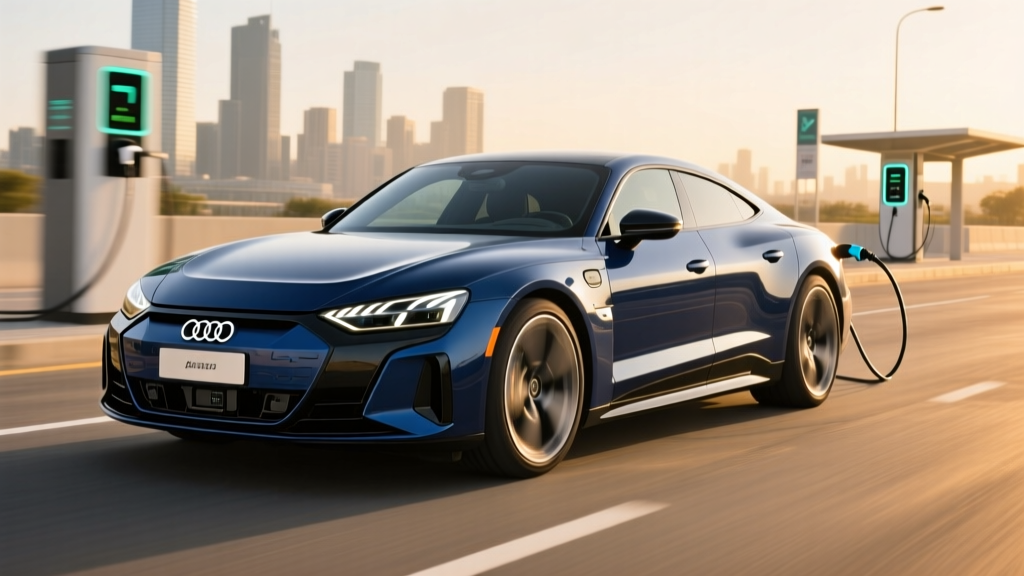
The 2025 Audi e-tron GT Premium Plus occupies a narrow but compelling lane in the electric luxury sedan market: it pairs Porsche Taycan-derived engineering with Audi's design language and a price point that undercuts its Stuttgart cousin by roughly $15,000. But with an EPA range of 238 miles and a starting MSRP over $100,000, the e-tron GT demands scrutiny beyond its striking sheet metal. This review breaks down the numbers that matter — real-world range, charging behavior, ownership costs, and whether the §30D federal tax credit applies — so you can evaluate the e-tron GT Premium Plus against the data, not the marketing.
2025 Audi e-tron GT Premium Plus at a Glance
| Spec | Value |
|---|---|
| EPA Range | 238 miles |
| Battery (Usable / Gross) | 83.7 kWh usable / 93.4 kWh gross, NMC lithium-ion |
| Drivetrain | Dual-motor AWD (quattro) |
| Horsepower (Boost Mode) | 522 hp |
| 0–60 mph | 3.9 seconds (manufacturer est.) |
| Peak DC Fast Charge | 270 kW |
| 10–80% DC Charge Time | ~22.5 minutes (ideal conditions) |
| Level 2 Home Charging | 11 kW (onboard charger) |
| Efficiency | 82 MPGe combined / 41 kWh/100 mi |
| Base MSRP | $106,395 (incl. destination) |
| Federal Tax Credit (§30D) | Not eligible (MSRP cap exceeded) |
| Battery Warranty | 8 years / 100,000 miles (70% capacity retention) |
Range: What the EPA Sticker Doesn't Tell You
Real-World Expectation: 200–220 miles on sustained highway driving (70–80 mph); 175–195 miles in cold weather (below 32°F) with cabin heating active. City driving with regenerative braking can approach or slightly exceed the EPA figure.
The e-tron GT's 238-mile EPA rating sits in the lower third of luxury EVs at this price. The Porsche Taycan 4S, which shares the J1 platform, posts a nearly identical 227–246 mile rating depending on configuration. The Tesla Model S Long Range, by contrast, delivers 402 miles EPA — a gap you'll notice on road trips longer than 250 miles.
A few factors compress the e-tron GT's real-world range below its sticker number. First, the car's 5,139-pound curb weight and performance-oriented Pirelli P Zero tires prioritize grip over rolling resistance. Second, the J1 platform's 800-volt architecture is optimized for charging speed rather than energy density. Third, the car lacks a heat pump in the U.S. market (Audi offers one in Europe), meaning cold-weather cabin heating draws directly from the traction battery via resistive elements — a 15–25% range penalty is typical in sub-freezing temperatures based on independent testing by fueleconomy.gov.
For daily commuting under 80 miles round-trip with home charging, the range is a non-issue. For road trips, plan charging stops every 180–200 miles to maintain a comfortable buffer.
Charging Speed: The 800-Volt Advantage
The e-tron GT's 800-volt electrical architecture is its strongest practical asset. While many competitors peak at 150–200 kW on DC fast chargers, the e-tron GT can accept up to 270 kW — but only at chargers capable of delivering that power (Electrify America's 350 kW stalls, for example).
| Charging Level | Power / Rate | Miles Added | Time |
|---|---|---|---|
| Level 1 (120V household) | ~1.4 kW | ~3–4 mi/hr | ~60+ hours (full) |
| Level 2 (240V home, 48A) | 11 kW (onboard max) | ~28–30 mi/hr | ~9 hours (full) |
| DC Fast (350 kW station) | Peak 270 kW | ~175 mi in 10 min | 10–80% in ~22.5 min |
| DC Fast (150 kW station) | ~130–150 kW | ~90–100 mi in 10 min | 10–80% in ~35 min |
A critical nuance: the 270 kW figure is a peak, not a sustained rate. Like all EVs, the e-tron GT's charge curve tapers as the battery fills. You'll see 270 kW between roughly 10–35% State of Charge (SoC), after which the rate steps down to ~150 kW through 60%, then further to ~75 kW above 80%. The 10–80% time of 22.5 minutes assumes ideal battery preconditioning (the car does this automatically when a DC charger is set as your navigation destination) and a 350 kW-capable station.
At home on a Level 2 wall connector, the 11 kW onboard charger means a full charge takes about 9 hours — easily achievable overnight. Most e-tron GT owners will rarely use DC fast charging except on road trips, making the home charging experience the daily reality. A Audi-recommended home charger installation typically costs $800–$2,000 depending on electrical panel proximity.
Performance and Driving Dynamics
The Premium Plus trim comes standard with dual electric motors producing 469 hp in normal driving and 522 hp in Launch Control (boost mode, available for 2.5-second bursts). Audi's quattro all-wheel-drive system distributes torque between axles with no mechanical linkage — the front and rear motors are independently controlled.
The 3.9-second 0–60 mph time places the e-tron GT Premium Plus in serious performance territory. For context, the BMW i5 M60 hits 3.7 seconds, and the Tesla Model S Plaid demolishes the sprint in 1.99 seconds — but the Audi's advantage is how it delivers that speed. The J1 platform's low center of gravity (battery pack under the floor), rear-wheel steering (standard on Premium Plus), and adaptive air suspension create a grand-touring character that feels planted at triple-digit speeds yet compliant over rough pavement.
Three-chamber air suspension adjusts ride height by up to 0.8 inches and offers Comfort, Auto, and Dynamic modes. The regenerative braking system provides up to 0.3g of deceleration, but unlike many EVs, it does not offer true one-pedal driving — you'll still use the brake pedal for full stops. This is a deliberate engineering choice by Audi to maintain a traditional luxury-sedan braking feel, though some EV converts find it frustrating.
Interior, Tech, and Cargo Practicality
The e-tron GT cabin is a showcase of Audi's material quality: standard Valcona leather, aluminum inlays, and a flat-bottom steering wheel. The Premium Plus trim adds a panoramic glass roof, matrix-design LED headlights, and a 16-speaker Bang & Olufsen sound system.
The infotainment system runs Audi's MMI touch response setup with a 10.1-inch upper touchscreen (navigation, media, vehicle settings) and an 8.6-inch lower screen (climate, handwriting recognition). It's responsive but menu-heavy compared to Tesla's minimalist interface. Wireless Apple CarPlay and Android Auto are standard.
Driver assistance includes Audi adaptive cruise control with Stop & Go, lane guidance, intersection assist, and a 360-degree camera system. This is SAE Level 2 driver assistance — the driver must remain attentive and keep hands on the wheel at all times. It is not autonomous driving.
Cargo space is the e-tron GT's most obvious compromise:
- Rear trunk: 9.2 cubic feet (sedan-style trunklid, not a hatchback)
- Front trunk (frunk): 3.0 cubic feet (fits a charging cable bag and a small duffel)
- Rear seat legroom: 32.6 inches (tight for adults over 6 feet on long trips)
- Total passenger volume: 88 cubic feet
Compared to the Tesla Model S (28 cu ft cargo, hatchback) or the Mercedes EQS (22 cu ft, hatchback), the e-tron GT is significantly less practical for luggage-heavy travel. Two carry-on bags fit in the trunk; a set of golf clubs requires creative angling.
Pricing, Trims, and Federal Tax Credit Eligibility
| Trim | Base MSRP | Federal §30D Credit | Effective Price |
|---|---|---|---|
| Premium Plus | $106,395 | Not eligible | $106,395 |
| Prestige | $112,595 | Not eligible | $112,595 |
| RS e-tron GT | $142,395 | Not eligible | $142,395 |
The 2025 Audi e-tron GT Premium Plus starts at $106,395 including destination charges. The Prestige trim adds a head-up display, night vision assist, and upgraded leather for $112,595. The high-performance RS e-tron GT (640 hp) starts at $142,395.
Federal tax credit status: The e-tron GT does not qualify for the $7,500 §30D federal EV tax credit. The IRS caps the credit at vehicles with an MSRP of $55,000 or less for sedans (and $80,000 for SUVs/pickups/vans), as detailed on irs.gov. At over $106,000, the e-tron GT exceeds this cap by a wide margin. Additionally, buyers must meet adjusted gross income limits ($150,000 single / $300,000 joint) and the vehicle must meet critical-mineral and battery-component sourcing requirements — but the MSRP cap alone disqualifies it regardless of buyer income.
Some state-level incentives may apply (California's CVRP, for example, has its own income and price thresholds), but these vary by jurisdiction. Consult your state's energy office or a tax professional for specifics.
Who Should Buy the 2025 Audi e-tron GT Premium Plus?
- You prioritize design and build quality over maximum range
- Your daily commute is under 100 miles and you charge at home
- You want Porsche Taycan dynamics at a ~$15,000 discount
- Road trips are occasional (2–4 per year) and you're comfortable planning DC charging stops
- Cargo needs are minimal (couple, no large gear)
- You need 300+ miles of range for frequent long-distance driving (Tesla Model S, Lucid Air)
- You need practical cargo space for family travel (BMW i5, Mercedes EQS hatchback)
- Federal tax credit eligibility is a purchase requirement
- You want one-pedal driving as a standard feature
The e-tron GT Premium Plus is best understood as a grand-touring EV for design-conscious buyers who value interior craftsmanship and driving refinement over spec-sheet dominance. It competes most directly with the Porsche Taycan 4S ($105,200, similar range), the BMW i5 M60 ($84,100, 256-mile range), and the Tesla Model S Long Range ($79,990, 402-mile range). Against the Model S, the Audi gives up 164 miles of range and $26,000 in price — but gains interior material quality, ride comfort, and a more traditional luxury ownership experience.
Pros, Cons, and Ownership Considerations
Pros
- 800V architecture enables 270 kW peak DC charging — among the fastest in its class
- Air suspension and rear-wheel steering deliver exceptional ride/handling balance
- Premium interior materials rival Mercedes and exceed Tesla
- quattro AWD with torque vectoring provides confident all-weather traction
- Striking exterior design with low-slung proportions
Cons
- 238-mile EPA range is below competitors (Model S: 402 mi; Lucid Air: 419 mi)
- 9.2 cu ft trunk is impractical for family or luggage-heavy travel
- No federal tax credit eligibility (MSRP exceeds $55,000 sedan cap)
- No true one-pedal driving mode
- U.S.-market cars lack a heat pump (cold-weather range suffers)
- Rear seat legroom is tight for tall adults
Warranty coverage: Audi provides a 4-year/50,000-mile limited warranty and an 8-year/100,000-mile battery warranty with a 70% capacity retention threshold. If the battery degrades below 70% of its original capacity within that window, Audi will repair or replace it. This is industry-standard and matches BMW, Mercedes, and Porsche — though Hyundai/Kia offer a more generous 10-year/100,000-mile battery warranty.
Insurance and maintenance: Expect annual insurance premiums of $2,800–$3,800 depending on location and driving record (luxury EVs carry higher premiums due to repair costs). Maintenance is minimal — no oil changes, fewer brake replacements (regenerative braking reduces pad wear), and cabin air filter replacement every ~20,000 miles. Audi includes 2 years/20,000 miles of scheduled maintenance.
Frequently Asked Questions
What is the real-world range of the 2025 Audi e-tron GT Premium Plus?
The EPA rates it at 238 miles. In real-world highway driving at 70–80 mph, expect 200–220 miles. In cold weather (below 32°F), range can drop to 175–195 miles due to resistive cabin heating and reduced battery efficiency. City driving with regenerative braking may match or slightly exceed the EPA figure.
How fast does the e-tron GT charge at home and on the road?
At home on a Level 2 (240V) charger, the 11 kW onboard charger adds roughly 28–30 miles per hour, reaching a full charge in about 9 hours. On DC fast chargers, the e-tron GT peaks at 270 kW (on 350 kW stations), achieving a 10–80% charge in approximately 22.5 minutes under ideal conditions with battery preconditioning active. On more common 150 kW stations, expect 10–80% in roughly 35 minutes.
Does the 2025 Audi e-tron GT qualify for the federal EV tax credit?
No. Under IRS §30D rules, the federal tax credit is limited to sedans with an MSRP of $55,000 or less. The e-tron GT Premium Plus starts at $106,395, making it ineligible regardless of buyer income or battery sourcing. State-level incentives may still apply — check your state's energy office for details.
Is the e-tron GT worth buying over the Porsche Taycan?
The e-tron GT shares the J1 platform with the Taycan and offers nearly identical driving dynamics at a ~$15,000 discount. The trade-offs are a slightly less engaging steering feel, fewer customization options, and Audi's more conservative infotainment interface versus Porsche's. If badge prestige and configurability matter, the Taycan wins. If value and understated luxury matter, the e-tron GT is the rational pick.
Does the e-tron GT have one-pedal driving?
No. The e-tron GT offers regenerative braking up to 0.3g via steering-wheel paddles or the "B" drive mode, but it does not bring the car to a complete stop without brake-pedal input. This is intentional — Audi engineered the braking feel to mimic a traditional luxury sedan. Drivers who prefer full one-pedal driving (as in a Tesla or Nissan Leaf) will need to adjust.
What is the battery chemistry and how long will it last?
The e-tron GT uses an NMC (nickel manganese cobalt) lithium-ion battery with a gross capacity of 93.4 kWh and 83.7 kWh usable. NMC chemistry offers high energy density and strong fast-charging performance but is more sensitive to prolonged high SoC storage than LFP. For longevity, Audi recommends charging to 80% for daily use and only charging to 100% before long trips. The battery is warranted for 8 years/100,000 miles at 70% minimum capacity retention. Independent data from fleet operators suggests NMC packs on the J1 platform retain approximately 88–92% capacity after 100,000 miles under normal use.
How does the e-tron GT handle cold weather?
U.S.-market e-tron GT models do not include a heat pump (it's available in European markets). Cabin heating relies on resistive PTC elements, which draw significant energy from the traction battery. Expect a 15–25% range reduction in sustained sub-freezing temperatures. Battery preconditioning for DC charging works automatically when a charger is set as your navigation destination, but preconditioning for departure (warming the battery while plugged in) should be scheduled via the MMI system for optimal cold-morning performance.
The 2025 Audi e-tron GT Premium Plus is a deliberate exercise in priorities: it trades range leadership and cargo practicality for build quality, charging speed, and grand-touring composure. For buyers whose daily driving fits within its 200-mile real-world envelope and who value the tactile experience of a luxury interior over spec-sheet bragging rights, it remains one of the most satisfying EVs on the market. For everyone else, the Tesla Model S, Lucid Air, or BMW i5 offer more range, more space, or a lower price — just not quite the same presence.