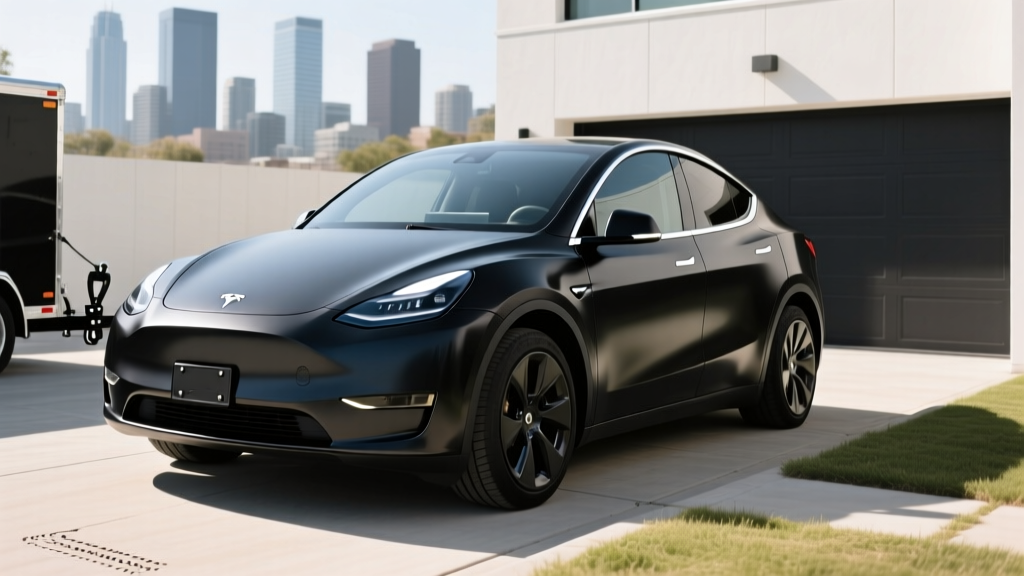
The Tesla Model Y is one of the best-selling electric vehicles in the United States, and for good reason: strong range, access to the Supercharger network, and a practical crossover footprint. But buyers who need to pull a small trailer, a pair of jet skis, or a lightweight camper have a specific question that spec sheets rarely answer fully: what is the real cost of using the Tesla Model Y tow capacity?
Towing with any EV is an exercise in physics. Aerodynamic drag and rolling resistance multiply at highway speeds, and a trailer can cut an electric vehicle's range by 30–50%. This review covers the 2026 Tesla Model Y's official tow rating, how towing affects real-world range and charging logistics, and whether the Model Y remains a sensible tow rig compared to electric truck and SUV alternatives.
Tesla Model Y Tow Capacity: Official Specs and What's Included
For the 2026 model year, Tesla rates the Model Y Long Range AWD and Performance variants at a maximum tow capacity of 3,500 pounds when equipped with the factory tow package. The base Rear-Wheel Drive (RWD) trim is not rated for towing and does not offer the hitch option from the factory.
| Trim | Drivetrain | Max Tow Capacity | Factory Tow Package | Tongue Weight Limit |
|---|---|---|---|---|
| Rear-Wheel Drive | RWD (single motor) | Not rated | Not available | N/A |
| Long Range AWD | Dual-motor AWD | 3,500 lbs | $1,000 (2" receiver) | 350 lbs |
| Performance | Dual-motor AWD | 3,500 lbs | $1,000 (2" receiver) | 350 lbs |
The factory tow package includes a 2-inch receiver hitch, a 4-pin wiring harness for trailer lights, and a software-enabled Tow Mode that adjusts throttle response, regenerative braking behavior, and stability control calibration for trailer loads. Tesla also integrates a trailer light check feature accessible from the touchscreen.
A critical limitation: the 350-pound tongue weight cap. This means lightweight utility trailers, small boat trailers, and compact teardrop campers are within spec, but many loaded cargo trailers or mid-size travel trailers will exceed the tongue weight limit well before hitting the 3,500-pound gross trailer weight ceiling. Always weigh your loaded trailer at a certified scale before hitching up.
Full Vehicle Specs: Range, Battery, and Efficiency
| Spec | RWD | Long Range AWD | Performance |
|---|---|---|---|
| EPA Range | ~300 mi | ~320 mi | ~295 mi |
| Battery (usable) | ~60 kWh (LFP) | ~75 kWh (NMC) | ~75 kWh (NMC) |
| MPGe (combined) | ~130 MPGe | ~122 MPGe | ~115 MPGe |
| Efficiency | ~26 kWh/100mi | ~28 kWh/100mi | ~30 kWh/100mi |
| 0–60 mph | ~6.5 sec | ~4.8 sec | ~3.5 sec |
| Horsepower | ~295 hp | ~384 hp | ~456 hp |
| Drivetrain | RWD | Dual-motor AWD | Dual-motor AWD |
| Tow Rating | Not rated | 3,500 lbs | 3,500 lbs |
The Long Range AWD uses an NMC (nickel manganese cobalt) battery pack, which offers higher energy density than the LFP (lithium iron phosphate) cells found in the RWD model. NMC packs deliver more range in a lighter package but are more sensitive to sustained 100% state-of-charge storage. LFP batteries, by contrast, can be charged to 100% daily without accelerated degradation — a useful trait if you need every mile of range before a tow trip.
The EPA estimates are measured under controlled conditions. In real-world driving at sustained highway speeds of 70–75 mph, expect the Long Range AWD to deliver approximately 260–280 miles. In cold weather (below 32°F), range can drop an additional 15–25% due to battery resistance and cabin heating demands. When towing, plan for significantly more reduction — detailed in the next section.
Towing Range Impact: The Physics Behind the Numbers
This is where the Tesla Model Y tow capacity story gets complicated. Towing doesn't just add weight — it adds aerodynamic drag, which is the dominant energy consumer at highway speeds. The energy required to overcome drag increases with the cube of velocity, meaning that pushing a boxy trailer through the air at 70 mph requires dramatically more energy than at 55 mph.
| Scenario | Trailer Type | Approx. Weight | Est. Range at 60 mph | Est. Range at 70 mph |
|---|---|---|---|---|
| No trailer | — | 0 lbs | ~280 mi | ~265 mi |
| Small utility trailer | Open, low-profile | 1,000 lbs | ~210 mi | ~185 mi |
| Lightweight camper | Teardrop, semi-aero | 2,000 lbs | ~175 mi | ~145 mi |
| Max-rated load | Boxy cargo trailer | 3,500 lbs | ~140 mi | ~110 mi |
These estimates are based on real-world EV towing tests from multiple owners and EV publications, which consistently show a 30–50% range reduction depending on trailer aerodynamics and speed. A sleek teardrop camper at 55 mph may only cut range by 30%, while a tall, flat-faced cargo trailer at 70 mph can slash range by more than half.
According to data compiled by the U.S. Department of Energy's fueleconomy.gov, EV efficiency drops significantly under high-load conditions, and towing represents one of the most demanding scenarios an EV powertrain faces.
If your trailer has a frontal area exceeding 25 square feet (most enclosed cargo trailers), plan your trip around charging stops every 100–130 miles at highway speeds. Use Tesla's built-in navigation with the trailer profile enabled — it will route you through Superchargers and adjust estimated arrival charge accordingly.
Charging While Towing: Speed, Logistics, and the Supercharger Advantage
Charging infrastructure is the make-or-break factor for EV towing. Here's what the 2026 Model Y delivers:
| Charging Level | Power | Speed / Time | Notes |
|---|---|---|---|
| Level 1 (120V) | ~1.4 kW | ~3–4 mi/hr | Emergency/top-up only |
| Level 2 (240V home) | ~11.5 kW | ~35–40 mi/hr | Full charge in ~7–8 hours |
| DC Fast Charge (peak) | ~250 kW | 10–80% in ~22 min | Peak rate not sustained; tapers above 50% |
| DC Fast (sustained avg.) | ~150–180 kW avg | 10–80% realistic ~25 min | Charge curve matters more than peak |
The Model Y's peak DC fast-charge rate of 250 kW is achievable only under ideal conditions: battery preconditioned to optimal temperature, state of charge below 20%, and a V3 or V4 Supercharger stall delivering full power. In practice, the charge curve tapers significantly above 50% SoC, and the 10–80% session averages closer to 150–180 kW.
The real advantage for towing is the Tesla Supercharger network. With over 6,000 Supercharger stalls in North America (as of early 2026), many locations now offer pull-through stalls designed for vehicles with trailers. This is a significant edge over CCS-equipped EVs, where pull-through DC fast chargers remain rare on non-Tesla networks like Electrify America and EVgo.
That said, not every Supercharger location has pull-through stalls. Before a towing trip, check the Supercharger details in the Tesla app or in-car navigation — sites marked with trailer-friendly access will save you from unhitching in a crowded parking lot.
Pricing, Tax Credits, and Total Cost
| Trim | Base MSRP | With Tow Package | Est. Federal Credit (§30D) | Effective Price |
|---|---|---|---|---|
| Rear-Wheel Drive | ~$44,990 | N/A | Up to $7,500* | ~$37,490 |
| Long Range AWD | ~$48,990 | ~$49,990 | Up to $7,500* | ~$42,490 |
| Performance | ~$52,990 | ~$53,990 | Up to $7,500* | ~$46,490 |
*Federal tax credit eligibility under IRS §30D is subject to multiple requirements. As of 2026, the credit is available as a point-of-sale reduction, but buyers must meet all of the following:
- MSRP cap: SUVs/crossovers must have an MSRP at or below $80,000 (all Model Y trims qualify)
- Income cap: Modified adjusted gross income must not exceed $150,000 (single), $225,000 (head of household), or $300,000 (joint filers)
- Battery sourcing: A percentage of critical minerals and battery components must be sourced from the U.S. or free-trade-agreement countries — this requirement tightens annually and may reduce the credit to $3,750 if only one of two sourcing thresholds is met
- FEOC restriction: Vehicles with battery components from a Foreign Entity of Concern are disqualified entirely
Always verify current eligibility on IRS.gov and consult a tax professional before relying on the credit. Tesla's checkout page typically displays whether a specific configuration qualifies for the full $7,500, partial $3,750, or no credit based on the latest sourcing data.
Cargo, Interior, and Daily Practicality
When you're not towing, the Model Y remains one of the most practical EVs in its class. The 2026 refresh (continuing the "Juniper" updates introduced in 2025) brought a quieter cabin, revised suspension tuning, and updated interior materials.
| Measurement | Value |
|---|---|
| Cargo (behind 2nd row) | ~30 cu ft |
| Cargo (2nd row folded) | ~72 cu ft |
| Front legroom | ~41.8 in |
| Rear legroom | ~38.4 in |
| Seating capacity | 5 (optional 7-seat available on LR AWD) |
| Frunk (front trunk) | ~4.1 cu ft |
The optional third row (available on Long Range AWD) is best suited for small children and reduces cargo space significantly when deployed. For buyers who need genuine 7-passenger space with towing capability, the Rivian R1S or Kia EV9 may be more appropriate — though both come at higher price points.
Driver Assistance, Tech, and Towing-Specific Features
The Model Y comes standard with Tesla's Basic Autopilot, which includes Traffic-Aware Cruise Control and Autosteer — an SAE Level 2 driver-assistance system. The driver must remain fully engaged with hands on the wheel and eyes on the road at all times.
Tesla's Autopilot and available Full Self-Driving (Supervised) are Level 2 systems. They do not make the Model Y autonomous. The driver is legally and operationally responsible for all vehicle control, especially when towing, where trailer sway and extended stopping distances require heightened attention.
Full Self-Driving (Supervised) is available as a $8,000 add-on or $99/month subscription and adds automatic lane changes, Navigate on Autopilot, and traffic light/stop sign recognition. When towing, FSD's lane-change behavior becomes more conservative, but Tesla recommends the driver take a more active role in steering and braking with a trailer attached.
Tow Mode, activated from the touchscreen, provides trailer sway mitigation, adjusts the regenerative braking profile to prevent trailer push, and enables the trailer light check sequence. The rear camera view can also be set to a wide-angle mode optimized for trailer alignment during hitching.
How the Model Y Stacks Up Against Towing Competitors
| Vehicle | Max Tow | EPA Range | Est. Range Towing (2,000 lbs) | Starting MSRP |
|---|---|---|---|---|
| Tesla Model Y LR AWD | 3,500 lbs | ~320 mi | ~145–175 mi | ~$48,990 |
| Ford F-150 Lightning (Ext. Range) | 10,000 lbs | ~320 mi | ~150–190 mi | ~$69,995 |
| Rivian R1S (Dual-Motor Max) | 7,700 lbs | ~352 mi | ~180–220 mi | ~$79,900 |
| Hyundai Ioniq 5 (AWD) | 2,300 lbs | ~290 mi | ~140–165 mi | ~$49,500 |
| Kia EV9 (AWD) | 5,000 lbs | ~270 mi | ~135–160 mi | ~$59,900 |
The Model Y occupies a specific niche: it's the most affordable EV with a 3,500-pound tow rating and access to the most mature fast-charging network. If your towing needs stay under 3,500 pounds and you value charging infrastructure and efficiency, the Model Y Long Range AWD is hard to beat on price.
If you need to tow heavier loads — a mid-size travel trailer, a horse trailer, or a large boat — you'll need to step up to the F-150 Lightning, Rivian R1S, or the upcoming electric pickups from GM and Ram. Those vehicles offer significantly higher tow ratings but come with higher prices, larger footprints, and (in most cases) less mature charging ecosystems.
Pros and Cons: Towing With the Model Y
- 3,500-lb rating covers most light trailers and watercraft
- Supercharger network with growing pull-through stall availability
- Tow Mode with trailer sway mitigation and regen adjustment
- Lowest cost-per-mile when not towing (~$0.04–0.06/mi at home rates)
- Excellent daily-driver efficiency when unhitched
- Over-the-air updates continue to improve tow-mode features
- Range drops to 110–175 mi when towing at highway speeds
- 350-lb tongue weight limit restricts trailer options
- Not all Supercharger locations have pull-through stalls
- RWD base trim cannot tow at all
- No spare tire — problematic for remote towing trips
- FSD (Supervised) less reliable with trailer attached
Who Should Buy the Model Y for Towing?
- Your trailer weighs under 2,500 lbs loaded (teardrop camper, small boat, utility trailer)
- You tow occasionally — weekends, vacations — not daily
- Your routes have reliable Supercharger coverage
- You want one vehicle that excels as a daily commuter AND a weekend tow rig
- Budget matters: you want EV towing under $50,000 before credits
Look elsewhere if:
- You regularly tow over 3,000 lbs or need a tongue weight above 350 lbs
- You tow in remote areas without Supercharger access
- You need a full-size spare tire for off-grid camping trips
- You need more than 5 seats with genuine adult-sized third-row space
Warranty Coverage
| Coverage | Term |
|---|---|
| Basic Vehicle | 4 years / 50,000 miles |
| Battery & Drive Unit (Long Range/Performance) | 8 years / 120,000 miles |
| Battery & Drive Unit (RWD — LFP) | 8 years / 100,000 miles |
| Battery Capacity Retention Threshold | 70% minimum over warranty period |
Tesla's battery warranty guarantees that the pack will retain at least 70% of its original capacity over the warranty term. Towing does not void the battery warranty, but sustained high-load use can accelerate degradation. Owners who tow frequently should monitor battery State of Health (SoH) via the Tesla app and avoid repeated 100% charges followed by heavy towing unless necessary for range.
Frequently Asked Questions
Can the Tesla Model Y tow a camper or travel trailer?
Yes, but with strict limits. The Model Y Long Range AWD and Performance can tow up to 3,500 lbs with a 350-lb tongue weight limit. This covers lightweight teardrop campers (typically 1,000–2,500 lbs) and small pop-up trailers. Most hard-sided travel trailers exceed the Model Y's rating. Expect range to drop to roughly 145–175 miles when towing a 2,000-lb camper at 60 mph.
Does towing affect the Model Y's battery warranty?
Towing within the rated capacity does not void Tesla's 8-year/120,000-mile battery warranty. However, frequent heavy towing can accelerate battery degradation due to sustained high-current discharge. Tesla's warranty covers capacity loss below 70% — if you tow regularly and notice accelerated degradation, the warranty still applies.
How far can the Model Y tow on a single charge?
Real-world towing range depends heavily on trailer aerodynamics, weight, speed, and temperature. With a 2,000-lb teardrop camper at 60 mph on a flat route, expect roughly 150–175 miles from the Long Range AWD. At 70 mph or with a boxy trailer, that drops to 110–145 miles. Plan charging stops conservatively and use Tesla's trip planner with the trailer profile enabled.
Are there Superchargers that accommodate trailers?
Yes. Tesla has been adding pull-through Supercharger stalls at select locations, primarily along major highway corridors and near recreational areas. As of early 2026, pull-through availability varies by region. Check the Supercharger details in the Tesla app before your trip — each station listing notes whether trailer-friendly stalls are available.
Does the Model Y qualify for the federal EV tax credit?
The Model Y qualifies for up to $7,500 under IRS §30D, available as a point-of-sale reduction, but only if you meet income caps ($150K single / $300K joint), and the specific vehicle's battery meets critical-mineral and component-sourcing requirements. These sourcing rules tighten annually. Check IRS.gov and Tesla's configurator for the latest eligibility status before ordering.
Is the Model Y a good tow vehicle compared to an electric truck?
For light loads under 2,500 lbs, the Model Y is an excellent tow vehicle — it's more efficient, less expensive, and easier to park than an electric truck. For loads above 3,000 lbs or frequent towing in remote areas, an electric truck like the F-150 Lightning offers higher capacity, a full-size spare, and more robust towing hardware. Match the vehicle to your actual trailer weight, not the maximum rating.
Sources: fueleconomy.gov (EPA range and efficiency data), Tesla.com Model Y specifications, IRS.gov Clean Vehicle Credits, NHTSA.gov safety ratings.