The 2024 VinFast VF8 occupies an unusual space in the electric SUV market. As the Vietnamese automaker's first volume model sold in the United States, it arrives with aggressive pricing, a subscription-based battery option that lowers the sticker price, and a dual-motor AWD powertrain standard on every trim. But early adopters have reported software quirks and efficiency figures that trail established rivals. This review breaks down the real numbers — EPA range, charging curves, ownership costs, and whether the VF8 earns a spot in your driveway against competitors like the Tesla Model Y, Hyundai IONIQ 5, and Ford Mustang Mach-E.
Quick Verdict: Who Should Consider the 2024 VinFast VF8?
The VF8 is a mid-size electric crossover aimed at buyers who want dual-motor AWD performance and distinctive styling without paying premium-badge prices. It suits urban commuters and small families who can charge at home and don't regularly exceed 200 miles between stops. However, its real-world highway efficiency and early-build software maturity make it a harder recommendation for road-trip-heavy buyers or those in charging-desert regions. If you prioritize a long warranty and unique design over polished infotainment, the VF8 deserves a test drive.
EPA Range, Battery, and Real-World Efficiency
The 2024 VinFast VF8 comes in two trims — Eco and Plus — both equipped with the same 82.7 kWh (usable) lithium-ion battery pack using NMC (nickel-manganese-cobalt) chemistry. The Eco trim is EPA-rated at 264 miles of range, while the heavier Plus trim drops slightly to 243 miles.
| Spec | VF8 Eco | VF8 Plus |
|---|---|---|
| EPA Range | 264 mi | 243 mi |
| Battery (Usable) | 82.7 kWh, NMC | 82.7 kWh, NMC |
| Drivetrain | Dual-motor AWD | Dual-motor AWD |
| Horsepower | 348 hp / 368 lb-ft | 402 hp / 457 lb-ft |
| 0–60 mph | ~5.5 sec (est.) | ~4.5 sec (est.) |
| EPA Efficiency | 87 MPGe / 39 kWh/100mi | 82 MPGe / 41 kWh/100mi |
| Max DC Fast Charge | ~160 kW (peak) | ~160 kW (peak) |
| 10–80% DC Charge | ~31 min | ~31 min |
| Level 2 (Home) Charge | 11 kW (~28 mi/hr) | 11 kW (~28 mi/hr) |
| Cargo Volume | ~14.1 cu ft (rear seats up) | ~14.1 cu ft (rear seats up) |
| Base MSRP | $46,000 (battery sub.) / $61,000 (battery incl.) | $51,000 (battery sub.) / $67,000 (battery incl.) |
Source: EPA fueleconomy.gov, VinFast US press specifications.
The VF8's efficiency of 39–41 kWh per 100 miles trails the class. For comparison, the Hyundai IONIQ 5 AWD achieves roughly 30 kWh/100mi, meaning the VF8 consumes about 30% more energy per mile. Over a year of driving 12,000 miles at $0.16/kWh, that difference translates to roughly $175 in additional electricity cost — not catastrophic, but a signal of the VF8's less aerodynamic profile and heavier curb weight (~5,600 lbs).
Charging Speed: DC Fast Charging and Home Level 2
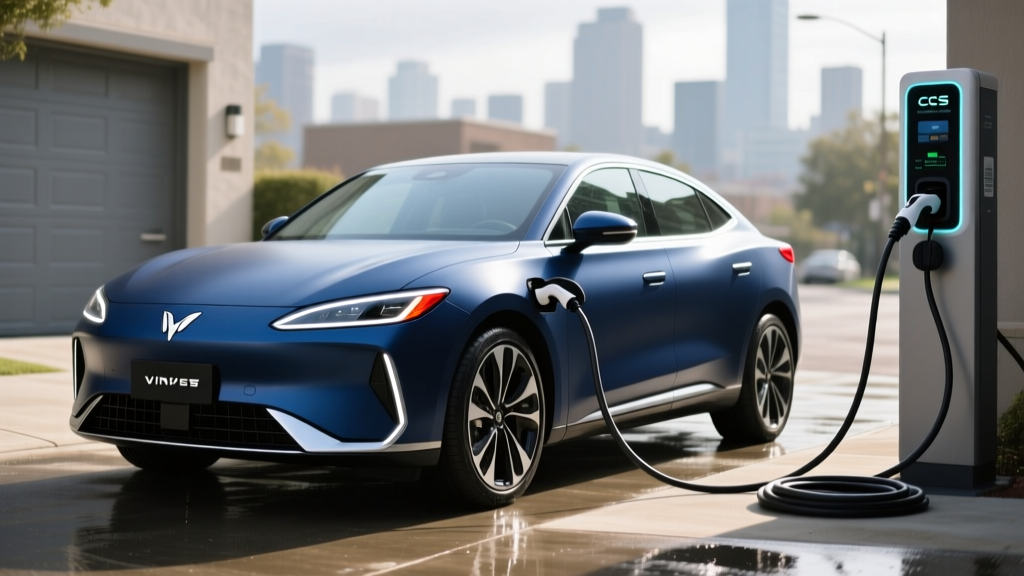
Charging speed is where many early VF8 owners have expressed frustration. The VF8 supports a peak DC fast-charge rate of approximately 160 kW via its CCS1 connector. Under ideal conditions (battery preconditioned, 10% SoC start, moderate ambient temperature), a 10–80% charge takes about 31 minutes.
| Charge Level | Power (kW) | Miles of Range Added per Hour | Typical Use Case |
|---|---|---|---|
| Level 1 (120V) | ~1.4 kW | ~3–4 mi/hr | Overnight trickle; emergency only |
| Level 2 (240V, 48A) | 11 kW | ~28 mi/hr | Home/workplace; full charge in ~8 hours |
| DC Fast Charge | Up to ~160 kW (peak) | ~300+ mi/hr (at peak) | Road trips; 10–80% in ~31 min |
For home Level 2 charging, the VF8's onboard charger accepts up to 11 kW. On a 48-amp, 240-volt circuit (the most common home EVSE setup), you'll add roughly 28 miles of range per hour. A full 0–100% charge takes approximately 8 hours, making overnight charging practical for daily driving needs.
Important note for home charging: A 48-amp EVSE requires a dedicated 60-amp circuit. If your electrical panel is near capacity (common in older homes), you may need a panel upgrade ($1,500–$3,000) in addition to the charger installation ($500–$1,200 for equipment and labor). Consult a licensed electrician for a site-specific assessment.
Performance and Driving Dynamics
Every 2024 VF8 ships with dual electric motors and all-wheel drive — a configuration that costs extra on many competitors. The Eco trim produces 348 horsepower and 368 lb-ft of torque, while the Plus trim bumps output to 402 hp and 457 lb-ft.
Acceleration is brisk in both trims. The Plus model's 0–60 mph time of approximately 4.5 seconds puts it in the same performance bracket as a Tesla Model Y Long Range, while the Eco's ~5.5-second run is adequate for highway merging and passing. The dual-motor setup provides confident traction in rain and light snow.
However, the VF8's ~5,600-pound curb weight is noticeable through corners. Body roll is more pronounced than in lighter rivals, and the regenerative braking calibration has drawn mixed reviews — some drivers find it inconsistent between the selectable regen levels. The VF8 does not offer true one-pedal driving that brings the car to a complete stop; you'll still need the friction brakes at low speeds.
Interior, Cargo Space, and Technology
The VF8's cabin is modern but polarizing. VinFast has stripped away nearly all physical controls, routing climate, media, and vehicle settings through a 15.6-inch center touchscreen. There is no traditional instrument cluster behind the steering wheel; instead, a head-up display (HUD) projects speed and navigation onto the windshield.
Passenger space is competitive for the mid-size crossover segment:
- Front legroom: ~41.3 inches
- Rear legroom: ~38.6 inches
- Cargo (behind rear seats): ~14.1 cu ft
- Cargo (rear seats folded): ~48.5 cu ft
The cargo volume is notably smaller than the Tesla Model Y (~30 cu ft behind the rear row) and the Hyundai IONIQ 5 (~27 cu ft). The VF8 does not have a front trunk (frunk), which further limits utility. For families who regularly haul strollers, groceries, or luggage, this is a meaningful drawback.
On the tech front, the VF8 includes:
- 15.6-inch center infotainment touchscreen
- Head-up display (HUD) replacing the instrument cluster
- Wireless Apple CarPlay and Android Auto
- Over-the-air (OTA) software update capability
- ADAS suite: adaptive cruise control, lane-keeping assist, automated emergency braking, blind-spot monitoring
Pricing, Trims, and Federal Tax Credit Eligibility
VinFast offers the VF8 in a unique pricing structure with two purchase paths:
- Battery subscription: Lower upfront price + monthly battery lease fee (~$150–$350/month depending on mileage tier). The battery remains VinFast's property.
- Battery included: Higher upfront price, but you own the battery outright — no monthly fee.
| Trim | Battery Subscription MSRP | Battery Included MSRP |
|---|---|---|
| VF8 Eco | $46,000 | $61,000 |
| VF8 Plus | $51,000 | $67,000 |
Federal §30D Tax Credit: Does the VF8 Qualify?
Under current IRS §30D rules, the federal clean vehicle credit offers up to $7,500 for qualifying new EVs. However, eligibility depends on multiple criteria:
- MSRP cap: SUVs must have an MSRP at or below $80,000. The VF8 (battery-included trims up to $67,000) clears this threshold.
- Buyer income cap: Modified adjusted gross income (MAGI) must not exceed $150,000 (single), $225,000 (head of household), or $300,000 (joint filers).
- Battery sourcing: A percentage of critical minerals and battery components must be sourced from the US or free-trade-agreement partners. VinFast's battery sourcing for US-market VF8 units has been a moving target — verify current-year eligibility on the IRS clean vehicle credit page or with your tax professional before purchase.
- Point-of-sale transfer: As of 2024, qualifying buyers can transfer the credit to the dealer at purchase, reducing the sale price directly rather than waiting for a tax refund.
- Final assembly: The vehicle must undergo final assembly in North America. VinFast's VF8 units sold in the US are assembled in Vietnam, which may disqualify the VF8 from the §30D new-vehicle credit entirely.
Warranty Coverage
VinFast backs the VF8 with one of the most generous warranties in the EV segment, signaling confidence in long-term reliability even as a new brand:
- Vehicle limited warranty: 7 years / 70,000 miles
- Battery and powertrain warranty: 10 years / 125,000 miles (capacity retention guaranteed above 70%)
- Roadside assistance: 7 years / 70,000 miles
The 10-year battery warranty exceeds the industry-standard 8-year/100,000-mile coverage offered by most competitors. For a first-generation product from a new automaker, this warranty provides meaningful peace of mind.
Pros and Cons
✓ Pros
- Dual-motor AWD standard on every trim
- Industry-leading 10-year battery warranty
- Bold, distinctive exterior design
- Battery subscription option lowers entry price
- Competitive 0–60 acceleration (Plus trim)
✗ Cons
- Below-average EPA range and efficiency vs. rivals
- Small cargo area and no frunk
- Software/infotainment maturity concerns
- DC fast charging peaks at 160 kW — slower than class leaders
- Likely ineligible for §30D federal tax credit (Vietnam assembly)
- High curb weight impacts handling and tire wear
VF8 vs. Key Competitors: Is It Worth Buying?
| Metric | VF8 Eco (AWD) | Tesla Model Y LR (AWD) | Hyundai IONIQ 5 (AWD) | Ford Mach-E (AWD ER) |
|---|---|---|---|---|
| EPA Range | 264 mi | 311 mi | 290 mi | 312 mi |
| Battery | 82.7 kWh NMC | ~75 kWh NMC | 77.4 kWh NMC | 91 kWh NMC |
| Peak DC Charge | ~160 kW | ~250 kW | ~240 kW | ~150 kW |
| 10–80% Time | ~31 min | ~20 min | ~18 min | ~38 min |
| Efficiency | 39 kWh/100mi | 28 kWh/100mi | 30 kWh/100mi | 33 kWh/100mi |
| Cargo (rear up) | 14.1 cu ft | 30.2 cu ft | 27.2 cu ft | 29.7 cu ft |
| Battery Warranty | 10 yr / 125k mi | 8 yr / 120k mi | 10 yr / 100k mi | 8 yr / 100k mi |
| Base MSRP (AWD) | $46,000 (sub.) | ~$48,000 | ~$50,000 | ~$49,000 |
Choose the VF8 If:
- You want standard AWD and a 10-year battery warranty at a competitive price
- You primarily drive under 200 miles daily and charge at home
- You value distinctive design over cargo utility
- You're comfortable with a newer brand and potential software growing pains
Choose a Competitor If:
- Tesla Model Y: You need maximum range, Supercharger access, and cargo space
- Hyundai IONIQ 5: You want the fastest DC charging (800V architecture, 18 min 10–80%)
- Ford Mach-E: You prefer a more established dealer/service network
Frequently Asked Questions
What is the real-world range of the 2024 VinFast VF8?
The EPA rates the VF8 Eco at 264 miles and the Plus at 243 miles. In real-world highway driving at 75 mph, expect roughly 210–230 miles (Eco). Cold weather (below freezing) can reduce that to 170–195 miles. City driving with regenerative braking will get you closer to the EPA sticker figure.
How fast does the VF8 charge at home and on the road?
On a Level 2 home charger (240V, 48A), the VF8 charges at up to 11 kW, adding about 28 miles of range per hour — a full charge takes ~8 hours. On DC fast chargers, it peaks at ~160 kW, reaching 10–80% in approximately 31 minutes under ideal conditions.
Does the 2024 VF8 qualify for the $7,500 federal EV tax credit?
Most likely not. The §30D credit requires final assembly in North America, and the VF8 is assembled in Vietnam. Verify current eligibility on fueleconomy.gov and consult a tax professional, as rules can change and VinFast may shift production.
How does the VF8 compare to the Tesla Model Y?
The Model Y Long Range AWD offers significantly more range (311 vs. 264 mi), faster DC charging (~250 kW peak vs. 160 kW), double the cargo space, and access to the Supercharger network. The VF8's advantages are its 10-year battery warranty and battery subscription pricing option. For most buyers, the Model Y remains the more versatile choice.
Is the battery subscription worth it?
The battery subscription lowers the upfront price by ~$15,000 but adds $150–$350/month indefinitely. If you plan to keep the VF8 for 5+ years, buying the battery outright is typically more economical. The subscription makes sense if you plan to sell within 3 years or want to avoid battery depreciation risk.
What is the VF8's towing capacity?
The 2024 VF8 is rated to tow up to approximately 3,300 pounds when properly equipped. Note that towing significantly reduces range — expect a 30–50% range reduction depending on trailer weight and aerodynamics.