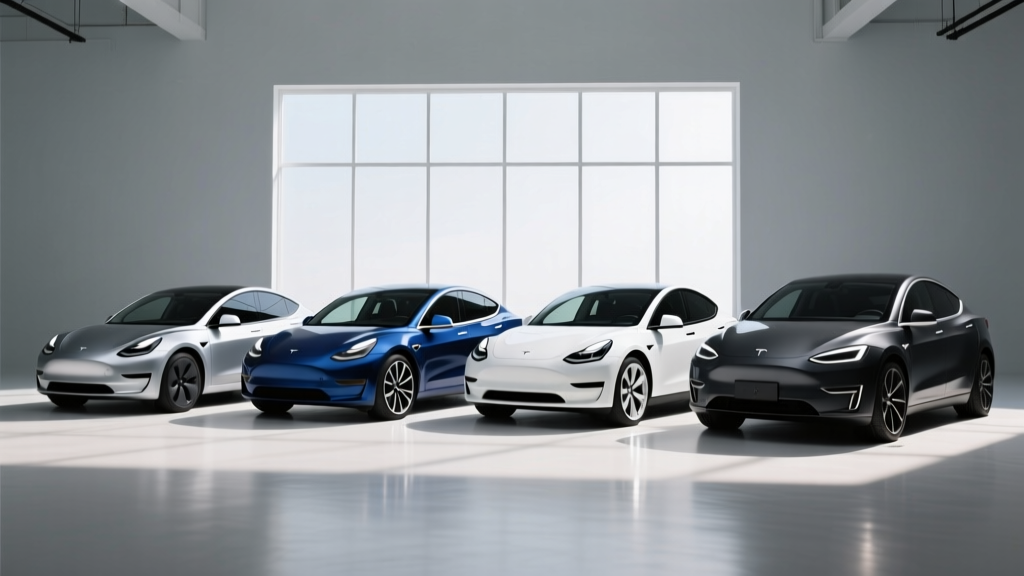
If you've been searching "how much is a 2024 Tesla," the answer depends heavily on which model you choose and how you configure it. Tesla's 2024 lineup spans from the refreshed Model 3 sedan starting around $38,990 to the Model X SUV crossing the $80,000 threshold — and the sticker price is only half the story. Federal tax credits, state incentives, charging costs, and real-world range all reshape what you actually pay to own one.
This guide walks through every current 2024 Tesla model with exact pricing, battery specs, charging speeds, and tax-credit eligibility so you can calculate your real out-of-pocket cost. We're writing from a 2026 market perspective, noting which 2024 models remain available as new or certified pre-owned inventory and how current pricing has shifted.
2024 Tesla Pricing at a Glance: Every Model and Trim
Tesla simplified its 2024 trim structure compared to prior years, dropping the old Standard Range and Long Range naming in some cases and consolidating around fewer configurations. Here's what the lineup looked like at launch, with notes on current availability.
| Model | Trim | Base MSRP | Drivetrain | EPA Range |
|---|---|---|---|---|
| Model 3 | RWD (Base) | $38,990 | Rear-Wheel Drive | 272 mi |
| Model 3 | Long Range AWD | $47,740 | Dual-Motor AWD | 341 mi |
| Model 3 | Performance | $52,990 | Dual-Motor AWD | 315 mi |
| Model Y | Long Range AWD | $48,990 | Dual-Motor AWD | 308 mi |
| Model Y | Performance | $52,490 | Dual-Motor AWD | 285 mi |
| Model S | Long Range | $74,990 | Dual-Motor AWD | 402 mi |
| Model S | Plaid | $89,990 | Tri-Motor AWD | 359 mi |
| Model X | Long Range | $79,990 | Dual-Motor AWD | 335 mi |
| Model X | Plaid | $94,990 | Tri-Motor AWD | 326 mi |
Availability note: As of 2026, new 2024 Model 3 and Model Y inventory is extremely limited at Tesla stores — most buyers are now looking at 2025 or 2026 model years, or certified pre-owned 2024 units. Model S and Model X continue with minor annual updates. The EPA's fueleconomy.gov database maintains official range and efficiency figures for all these configurations.
Real-World Range: What the EPA Sticker Doesn't Tell You
EPA estimates provide a standardized comparison, but real-world range varies significantly based on speed, temperature, and terrain. Tesla's thermal management systems are among the best in the industry, yet physics still applies.
Model 3 Long Range AWD: EPA 341 miles. Expect approximately 280–300 miles on a sustained highway trip at 70–75 mph. In winter conditions (below 32°F), plan for 220–260 miles depending on cabin heat usage and whether you precondition the battery.
Model Y Long Range AWD: EPA 308 miles. Highway real-world: ~250–275 miles. Winter: ~200–240 miles. The Model Y's taller, less aerodynamic profile costs it efficiency versus the Model 3 at speed.
Model S Long Range: EPA 402 miles. Highway real-world: ~330–360 miles. This is where the larger battery pack and superior aero pay dividends on road trips.
Tesla's navigation system factors in elevation, wind, and temperature when predicting arrival charge — a feature that makes range estimation more reliable than the EPA sticker alone. Still, if your commute includes sustained 80 mph interstate driving in January, budget for 25–35% less than the sticker number.
Battery Chemistry and Capacity: LFP vs. NMC in the 2024 Lineup
Tesla uses two distinct battery chemistries across its 2024 models, and the choice affects charging habits, longevity, and cold-weather performance.
| Model/Trim | Chemistry | Usable Capacity (kWh) | Charge Recommendation |
|---|---|---|---|
| Model 3 RWD | LFP (Lithium Iron Phosphate) | ~60 kWh | Charge to 100% regularly |
| Model 3 Long Range | NMC (Nickel Manganese Cobalt) | ~79 kWh | Daily limit 80%; 100% for trips |
| Model 3 Performance | NMC | ~79 kWh | Daily limit 80%; 100% for trips |
| Model Y Long Range | NMC | ~75 kWh | Daily limit 80%; 100% for trips |
| Model Y Performance | NMC | ~75 kWh | Daily limit 80%; 100% for trips |
| Model S / X Long Range | NMC | ~95 kWh | Daily limit 80%; 100% for trips |
| Model S / X Plaid | NMC | ~95 kWh | Daily limit 80%; 100% for trips |
LFP (base Model 3 RWD): Lithium iron phosphate batteries are heavier and less energy-dense, which is why the base Model 3 has lower range despite similar physical pack size. However, LFP cells degrade more slowly over time, tolerate frequent 100% charging without harm, and contain no cobalt or nickel. Tesla recommends charging LFP packs to 100% at least once a week for accurate state-of-charge calibration.
NMC (Long Range, Performance, Model S/X): Nickel manganese cobalt chemistry delivers higher energy density — more range in a lighter package. The trade-off: Tesla recommends setting your daily charge limit to 80% and only charging to 100% when you need the full range for a trip. Sustained 100% storage accelerates degradation in NMC cells.
Charging Speed: DC Fast Charging and Home Level 2
Charging speed is where Tesla still holds an edge over most competitors, thanks to the Supercharger network and efficient thermal preconditioning. Here's what to expect across the lineup.
| Model/Trim | Peak DC Fast Charge (kW) | 10–80% Time | Level 2 Home Rate (kW) | Miles Added per Hour (L2) |
|---|---|---|---|---|
| Model 3 RWD | 170 kW | ~25 min | 11.5 kW | ~44 mi/hr |
| Model 3 Long Range | 250 kW | ~22 min | 11.5 kW | ~44 mi/hr |
| Model 3 Performance | 250 kW | ~22 min | 11.5 kW | ~44 mi/hr |
| Model Y Long Range | 250 kW | ~24 min | 11.5 kW | ~40 mi/hr |
| Model Y Performance | 250 kW | ~24 min | 11.5 kW | ~40 mi/hr |
| Model S Long Range | 250 kW | ~27 min | 11.5 kW | ~41 mi/hr |
| Model X Long Range | 250 kW | ~29 min | 11.5 kW | ~36 mi/hr |
Charging curve reality check: The "250 kW" peak figure applies only in a narrow state-of-charge window (roughly 10–30% on a warm, preconditioned battery). By 50% SoC, charge rates taper to approximately 150 kW, and above 80% they drop below 60 kW. This is why the 10–80% time is the meaningful metric — charging from 80–100% can add another 25–40 minutes. On road trips, Tesla's navigation automatically routes you through Superchargers and preconditions the battery for optimal charge speed upon arrival.
Home charging: All 2024 Teslas accept up to 11.5 kW on a Level 2 (240V) home charger using a 48-amp circuit. Tesla's Wall Connector costs approximately $475 for the hardware; expect $500–$2,000 for professional installation depending on whether your electrical panel needs an upgrade. A full overnight charge adds enough range to cover virtually any daily commute.
For the 2024 model year, Tesla vehicles still shipped with the proprietary Tesla connector (now formalized as NACS). By 2025–2026, Tesla transitioned to the NACS standard natively, and adapters are available for legacy CCS stations. The Supercharger network — over 6,000 U.S. stalls — remains the most reliable public DC fast-charging ecosystem available.
Performance and Efficiency: 0–60, Horsepower, and MPGe
Even the base Model 3 RWD delivers performance that would have been considered sports-car territory a decade ago. Here's the full performance breakdown.
| Model/Trim | Horsepower | 0–60 mph | MPGe (Combined) | kWh/100 mi |
|---|---|---|---|---|
| Model 3 RWD | 271 hp | 5.8 sec | 132 MPGe | 25 kWh |
| Model 3 Long Range | 346 hp | 4.2 sec | 134 MPGe | 25 kWh |
| Model 3 Performance | 510 hp | 2.9 sec | 121 MPGe | 28 kWh |
| Model Y Long Range | 384 hp | 4.8 sec | 122 MPGe | 28 kWh |
| Model Y Performance | 456 hp | 3.5 sec | 115 MPGe | 30 kWh |
| Model S Long Range | 670 hp | 3.1 sec | 120 MPGe | 28 kWh |
| Model S Plaid | 1,020 hp | 1.99 sec | 116 MPGe | 29 kWh |
| Model X Long Range | 670 hp | 3.8 sec | 109 MPGe | 31 kWh |
| Model X Plaid | 1,020 hp | 2.5 sec | 105 MPGe | 32 kWh |
Efficiency is where Tesla's engineering shows. The Model 3 Long Range achieves 134 MPGe combined — roughly 4.0 miles per kWh — making it one of the most efficient EVs in its class. The Model Y, while slightly less aerodynamic, still posts strong numbers. For context, the average U.S. electricity cost of $0.16/kWh means a Model 3 Long Range owner pays approximately $4.00 to travel 100 miles, versus $12–$15 for a comparable 25 MPG gas sedan at $3.50/gallon.
Federal Tax Credit: Does a 2024 Tesla Qualify for $7,500?
The federal EV tax credit under IRS §30D is one of the most confusing aspects of EV purchasing. Here's the precise eligibility picture for 2024 Tesla models.
- MSRP cap: Sedans (Model 3) must be under $55,000. SUVs, trucks, and vans (Model Y, Model X) must be under $80,000. The Model S does NOT qualify — its base price exceeds the $55,000 sedan cap.
- Buyer income cap: Modified AGI must not exceed $150,000 (single), $225,000 (head of household), or $300,000 (married filing jointly).
- Battery sourcing: At least 50% of battery components must be manufactured or assembled in North America (2024 requirement). Critical minerals must meet a separate threshold of 40% from the U.S. or FTA partners. Tesla's Fremont and Austin-built vehicles generally meet these requirements, but verify at fueleconomy.gov for your specific VIN.
- Point-of-sale transfer: As of 2024, you can transfer the credit to the dealer at purchase, reducing your out-of-pocket cost immediately rather than waiting for a tax refund. Tesla supports this at checkout.
- New vs. used: The $7,500 credit applies to new vehicles only. A separate used-EV credit (up to $4,000) applies to qualifying pre-owned Teslas under $25,000 from a licensed dealer.
Source: IRS §30D guidance. Tax eligibility rules change — consult a tax professional for your situation.
| Model/Trim | MSRP | §30D Credit | Effective Price | Qualifies? |
|---|---|---|---|---|
| Model 3 RWD | $38,990 | $7,500 | $31,490 | Yes (if income/sourcing met) |
| Model 3 Long Range AWD | $47,740 | $7,500 | $40,240 | Yes |
| Model 3 Performance | $52,990 | $7,500 | $45,490 | Yes (under $55K sedan cap) |
| Model Y Long Range AWD | $48,990 | $7,500 | $41,490 | Yes |
| Model Y Performance | $52,490 | $7,500 | $44,990 | Yes |
| Model S Long Range | $74,990 | $0 | $74,990 | No (exceeds $55K sedan cap) |
| Model X Long Range | $79,990 | $7,500 | $72,490 | Yes (under $80K SUV cap) |
The Model 3 RWD at an effective $31,490 after the federal credit represents one of the lowest entry points into a new Tesla — competitive with mid-trim Toyota Camrys once you factor in fuel savings. The Model X Long Range just squeaks under the $80,000 SUV cap, making it eligible, while the Model X Plaid at $94,990 does not qualify.
Cargo Space, Interior, and Technology
Tesla's minimalist interior philosophy remains polarizing, but the practical utility is hard to argue with.
Model 3 (Highland refresh): The 2024 Model 3 received a significant interior refresh with improved sound insulation, ventilated front seats, ambient lighting, and a rear touchscreen for passengers. Cargo: 23 cu ft (trunk + frunk combined). Rear legroom: 35.2 inches — adequate for adults but tight for taller passengers on long trips.
Model Y: The best-selling vehicle in the world in 2023 for good reason. Cargo: 76 cu ft with rear seats folded (34 cu ft behind the second row). Available 7-seat configuration adds a small third row suitable only for children. Rear legroom: 41.6 inches — genuinely spacious.
Model S: 28 cu ft cargo (trunk + frunk). The hatchback design provides more practical loading than a traditional sedan trunk. Rear legroom: 35.4 inches. The yoke steering wheel remains optional; a conventional round wheel is standard.
Model X: Up to 88 cu ft of cargo with seats folded. Available in 5-, 6-, or 7-seat layouts. The falcon-wing rear doors provide excellent access in tight parking spaces but add mechanical complexity.
Technology highlights across all 2024 models:
- 15.4-inch center touchscreen (Model 3/Y) or 17-inch (Model S/X)
- Over-the-air software updates that add features post-purchase
- Tesla Autopilot (SAE Level 2 driver assistance) included standard — adaptive cruise, lane centering, automatic emergency braking
- Full Self-Driving (Supervised) available as a $8,000 add-on or $99/month subscription — still requires active driver supervision at all times
- Phone-as-key with Bluetooth proximity unlock
- Sentry Mode dashcam recording and theft deterrent
- Integrated trip planner with Supercharger routing and battery preconditioning
Tesla's Autopilot and Full Self-Driving (Supervised) are SAE Level 2 driver-assistance systems. Despite the "Full Self-Driving" name, the driver must remain fully engaged, hands on the wheel (or providing torque input), and eyes on the road at all times. The system does not make the vehicle autonomous. Only Level 4 robotaxi services like Waymo operate without a human driver. See NHTSA's guidance on automated driving for the full framework.
Warranty Coverage and Long-Term Ownership
Tesla's warranty structure is straightforward but less generous than some competitors like Hyundai (10-year/100,000-mile battery coverage).
| Coverage | Model 3/Y | Model S/X |
|---|---|---|
| Basic Vehicle | 4 years / 50,000 miles | 4 years / 50,000 miles |
| Battery & Drive Unit | 8 years / 100,000 mi (RWD) 8 years / 120,000 mi (LR/Perf) | 8 years / 150,000 miles |
| Battery Capacity Guarantee | Minimum 70% retention over warranty period | Minimum 70% retention over warranty period |
The 70% capacity retention threshold is the key number: if your battery degrades below 70% of its original capacity within the warranty window, Tesla will replace or refurbish it. Real-world data from high-mileage Tesla owners suggests average degradation of approximately 10–12% after 100,000 miles for NMC packs, with the steepest drop occurring in the first 20,000 miles before leveling off. LFP packs in the Model 3 RWD show even slower degradation curves.
Out-of-warranty battery replacement: A Model 3/Y battery replacement costs approximately $12,000–$16,000 at a Tesla service center. Model S/X replacements run $18,000–$22,000. These costs have been declining as Tesla's remanufacturing capabilities improve.
Pros, Cons, and the Verdict: Is a 2024 Tesla Worth It?
Pros
- Supercharger network access — the most reliable public charging ecosystem
- Industry-leading efficiency (kWh/100mi) translates to lower charging costs
- Over-the-air updates continuously improve the vehicle
- Strong resale value relative to most EVs
- Model 3 RWD at ~$31,500 after tax credit is exceptional value
- Class-leading performance across every trim
- Excellent thermal management preserves battery health
Cons
- Minimalist interior lacks physical controls — everything through the touchscreen
- Panel gap and paint quality inconsistencies still reported
- No Apple CarPlay or Android Auto support
- FSD subscription cost ($99/mo) adds up without delivering true autonomy
- Insurance premiums run 15–30% higher than comparable gas vehicles
- Service center wait times can stretch weeks in some markets
- Model S/X pricing exceeds federal tax credit caps for sedans
Decision Framework
Choose the Model 3 RWD if: You want the most affordable entry into the Tesla ecosystem, commute under 60 miles daily, have reliable home charging, and value simplicity. At $31,490 after the tax credit, it undercuts most competitors on total cost of ownership.
Choose the Model 3 Long Range if: You take regular road trips, live in a cold-weather state, or want dual-motor AWD traction. The 341-mile EPA range provides the most buffer for real-world highway and winter driving.
Choose the Model Y Long Range if: You need family SUV practicality, cargo space, and the option for a third row. It's the best-selling Tesla for a reason — it does everything reasonably well.
Choose the Model S/X if: Budget is less of a concern, you want maximum range (Model S) or maximum space (Model X), and you accept that the sedan won't qualify for the federal tax credit.
Look at competitors if: You want Apple CarPlay (BMW i4, Hyundai Ioniq 6), a more traditional luxury interior (BMW iX, Mercedes EQE), or a longer battery warranty (Hyundai/Kia 10-year coverage).
Frequently Asked Questions
What is the cheapest 2024 Tesla you can buy?
The 2024 Model 3 RWD at $38,990 MSRP is the most affordable new Tesla. After the $7,500 federal tax credit (if you meet income and sourcing requirements), the effective price drops to approximately $31,490. Certified pre-owned 2024 Model 3 RWD units may be available for $28,000–$33,000 depending on mileage and condition.
How much does it cost to charge a 2024 Tesla at home?
At the U.S. average electricity rate of $0.16/kWh, fully charging a Model 3 Long Range (79 kWh usable) costs about $12.64. A Model Y Long Range (75 kWh) costs about $12.00. Most owners charge overnight on a Level 2 home charger and never visit a gas station. Supercharger rates vary by location, typically $0.25–$0.40/kWh, making a full DC fast charge roughly $20–$32.
Does the 2024 Model Y qualify for the $7,500 tax credit?
Yes. The 2024 Model Y (both Long Range at $48,990 and Performance at $52,490) falls under the $80,000 MSRP cap for SUVs. Eligibility still depends on your income (under $150K single / $300K joint), battery component sourcing (Tesla's U.S.-built vehicles generally qualify), and purchasing new from Tesla. You can transfer the credit at point of sale to reduce your purchase price immediately.
Is Tesla's Full Self-Driving worth the $8,000 cost?
For most buyers, no — not at the current price. FSD (Supervised) is an SAE Level 2 system that requires constant driver attention. It handles highway lane changes, stoplight recognition, and some city driving competently, but it is not autonomous and makes errors that require human intervention. The $99/month subscription is a lower-risk way to try the feature. Unless you drive extensively on highways and find the assistive features reduce fatigue, the standard Autopilot (included free) covers adaptive cruise and lane centering adequately.
How does a 2024 Tesla compare to the Hyundai Ioniq 6 or BMW i4?
The Model 3 Long Range ($47,740) offers more range (341 vs. 361 miles for the Ioniq 6 SEL, though the Ioniq 6 is slightly higher), faster Supercharger network access, and stronger software integration. The Hyundai Ioniq 6 counters with Apple CarPlay, a more conventional interior, and a 10-year battery warranty. The BMW i4 offers superior build quality and driving dynamics at a higher price ($52,200+). If Supercharger access and software matter most, Tesla wins. If interior quality and traditional controls matter more, look at Hyundai or BMW.
What happens to a Tesla battery after 100,000 miles?
Real-world data from fleet operators and high-mileage owners shows NMC Tesla batteries typically retain 88–92% of original capacity at 100,000 miles. Degradation is front-loaded — you'll see the most capacity loss (5–8%) in the first 20,000–30,000 miles, then the curve flattens considerably. LFP batteries in the Model 3 RWD show even less degradation. The 8-year/100,000–150,000-mile warranty provides a safety net, though most batteries outlast the warranty period without requiring replacement.