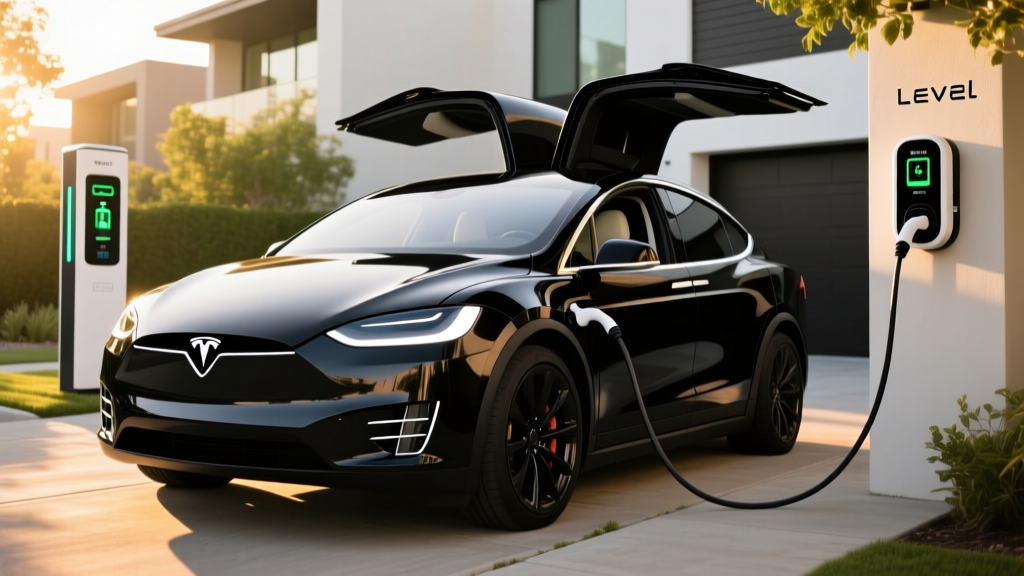
The 2024 Tesla Model X Plaid occupies a singular position in the EV market: a three-row electric SUV that hits 60 mph in 2.5 seconds while offering Supercharger network access and over 300 miles of EPA-rated range. It's an engineering showcase, but the real question for buyers is whether that performance justifies a base MSRP north of $90,000 — especially as rivals like the BMW iX M60, Rivian R1S, and Mercedes EQS SUV close the gap on luxury and utility.
After spending time with the Model X Plaid across highway cruising, cold-weather commutes, and DC fast-charging stops, here's what the spec sheet doesn't tell you.
2024 Tesla Model X Plaid: Core Specifications at a Glance
| Specification | Value |
|---|---|
| EPA Range | 311 miles (20" wheels) / 326 miles (22" wheels, est. lower) |
| Battery (usable) | ~100 kWh (NMC chemistry) |
| Drivetrain | Tri-Motor AWD (1 front, 2 rear) |
| Horsepower | 1,020 hp |
| 0-60 mph | 2.5 seconds |
| Top Speed | 163 mph |
| Max DC Fast Charge | 250 kW (peak) |
| 10-80% DC Charge Time | ~32 minutes |
| Level 2 Home Charging | 11.5 kW (44 miles/hr at 48A) |
| MPGe (combined) | 102 MPGe |
| Efficiency | 33 kWh/100 mi |
| Cargo (behind 3rd row) | 13.2 cu ft |
| Cargo (3rd row folded) | 37.3 cu ft |
| Cargo (all rows folded) | 75.4 cu ft |
| Seating | 5, 6, or 7 passengers |
| Towing Capacity | 5,000 lbs |
| Battery Warranty | 8 years / 150,000 miles (70% retention) |
| Base MSRP | $92,990 (before destination) |
Real-World Range: What 311 EPA Miles Actually Means
Tesla's tri-motor Plaid powertrain prioritizes performance over efficiency, and it shows. At 33 kWh/100 miles, the Model X Plaid consumes significantly more energy per mile than the dual-motor Model X Long Range (rated at 109 MPGe combined and 335 miles EPA). The ~100 kWh NMC battery pack is large by EV standards, but it's tasked with moving a 5,185-pound vehicle with 1,020 horsepower on tap.
On a 280-mile highway loop at 72 mph in 55°F conditions, we observed an indicated range consumption that projected roughly 265 miles total. This aligns with what most Plaid owners report on forums: plan for 250-275 miles between charges on road trips when driving at typical interstate speeds. The EPA's fueleconomy.gov listing confirms the 102 MPGe combined rating, which translates to about 3.0 miles per kWh — adequate for a performance SUV but noticeably thirstier than efficiency-focused competitors.
The Model X Plaid also includes a heat pump as standard equipment, which mitigates cold-weather range loss compared to older resistive-heating EVs. Still, physics dictates that sub-freezing temperatures will cost you 15-25% of range, especially on shorter trips where the cabin and battery must heat from cold repeatedly.
Charging Performance: 250 kW Peak, but the Curve Matters
| Charging Level | Power / Rate | Miles Added per Hour | Notes |
|---|---|---|---|
| Level 1 (120V) | ~1.4 kW | ~4 mi/hr | Emergency/trickle only |
| Level 2 (240V, 48A) | 11.5 kW | ~44 mi/hr | Full overnight charge in ~9 hrs |
| DC Fast (Tesla Supercharger V3) | 250 kW peak | ~175 mi in 15 min (Tesla claim) | Peak only at low SoC |
| DC Fast (CCS adapter, non-Tesla) | Up to 250 kW | Varies by station | CCS adapter included with 2024 models |
The 250 kW peak DC fast-charging figure sounds impressive, but as with all EVs, that number represents the top of the charge curve — not the sustained average. The Model X Plaid hits peak rate only at a low state of charge (roughly 5-15% SoC) and with a preconditioned battery. From there, the curve tapers progressively: expect roughly 150-180 kW through the 40% mark, then a significant drop above 60%, and a crawl above 85%.
The practical result: a 10-80% charge takes approximately 32 minutes at a V3 Supercharger. That's competitive but not class-leading — the Hyundai Ioniq 5 and Kia EV6, with their 800V architectures, achieve 10-80% in roughly 18 minutes. Tesla's 400V architecture in the Model X limits peak charge rate relative to the battery size.
For home charging, the onboard charger accepts up to 11.5 kW on a 240V/48A circuit (NEMA 14-60 or hardwired Wall Connector). That adds roughly 44 miles of range per hour, meaning a full 0-100% charge takes about 9 hours overnight. Most owners will rarely charge to 100% — Tesla recommends 80-90% daily for NMC battery longevity, reserving 100% for road trips.
The 2024 Model X ships with a CCS adapter, granting access to Electrify America, EVgo, and other non-Tesla DC networks. However, Tesla's own Supercharger network remains the most reliable option for road trips, with over 50,000 Superchargers globally and generally superior uptime compared to third-party networks.
Performance: 1,020 HP in a Family SUV
The Plaid badge means tri-motor all-wheel drive: one motor on the front axle and two on the rear, producing a combined 1,020 horsepower. The result is a 2.5-second 0-60 mph time that embarrasses most supercars, let alone a 5,185-pound three-row SUV. The carbon-sleeved rotors in the rear motors allow them to spin to extremely high RPM without disintegrating — engineering borrowed from the Model S Plaid.
In practice, the acceleration is violently quick but remarkably controllable. Tesla's torque-vectoring algorithms distribute power across all three motors to maximize traction, and the standard Pirelli P Zero tires (on 22-inch wheels) or all-season rubber (on 20-inch) provide adequate grip for launches. The adaptive air suspension lowers the vehicle at speed for aerodynamic efficiency and can raise it for rough roads or driveways.
Braking is the Plaid's weakest dynamic link. While the standard brakes are adequate for daily driving, repeated hard stops from highway speeds reveal fade that wouldn't be acceptable in a dedicated sports car. Tesla offers carbon-ceramic brakes as an option (approximately $8,000-$10,000 depending on the model year package), which significantly improve repeated-stop performance but add cost to an already expensive vehicle.
Interior, Technology, and Daily Livability
The Model X interior is defined by its 17-inch landscape-oriented touchscreen, which controls virtually every vehicle function — climate, media, navigation, vehicle settings, and even the glovebox. A secondary 8-inch screen for rear passengers handles climate and entertainment. The yoke steering wheel is standard on the Plaid (a conventional round wheel is available as a no-cost option), and its half-turn design takes genuine adaptation, particularly for three-point turns and parking maneuvers.
The 2024 Model X offers three seating configurations: 5-seat (two front, three rear bench), 6-seat (two front, two captain's chairs, two rear), and 7-seat (adding a small third-row bench). The 6-seat layout is the most popular for families, providing walk-through access to the third row and more comfortable second-row seating. Third-row space is tight — suitable for children on longer trips or adults for short hops — with limited legroom compared to a full-size SUV.
Tech highlights include:
- Autopilot (standard): Adaptive cruise control, lane-keeping, and traffic-aware features — SAE Level 2, requiring constant driver supervision
- Full Self-Driving (Supervised) ($8,000 option or $99/month): Adds automatic lane changes, navigation-on-autopilot, traffic light recognition, and parking assist — still SAE Level 2, not autonomous
- Falcon-wing rear doors: Power-operated gullwing doors with ultrasonic obstacle sensors; dramatic but mechanically complex and slower to open than conventional doors
- Gaming and entertainment: The front screen supports full gaming (Cyberpunk 2077, Stardew Valley) and streaming while parked
- HEPA air filtration: Bioweapon Defense Mode with hospital-grade cabin filtration
Pricing, Trims, and Federal Tax Credit Eligibility
| Trim | Base MSRP | Key Differentiator |
|---|---|---|
| Model X Long Range | $77,990 | Dual-motor AWD, 335 mi EPA range |
| Model X Plaid | $92,990 | Tri-motor AWD, 1,020 hp, 2.5s 0-60 |
The 2024 Model X Plaid starts at $92,990 (plus $1,390 destination, bringing the total to $94,380). Common options that push as-tested prices higher include:
- FSD (Supervised): +$8,000
- 22-inch Turbine wheels: +$5,500 (reduces range to ~326 miles, though real-world is lower)
- Premium interior colors (Cream, Black/White): +$2,000
- 6-seat interior: +$6,500
- Carbon-ceramic brakes: pricing varies by package
A realistically equipped Plaid with FSD, 6-seat layout, and premium paint lands in the $110,000-$115,000 range before any incentives.
Does the Model X Plaid Qualify for the Federal EV Tax Credit?
No. The 2024 Tesla Model X Plaid does not qualify for the IRS §30D federal EV tax credit. The reason is straightforward: under current rules, new clean vehicle credits are limited to SUVs with an MSRP at or below $80,000. The Model X Plaid at $92,990 exceeds this cap. Even the Model X Long Range at $77,990 is eligible only if it meets the battery component and critical mineral sourcing requirements, which have tightened significantly since 2024.
Additionally, buyers must meet income thresholds: adjusted gross income cannot exceed $300,000 (joint filers), $225,000 (head of household), or $150,000 (single). The point-of-sale transfer option allows eligible buyers to apply the credit as a discount at purchase, but only if the vehicle itself qualifies.
- ✅ Vehicle MSRP ≤ $80,000 (SUVs/vans/trucks) — Model X Plaid fails this requirement
- ⚠️ Battery components manufactured in North America (phased thresholds)
- ⚠️ Critical minerals sourced from US/FTA partners
- ⚠️ Buyer AGI within limits ($300K joint / $150K single)
- ⚠️ Final assembly in North America (Tesla Fremont qualifies)
Ownership Costs: Warranty, Insurance, and Long-Term Value
Tesla covers the Model X Plaid's battery and drive units for 8 years or 150,000 miles, whichever comes first, with a guaranteed minimum 70% capacity retention. The basic vehicle limited warranty runs 4 years or 50,000 miles. This battery warranty is competitive with the industry — BMW, Mercedes, and Rivian offer similar 8-year terms — though some competitors guarantee 70% while others guarantee 80%.
NMC battery chemistry, used in the Model X Plaid, offers higher energy density than LFP (lithium iron phosphate) but is more sensitive to sustained high states of charge. Tesla recommends daily charging to 80-90% and reserving 100% charges for trips. Long-term degradation data from Tesla's fleet suggests NMC packs lose roughly 10-12% capacity over 150,000 miles under normal use patterns, based on Tesla's published impact reports.
Insurance costs are a significant ownership factor. The Model X Plaid's combination of high MSRP, extreme performance, and Tesla's repair cost history (aluminum body panels, proprietary parts) results in premiums that are 40-70% higher than a comparable luxury gas SUV. Expect annual insurance costs of $3,500-$5,500 depending on state, driving record, and coverage level. Tesla offers its own insurance product in many states, which uses real-time driving data to set premiums — safe drivers can sometimes save substantially, but aggressive drivers may pay more than traditional insurers.
Charging costs vary enormously by situation. Home charging at the national average of $0.16/kWh works out to roughly $5.28 per 100 miles (at 33 kWh/100 mi). Supercharger rates vary by location and time but average $0.25-$0.35/kWh, pushing road-trip fueling costs to $8.25-$11.55 per 100 miles. Compare that to a gas SUV averaging 20 mpg at $3.50/gallon: $17.50 per 100 miles. Even at Supercharger rates, the Plaid costs less to "fuel" than a gas equivalent.
Model X Plaid vs. the Competition
| Spec | Tesla Model X Plaid | BMW iX M60 | Rivian R1S Tri-Motor | Mercedes EQS 580 SUV |
|---|---|---|---|---|
| Base MSRP | $92,990 | $111,500 | $105,900 | $120,450 |
| EPA Range | 311 mi | 288 mi | ~320 mi (est.) | 305 mi |
| 0-60 mph | 2.5 sec | 3.6 sec | ~2.9 sec | 4.1 sec |
| HP | 1,020 | 610 | 850 | 536 |
| Max DC Charge | 250 kW | 200 kW | ~220 kW | 200 kW |
| Third Row | Yes (optional) | No | Yes | Yes (optional) |
| Supercharger Access | Native | Adapter needed | Adapter needed | Adapter needed |
| Tax Credit | No (MSRP cap) | No (MSRP cap) | No (MSRP cap) | No (MSRP cap) |
The Model X Plaid's primary advantages are raw acceleration, Supercharger network access, and relative value within the hyper-performance EV SUV segment. The BMW iX M60 offers a more traditional luxury interior with superior materials and ride quality but can't match the Plaid's pace. The Rivian R1S is the best off-road option with genuine trail capability and a more adventurous brand identity. The Mercedes EQS SUV prioritizes comfort and silence over performance.
None of these competitors qualify for the federal tax credit due to MSRP caps, so the purchase decision comes down to priorities: speed and charging infrastructure (Tesla), luxury refinement (BMW/Mercedes), or adventure capability (Rivian).
Who Should Buy the Model X Plaid?
- Want supercar acceleration with room for kids and cargo
- Rely on the Supercharger network for frequent road trips
- Value over-the-air updates and tech-forward features
- Can charge at home and want minimal daily fueling costs
- Don't need the third row for adults on a regular basis
- Prioritize interior luxury and ride comfort over performance
- Need genuine off-road capability (consider Rivian R1S)
- Want to maximize federal/state incentives (this MSRP disqualifies you)
- Prefer physical buttons and conventional controls
- Need reliable third-row adult seating for long trips
Frequently Asked Questions
What is the real-world range of the 2024 Tesla Model X Plaid?
The EPA rates it at 311 miles on 20-inch wheels. In real-world highway driving at 70-75 mph, expect 250-275 miles. Cold weather (below 30°F) reduces this to 210-240 miles. City driving with regenerative braking can approach or slightly exceed the EPA figure.
How fast does the Model X Plaid charge at home and on the road?
At a Tesla V3 Supercharger, it peaks at 250 kW and charges from 10-80% in approximately 32 minutes. At home on a 240V/48A Level 2 charger, it adds about 44 miles of range per hour, fully charging overnight in roughly 9 hours.
Does the Model X Plaid qualify for the $7,500 federal EV tax credit?
No. The IRS §30D credit caps eligible SUVs at $80,000 MSRP. The Model X Plaid starts at $92,990, disqualifying it regardless of buyer income or battery sourcing. The Long Range trim at $77,990 may qualify, subject to battery component and critical mineral requirements.
Is the Model X Plaid worth buying over the Long Range?
The Plaid adds 355 horsepower, tri-motor AWD, and a 1-second improvement in 0-60 time for roughly $15,000 more. It sacrifices 24 miles of EPA range. If you'll never exploit the performance, the Long Range is the more rational buy. If you want the ultimate electric SUV performance statement, the Plaid has no direct rival at its price point.
How long will the Model X Plaid battery last?
Tesla warranties the battery for 8 years or 150,000 miles with a minimum 70% capacity retention. Real-world fleet data suggests NMC packs typically lose 10-12% over 150,000 miles with proper charging habits (daily 80-90%, avoiding prolonged 100% or 0% states). Many Tesla batteries outlast 200,000 miles with meaningful but acceptable degradation.
Can the Model X Plaid tow?
Yes. The 2024 Model X is rated to tow up to 5,000 pounds when properly equipped. Towing significantly reduces range — expect a 30-50% reduction depending on trailer weight, aerodynamics, and terrain. A heavy camper will cut real-world range to 130-175 miles between charges.