Quick Verdict: The Performance Sedan Benchmark Gets Sharper
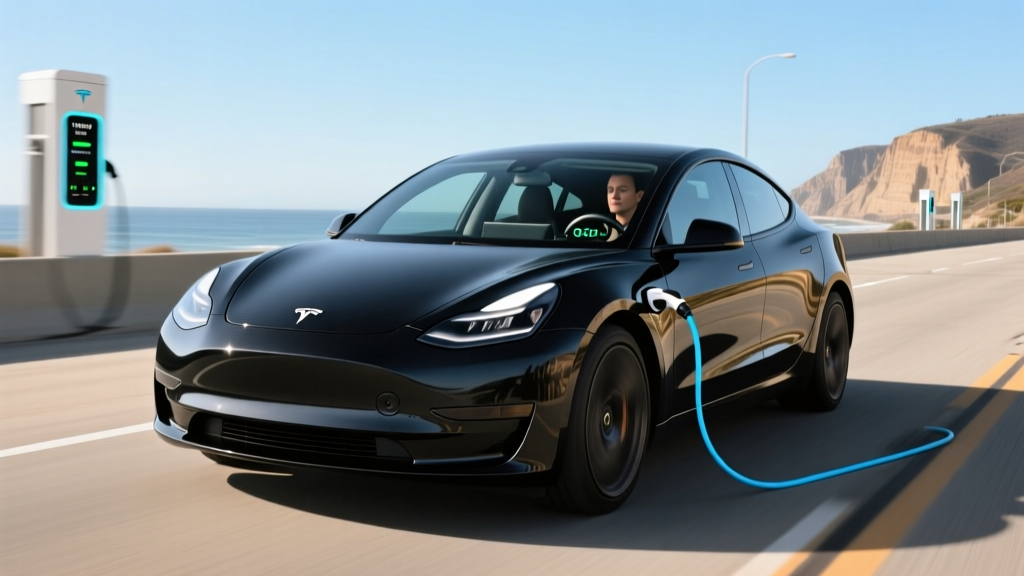
The 2024 Tesla Model 3 Performance (internally called the "Highland" refresh) is not just a carryover with a new badge. Tesla reworked the suspension, added adaptive dampers, revised the interior, and squeezed out a 2.9-second 0-60 mph time that embarrasses cars costing three times as much. But beyond the headline acceleration, this is a 315-mile EPA-range daily driver with access to the most reliable DC fast-charging network in North America. For buyers cross-shopping the BMW i4 M50, Hyundai Ioniq 6 N, or Polestar 2, the Model 3 Performance remains the spec-sheet king — though interior material quality and the touchscreen-only interface continue to divide owners.
| Spec | Value |
|---|---|
| EPA Range | 315 miles |
| Battery (usable) | ~75 kWh, NMC (Nickel Manganese Cobalt) |
| Drivetrain | Dual-Motor AWD |
| Horsepower | 510 hp (combined) |
| 0-60 mph | 2.9 seconds (manufacturer, rollout subtracted) |
| Top Speed | 163 mph |
| Max DC Fast Charge | 250 kW peak |
| 10-80% DC Time | ~25 minutes |
| Level 2 Home Charge | 11.5 kW (~44 mi/hr) |
| MPGe (combined) | 121 MPGe |
| Efficiency | 28 kWh/100 mi |
| Cargo Volume | 23 cu ft (rear trunk + frunk) |
| Base MSRP | $54,990 (incl. destination) |
| Battery Warranty | 8 years / 120,000 miles (70% retention) |
2024 Tesla Model 3 Performance 0-60 and Driving Dynamics
The number that defines this car: 2.9 seconds to 60 mph. Tesla rates this with a 1-foot rollout subtracted, which is standard for performance claims. In independent testing by outlets like Car and Driver and Motor Trend, the 2024 Model 3 Performance consistently hits 2.9–3.1 seconds depending on surface and tire temperature. That puts it ahead of the BMW i4 M50 (3.3 sec) and on par with the Porsche Taycan GTS, at roughly half the price.
The new Performance model features Tesla's latest-generation dual-motor setup with a rear induction motor and front permanent-magnet unit, producing 510 hp and 546 lb-ft of torque. The adaptive damper system — new for the Highland refresh — offers three modes (Comfort, Sport, Track) and genuinely transforms the car's character. In Comfort, it absorbs freeway expansion joints better than the pre-2024 model. In Track mode, body roll is nearly eliminated on canyon roads.
Tesla also added a dedicated "Track Mode" that allows torque-vectoring customization, letting you bias power rearward for a more playful feel. The steering remains quick but somewhat numb — a common Tesla criticism — though the new intermediate steering ratio feels more natural than the older overly aggressive rack.
Range and Efficiency: EPA vs. the Real World
EPA Estimated Range: 315 miles
Real-World Expectation: ~260–285 miles on mixed highway driving; ~220–240 miles in sustained cold weather (below 32°F); up to ~300 miles in city-heavy commuting with regen braking.
The 315-mile EPA figure is competitive within the performance-sedan class. According to fueleconomy.gov, the Model 3 Performance returns 121 MPGe combined (28 kWh/100 mi), which is impressive given the dual-motor AWD weight penalty.
Here is what those numbers look like in practice. On a 70-mph highway loop at 65–75°F, expect to see roughly 270–285 miles before the battery hits 10%. Push to 80 mph and that drops to ~250 miles. In winter conditions (20–30°F), the battery's internal resistance increases and cabin heating draws significant power — plan for 220–240 miles of usable range. The heat pump (standard on all 2024 Model 3 trims) mitigates some cold-weather loss compared to older resistive-heater EVs, but physics still wins.
For context, the rear-wheel-drive Model 3 Long Range achieves 363 miles EPA — a 48-mile advantage for $5,000 less and a 4.2-second 0-60 time. If you do not need the 2.9-second rush, the Long Range RWD is the efficiency sweet spot.
Charging Speed: DC Fast, Level 2, and Network Access
| Level | Power | Speed | Typical Use Case |
|---|---|---|---|
| Level 1 (120V) | ~1.4 kW | ~3–5 mi/hr | Emergency / trickle |
| Level 2 (240V, 48A) | 11.5 kW | ~44 mi/hr | Home overnight |
| DC Fast (Tesla Supercharger) | 250 kW peak | 10-80% in ~25 min | Road trips |
| DC Fast (CCS adapter) | ~150–200 kW typical | 10-80% in ~30–35 min | Non-Tesla networks |
The Model 3 Performance peaks at 250 kW on V3 Tesla Superchargers, though this peak only holds between roughly 10–30% State of Charge. The charging curve tapers progressively: by 60% SoC you are seeing ~120 kW, and above 80% it drops to under 50 kW. This is standard lithium-ion behavior — the battery management system protects cell longevity by reducing current as voltage rises.
The 10-80% time of approximately 25 minutes is among the fastest in the segment, though newer 800V architectures (Hyundai Ioniq 5, Kia EV6, Porsche Taycan) can achieve 10-80% in 18 minutes on 350 kW chargers. The Model 3's 400V architecture is the limiting factor here.
At home on a Wall Connector (hardwired, 60A circuit), the onboard charger accepts up to 11.5 kW, adding roughly 44 miles of range per hour. A full 10-100% charge takes about 7.5 hours — easily overnight. Home installation typically runs $500–$2,000 depending on panel capacity and run length; a 200A electrical panel is usually sufficient, but older homes with 100A service may need a $1,500–$3,000 panel upgrade.
A significant advantage: native access to 17,000+ Tesla Superchargers across North America, which consistently rank highest in uptime and ease of use. The Model 3 also ships with a CCS adapter, opening up Electrify America, EVgo, and ChargePoint DC fast chargers — though real-world speeds on non-Tesla networks are often lower due to handshake and cable limitations.
Pricing, Trims, and Federal Tax Credit Eligibility
| Item | Amount |
|---|---|
| Base MSRP (incl. destination) | $54,990 |
| Common add-ons (red paint, 20" wheels) | +$2,500–$4,500 |
| As-tested typical price | $57,000–$59,500 |
| Federal §30D Tax Credit (if eligible) | Up to $7,500 |
| Effective price after credit | ~$47,490–$52,000 |
| Estimated monthly (72 mo, 6% APR, $5k down) | ~$640–$690 |
The 2024 Model 3 Performance starts at $54,990 including the $1,390 destination charge. Tesla eliminated the separate "Performance Package" upcharge that existed on pre-2024 models — adaptive dampers, Track Mode, and the performance brakes are all standard on this trim.
Federal Tax Credit: Does It Qualify?
The Model 3 Performance may qualify for up to $7,500 under IRS §30D, but eligibility depends on three factors that buyers must verify:
- MSRP cap: Sedans must be under $55,000 MSRP. The Model 3 Performance at $54,990 squeaks under this cap — but adding options that push the sticker above $55,000 may disqualify the credit. Verify the final VIN-specific price on the window sticker.
- Income cap: Modified adjusted gross income must not exceed $150,000 (single), $225,000 (head of household), or $300,000 (joint). Check IRS.gov §30D guidelines for current-year thresholds.
- Battery sourcing: The credit splits into two halves — $3,750 for critical-minerals sourcing and $3,750 for battery-component assembly. Tesla's supply chain has shifted significantly, and the exact credit amount varies by production batch. As of the 2024 model year, most Model 3 Performance units qualify for the full $7,500, but always confirm via the IRS's clean vehicle report at the point of sale.
Since January 2024, the credit can be transferred to the dealer at the point of sale, reducing your out-of-pocket cost immediately rather than waiting for a tax refund. Tesla's checkout process now includes this transfer option.
Interior, Tech, and Daily Practicality
The Highland refresh brought meaningful interior upgrades: ventilated front seats (finally), ambient lighting, a rear-seat touchscreen for climate and media controls, acoustic glass on all windows (noticeably quieter at highway speed), and revised materials including a woven textile dash option. The minimalist ethos remains — there are no physical buttons for climate, mirrors, or glovebox. Everything routes through the 15.4-inch center touchscreen.
Passenger space is adequate for a compact sport sedan: 42.0 inches of front legroom and 34.9 inches rear. Two adults fit comfortably in back; three is tight. The panoramic glass roof creates an airy feel, though it does not open. Rear headroom can feel snug for taller passengers due to the sloping roofline.
Cargo capacity totals 23 cubic feet — 21 in the rear trunk (with a usefully wide hatch opening) and roughly 2 cu ft in the front trunk (frunk). The frunk is best for charging cables and small bags. The rear seats fold 60/40, though the pass-through is narrow.
Tech highlights include Tesla's latest infotainment software (faster processor, smoother UI), over-the-air updates that add features post-purchase, a 17-speaker audio system with impressive bass response, and the Tesla mobile app for preconditioning, location tracking, and remote commands. The built-in navigation with real-time Supercharger routing is genuinely best-in-class for EV trip planning.
Driver assistance: Basic Autopilot (adaptive cruise + lane centering) is standard. Full Self-Driving (Supervised) is a $8,000 add-on or $99/month subscription. To be clear: FSD is an SAE Level 2 system — you must remain engaged, hands on or near the wheel, eyes on the road. It is not autonomous driving. FSD performs well on highways but requires constant supervision in construction zones, on surface streets with complex intersections, and in adverse weather.
Pros
- 2.9-sec 0-60 mph at a sub-$55K starting price
- 315-mile EPA range is strong for a performance AWD sedan
- Supercharger network access — the most reliable DC network
- Adaptive dampers transform ride quality vs. prior Model 3
- Low running costs: ~$0.04–0.06/mile on home electricity
- OTA updates keep software current for years
Cons
- Touchscreen-only controls frustrate some drivers (no stalks for turn signals on 2024+)
- 250 kW peak charge rate trails 800V competitors on 350 kW chargers
- Rear seat space is tighter than BMW i4 or Hyundai Ioniq 6
- Insurance premiums run 15–30% above class average
- FSD is expensive and still requires full driver attention
- Turn-signal buttons on steering wheel (no stalk) take adjustment
How It Stacks Up Against Key Competitors
| Tesla Model 3 Perf. | BMW i4 M50 | Hyundai Ioniq 6 N | |
|---|---|---|---|
| 0-60 mph | 2.9 sec | 3.7 sec | 3.2 sec |
| EPA Range | 315 mi | 270 mi | 260 mi (est.) |
| Max DC Charge | 250 kW | 205 kW | 350 kW (800V) |
| 10-80% Time | ~25 min | ~31 min | ~18 min |
| Base MSRP | $54,990 | $69,900 | ~$57,000 |
| Federal Credit | Up to $7,500 | $0 (MSRP cap) | Varies |
The Model 3 Performance wins on straight-line acceleration, range, and price. The BMW i4 M50 offers a more traditional luxury interior and physical controls but costs $15,000 more and cannot access the full federal credit due to its MSRP. The Ioniq 6 N charges faster thanks to its 800V architecture and delivers a more engaging driver experience with simulated gear shifts, but gives up range and has a smaller charging network advantage.
Who Should Buy the 2024 Model 3 Performance?
Buy the Model 3 Performance if:
- You want sub-3-second acceleration without spending $80K+
- You commute 40–80 miles daily and can charge at home
- You take road trips and value Supercharger network reliability
- You are comfortable with a touchscreen-centric interface
- You qualify for the federal tax credit (check income and MSRP caps)
Look elsewhere if:
- You need maximum rear-seat space (consider Model Y or Ioniq 5)
- You want physical buttons and a traditional cockpit (BMW i4, Polestar 2)
- Fastest possible DC charging is your top priority (Ioniq 6, EV6 GT)
- You frequently tow (Model 3 is not rated for towing)
Warranty and Long-Term Ownership
Tesla covers the Model 3 Performance battery and drive unit for 8 years or 120,000 miles, whichever comes first, with a guaranteed minimum 70% capacity retention. The basic vehicle warranty is 4 years / 50,000 miles. Based on fleet data from high-mileage Teslas, NMC batteries in the Model 3 typically retain 85–90% capacity at 100,000 miles when owners avoid frequent 100% charges and minimize DC fast charging above 80%.
Maintenance costs are minimal — no oil changes, no transmission fluid, brake pads last 80,000+ miles thanks to regenerative braking. The primary ongoing costs are tires (performance summer tires wear at 20,000–30,000 miles; expect $1,200–$1,800 for a set of four), cabin air filter replacement (~$50 annually), and windshield washer fluid.
Insurance is the cost wildcard. The Model 3 Performance carries higher premiums than its MSRP suggests — national averages run $2,200–$3,200 annually depending on age, location, and driving record. Always get a quote before purchasing.
Frequently Asked Questions
What is the real-world range of the 2024 Tesla Model 3 Performance?
The EPA rates it at 315 miles, but real-world highway driving at 70+ mph typically yields 260–285 miles. In cold weather (below freezing), expect 220–240 miles. City driving with regenerative braking can approach or even exceed the EPA number.
How fast does the 2024 Model 3 Performance charge?
On a V3 Tesla Supercharger, it peaks at 250 kW and charges from 10-80% in approximately 25 minutes. At home on a Level 2 Wall Connector (11.5 kW), a full charge takes about 7.5 hours, adding ~44 miles of range per hour.
Does the 2024 Model 3 Performance qualify for the $7,500 federal tax credit?
It may, depending on your income, the final MSRP (must stay under $55,000 for sedans), and battery sourcing compliance. Most 2024 Model 3 Performance units qualify, but always verify via the IRS clean vehicle report for your specific VIN. See IRS.gov for current rules.
Is the 2024 Model 3 Performance worth buying over the Long Range?
If you value the 2.9-second 0-60 time, adaptive dampers, and Track Mode, the $5,000 premium over the Long Range RWD is justified. If you prioritize maximum range (363 mi EPA) and a lower price, the Long Range is the rational choice. Both share the same battery and charging hardware.
Is Tesla's Full Self-Driving actually self-driving?
No. FSD (Supervised) is an SAE Level 2 driver-assistance system. You must remain fully engaged — eyes on the road, hands ready to take over. It handles highway lane changes, on-ramps, and some city streets, but it makes errors and requires constant supervision. True autonomous driving (Level 4) is currently only available via robotaxi services like Waymo in limited metro areas.
What is the 2024 Tesla Model 3 Performance 0-60 time?
Tesla rates it at 2.9 seconds with a 1-foot rollout subtracted. Independent testing confirms 2.9–3.1 seconds depending on surface conditions and tire temperature. This makes it one of the quickest production sedans under $60,000.