Quick Answer: Should You Buy a Foxconn Electric Vehicle?
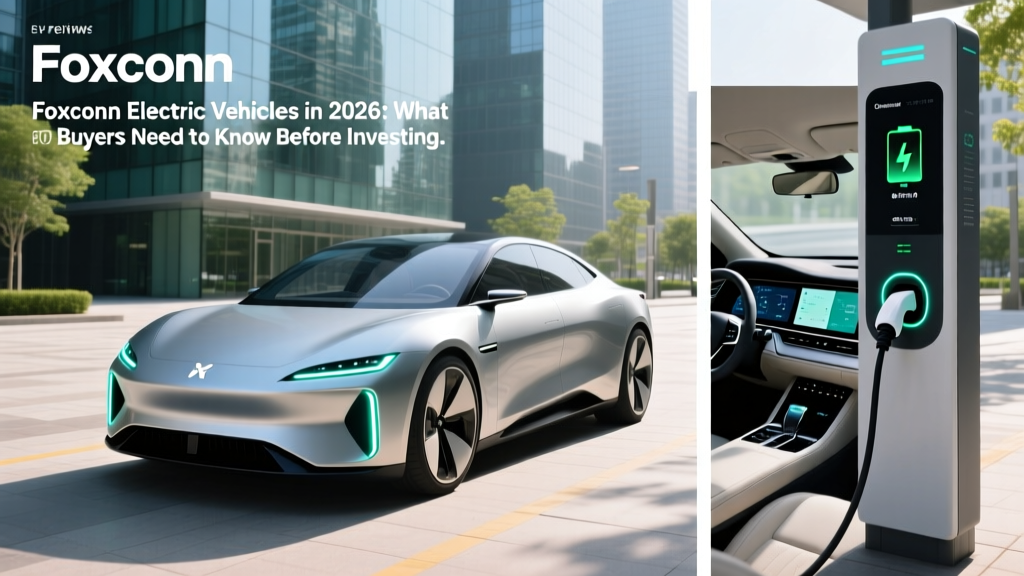
Foxconn electric vehicles are not sold under the "Foxconn" brand to consumers. Instead, Foxconn operates as a contract manufacturer and platform provider through its MIH (Mobility In Harmony) Open EV Platform and joint ventures like Foxtron (with Yulon). Vehicles built on Foxconn platforms are sold under partner brands — including the Luxgen n⁷ (Taiwan), the Fisker PEAR (announced, delayed), and Lordstown's Endurance pickup (limited production, company insolvent). As of early 2026, the only volume-production Foxconn-built EV available to consumers is the Luxgen n⁷ crossover in select Asian markets. No Foxconn-platform vehicle is currently available for retail purchase in the United States. If you're researching Foxconn EVs for investment or future purchase, the honest answer is: wait for confirmed U.S. market launches, and don't confuse platform announcements with buyable products.
What Foxconn Electric Vehicles Actually Are
Foxconn — formally Hon Hai Precision Industry — is the world's largest electronics contract manufacturer (best known for assembling iPhones). Since 2020, it has pivoted aggressively into electric-vehicle manufacturing, positioning itself as the "Android of EVs" by offering its MIH platform to automakers who want to outsource EV engineering and production.
The company's strategy breaks into three pillars:
- MIH Open Platform: A skateboard-style EV architecture (battery pack, motors, thermal management, software stack) that automakers can license and customize. Foxconn claims over 2,700 partners in the MIH ecosystem as of late 2025.
- Foxtron Joint Venture: A 50/50 partnership with Taiwan's Yulon Motor producing vehicles like the Luxgen n⁷ crossover and the Foxtron Model T electric bus.
- Contract Manufacturing: Building vehicles for third-party brands at Foxconn's Lordstown, Ohio plant and facilities in Thailand and India.
This means when you search for "Foxconn electric vehicles," you're really looking at a manufacturing ecosystem, not a consumer car brand. The vehicles that roll off Foxconn lines carry other badges.
Current Foxconn-Platform Vehicles: Specs and Availability
| Vehicle | Brand | Platform | Battery (kWh) | EPA/WLTP Range | Peak DC Charge | 0–100 km/h | Status (2026) | Market |
|---|---|---|---|---|---|---|---|---|
| Luxgen n⁷ | Luxgen (Yulon) | MIH | ~75 kWh (NMC) | WLTP ~310 mi | ~150 kW | ~7.0 sec | In production | Taiwan, limited Asia |
| Foxtron Model T | Foxtron | MIH (bus) | ~240 kWh | ~200 mi (city bus) | ~150 kW | N/A | In production | Taiwan, fleet |
| Fisker PEAR | Fisker Inc. | MIH (Pear) | ~80 kWh (est.) | ~250 mi (est.) | TBD | TBD | Delayed / Fisker bankrupt 2024 | None — project stalled |
| Lordstown Endurance | Lordstown Motors | Custom (Foxconn-built) | 109 kWh (NMC) | EPA 200 mi | ~80 kW | ~6.3 sec | Discontinued; company insolvent | U.S. (limited fleet) |
Real-World Range Reality Check: The Luxgen n⁷'s WLTP rating of ~310 miles translates to roughly 260–275 miles under real-world highway driving and closer to 200–220 miles in cold weather (below 32°F). WLTP tends to overstate range by 10–15% compared to EPA testing. No U.S. EPA sticker exists for this vehicle since it isn't sold stateside.
How Foxconn-Built EVs Compare to Established Brands
Since no Foxconn-platform vehicle is available in the U.S. retail market, the most useful comparison is against the established EVs American buyers can actually purchase today. Here's how the Luxgen n⁷ stacks up against similarly sized crossovers:
| Spec | Luxgen n⁷ (Foxconn MIH) | Hyundai Ioniq 5 (2026) | Tesla Model Y LR (2026) | Toyota RAV4 Hybrid (Gas) |
|---|---|---|---|---|
| Base Price | ~NT$1.1M (~$34,000 USD equiv.) | $43,500 | $48,990 | $33,500 |
| Range (EPA/WLTP) | WLTP ~310 mi | EPA 318 mi | EPA 320 mi | 580 mi (gas tank) |
| Battery | ~75 kWh NMC | 84 kWh NMC | 78.1 kWh (NMC/LFP) | N/A |
| DC Fast Charge (peak) | ~150 kW | 240 kW | 250 kW | N/A |
| 10–80% Charge Time | ~30 min (est.) | ~18 min | ~25 min | 5 min (gas station) |
| U.S. Availability | No | Yes | Yes | Yes |
| Federal Tax Credit (§30D) | N/A | Up to $7,500 (varies) | Up to $7,500 (varies) | N/A |
The comparison reveals Foxconn's current gap: the n⁷'s 150 kW peak charging and WLTP-only range figures put it a generation behind Hyundai's E-GMP and Tesla's latest architecture. That said, Foxconn's MIH platform is designed to iterate — the company has announced next-gen 800V architecture support for future models, which could push charge rates to 300+ kW.
The Real Cost Picture: Foxconn EV Ownership vs. Gas and Established EVs
Since Foxconn-platform EVs aren't sold in the U.S., the cost breakdown below uses the Luxgen n⁷'s estimated U.S.-equivalent pricing against a comparable gas crossover and a mainstream EV to illustrate what ownership would look like if the n⁷ were available stateside.
| Cost Category (5-Year / 75,000 mi) | Luxgen n⁷ (Est. U.S.) | Hyundai Ioniq 5 | Toyota RAV4 Gas |
|---|---|---|---|
| Purchase Price | $34,000 (est.) | $43,500 | $33,500 |
| Federal Tax Credit | $0 (not U.S.-sold) | Up to $7,500* | $0 |
| Effective Purchase | $34,000 | $36,000 | $33,500 |
| Fuel / Electricity (75k mi) | $3,750 (est. @ $0.15/kWh) | $3,900 | $7,500 (@ $3.50/gal, 28 MPG) |
| Maintenance | $1,200 | $1,200 | $3,500 |
| Insurance (est.) | $7,500 | $8,000 | $6,500 |
| Total 5-Year Cost | $46,450 | $49,100 | $51,000 |
*Per IRS §30D rules, the $7,500 credit requires meeting MSRP caps ($80,000 for SUVs), buyer income limits ($150k single / $300k joint), and critical-mineral/battery-sourcing thresholds. Eligibility varies by model year and trim. Always verify with a tax professional.
The takeaway: even without the U.S. tax credit, a competitively priced Foxconn-platform EV could undercut established EVs and gas cars on total cost — but only if Foxconn can deliver U.S. availability, service networks, and reliable parts supply. That's a significant "if."
Common Misconceptions About Foxconn Electric Vehicles
| Myth | Fact |
|---|---|
| "Foxconn makes its own branded cars you can buy." | Foxconn is a contract manufacturer. Vehicles carry partner brands (Luxgen, formerly Lordstown). You cannot buy a "Foxconn" branded car. |
| "The Fisker PEAR built by Foxconn is coming soon." | Fisker Inc. filed for bankruptcy in June 2024. The PEAR project, which was to be built at Foxconn's Lordstown plant, is effectively dead as of 2026. |
| "Foxconn's MIH platform is unproven." | The Luxgen n⁷ has been in production since 2023 with thousands delivered in Taiwan. The Foxtron Model T bus is in active fleet service. The platform is proven in limited markets. |
| "Foxconn EVs qualify for the U.S. $7,500 tax credit." | No Foxconn-platform vehicle is currently sold in the U.S., so §30D eligibility is moot. Future models would need to meet North American assembly, battery sourcing, and critical-mineral requirements. |
| "Foxconn will replace traditional automakers." | Foxconn is a manufacturing partner, not a replacement. It competes with Magna, Valmet, and other contract manufacturers — not with Tesla or Hyundai directly. |
Real-World Ownership Considerations for Foxconn-Built EVs
If a Foxconn-platform vehicle does launch in the U.S. (Foxconn has signaled interest in manufacturing for additional OEM partners at its Lordstown facility), buyers should weigh these practical factors:
Home Charging Access
Any Foxconn MIH-based EV will support Level 2 (240V) home charging, likely at 7–11 kW. A full charge from 10% to 100% at 11 kW takes roughly 7 hours — fine for overnight charging. Home Level 2 installation typically costs $800–$2,500 (equipment + electrician + permit), but can reach $4,000+ if your electrical panel needs a 200-amp upgrade. If you live in an apartment or lack garage access, public charging dependency becomes a daily reality — and public DC fast charging costs roughly 2–3× more per kWh than home electricity.
Cold-Weather Range Loss
NMC battery chemistry (used in the Luxgen n⁷) typically loses 20–30% of rated range in sustained sub-freezing temperatures. A 310-mile WLTP vehicle could realistically deliver 200–220 miles in a Midwest winter. The MIH platform includes a thermal management system with battery preconditioning, which mitigates but doesn't eliminate cold-weather losses. Buyers in northern climates should plan for this.
Charging Infrastructure and Connectors
The MIH platform was designed with CCS1 compatibility. However, the industry is rapidly shifting to NACS (Tesla's connector), with most major automakers adopting it for 2025+ models. Any future Foxconn U.S. vehicle would need NACS compatibility to access the Tesla Supercharger network — the largest and most reliable DC fast-charging network in North America with over 25,000 stalls. Confirm connector type before purchasing any new EV.
Service and Parts Network
This is the biggest unknown. Established EV brands (Tesla, Hyundai, Ford) have hundreds of U.S. service centers. A new Foxconn-partner brand entering the U.S. would need to build a service network from scratch or partner with existing dealer groups. Early adopters of low-volume brands (e.g., Rivian's first two years, Fisker Karma) often face long wait times for parts and service. Factor this into your risk tolerance.
Decision Framework: Should You Wait for Foxconn-Platform EVs?
Choose to Wait for a Foxconn-Platform U.S. Launch If:
- You're not in a rush to buy and your current vehicle has 2+ years of life left
- You're attracted to potentially lower pricing from contract-manufacturing efficiencies
- You're an EV enthusiast willing to accept first-year risk (limited service centers, software bugs, possible recalls)
- You're evaluating Foxconn (Hon Hai, 2317.TW) as an investment and want to understand the product side
Buy an Established EV Now If:
- You need a vehicle within 6 months
- You want full U.S. service network coverage and proven reliability data
- You want to claim the federal §30D tax credit on a vehicle with confirmed eligibility
- You value fast-charging speeds above 200 kW (the Ioniq 5, EV6, and Tesla Model Y all exceed this)
- You need verified EPA range figures, not WLTP estimates
Consider a Hybrid or PHEV Instead If:
- You lack reliable home charging access
- You regularly drive 300+ miles in a single trip through areas with sparse charging infrastructure
- You want EV-like efficiency without range anxiety (e.g., Toyota RAV4 Prime PHEV: 42 miles electric-only, 94 MPGe, then 38 MPG on gas)
Frequently Asked Questions
Can I buy a Foxconn electric vehicle in the United States in 2026?
No. As of early 2026, no vehicle built on a Foxconn platform is available for retail purchase in the U.S. The Lordstown Endurance (the only Foxconn-built vehicle that briefly reached U.S. buyers) was discontinued after Lordstown Motors' bankruptcy in 2023. The Luxgen n⁷ is sold only in Taiwan and select Asian markets.
What is Foxconn's MIH platform?
MIH (Mobility In Harmony) is Foxconn's open-source-style EV skateboard platform. It provides the battery architecture, electric drivetrain, thermal management, and software foundation that automakers can license and customize. Think of it as a "reference design" for building an EV — similar to how Android provides a base OS that phone manufacturers customize. According to the MIH Consortium, over 2,700 companies have joined the ecosystem.
Is the Fisker PEAR still happening?
Effectively no. Fisker Inc. filed for Chapter 11 bankruptcy in June 2024. The PEAR (Personal Electric Automotive Reasonable), which was planned to be manufactured by Foxconn at its Lordstown, Ohio plant, was a key part of Fisker's future lineup but was never produced. The project's intellectual property may be acquired by another company, but as of 2026, no entity has revived it.
Does Foxconn compete with Tesla?
Not directly. Foxconn is a contract manufacturer — it builds vehicles for other brands. Tesla is a vertically integrated automaker that designs, manufactures, and sells its own vehicles. Foxconn's competitors are other contract manufacturers like Magna International, Valmet Automotive, and VDL Nedcar. However, Foxconn's MIH platform could enable new EV startups to compete with Tesla at lower capital cost.
Will Foxconn electric vehicles qualify for the federal EV tax credit?
Any future Foxconn-platform vehicle sold in the U.S. would need to meet IRS §30D requirements independently: MSRP under $55,000 (sedans) or $80,000 (SUVs/trucks), buyer income within limits ($150k single / $300k joint), North American final assembly, and battery/critical-mineral sourcing thresholds. Vehicles built at Foxconn's Lordstown, Ohio plant would meet the assembly requirement, but battery sourcing would depend on the specific cell supplier and chemistry chosen for each model.
How does Foxconn's EV manufacturing differ from traditional automakers?
Traditional automakers (Ford, GM, Toyota) design and build their own vehicles in-house. Foxconn offers a "platform + manufacturing" service: a brand provides the design and marketing, and Foxconn handles engineering integration, supply chain, and assembly. This can reduce a new brand's time-to-market from 5–7 years to 2–3 years and lower capital requirements by billions. The tradeoff is less vertical control over components and software integration.
The Bottom Line on Foxconn Electric Vehicles
Foxconn is a serious player in EV manufacturing infrastructure, not a consumer car brand. Its MIH platform and Foxtron joint venture have produced real, drivable vehicles — the Luxgen n⁷ and Model T bus — with competitive specs for Asian markets. But for U.S. buyers in 2026, Foxconn electric vehicles remain a future possibility, not a present option.
The Lordstown Endurance's failure and Fisker's bankruptcy demonstrate that manufacturing partnerships alone don't guarantee market success. Execution, service networks, and brand trust matter as much as platform engineering. If Foxconn secures a major U.S. OEM partnership (rumors have included discussions with several legacy brands), the calculus could change quickly. Until then, U.S. EV buyers are better served by the proven options from Hyundai, Tesla, Ford, and others — vehicles with EPA-verified range, established service networks, and confirmed tax-credit eligibility.
Sources: EPA fueleconomy.gov, IRS §30D Clean Vehicle Credits, MIH Consortium, manufacturer specifications.