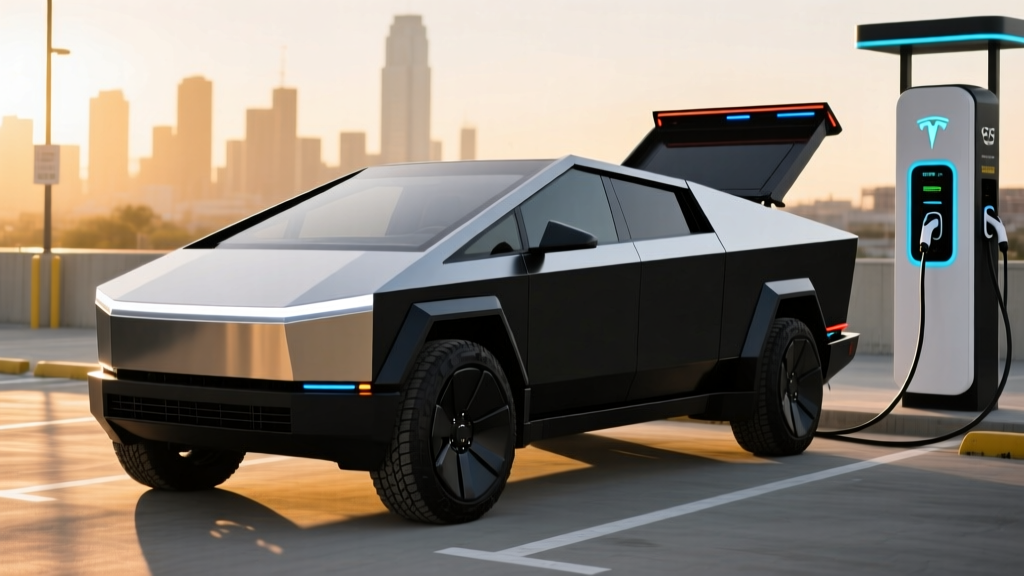
The Tesla Cybertruck finally reached driveways in late 2023, and the 2024 model year represents the first full production cycle of Tesla's polarizing electric pickup. Built on a 48-volt architecture with an 800-volt battery pack and a stainless-steel exoskeleton, the Cybertruck is unlike any EV Tesla has produced before. But beyond the angular styling and social-media hype, how does it perform as a daily driver, a towing platform, and a road-trip vehicle? We break down every spec that matters — with real-world caveats the brochure won't tell you.
2024 Cybertruck Trim Lineup and Pricing
Tesla launched the Cybertruck in three trims for the 2024 model year. The long-promised base RWD model (slated for 2025) never materialized at the originally advertised $39,900 price point. Here's where pricing stands for the available configurations:
| Trim | Drivetrain | Base MSRP | As-Tested (Typical Options) | Delivery/Est. Wait |
|---|---|---|---|---|
| AWD (Dual Motor) | Dual-Motor AWD | $79,990 | $82,000–$85,000 | Available (Foundation Series sold out) |
| Cyberbeast (Tri Motor) | Tri-Motor AWD | $99,990 | $102,000–$106,000 | Available |
| RWD (Base) | Rear-Wheel Drive | $60,990 (announced for 2025) | TBD | Not yet available |
Tax credit note: The Cybertruck is classified as a light truck under IRS §30D rules, which means the MSRP cap for credit eligibility is $80,000 (vs. $55,000 for sedans). The AWD trim at $79,990 may qualify for up to $7,500 under the federal EV tax credit, but eligibility depends on buyer income limits (AGI ≤ $150,000 single / $300,000 joint), battery critical-mineral sourcing requirements, and point-of-sale transfer rules. The Cyberbeast at $99,990 exceeds the truck MSRP cap and does not qualify. Always verify current-year rules at IRS.gov and consult a tax professional before purchasing.
Range, Efficiency, and the Real-World Gap
The Cybertruck AWD carries an EPA-estimated range of 340 miles, while the Cyberbeast is rated at 320 miles. Those numbers look competitive on paper — but the Cybertruck's brutalist shape and heavy curb weight (roughly 6,600–6,800 lbs depending on trim) create real-world penalties that buyers need to understand.
| Condition | AWD (EPA 340 mi) | Cyberbeast (EPA 320 mi) |
|---|---|---|
| EPA Combined | 340 miles | 320 miles |
| Highway (70–75 mph) | ~260–285 miles | ~240–265 miles |
| Cold Weather (below 32°F) | ~220–260 miles | ~200–240 miles |
| Towing (5,000 lb trailer) | ~150–180 miles | ~140–170 miles |
Source: EPA estimates via fueleconomy.gov; real-world figures based on independent testing and owner reports. Highway and cold-weather range losses of 15–35% are typical for large, heavy EVs with poor aerodynamics.
Efficiency is rated at approximately 2.0–2.2 kWh/mile (roughly 68 MPGe combined for the AWD). For context, the Rivian R1T achieves around 2.0 kWh/mile with its larger battery, and the Ford F-150 Lightning sits at 2.0–2.4 kWh/mile depending on configuration. The Cybertruck's stainless-steel body is heavy, and its flat-panel geometry, while angular, does not optimize airflow the way a curved body would.
Battery, Powertrain, and Performance Specs
The Cybertruck uses an 800-volt architecture with a structural battery pack. Tesla has not officially disclosed the exact usable kWh capacity or cell chemistry in its public spec sheets, but teardowns and regulatory filings indicate a pack in the 123 kWh (usable) range using 4680-format cells. The chemistry is believed to be NMC (nickel-manganese-cobalt), consistent with Tesla's performance-oriented vehicles — not the LFP chemistry found in the base Model 3 RWD.
| Spec | AWD (Dual Motor) | Cyberbeast (Tri Motor) |
|---|---|---|
| Battery (Usable, Est.) | ~123 kWh | ~123 kWh |
| Cell Chemistry | NMC (4680 cells) | NMC (4680 cells) |
| Architecture | 800V | 800V |
| Horsepower | 600 hp | 845 hp |
| 0–60 mph | 4.1 seconds | 2.6 seconds |
| Top Speed | 112 mph | 130 mph |
| Drivetrain | Dual-Motor AWD | Tri-Motor AWD |
| Towing Capacity | 11,000 lbs | 11,000 lbs |
| Payload Capacity | 2,500 lbs | 2,500 lbs |
| EPA Range | 340 miles | 320 miles |
The Cyberbeast's 2.6-second 0–60 time places it among the quickest production vehicles ever sold, regardless of powertrain. But the more relevant number for truck buyers is the 11,000-pound towing rating — competitive with the F-150 Lightning (10,000 lbs) and ahead of the Rivian R1T (11,000 lbs max with specific configuration). Just remember: towing at max capacity effectively halves your range.
Charging Speed: DC Fast, Level 2, and the 800V Advantage
The Cybertruck's 800-volt battery architecture is its most underappreciated feature. Higher voltage allows faster charging at compatible stations with less heat buildup. Here's how the charging profile breaks down across levels:
| Charging Level | Power / Rate | Miles of Range Added | Notes |
|---|---|---|---|
| Level 1 (120V household) | ~1.4 kW | ~3–4 miles/hour | Emergency/trickle only; full charge takes days |
| Level 2 (240V home, 48A) | ~11.5 kW | ~30–34 miles/hour | Full charge overnight (~10–12 hours from 10%) |
| DC Fast Charge (V4 Supercharger) | Peak ~250 kW | ~200 miles in 15 min | 10–80% in ~25–30 minutes; tapers above 80% |
| DC Fast Charge (350 kW CCS station w/ adapter) | Peak ~250 kW (limited by vehicle) | Similar to above | Requires NACS-to-CCS adapter for non-Tesla networks |
Charging curve reality: The Cybertruck peaks near 250 kW on V4 Superchargers but does not sustain that rate across the full 10–80% window. Expect an average rate closer to 170–190 kW during the 10–80% session, yielding a 25–30 minute charge time. This is respectable but not class-leading — Hyundai's Ioniq 5 and Kia EV6, with their own 800V systems, can achieve 10–80% in roughly 18 minutes. The Cybertruck's massive battery simply takes more total energy to fill.
At home on a 48-amp Level 2 circuit (the Tesla Wall Connector on a 60-amp breaker), you'll add roughly 30–34 miles of range per hour. A full charge from near-empty takes 10–12 hours, which works fine for overnight charging. If your daily commute is under 80 miles round-trip, you'll rarely need more than a few hours of Level 2 charging each night.
Cargo, Interior Space, and Daily Practicality
The Cybertruck's dimensions create a unique set of trade-offs. The 6-foot bed (with the tonneau cover deployed) is shorter than a full-size F-150's 6.5-foot bed, but the vault-style design and under-bed storage add flexibility. Key measurements:
- Bed length: 72 inches (6 feet) with tailgate closed; extends with tailgate down
- Bed width (between wheel wells): ~48 inches
- Cargo volume (bed): ~67 cu ft (bed alone); additional ~14 cu ft in under-bed rear trunk
- Front trunk (frunk): ~7 cu ft (small; houses washer fluid and 12V components)
- Rear-seat legroom: ~38 inches (adequate for adults, tighter than an F-150 SuperCrew)
- Front headroom: ~40 inches (generous, thanks to the roof peak)
- Seating: 5 passengers (3-across front bench, 2-across rear bench)
The interior is minimalist in classic Tesla fashion: an 18.5-inch center touchscreen dominates the dash, with a smaller rear touchscreen for passengers. There are no physical buttons for climate or audio. The yoke-style steering wheel (standard on early builds) has drawn mixed reviews — some owners adapt quickly, others find it awkward for low-speed maneuvering. Tesla has since offered a round wheel option.
Notable drawbacks: The stainless-steel body panels are prone to fingerprint smudges and can be difficult to repair if dented (panel replacement is often required rather than traditional bodywork). The powered tonneau cover, while sleek, limits bed height for tall cargo. Visibility out the rear is compromised by the bed design and small rear window — the digital rearview camera mirror is essential.
Driver Assistance, Tech, and Safety
The Cybertruck ships with Tesla's Autopilot as standard, which includes adaptive cruise control and lane-centering on highways. Full Self-Driving (FSD) Supervised is available as a $8,000 add-on or $99/month subscription.
Both Autopilot and FSD Supervised are SAE Level 2 driver-assistance systems. This means the driver must remain fully attentive, keep hands on the wheel (or demonstrate engagement), and be prepared to take over instantly. These systems are not self-driving. Only Level 4 services like Waymo One operate without a human driver in defined areas. Never disengage from the driving task while using Autopilot or FSD.
On the technology front, the Cybertruck features:
- Steer-by-wire: No physical connection between the steering wheel and the wheels. This enables the variable-ratio steering (fewer turns lock-to-lock) but is unfamiliar to most drivers and eliminates traditional road feel.
- 48-volt electrical architecture: A first for a production vehicle, reducing wiring harness weight and enabling more efficient power distribution.
- Bioweapon Defense Mode: HEPA air filtration system, carried over from the Model S/X.
- Over-the-air updates: Tesla continues to push feature updates, performance tweaks, and UI improvements remotely.
- Powershare (V2L/V2H): Vehicle-to-load capability allows you to power tools or appliances from the bed outlets (up to 9.6 kW). Vehicle-to-home capability is announced but requires additional hardware and utility coordination.
As of this writing, the Cybertruck has been rated by the NHTSA with a 5-star overall safety rating. The IIHS has not yet completed a full evaluation of the 2024 model year. The stainless-steel exoskeleton is extremely rigid, which benefits crash protection but complicates repair logistics.
Warranty Coverage and Battery Longevity
Tesla's warranty structure for the Cybertruck follows the pattern set by its other vehicles, with one important addition for the stainless-steel body:
| Component | Coverage |
|---|---|
| Basic Vehicle (Bumper-to-Bumper) | 4 years / 50,000 miles |
| Battery & Drive Unit | 8 years / 120,000 miles (whichever comes first), with minimum 70% capacity retention |
| Stainless-Steel Body Panels | 5 years / 60,000 miles (corrosion and structural defects) |
| Restraint System | 5 years / 60,000 miles |
The 8-year/120,000-mile battery warranty with a 70% retention threshold is consistent with the Model S and Model X. NMC chemistry typically exhibits a degradation curve of roughly 5–8% loss in the first two years, then a slower linear decline. Most Tesla owners report 10–12% total degradation at 100,000 miles based on fleet data. Battery replacement out of warranty is expensive — estimated at $15,000–$25,000+ for a pack of this size, though Tesla's 4680 cell costs are expected to decrease over time.
Pros, Cons, and the Verdict
✅ Pros
- Tri-motor Cyberbeast delivers supercar acceleration (2.6s 0–60) in a truck body
- 800V architecture enables efficient DC fast charging at ~250 kW peak
- 11,000-lb towing capacity is competitive with full-size electric trucks
- Steer-by-wire and 48V architecture are genuine engineering milestones
- Access to Tesla's Supercharger network — the most reliable DC fast-charging network in the US
- Powershare V2L capability (9.6 kW) for job-site or camping power
- Stainless-steel body resists dents and corrosion exceptionally well
❌ Cons
- Real-world highway range drops to ~260–285 miles (AWD) — far below the 340-mile EPA sticker
- AWD trim at $79,990 barely squeezes under the §30D MSRP cap; Cyberbeast at $99,990 does not qualify
- Stainless-steel panels are fingerprint magnets and difficult to repair after collision damage
- 6-foot bed is shorter than competitors; powered tonneau limits vertical cargo height
- Rear-seat space is tighter than the F-150 Lightning or Silverado EV
- Steer-by-wire requires an adjustment period and eliminates traditional steering feedback
- No Apple CarPlay or Android Auto — Tesla's proprietary interface only
- Build quality inconsistencies reported on early 2024 production units
Who Should Buy the 2024 Tesla Cybertruck?
Decision Framework
Choose the Cybertruck AWD if: You want a fast, tech-forward electric truck with Supercharger access, need 11,000-lb towing occasionally, have home Level 2 charging, and your daily commute is under 150 miles round-trip. The AWD at $79,990 may qualify for the $7,500 federal credit, bringing effective cost to ~$72,490 — competitive with a well-equipped F-150 Lightning Lariat.
Choose the Cyberbeast if: Performance is a priority, budget is not a primary constraint, and you want the fastest truck ever produced. Accept that the $99,990 price excludes you from the federal tax credit and that real-world range is closer to 240–265 highway miles.
Look elsewhere if: You need a full-size 6.5-foot bed for work, prioritize rear-seat comfort for tall passengers, want Apple CarPlay, live in an area with limited Supercharger coverage, or need a proven commercial fleet vehicle with established service infrastructure. The F-150 Lightning or Rivian R1T may serve you better.
Frequently Asked Questions
What is the real-world range of the 2024 Tesla Cybertruck?
The EPA rates the AWD at 340 miles and the Cyberbeast at 320 miles. In real-world highway driving at 70–75 mph, expect roughly 260–285 miles (AWD) and 240–265 miles (Cyberbeast). Cold weather below freezing can reduce range by an additional 15–25%. Towing a 5,000-pound trailer drops effective range to approximately 150–180 miles.
How fast does the Cybertruck charge at home and on the road?
On a Level 2 home charger (48A/240V), the Cybertruck adds roughly 30–34 miles of range per hour, with a full charge taking 10–12 hours. On a Tesla V4 Supercharger, it peaks at approximately 250 kW, achieving a 10–80% charge in about 25–30 minutes. Charging slows significantly above 80% State of Charge to protect the battery.
Does the 2024 Cybertruck qualify for the $7,500 federal EV tax credit?
The AWD trim at $79,990 is at the MSRP cap threshold for light trucks under IRS §30D rules ($80,000 maximum). Eligibility depends on your adjusted gross income (≤$150,000 single / ≤$300,000 joint filer), the vehicle's battery critical-mineral and component sourcing compliance, and whether you elect a point-of-sale transfer. The Cyberbeast at $99,990 exceeds the MSRP cap and does not qualify. Check current rules at IRS.gov before purchasing.
Is the Cybertruck worth buying over the F-150 Lightning or Rivian R1T?
It depends on your priorities. The Cybertruck offers the fastest acceleration (Cyberbeast), Supercharger network access, and a unique design. The F-150 Lightning provides a more traditional truck experience with a larger bed, more rear-seat room, and broader dealer service coverage. The Rivian R1T offers superior off-road capability, a quad-motor option, and a more refined interior at a similar price point. For pure work-truck duty, the Lightning remains the pragmatic choice; for tech enthusiasts and performance seekers, the Cybertruck is compelling.
What is the Cybertruck's towing capacity, and how does it affect range?
The Cybertruck is rated to tow 11,000 pounds across all trims. However, towing at or near maximum capacity roughly halves your range — expect 150–180 miles with a 5,000-pound trailer and potentially as low as 100–120 miles at max load on hilly terrain. Plan charging stops accordingly and precondition the battery before fast-charging while towing.
How reliable is the Cybertruck's steer-by-wire system?
Steer-by-wire eliminates the mechanical connection between the steering wheel and the wheels, relying on redundant electronic actuators. Tesla has engineered multiple redundancy layers, and the system has performed without widespread failure reports in early ownership. However, it is a new technology in a production vehicle, and long-term reliability data (5+ years) does not yet exist. Some drivers find the lack of road feel disconcerting, while others appreciate the variable steering ratio that requires less hand movement at low speeds.