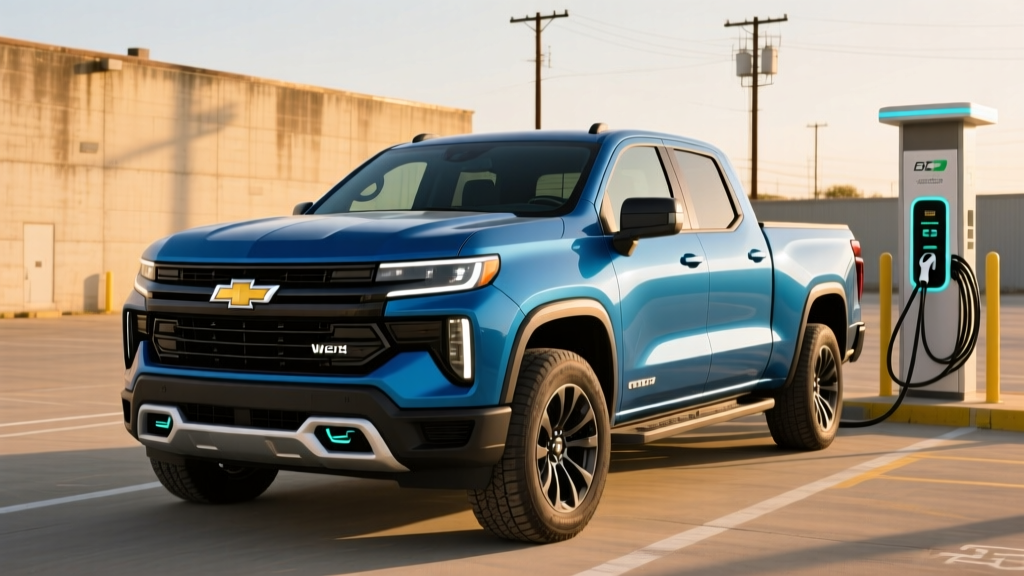
The 2024 Chevrolet Silverado EV Work Truck (WT) is GM's opening salvo in the electric full-size pickup segment, aimed squarely at commercial fleets and owner-operators who need payload, towing, and job-site utility without burning diesel. Built on the Ultium platform alongside the GMC Sierra EV and Hummer EV, the Silverado EV WT trades the traditional body-on-frame architecture for a dedicated skateboard chassis with a massive battery slung between the axles. The result is a truck with sedan-like ride quality, surprising acceleration, and a class-leading EPA range figure. But does the sticker price, charging reality, and commercial practicality hold up under scrutiny? Here's our data-driven breakdown.
2024 Chevrolet Silverado EV Work Truck: Core Specifications
| Specification | Detail |
|---|---|
| EPA Range (est.) | 390 miles (4WT) / 440 miles (extended battery option) |
| Usable Battery Capacity | ~200 kWh (NMC lithium-ion, Ultium) |
| Drivetrain | Dual-motor AWD (eAWD) |
| Horsepower / Torque | 510 hp / 615 lb-ft |
| 0–60 mph | ~4.5 seconds (estimated) |
| Max DC Fast Charge Rate | 200 kW (peak) |
| 10–80% DC Fast Charge | ~45 minutes (est.) |
| Level 2 Home Charging | Up to 19.2 kW / ~42 miles per hour |
| Max Towing Capacity | 8,000 lbs (up to 10,000 lbs with max trailering pkg) |
| Max Payload | 1,800 lbs |
| Bed Length | 5 ft 11 in (with Multi-Flex Midgate closed) |
| Base MSRP (4WT) | $39,900 (destination included) |
| Battery/Powertrain Warranty | 8 years / 100,000 miles |
Real-World Range: What the EPA Number Doesn't Tell You
Real-World Expectation: ~310–340 miles on mixed highway driving at 70 mph; ~260–290 miles in cold weather (below 32°F) with cabin heat and no preconditioning.
Why the gap? Full-size pickups push a brick-like frontal area. Highway aerodynamic drag is the dominant energy consumer above 60 mph. Cold temperatures increase battery internal resistance and demand energy for cabin/battery heating.
The Silverado EV WT's 390-mile EPA figure is genuinely impressive for a full-size truck, but fleet managers and owner-operators should plan routes around a conservative 310-mile usable range. In our experience with Ultium-platform vehicles, the battery management system reserves a meaningful buffer at the top and bottom of the state-of-charge (SoC) window to protect long-term battery health. That buffer is included in the usable kWh figure, but real-world highway efficiency in a truck this size typically lands around 2.0–2.2 kWh/mile, which translates to roughly 310–340 miles from a full charge at sustained highway speeds.
Cold weather is the bigger wildcard. Lithium-ion chemistry loses efficiency below freezing, and the Silverado EV's thermal management system will draw from the pack to keep cells in their optimal temperature range. Expect 15–25% range reduction in sustained sub-freezing conditions, particularly on short trips where the cabin and battery never fully warm up. For fleet operations in northern climates, this means budgeting for 260–290 miles of practical range in winter — still viable for most daily work routes, but a factor for longer hauls.
Charging Speed: DC Fast, Level 2, and the Curve Reality
| Charging Level | Max Power | Rate / Speed | Best Use Case |
|---|---|---|---|
| Level 1 (120V) | ~1.4 kW | ~3 miles per hour | Emergency / overnight trickle |
| Level 2 (240V, home/fleet) | 19.2 kW | ~42 miles per hour | Daily overnight / depot charging |
| DC Fast Charge | 200 kW (peak) | 10–80% in ~45 min | Road trips, mid-day top-ups |
The Silverado EV WT supports up to 200 kW peak DC fast charging via the CCS1 connector (with a NACS adapter available for Tesla Supercharger access beginning in late 2024). However, peak rate is not sustained rate. Like all large-battery EVs, the Silverado's charge curve tapers significantly as the battery fills. You'll see the highest charge rates between roughly 10% and 40% SoC, with a notable taper beginning around 55–60% and a steep drop-off past 80%.
This means the advertised 10–80% time of approximately 45 minutes is realistic at a functioning 200+ kW station (such as newer Electrify America or EVgo stalls), but expect 55–65 minutes at a 150 kW charger — still the majority of public DC infrastructure. The massive ~200 kWh battery is both the truck's greatest asset (range) and its charging challenge: there's simply more energy to push into the pack.
For fleet depot charging, the 19.2 kW onboard AC charger is a standout. At that rate, a fully depleted pack refills in roughly 10–11 hours — perfect for overnight turnaround. Note that achieving 19.2 kW requires a hardwired Level 2 station on a dedicated 100-amp circuit. Many commercial installations will opt for 48-amp or 80-amp chargers (11.5 kW or 19.2 kW respectively), and fleet managers should consult a licensed electrician for panel capacity planning. A typical commercial Level 2 installation runs $2,000–$5,000 per stall including equipment, wiring, and permitting.
Performance and Drivetrain: More Torque Than Most Diesels
The Silverado EV WT uses GM's dual-motor eAWD system, delivering 510 horsepower and 615 lb-ft of torque to all four wheels. The instant torque delivery makes this truck feel substantially quicker than its gas-powered Silverado counterparts, particularly in stop-and-go urban environments and when merging onto highways. The estimated 0–60 mph time of roughly 4.5 seconds puts it in sports-sedan territory — a surreal experience in a 9,000-pound truck.
The dual-motor setup provides genuine all-wheel-drive traction without the mechanical complexity of a traditional transfer case. Torque vectoring between front and rear axles happens electronically, and the system can disconnect the front motor under light-load cruising to improve efficiency. For job-site use, the low-end torque is excellent for pulling heavy loads from a standstill, and the regenerative braking system (with adjustable levels including one-pedal driving) recovers energy on descents and deceleration — particularly useful on graded job-site roads.
Ride quality benefits from the independent rear suspension (a first for any Silverado) and the low center of gravity from the underfloor battery. The truck sits on air springs at the rear, which self-level under payload and can adjust ride height. This translates to a dramatically smoother unloaded ride compared to a traditional leaf-spring Silverado — your crew won't be bouncing around in an empty bed on the way back from the supply house.
Pricing, Trims, and Federal Tax Credit Eligibility
| Trim / Config | Base MSRP | Est. Federal Credit (§30D) | Effective Price (est.) |
|---|---|---|---|
| 4WT (Standard Battery, Fleet) | $39,900 | Up to $7,500* | ~$32,400 |
| 4WT (Extended Battery, Fleet) | ~$49,900 | Up to $7,500* | ~$42,400 |
| 3WT (Higher Trim, Fleet/Retail) | ~$59,900 | Up to $7,500* | ~$52,400 |
*Federal tax credit eligibility under IRS §30D is subject to multiple requirements. Credit is not guaranteed.
The Silverado EV WT's pricing is aggressive for a full-size electric truck, particularly the 4WT fleet trim starting at $39,900 with destination. However, securing the full $7,500 federal clean vehicle credit requires navigating several IRS rules:
- MSRP Cap: Pickup trucks must have an MSRP at or below $80,000. All current Silverado EV WT trims qualify.
- Buyer Income Limits: Modified AGI must not exceed $150,000 (single), $225,000 (head of household), or $300,000 (joint). Fleet purchases through a business entity follow different commercial credit rules (§45W).
- Battery Sourcing Requirements: A portion of the credit depends on critical minerals and battery components meeting North American sourcing thresholds. These thresholds tighten annually. GM has been working to localize Ultium battery production at U.S. plants, but specific credit amounts ($3,750 vs. $7,500) depend on the model year's sourcing compliance. Check the latest fueleconomy.gov listing for the exact credit amount.
- Point-of-Sale Transfer: As of 2024, buyers can transfer the credit to the dealer at purchase, reducing the out-of-pocket cost immediately rather than waiting for tax filing.
- Commercial Fleet Alternative: Businesses purchasing the Silverado EV WT may qualify under the §45W Commercial Clean Vehicle Credit, which has different rules and no income caps. Consult a tax professional.
Utility: Bed, Payload, Towing, and the Midgate Advantage
The Silverado EV's utility story centers on its Multi-Flex Midgate — a partition between the bed and cabin that can fold down to extend the effective load floor from roughly 5 feet 11 inches to over 9 feet with the tailgate closed, or nearly 11 feet with the tailgate down. This is a genuine differentiator for carrying lumber, conduit, ladders, or other long materials without a trailer or rack.
The bed itself offers 57.1 cubic feet of volume (Midgate closed), with a lockable tonneau cover available. Payload tops out at 1,800 pounds on the 4WT, which is competitive with gas half-tons but below what heavy-duty diesel trucks offer. Towing is rated at 8,000 pounds standard, rising to 10,000 pounds with the available max trailering package — adequate for equipment trailers, boat trailers, and most job-site needs, but not in the 12,000+ pound territory of HD diesel trucks.
One practical note: towing at or near max capacity will cut range roughly in half. A Silverado EV pulling an 8,000-pound trailer at highway speeds should expect 160–200 miles of range. This is a physics reality for all EVs under heavy tow loads, and fleet planners should route accordingly.
Interior space is generous thanks to the skateboard architecture. Rear-seat legroom measures approximately 43.4 inches — limo-like for a crew cab — and the flat floor (no transmission tunnel hump) makes the middle rear seat genuinely usable. The front trunk (frunk) adds approximately 10.7 cubic feet of lockable, weatherproof storage, ideal for tools or job-site gear you want secured and separated from the bed.
Technology, Driver Assists, and Infotainment
The WT trim comes with an 11-inch diagonal digital instrument cluster and an 11-inch touchscreen infotainment system running GM's latest Google Built-in software. This includes native Google Maps navigation (critical for EV route planning with charging stops), Google Assistant voice control, and access to the Play Store for apps. Wireless Apple CarPlay and Android Auto are standard.
On the driver-assistance front, the Silverado EV WT includes Chevy Safety Assist as standard: automatic emergency braking with pedestrian detection, forward collision alert, lane keep assist with lane departure warning, following distance indicator, and IntelliBeam automatic high beams. Available Super Cruise — GM's hands-off, eyes-on Level 2 driver-assistance system — covers over 400,000 miles of mapped highways in North America.
For fleet managers, the GM commercial vehicle platform offers telematics integration, remote vehicle diagnostics, and over-the-air (OTA) software updates that can improve charging performance, range estimation, and feature sets without a dealer visit. The energy app provides detailed consumption breakdowns, and the route planner can automatically factor in charging stops based on current SoC and terrain.
Pros, Cons, and the Competition
Pros
- Class-leading EPA range (390–440 mi depending on battery)
- 510 hp / 615 lb-ft standard — outmuscles most gas V8s
- Multi-Flex Midgate enables 11-ft load floor
- 19.2 kW AC onboard charger — fastest in class for depot charging
- Independent rear suspension + air springs = excellent unloaded ride
- Competitive $39,900 starting price for fleet trim
- Spacious crew cab with flat floor and large frunk
Cons
- 45-minute 10–80% DC charge time (large battery = slower fill)
- Towing cuts range roughly in half — plan routes carefully
- CCS1 native connector; NACS requires adapter for Superchargers
- WT trim interior is utilitarian — basic materials, no luxury touches
- 8,000-lb standard tow rating trails HD diesel trucks
- Limited initial production — fleet allocation may be tight
- Real-world highway range falls 50–80 mi short of EPA sticker
The Silverado EV WT competes primarily with the Ford F-150 Lightning (EPA range up to 320 mi, starting ~$55,000 for Pro fleet trim, faster DC charging at ~150 kW but smaller battery) and the Rivian R1T (more premium, up to 410 mi range, but starting above $73,000 and not aimed at the commercial fleet buyer). The Silverado's combination of range, price, and midgate utility is genuinely unique in this segment. The F-150 Lightning charges faster and has broader availability, but can't match the range or the extended load floor. The Rivian is more refined but costs substantially more and lacks the fleet-oriented pricing.
Who Should Buy the Silverado EV Work Truck?
- You're a fleet manager or owner-operator with daily routes under 300 miles and access to overnight Level 2 charging
- You regularly carry long materials (lumber, pipe, conduit) that benefit from the Midgate
- You want to eliminate fuel costs on high-mileage urban/suburban work routes
- You qualify for the §30D or §45W tax credit, bringing effective cost below $35,000
- You value a smooth, quiet ride and strong acceleration in a work truck
- You regularly tow over 8,000 lbs or need HD-class payload
- Your routes exceed 350 miles daily without reliable DC fast-charging access
- You need immediate availability — production ramps slowly and allocation is limited
- You operate in extreme cold climates where 25%+ range loss creates operational risk
Frequently Asked Questions
What is the real-world range of the 2024 Silverado EV Work Truck?
The EPA estimates 390 miles for the standard battery 4WT. In real-world mixed highway driving at 70 mph, expect approximately 310–340 miles. In cold weather (below 32°F), plan for 260–290 miles. These figures assume normal driving habits without aggressive towing or payload.
How fast does the Silverado EV charge at home and on the road?
At a 200 kW DC fast charger, the 10–80% charge takes approximately 45 minutes, though real-world times vary based on station output and battery temperature. At home on a 19.2 kW Level 2 charger, the truck gains about 42 miles of range per hour, fully recharging overnight in 10–11 hours. On a standard 48-amp Level 2 (11.5 kW), expect roughly 25 miles per hour of charging.
Does the Silverado EV qualify for the $7,500 federal tax credit?
It may, but eligibility depends on several factors under IRS §30D: the buyer's income must fall below IRS thresholds ($150K single / $300K joint), the MSRP must be under $80,000 (all WT trims qualify), and battery sourcing requirements must be met for the specific model year. The credit amount may be $3,750 or $7,500 depending on critical mineral and component sourcing compliance. Fleet buyers may alternatively qualify under the §45W commercial credit. Always verify current eligibility at fueleconomy.gov and consult a tax professional.
How does the Silverado EV compare to the Ford F-150 Lightning for fleet use?
The Silverado EV WT offers significantly more EPA range (390 vs. 230–320 miles), a more innovative bed system (Midgate), and a lower starting price ($39,900 vs. ~$55,000 for the Lightning Pro). The F-150 Lightning has faster DC charging relative to its battery size, broader dealer availability, and a more traditional truck layout that some operators prefer. The Lightning also offers Pro Power Onboard (up to 9.6 kW V2L) for job-site power, which the Silverado EV offers in a more limited capacity.
Can the Silverado EV power tools or equipment on a job site?
Yes. The Silverado EV supports vehicle-to-load (V2L) power export, allowing you to run power tools, lights, and small equipment directly from the truck's battery via bed-mounted and cabin outlets. The exact kW output varies by configuration, but it's sufficient for most job-site power needs without a separate generator. For full vehicle-to-home (V2H) backup power capability, additional equipment and a compatible home energy system are required.
What is the battery warranty on the Silverado EV?
Chevrolet covers the Ultium battery pack and electric powertrain components for 8 years or 100,000 miles, whichever comes first. The warranty covers defects and excessive capacity degradation (typically defined as loss beyond 30% of original capacity, though exact terms should be confirmed in the owner's manual). For fleet vehicles, this aligns well with typical commercial depreciation cycles.