Quick Verdict: The Electric Truck That Actually Works
The 2024 Rivian R1T remains the most versatile electric pickup on the market, blending genuine off-road capability with a refined on-road demeanor that body-on-frame competitors can't match. With up to 352 miles of EPA-estimated range on the Max Pack and dual-motor efficiency that outpaces the Ford F-150 Lightning and GMC Hummer EV, the R1T earns its premium pricing through engineering substance rather than hype. For buyers who need a truck that can tow, explore backcountry trails, and serve as a daily driver without compromise, the R1T is the benchmark — but the entry cost and charging logistics demand careful consideration.
Range, Efficiency & Real-World Expectations
Rivian offers three battery configurations for the 2024 R1T, each with distinct range and efficiency profiles. The Standard Pack (95 kWh usable, LFP chemistry) anchors the lineup, while the Large Pack (128.9 kWh, NMC) and Max Pack (149 kWh, NMC) push range well past 300 miles.
| Battery Pack | Chemistry | Usable kWh | Drivetrain | EPA Range (mi) | Combined MPGe | kWh/100mi |
|---|---|---|---|---|---|---|
| Standard Pack | LFP | 95 | Dual-Motor AWD | 258 | 97 | 35 |
| Large Pack | NMC | 128.9 | Dual-Motor AWD | 328 | 94 | 36 |
| Max Pack | NMC | 149 | Dual-Motor AWD | 352 | 91 | 37 |
| Large Pack | NMC | 128.9 | Quad-Motor AWD | 285 | 86 | 39 |
| Max Pack | NMC | 149 | Quad-Motor AWD | 309 | 84 | 40 |
Source: fueleconomy.gov
Charging Speed: DC Fast Charge & Home Level 2
The 2024 R1T uses the CCS1 connector for DC fast charging (with Rivian's NACS adapter enabling Tesla Supercharger access starting mid-2024). Charging performance varies significantly by pack size and state of charge.
| Charge Level | Connector | Peak Power | 10–80% Time | Miles Added/Hour |
|---|---|---|---|---|
| Level 1 (120V) | J1772 | 1.4 kW | N/A (days) | ~3 mi/hr |
| Level 2 (240V, 48A) | J1772 | 11.5 kW | ~12–15 hrs (0–100%) | ~25–28 mi/hr |
| Level 2 (240V, 80A Wall Connector) | J1772 / NACS | 19.2 kW | ~8–10 hrs (0–100%) | ~40–45 mi/hr |
| DC Fast Charge (Standard Pack) | CCS1 / NACS | ~165 kW peak | ~28 min | ~140 mi in 20 min |
| DC Fast Charge (Large Pack) | CCS1 / NACS | ~200 kW peak | ~30 min | ~140 mi in 20 min |
| DC Fast Charge (Max Pack) | CCS1 / NACS | ~220 kW peak | ~33 min | ~150 mi in 20 min |
Charging curve reality: Peak kW figures are achieved between roughly 10–35% state of charge. Above 60%, the charge rate tapers significantly — dropping below 80 kW by 80% SoC. On a road trip, plan stops around the 15–20 minute mark to add 140+ miles rather than waiting for a full charge. Rivian's battery preconditioning feature (activated when navigating to a charger) warms the pack to optimize charge speed, which is critical in cold weather where unplugged DC charging can be 40–50% slower.
Performance & Drivetrain
The R1T's dual-motor and quad-motor powertrains deliver performance that ranges from brisk to supercar-rivaling:
- Dual-Motor AWD: 533 hp, 610 lb-ft torque, 0–60 mph in 4.5 seconds
- Performance Dual-Motor AWD: 665 hp, 829 lb-ft torque, 0–60 mph in 3.5 seconds
- Quad-Motor AWD: 1,025 hp, 1,198 lb-ft torque, 0–60 mph in 3.0 seconds
All configurations feature a single-speed reduction gear, fully independent suspension with air springs (adjustable ride height from 7.9 to 14.9 inches of ground clearance), and a maximum towing capacity of 11,000 pounds (dual-motor) or 10,000 pounds (quad-motor). Towing at highway speeds cuts range roughly in half — plan for 140–175 miles between charges when pulling a loaded trailer.
Pricing, Trims & Federal Tax Credit Eligibility
| Trim / Configuration | Base MSRP | As-Tested (Typical) | §30D Credit Eligible? |
|---|---|---|---|
| Dual-Motor Standard Pack Adventure | $69,800 | $72,000–$76,000 | Yes (if under MSRP + income caps) |
| Dual-Motor Large Pack Adventure | $75,800 | $79,000–$85,000 | Yes (truck MSRP cap: $80,000) |
| Dual-Motor Max Pack Adventure | $85,800 | $89,000–$95,000 | No (exceeds $80K truck cap) |
| Quad-Motor Large Pack Adventure | $87,800 | $92,000–$98,000 | No (exceeds $80K truck cap) |
| Performance Dual-Motor Max Pack Ascend | $99,000 | $102,000+ | No (exceeds $80K truck cap) |
- MSRP Cap: Pickup trucks must have an MSRP at or below $80,000 to qualify. This limits eligibility to the Dual-Motor Standard and Large Pack Adventure trims.
- Income Caps: Modified AGI must not exceed $150,000 (single), $225,000 (head of household), or $300,000 (joint filers).
- Battery Sourcing: The full $7,500 credit requires meeting both critical-mineral and battery-component sourcing thresholds, which tightened significantly in 2024. Rivian's eligibility for the full amount vs. the partial $3,750 depends on the specific build month and supply chain — verify via the IRS's official list at irs.gov before purchasing.
- Point-of-Sale Transfer: The credit can be transferred to the dealer at purchase, reducing your out-of-pocket cost immediately rather than waiting for tax filing.
Cargo, Passenger Space & Practical Utility
The R1T's 54.4-inch bed is shorter than a full-size truck's, but the innovative Gear Tunnel (11.7 cu ft of lockable, pass-through storage behind the cab) and front trunk (frunk, 11.0 cu ft) give it cargo flexibility that defies the bed length alone.
- Bed volume: 29.2 cu ft (to top of bed sides)
- Gear Tunnel: 11.7 cu ft (fits snowboards, golf bags, camp gear)
- Frunk: 11.0 cu ft (drainable, weatherproof)
- Front legroom: 41.3 inches
- Rear legroom: 38.2 inches
- Seating: 5 passengers
- Bed length: 54.4 inches (extends to ~72 inches with tailgate down)
- Payload capacity: ~1,760 lbs
The Gear Tunnel is the R1T's defining practicality feature. It transforms the truck from a conventional short-bed pickup into something closer to a sport-utility hybrid, particularly valuable for outdoor enthusiasts who need secure, weather-protected storage without a bed cap.
Warranty & Long-Term Ownership
Rivian's warranty coverage for the 2024 R1T:
- Battery: 8 years / 175,000 miles (retains ≥70% capacity)
- Powertrain (drive unit): 8 years / 175,000 miles
- Bumper-to-bumper: 5 years / 60,000 miles
- Corrosion: 5 years / unlimited miles
The 175,000-mile battery warranty is among the most generous in the EV truck segment, exceeding the F-150 Lightning's 8-year/100,000-mile coverage. Rivian's battery management system uses a conservative buffer (roughly 3–5% at the top and bottom of the pack) to minimize degradation. Based on early owner data and Rivian's published degradation curves, expect 5–8% capacity loss over the first 100,000 miles with typical use — well within the 70% retention threshold.
Tech, Driver Assistance & Standout Features
The R1T runs Rivian's proprietary software stack with a 15.6-inch center touchscreen and 12.3-inch driver display. Over-the-air updates continuously add features — recent additions include enhanced camp mode, improved route planning with charge-stop integration, and refined regenerative braking profiles.
Driver assistance (SAE Level 2): Rivian's Driver+ combines adaptive cruise control, lane centering, and automatic lane changes on divided highways. It requires continuous driver supervision — hands must remain on the wheel and eyes on the road. This is a driver-assist system, not autonomous driving.
Standout features: The built-in air compressor (bed-mounted), Camp Kitchen accessory (slide-out induction cooktop and sink), four-zone air suspension with kneel mode, and integrated Bluetooth speaker make the R1T uniquely oriented toward outdoor and adventure use. The vehicle's software-defined architecture means features like the Gear Guard (cable lock system with bed cameras) and Pet Mode continue to improve via OTA.
Who Should Buy the 2024 Rivian R1T?
Choose the R1T if:
- You need genuine off-road capability (14.9" ground clearance, quad-motor tank turns)
- Adventure features matter: Gear Tunnel, air compressor, camp kitchen compatibility
- You want 300+ mile range in a truck without the Hummer EV's size penalty
- Daily drivability and car-like ride quality are priorities alongside truck utility
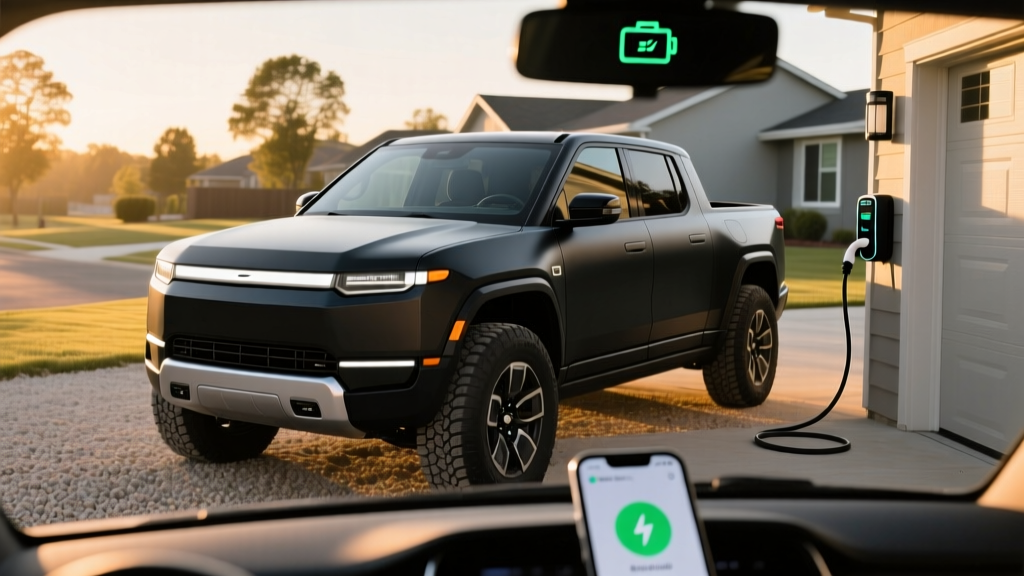
- You can install a Level 2 home charger (essential for any EV truck this size)
Look elsewhere if:
- You need an 8-foot bed for commercial/lumber use (bed is 54.4")
- Budget is under $65,000 — the R1T starts near $70K
- You frequently tow over 8,000 lbs on long highway routes (range drops drastically)
- You lack home charging access — public DC charging a 149 kWh pack is time-consuming and costly
- You want the latest NACS-native port without an adapter (2025+ models will integrate NACS natively)
Frequently Asked Questions
What is the real-world range of the 2024 Rivian R1T?
Highway driving at 70 mph in moderate temperatures, expect 270–300 miles from the Max Pack (EPA 352) and 240–270 miles from the Large Pack (EPA 328). Cold weather (below freezing) reduces these figures by 20–30%. City driving with regenerative braking can match or slightly exceed EPA estimates.
How fast does the R1T charge at home and on the road?
On a 48-amp Level 2 home charger, the R1T adds approximately 25–28 miles of range per hour — a full charge from empty takes 12–15 hours depending on pack size. At a DC fast charger, expect 10–80% in roughly 28–33 minutes, with the Max Pack peaking around 220 kW. Charge speed tapers significantly above 60% SoC.
Does the 2024 Rivian R1T qualify for the $7,500 federal tax credit?
Only certain configurations qualify. The IRS §30D credit requires a pickup truck MSRP at or below $80,000, buyer income within caps ($150K single / $300K joint), and compliance with battery-sourcing requirements. In practice, this limits eligibility to the Dual-Motor Standard Pack and some Large Pack Adventure builds. Always verify current eligibility at irs.gov before purchasing, as sourcing rules and qualifying lists change.
Is the Rivian R1T worth buying over the Ford F-150 Lightning?
The R1T is more expensive but offers superior off-road capability, a more car-like unibody ride, the Gear Tunnel, and higher range on equivalent pack sizes. The F-150 Lightning wins on price (starting ~$55K), bed length (5.5' or 6.5'), Pro Power Onboard for job-site use, and broader dealer service coverage. Choose the R1T for adventure and refinement; choose the Lightning for work-truck duty and value.
What are the biggest drawbacks of the R1T?
The short bed (54.4") limits utility for conventional truck tasks. Service center availability remains limited in rural areas compared to legacy automakers. The premium price ($70K–$100K+) puts it out of reach for many truck buyers. And like all large-battery EVs, DC fast charging a 149 kWh Max Pack at public rates ($0.35–$0.50/kWh) can cost $45–$70 per session — reducing the fuel-cost advantage over gas trucks on road trips.
How long will the R1T battery last?
Rivian warranties the battery for 8 years / 175,000 miles at ≥70% capacity retention. Based on NMC chemistry degradation data and Rivian's conservative buffer management, most owners can expect 90%+ capacity at 100,000 miles and 80–85% at 200,000 miles with normal charging habits (avoiding frequent 100% charges and deep discharges). Battery replacement cost, if needed out of warranty, is estimated at $15,000–$25,000 depending on pack size — though this is expected to decline as battery costs continue to fall.