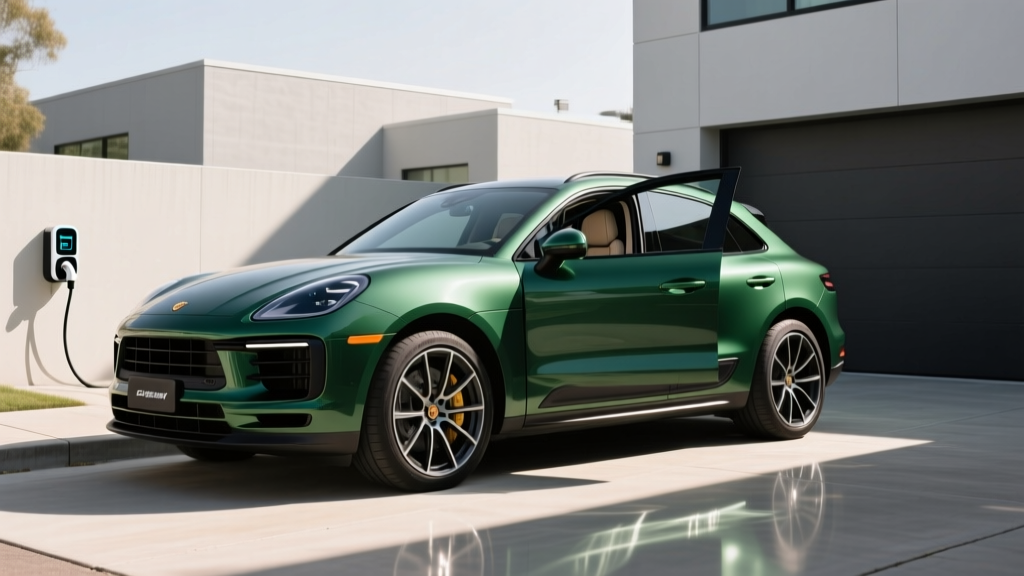
Quick Answer: The 2024 Porsche Macan EV (specifically the Macan 4 Electric) delivers an EPA-estimated 308 miles of range from its 100 kWh gross (95 kWh usable) battery, peaks at 270 kW DC fast charging (10–80% in roughly 21 minutes), and starts around $78,800 before destination. It does not qualify for the federal §30D tax credit due to its MSRP exceeding the $55,000 SUV cap and its overseas battery sourcing. If you want Porsche dynamics with daily EV practicality and can charge at home, it's compelling — but the gas Macan starts $20K lower and has no charging logistics to manage.
What the 2024 Porsche Macan EV Actually Is
The 2024 Macan EV is Porsche's first all-electric SUV, built on the Volkswagen Group's PPE (Premium Platform Electric) architecture co-developed with Audi. It shares underpinnings with the Audi Q6 e-tron but wears distinct Porsche tuning, a 800-volt electrical system, and a two-motor all-wheel-drive layout in its initial U.S. trims. Porsche launched two variants for the U.S. market:
- Macan 4 Electric: 402 hp (overboost), 0–60 mph in 4.9 seconds, EPA 308 miles, MSRP ~$78,800
- Macan Turbo Electric: 630 hp (overboost), 0–60 mph in 3.1 seconds, EPA 288 miles, MSRP ~$105,300
Both trims use a lithium-ion NMC (nickel-manganese-cobalt) battery pack mounted low in the chassis. The 800V architecture is the real engineering story here — it enables the 270 kW peak DC charge rate and sustained high-power delivery that most 400V competitors simply cannot match.
Range Reality: EPA Sticker vs. Real-World Miles
Porsche's EPA range figures are more conservative than some competitors', which is a good thing for expectation management. Here's what the numbers actually mean for your driving:
| Trim | EPA Range | Real-World Highway (70 mph) | Cold Weather (32°F, mixed) |
|---|---|---|---|
| Macan 4 Electric | 308 mi | ~260–275 mi | ~215–240 mi |
| Macan Turbo Electric | 288 mi | ~240–255 mi | ~200–220 mi |
Real-world estimates based on observed efficiency of 2.8–3.2 mi/kWh at highway speeds and typical NMC cold-weather losses of 20–30%. The Macan EV's heat pump (standard) mitigates some winter range loss.
At 95 kWh usable, the Macan 4's battery is large. On the highway, expect consumption around 32–35 kWh/100mi depending on speed and elevation. That translates to roughly 2.8–3.1 mi/kWh — respectable for a 5,300-lb performance SUV, but not Tesla Model Y territory. Around town with regenerative braking doing heavy lifting, you'll see closer to the EPA sticker or occasionally exceed it.
Charging Speed: Where the 800V System Pays Off
The 2024 Macan EV's 800-volt architecture isn't just a spec-sheet flex — it fundamentally changes your road-trip experience. Here's the charging breakdown:
| Level | Power | Connector | Speed | Time (10–80%) |
|---|---|---|---|---|
| Level 1 (120V) | ~1.4 kW | J1772 (w/ adapter) | ~4 mi/hr | N/A (days) |
| Level 2 (240V, 48A) | ~11.5 kW | J1772 / NACS* | ~33 mi/hr | ~8.5 hours (0–100%) |
| DC Fast (peak) | 270 kW | CCS1 / NACS* | ~750+ mi/hr (peak) | ~21 minutes |
*Porsche began transitioning to NACS ports for the North American market. Verify connector type with your dealer, as 2024 production vehicles may ship with CCS1; a NACS adapter is available. The onboard AC charger is 11 kW standard; a 22 kW option was offered in some markets.
The DC fast-charging curve is where Porsche engineers earned their money. The Macan EV can sustain above 200 kW well past 50% state of charge before tapering. On a 350 kW Electrify America or Tesla Supercharger (with adapter), expect 10–80% in approximately 21 minutes under ideal thermal conditions. Preconditioning the battery via the navigation-routed charging feature is essential — without it, cold-soaked batteries will charge significantly slower.
For daily driving, home Level 2 charging at 11 kW means a full overnight replenishment. If your daily commute is 40–60 miles, you'll plug in every other night and wake up full. This is the ownership pattern that makes EVs effortless.
Cost Breakdown: Macan EV vs. Gas Macan Over 5 Years
The purchase price gap between the electric and gas Macan is substantial. Let's model a realistic 5-year ownership comparison using the Macan 4 Electric ($78,800) against a comparably equipped gas Macan S ($67,500 MSRP, 375 hp, EPA 21 mpg combined).
| Cost Category | Macan 4 Electric | Gas Macan S |
|---|---|---|
| MSRP (base) | $78,800 | $67,500 |
| Federal Tax Credit (§30D) | $0 (exceeds $55K SUV cap) | $0 |
| Fuel/Energy (5 yr, 60K mi) | $4,800 (home L2 @ $0.16/kWh) | $12,300 (@ $3.80/gal, 21 mpg) |
| Maintenance (5 yr) | $1,800 (tires, cabin filter, fluid top-offs) | $4,500 (oil, brakes, filters, spark plugs) |
| Insurance (5 yr avg) | $14,400 (~$240/mo) | $11,400 (~$190/mo) |
| Estimated Depreciation (5 yr) | ~$35,500 (45%) | ~$27,000 (40%) |
| 5-Year Total Cost | ~$100,300 | ~$96,300 |
Source: Fuel costs based on fueleconomy.gov data. Depreciation estimates reflect early EV market trends. Insurance averages from industry data; actual quotes vary by driver and state. Electricity rate assumes 85% home charging at $0.16/kWh, 15% DC fast charging at $0.40/kWh.
The EV saves roughly $7,500 in fuel and $2,700 in maintenance over five years, but those savings are erased by higher insurance premiums (~$3,000 more), steeper depreciation (~$8,500 more), and the $11,300 MSRP premium. The 5-year total cost is close — within $4,000 — but the gas Macan retains a slight financial edge unless electricity costs in your area are unusually low or gas prices spike significantly.
Where the Macan EV wins is subjective but real: instant torque, a quieter cabin, one-pedal driving in stop-and-go traffic, and the satisfaction of bypassing gas stations entirely. If those qualities matter to you, the cost parity becomes easier to justify.
Tax Credit, Incentives, and the Fine Print
Let's address this directly: the 2024 Porsche Macan EV does not qualify for the $7,500 federal §30D clean vehicle tax credit. There are two reasons, and both are independently disqualifying:
- MSRP Cap: IRS §30D limits the credit to SUVs with a base MSRP of $80,000 or less. The Macan 4 Electric starts at $78,800, which is under the cap — but with common options (premium paint, larger wheels, Sport Chrono), many builds exceed $80,000 and lose eligibility.
- Battery Sourcing: The §30D credit requires that critical minerals and battery components meet phased-in domestic/FRTA-sourcing thresholds. The Macan EV's battery cells are manufactured overseas (primarily by Samsung SDI and LG Energy Solution in facilities outside qualifying trade agreement countries for the 2024 model year). This alone disqualifies the vehicle regardless of MSRP.
- Buyer Income Cap: Even if the vehicle qualified, buyers must have an adjusted gross income below $150,000 (single) or $300,000 (joint) to claim the credit.
Always verify current eligibility on IRS.gov or consult a tax professional before relying on any incentive in your purchase decision.
Some states offer additional rebates or HOV lane access regardless of federal credit eligibility — check your state's energy office or DMV for specifics. California's CVRP rebate, for example, has its own income and price caps that may apply.
Common Misconceptions About the Macan EV
| Myth | Fact |
|---|---|
| "It's just an electric Audi Q6 e-tron in a Porsche body." | While they share the PPE platform, the Macan EV has unique Porsche-tuned air suspension, rear-axle steering, specific motor calibration, and a distinct interior. Driving dynamics are measurably different — the Porsche is sharper and more responsive. |
| "308 miles of range isn't enough for road trips." | With 270 kW charging adding ~170 miles in 15 minutes at a DC fast charger, a 500-mile trip requires only two ~20-minute stops. Most drivers need a break at that interval anyway. |
| "I'll save a fortune on fuel compared to the gas Macan." | You'll save approximately $7,500 over 5 years on energy — meaningful, but not enough to offset the higher purchase price alone. The savings are one factor among many. |
| "The battery will need replacing in a few years." | Porsche warranties the high-voltage battery for 8 years/100,000 miles with a capacity retention threshold of 70%. NMC batteries in thermally managed systems like the PPE typically retain 85–90% capacity at 100K miles based on industry degradation data. |
| "I can charge it on any public charger." | The Macan EV uses CCS1 (or NACS on newer builds). CHAdeMO-only stations won't work. Verify your local charging networks (Electrify America, EVgo, ChargePoint) support CCS or NACS before relying on public infrastructure. |
Who Should Buy the Macan EV — and Who Shouldn't
Buy the 2024 Porsche Macan EV if:
- You have reliable home Level 2 charging (a 240V/48A circuit installed or available)
- You value driving dynamics and want an EV that feels like a Porsche, not an appliance
- Your daily driving is under 200 miles round-trip, with occasional longer trips on DC fast-charging corridors
- You're willing to pay a $10K+ premium over the gas Macan for the EV experience and don't need the tax credit to justify the purchase
- You want a luxury compact EV SUV and find the Tesla Model Y too mainstream or the BMW iX too large
Consider the gas Macan (or wait) if:
- You lack home charging access and your area has sparse public DC fast-charging infrastructure
- You regularly drive in extreme cold (below 10°F) where range loss of 30%+ makes 308 miles feel like 210
- You frequently tow — the Macan EV's 4,409-lb tow rating is adequate for light trailers, but towing crushes range to under 180 miles
- Budget is a primary concern and the gas Macan S at $67,500 meets your performance needs
- You plan to keep the vehicle 8+ years and are uncertain about long-term EV depreciation trends
Frequently Asked Questions
Does the 2024 Macan EV have a frunk (front trunk)?
Yes, but it's modest — approximately 2.9 cubic feet, enough for a charging cable bag and a small duffel. The rear cargo area offers 17.1 cu ft behind the second row and 55.5 cu ft with seats folded. This is competitive with the gas Macan but smaller than a Tesla Model Y's total volume.
Can I use Tesla Superchargers with the Macan EV?
Porsche has confirmed NACS adoption for North American models. If your 2024 Macan EV shipped with a CCS1 port, Porsche offers a NACS adapter that enables access to Tesla's V3 and V4 Supercharger network (150–250 kW stations). Confirm adapter availability and compatibility with your specific VIN through your dealer.
What is the real-world efficiency in kWh/100mi?
Expect approximately 32–36 kWh/100mi in mixed driving, 35–40 kWh/100mi on the highway at 70+ mph, and 28–32 kWh/100mi in city driving with regen active. The EPA combined rating for the Macan 4 Electric is 84 MPGe (approximately 33 kWh/100mi). For context, the Tesla Model Y Long Range achieves about 28 kWh/100mi — the Porsche is heavier and less aero-optimized.
How does regenerative braking work in the Macan EV?
Porsche offers adjustable regen via steering-wheel paddles or a one-pedal driving mode. Maximum regen deceleration is approximately 0.3g — enough for most stopping scenarios without touching the friction brakes. The brake-by-wire system blends regen and mechanical braking seamlessly. Expect significantly longer brake pad life compared to the gas Macan.
What happens if the battery degrades past the warranty threshold?
Porsche's 8-year/100,000-mile battery warranty guarantees 70% capacity retention. If your battery falls below that threshold within the warranty period, Porsche will repair or replace it at no cost. Out-of-warranty replacement costs for a ~100 kWh pack currently range from $20,000–$30,000 depending on labor and parts availability — though module-level repairs (replacing individual degraded modules rather than the entire pack) may reduce that figure significantly.
Is the Macan EV's all-wheel drive system different from the gas Macan's?
Yes. The gas Macan uses a mechanical torque-vectoring AWD system with a center differential. The Macan EV uses two independent electric motors (one per axle) with electronic torque distribution that reacts in milliseconds — faster than any mechanical system. The result is excellent traction in rain and light snow, though the EV's 5,300-lb curb weight means winter tires are still strongly recommended in snowy climates.