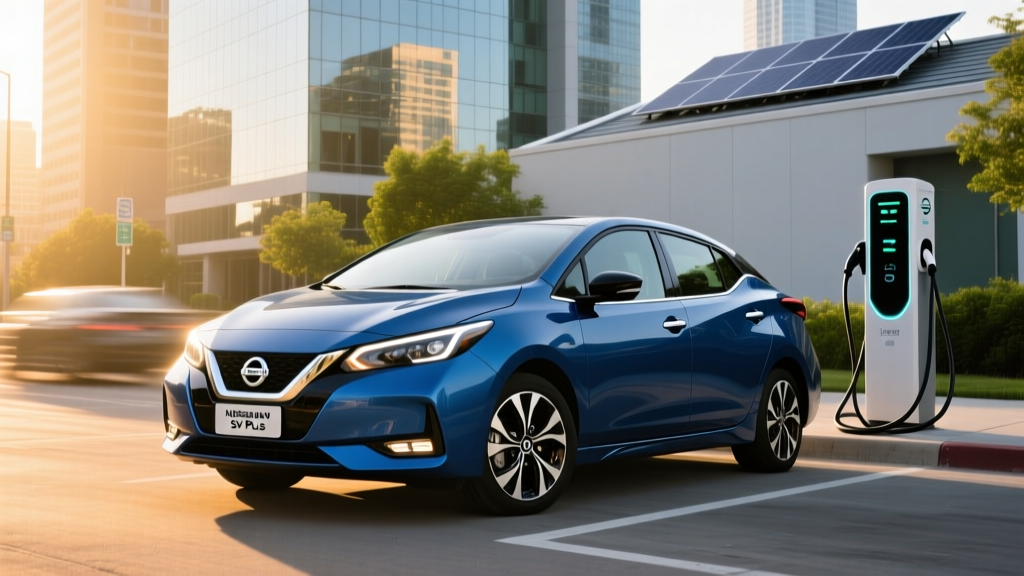
The 2024 Nissan Leaf SV Plus occupies a specific niche in the new-EV market: a practical, front-wheel-drive hatchback with usable range, a comfortable ride, and one of the lowest starting prices among battery-electric vehicles. But with the EV market shifting toward NACS connectors, liquid-cooled batteries, and 200+ kW fast charging, where does this legacy nameplate stand for buyers evaluating it in 2026? This review breaks down the Leaf SV Plus with exact numbers, real-world ownership expectations, and a clear-eyed look at what it does well — and where it shows its age.
Spec Snapshot: 2024 Nissan Leaf SV Plus at a Glance
| Specification | Value |
|---|---|
| EPA Estimated Range | 212 miles |
| Battery (Usable / Gross) | ~58 kWh usable / ~62 kWh gross, NMC lithium-ion |
| Motor Output | 160 kW (214 hp), 250 lb-ft torque |
| Drivetrain | Front-wheel drive (single motor) |
| 0–60 mph | ~6.5 seconds |
| Max DC Fast Charge Rate | ~100 kW (CHAdeMO) |
| 10–80% DC Charge Time | ~45 minutes (estimated) |
| Level 2 Onboard Charger | 7.2 kW (J1772) |
| EPA Efficiency | 121 MPGe combined / 28 kWh/100 mi |
| Cargo Volume (rear seats up / folded) | 23.6 cu ft / 31.6 cu ft |
| Base MSRP (SV Plus) | $36,190 (incl. destination) |
| Battery/Powertrain Warranty | 8 years / 100,000 miles |
Range and Efficiency: What 212 EPA Miles Actually Means on the Road
The 2024 Leaf SV Plus carries an EPA-estimated 212 miles of range from its roughly 60 kWh usable NMC (nickel-manganese-cobalt) battery pack. That EPA figure was achieved under mixed city/highway conditions and represents a reasonable baseline for moderate-temperature, suburban driving.
- City / suburban (moderate temps): ~200–215 miles — the Leaf's strong regenerative braking and low-speed efficiency let it match or slightly beat its EPA sticker in stop-and-go driving.
- Highway (65–75 mph, moderate temps): ~165–185 miles — the Leaf's aerodynamic profile and single-speed reduction gear take a hit at sustained speed. Expect roughly a 15–20% reduction from the EPA figure.
- Cold weather (below 32°F / 0°C): ~145–170 miles — the Leaf SV Plus uses a resistance heater rather than a heat pump, which draws significant battery energy for cabin warming. Combined with cold-induced battery chemistry sluggishness, range loss of 20–30% is typical.
The Leaf SV Plus achieves 121 MPGe combined (28 kWh per 100 miles), which is competitive with similarly sized EVs. Efficiency drops notably at highway speeds, however, and the absence of a heat pump is a meaningful disadvantage in cold climates compared to competitors like the Hyundai Kona Electric or Chevrolet Bolt EUV.
Charging: CHAdeMO in a NACS World
Charging is where the 2024 Leaf SV Plus reveals its most significant competitive disadvantage. Nissan retained the CHAdeMO DC fast-charging connector for this model year, while virtually every other major automaker has adopted or committed to the Tesla-designed NACS standard (or uses CCS1). This matters for long-term public charging access.
| Charging Level | Connector | Max Power (kW) | Approximate Speed |
|---|---|---|---|
| Level 1 (120V household) | J1772 | ~1.4 kW | ~4–5 miles per hour |
| Level 2 (240V home / public) | J1772 | 7.2 kW | ~22–25 miles per hour; full charge in ~8.5 hours |
| DC Fast Charge | CHAdeMO | ~100 kW peak | 10–80% in ~45 minutes; tapering significantly above 80% |
The 7.2 kW Level 2 onboard charger is adequate for overnight home replenishment — plug in at 10 PM and you'll wake up to a full battery. On DC fast charging, the Leaf peaks around 100 kW but, like many EVs, does not sustain that rate. The charge curve tapers progressively above 60% state of charge, with a steep drop above 80%. A 10–80% session takes approximately 45 minutes at a capable CHAdeMO station.
The CHAdeMO connector is the critical concern. Electrify America, EVgo, and other networks still maintain CHAdeMO plugs at many stations, but new installations increasingly favor NACS and CCS1. For buyers who rely on public DC fast charging, adapter solutions (CHAdeMO-to-NACS) are limited and unreliable. Nissan offers a CHAdeMO-to-CCS adapter in some markets, but availability and compatibility vary. If home Level 2 charging covers your daily needs and you only need DC fast charging a few times a year, this may be manageable. If you road-trip frequently or lack home charging, it's a serious limitation.
Performance and Driving Dynamics
The SV Plus's 160 kW (214 horsepower) front-mounted electric motor delivers 250 lb-ft of instant torque to the front wheels. The 0–60 mph sprint takes approximately 6.5 seconds — brisk enough for confident highway merging and passing, though not in the same league as dual-motor AWD competitors. The single-speed reduction transmission means power delivery is linear and uninterrupted.
Ride quality is a genuine strength. The Leaf's suspension tuning prioritizes comfort, absorbing road imperfections with a maturity that rivals more expensive crossovers. The low center of gravity from the under-floor battery pack keeps body roll well-controlled through corners, though the eco-oriented tires prioritize efficiency over grip. Steering is light and predictable — ideal for city maneuvering but not engaging on twisty back roads.
Nissan's e-Pedal mode enables one-pedal driving with aggressive regenerative braking that can bring the car to a full stop without touching the brake pedal. It's intuitive and reduces brake wear significantly. The conventional hydraulic brakes blend smoothly when additional stopping power is needed.
Interior, Tech, and Daily Livability
The Leaf SV Plus interior is functional and well-assembled, if not particularly modern. An 8-inch touchscreen with Apple CarPlay and Android Auto (wired) serves as the infotainment hub. The SV Plus trim adds navigation, a Bose premium audio system, and a portable charging cable. Physical buttons for climate and volume remain — a welcome choice for drivers tired of menu-diving.
Passenger space is generous for a compact hatchback:
- Front legroom: 42.1 inches
- Rear legroom: 33.5 inches
- Cargo (seats up): 23.6 cubic feet
- Cargo (seats folded): 31.6 cubic feet
That cargo volume is competitive with small crossovers and significantly more practical than many sedan-shaped EVs. The rear seats fold in a 60/40 split, though the load floor isn't perfectly flat due to the battery placement beneath.
One notable absence: the Leaf SV Plus does not offer a frunk (front trunk). The space under the hood houses conventional power electronics, so all cargo capacity is in the rear hatch area.
Driver Assistance: ProPILOT Assist
The SV Plus includes Nissan's ProPILOT Assist, an SAE Level 2 driver-assistance system combining adaptive cruise control with lane-centering steering. It works well on divided highways, maintaining speed and lane position with smooth inputs. However, it requires continuous driver engagement — hands on the wheel, eyes on the road. This is not autonomous driving; it is a convenience aid that reduces fatigue on long trips. The system can struggle with faded lane markings and construction zones, as all Level 2 systems do.
The Leaf also includes Nissan Safety Shield 360 as standard: automatic emergency braking with pedestrian detection, lane departure warning, blind-spot monitoring, rear cross-traffic alert, and rear automatic braking.
Pricing, Tax Credits, and Value Proposition
The 2024 Nissan Leaf SV Plus starts at $36,190 including destination charges. The lower-range Leaf S (149-mile EPA range, 40 kWh battery) starts at $28,140. Nissan also offers the SV trim (non-Plus, 149-mile range) at approximately $29,140.
| Trim | EPA Range | MSRP (incl. destination) |
|---|---|---|
| S | 149 miles | $28,140 |
| SV | 149 miles | $29,140 |
| SV Plus | 212 miles | $36,190 |
Federal Tax Credit Eligibility (§30D)
The 2024 Nissan Leaf's federal tax credit eligibility under IRS §30D is constrained by battery-sourcing and critical-minerals requirements that took effect in 2024. As of the 2024 model year, the Leaf assembled in the U.S. (Smyrna, Tennessee) may qualify for a partial credit — typically $3,750 — depending on the specific battery-component and critical-minerals sourcing thresholds met. The full $7,500 credit requires meeting both thresholds simultaneously.
Key eligibility requirements for the buyer:
- MSRP cap: The Leaf is a passenger car (not an SUV/truck/van), so the MSRP cap is $55,000. All Leaf trims fall well under this limit. ✓
- Buyer income cap: Modified adjusted gross income must not exceed $150,000 (single), $225,000 (head of household), or $300,000 (married filing jointly).
- Battery sourcing: Must meet escalating critical-minerals and battery-component thresholds set by the IRS. The Leaf's Japan-sourced battery cells have historically struggled to meet U.S. sourcing requirements, which is why partial credit is more common than the full $7,500.
- Point-of-sale transfer: Eligible buyers can transfer the credit to the dealer at purchase, reducing the out-of-pocket price immediately rather than waiting for a tax return.
Because sourcing rules tighten annually and are subject to IRS guidance updates, buyers should verify current eligibility at the point of purchase and consult a tax professional for individual circumstances.
Warranty Coverage
Nissan provides the following warranty coverage for the 2024 Leaf SV Plus:
- Lithium-ion battery capacity: 8 years / 100,000 miles (guarantees against capacity loss below 9 bars out of 12 on the battery health gauge — roughly equivalent to ~66% of original capacity)
- EV system coverage: 5 years / 60,000 miles
- New vehicle limited warranty: 3 years / 36,000 miles
- Powertrain: 5 years / 60,000 miles
The battery warranty's capacity threshold is less generous than competitors who guarantee 70% retention over 8 years / 100,000 miles. The 9-bar gauge is Nissan-specific and can be confusing — it does not map linearly to percentage. Historically, Leaf batteries (which are passively air-cooled rather than liquid-cooled) have shown higher degradation rates in hot climates compared to liquid-cooled packs. For buyers in the Southwest or other high-temperature regions, this is a factor worth monitoring via the dashboard battery health indicator and, ideally, an OBD-II SoH (state of health) reading before purchasing used.
Pros and Cons
- One of the lowest-priced new EVs with 200+ miles of range
- Comfortable ride and quiet cabin
- Generous cargo space for a compact hatch (23.6 cu ft)
- Proven ProPILOT Assist and comprehensive standard safety features
- e-Pedal one-pedal driving is intuitive and effective
- U.S.-assembled (Smyrna, TN)
- CHAdeMO connector limits DC fast-charging access as networks shift to NACS/CCS
- Peak DC charge rate of ~100 kW is slow by 2024+ standards
- No heat pump — significant cold-weather range loss
- Air-cooled battery may degrade faster in hot climates
- Dated interior design and infotainment compared to newer rivals
- No frunk; limited front storage
Who Should Buy the 2024 Nissan Leaf SV Plus?
- You have reliable Level 2 home charging and your daily commute is under 80 miles round-trip
- You want a comfortable, practical EV hatchback at one of the lowest prices in the segment
- You rarely need DC fast charging (a few road trips per year at most)
- You live in a moderate climate where cold-weather range loss is manageable
- You value physical controls, a smooth ride, and strong cargo utility over cutting-edge tech
- You road-trip frequently and need fast, widely available DC charging (NACS/CCS vehicles are better served)
- You live in a very hot or very cold climate where battery thermal management matters
- You want the latest infotainment, over-the-air updates, or a modern EV platform
- You need all-wheel drive or higher performance
The Leaf SV Plus competes against the Chevrolet Bolt EV/EUV (discontinued after 2023 but available used), Hyundai Kona Electric, Kia Niro EV, and increasingly affordable compact crossovers like the Volvo EX30. Its strongest value proposition is price — few new EVs offer 212 miles of EPA range for under $37,000 before incentives. Its weakest point is the charging ecosystem, where CHAdeMO's declining infrastructure support creates a genuine ownership risk for anyone dependent on public fast charging.
Frequently Asked Questions
What is the real-world range of the 2024 Nissan Leaf SV Plus?
The EPA estimates 212 miles. In real-world driving, expect approximately 200–215 miles in city conditions, 165–185 miles on the highway, and 145–170 miles in cold weather. The lack of a heat pump makes winter range loss more pronounced than in competing EVs equipped with one.
How fast does the Leaf SV Plus charge?
At home on a 240V Level 2 charger, the 7.2 kW onboard charger adds roughly 22–25 miles of range per hour, fully replenishing the battery in about 8.5 hours. On a CHAdeMO DC fast charger, the Leaf peaks around 100 kW and charges from 10–80% in approximately 45 minutes, with significant tapering above 80%.
Does the 2024 Nissan Leaf qualify for the federal EV tax credit?
It may qualify for a partial credit (typically $3,750) under IRS §30D, depending on battery-sourcing and critical-minerals thresholds. The full $7,500 requires meeting both sourcing requirements simultaneously, which the Leaf's battery supply chain has historically not achieved. Buyer income caps and the $55,000 MSRP cap for passenger cars also apply. Verify eligibility at purchase and consult a tax professional.
Is the Leaf SV Plus worth buying vs. competitors?
If you prioritize low purchase price and have home charging, the Leaf SV Plus offers strong value. However, the CHAdeMO connector is a growing liability as public networks adopt NACS. The Hyundai Kona Electric and Kia Niro EV offer CCS/NACS compatibility, heat pumps, and more modern platforms at slightly higher prices. For buyers who need frequent DC fast charging, the Leaf's connector and ~100 kW charge rate are significant drawbacks.
How long will the Leaf's battery last?
Nissan warrants the battery for 8 years / 100,000 miles against dropping below 9 of 12 capacity bars (roughly 66% of original). The air-cooled battery design is more susceptible to heat-related degradation than liquid-cooled competitors. Real-world data from earlier Leaf generations shows batteries in hot climates (Arizona, Texas) losing capacity faster than those in moderate regions. Regular monitoring via the dashboard health gauge and avoiding frequent DC fast charging in extreme heat can help preserve longevity.
Can I charge the Leaf at Tesla Superchargers?
Not directly. Tesla Superchargers use the NACS connector, while the Leaf uses CHAdeMO for DC fast charging and J1772 for Level 2. No reliable, widely supported CHAdeMO-to-NACS adapter exists as of 2024. Some Tesla Destination Chargers (Level 2, J1772-compatible with an adapter) may be accessible, but Supercharger access is not available for the Leaf.