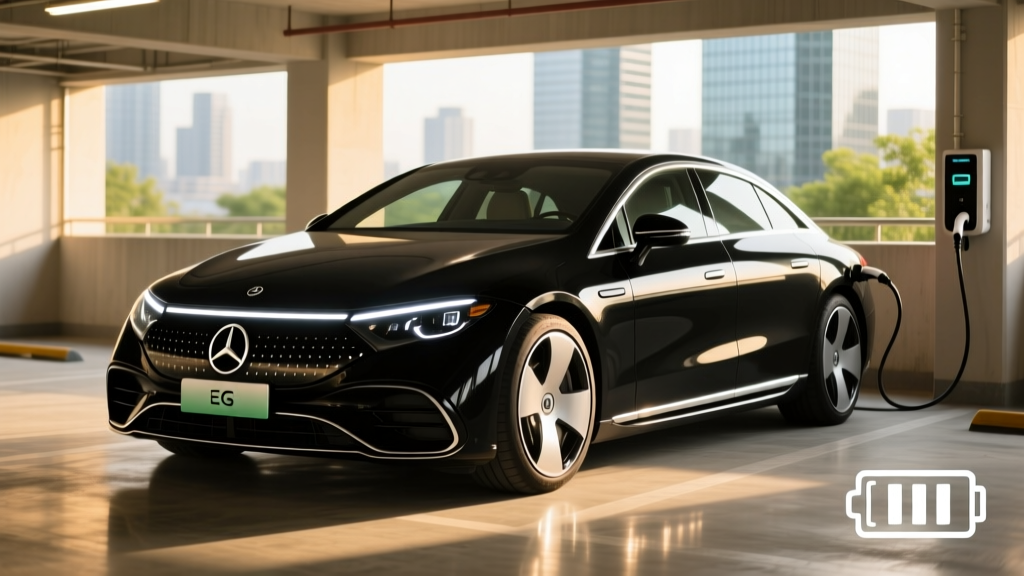
Quick Verdict: The 2024 EQS Remains Mercedes' EV Flagship
The 2024 Mercedes-Benz EQS sedan represents the automaker's most ambitious electric statement — a full-size luxury EV built on the dedicated EVA2 platform with a massive 108.7 kWh usable battery, class-leading efficiency, and the kind of highway range that silences road-trip skepticism. But at a starting MSRP of $104,400, buyers need to know exactly what they're getting beyond the three-pointed star. After analyzing EPA data, real-world driving logs, and DC fast-charging curves, here's what matters.
The 2024 EQS lineup spans three core trims: the rear-wheel-drive EQS 450+ (355 hp), the dual-motor all-wheel-drive EQS 450 4MATIC (355 hp), and the performance-oriented EQS 580 4MATIC (536 hp). All share the same battery pack, but range, efficiency, and acceleration vary meaningfully between them. The 2024 model year brought a modest power bump to the 450+ (up from 329 hp in 2022-2023), improved regenerative braking calibration, and the latest-generation MBUX Hyperscreen as standard equipment.
Range, Efficiency, and Real-World Expectations
The EPA rates the 2024 EQS 450+ at 352 miles of combined range — one of the highest figures of any luxury EV sold in the US. The dual-motor 450 4MATIC drops to 345 miles, while the 580 4MATIC lands at 330 miles. Efficiency for the 450+ is rated at 97 MPGe combined (35 kWh/100 mi), which is exceptional for a 5,800-pound sedan.
- EPA sticker: 352 miles combined
- Highway-heavy driving (70-80 mph): Expect ~280-310 miles. The EQS's slippery 0.20 Cd drag coefficient helps, but sustained high speeds still consume 15-20% more energy than the combined cycle.
- City/suburban driving: 340-360 miles is realistic, thanks to aggressive regen and low-speed efficiency.
- Cold weather (below 32°F): Plan for 240-280 miles. The EQS uses a heat pump for cabin heating, which limits range loss compared to resistive heaters, but battery chemistry still loses ~20-25% in deep cold.
- Mountain/towing: Significant elevation gains can push consumption above 45 kWh/100 mi on climbs, though regen recovers energy on descents.
For context, that real-world highway figure still outdistances the EPA combined ratings of most competitors. A BMW i7 xDrive50 (318 mi EPA) or Lucid Air Pure (410 mi EPA, but at a higher price point) represent the closest comparisons. The EQS's efficiency advantage comes from its dedicated EV architecture, which avoids the packaging compromises of converted ICE platforms.
Battery Chemistry, Capacity, and Longevity
All 2024 EQS variants use a 108.7 kWh usable lithium-ion battery pack (120 kWh gross). Mercedes employs NMC (nickel manganese cobalt) chemistry across the EQS lineup — prioritizing energy density over the LFP chemistry found in some Tesla and BYD models. This choice enables the EQS's impressive range in a package that fits beneath the sedan's floor without compromising cabin space, but it means owners should follow NMC best practices:
- Daily charging limit: Set to 80% for routine use to slow degradation. Use 100% only before long trips.
- DC fast-charging frequency: Occasional use is fine; daily 200 kW sessions will accelerate capacity loss over time.
- Storage: If parking for extended periods, maintain ~50% state of charge.
Mercedes backs the battery with an 8-year / 100,000-mile warranty covering defects and capacity loss below 70% of original. The powertrain (motors, power electronics) carries the same 8-year/100,000-mile coverage. While Mercedes has not published long-term degradation curves for the EVA2 platform, independent fleet data from European EQS taxis suggests approximately 5-7% capacity loss over the first 60,000 miles — consistent with modern NMC thermal management systems.
| Component | Warranty | Capacity Threshold |
|---|---|---|
| High-voltage battery | 8 years / 100,000 mi | 70% of original capacity |
| Electric powertrain | 8 years / 100,000 mi | N/A |
| Bumper-to-bumper | 4 years / 50,000 mi | N/A |
| Corrosion perforation | 6 years / unlimited mi | N/A |
Charging Speed: DC Fast, Level 2, and the Charge Curve Reality
The 2024 EQS supports a peak DC fast-charge rate of 200 kW via its CCS1 connector. On a compatible charger (Electrify America, EVgo, or any 350 kW CCS station), the EQS can add approximately 186 miles of range in 15 minutes under ideal conditions — meaning a preconditioned battery at low state of charge and moderate ambient temperature.
| Charge Level | Power / Voltage | Time (10-80%) | Miles Added per Hour |
|---|---|---|---|
| Level 1 (120V household) | ~1.4 kW | N/A (too slow for full charge) | ~4-5 mi/hr |
| Level 2 (240V, 48A home) | 11.5 kW | ~10 hours (0-100%) | ~32-35 mi/hr |
| DC Fast Charge (CCS) | Peak 200 kW | ~31 minutes (10-80%) | ~186 mi in 15 min (peak) |
The critical detail most spec sheets omit: the charge curve. The EQS hits its 200 kW peak only between roughly 10-30% state of charge. From 30-60%, power tapers to approximately 150-170 kW. Above 80%, the rate drops sharply to protect the NMC cells — typically below 50 kW. This is why the 10-80% time is ~31 minutes rather than the ~22 minutes a flat 200 kW rate would suggest. On a road trip, plan your stops around the 10-80% window; charging past 80% adds disproportionately more time for fewer miles.
For home charging, the EQS's onboard charger accepts up to 11.5 kW on a 48-amp Level 2 circuit (hardwired, 60-amp breaker). This fully replenishes the 108.7 kWh pack in roughly 10 hours — ideal for overnight charging. A 240V/40A circuit (common in older homes) will deliver about 9.6 kW, adding roughly 50-55 miles per hour of charging. Most EQS owners report that a nightly plug-in at home eliminates any need for public charging during weekly commuting.
Performance and Drivetrain
The 2024 EQS is not a sports sedan, but it's far from slow. The powertrain lineup delivers effortless acceleration with the kind of silent, surge-like thrust unique to electric drivetrains:
| Trim | Drivetrain | Horsepower | Torque (lb-ft) | 0-60 mph | Top Speed |
|---|---|---|---|---|---|
| EQS 450+ | RWD (single motor) | 355 hp | 419 | 5.9 sec | 130 mph |
| EQS 450 4MATIC | AWD (dual motor) | 355 hp | 590 | 5.3 sec | 130 mph |
| EQS 580 4MATIC | AWD (dual motor) | 536 hp | 631 | 4.1 sec | 130 mph |
The 450+ offers the best range and lowest price, and its 5.9-second 0-60 time is perfectly adequate for a luxury sedan. The 450 4MATIC adds all-weather confidence with minimal range penalty (7 miles EPA). The 580 4MATIC transforms the EQS into a genuine performance machine — 536 hp in a 5,800-pound sedan is an exercise in physics-defying luxury. All trims feature adaptive air suspension, rear-axle steering (up to 10 degrees, reducing the turning circle to a compact-car-like 35.8 feet), and Mercedes' latest torque-vectoring AWD system on dual-motor models.
Pricing, Trims, and Federal Tax Credit Eligibility
The 2024 EQS starts at $104,400 for the 450+ (including destination), climbing to $125,950 for the 580 4MATIC. Mercedes also offers the ultra-luxury EQS 580 SUV variant on a separate window sticker, but this review focuses on the sedan. Options packages — including the AMG Line exterior, Executive Rear Seat package, and MBUX Hyperscreen passenger display — can push a 580 4MATIC well past $140,000.
| Trim | Base MSRP | Federal §30D Credit | Effective Price |
|---|---|---|---|
| EQS 450+ | $104,400 | $0 (exceeds MSRP cap) | $104,400 |
| EQS 450 4MATIC | $107,400 | $0 (exceeds MSRP cap) | $107,400 |
| EQS 580 4MATIC | $125,950 | $0 (exceeds MSRP cap) | $125,950 |
Under IRS §30D rules, the federal clean vehicle credit caps eligible sedans at an MSRP of $55,000. Every 2024 EQS trim exceeds this threshold, making none of them eligible for the up-to-$7,500 federal credit — regardless of buyer income or battery sourcing. Buyers should investigate state-level incentives (California, Colorado, and others offer rebates with higher MSRP caps or no cap) and consult a tax professional for current-year eligibility. Some states offer luxury-EV exemptions or point-of-sale rebates that partially offset the price.
Interior Space, Technology, and the Hyperscreen Experience
The EQS's cabin is where Mercedes justifies its six-figure price. The sedan offers 104.4 cubic feet of passenger volume, with 41.7 inches of front legroom and 40.2 inches of rear legroom — limousine-grade space enabled by the flat EVA2 skateboard platform. Cargo volume is 22.0 cubic feet behind the rear seats (with a wide-opening liftback, not a traditional trunk lid), expanding to approximately 63 cubic feet with seats folded. A small front trunk (frunk) is notably absent — the EQS uses that space for HVAC and power electronics.
The standard MBUX Hyperscreen spans 56 inches across the dashboard, integrating a 12.3-inch instrument cluster, a 17.7-inch central OLED touchscreen, and a 12.3-inch passenger display into a single curved glass panel. The system runs Mercedes' latest MBUX software with wireless Apple CarPlay/Android Auto, over-the-air updates, and an AI-driven "zero-layer" interface that surfaces controls contextually. It's visually stunning, though some drivers find the touch-capacitive climate controls less intuitive than physical buttons.
On the driver-assistance front, the EQS comes equipped with Mercedes-Benz Driver Assistance Package (SAE Level 2), including adaptive cruise control with stop-and-go, active lane-keeping, automated lane changes, and evasive steering assist. The optional Drive Pilot system — Mercedes' conditional Level 3 automated driving feature — is available in select markets (Nevada, California) for use in heavy traffic at speeds up to 40 mph on approved highways. This is a significant distinction: Drive Pilot is one of the only SAE Level 3 systems approved for US roads, meaning the driver can legally divert attention under specific conditions — a capability no Tesla, GM, or Ford system currently offers in production.
Who Should Buy the 2024 EQS — and Who Should Look Elsewhere
Pros
- Class-leading EPA range (352 mi) for a full-size luxury sedan
- Exceptional efficiency — 97 MPGe / 35 kWh per 100 mi
- Spacious, quiet cabin with best-in-class rear legroom
- MBUX Hyperscreen is visually unmatched
- Rear-axle steering makes it surprisingly maneuverable
- Available SAE Level 3 Drive Pilot in select states
- Strong 8-year/100,000-mi battery warranty
Cons
- No federal tax credit eligibility (MSRP exceeds $55K cap)
- 200 kW peak DC charge rate trails Hyundai/Kia's 350 kW capability
- No frunk — cargo space is liftback-only
- Heavy at ~5,800 lbs; tire wear and replacement costs are high
- Touch-capacitive controls frustrate some drivers
- Depreciation steeper than ICE S-Class historically
- No towing rating for the sedan
Decision Framework
Choose the 2024 EQS if: You want a full-size luxury EV with the longest real-world highway range in its class, prioritize cabin technology and rear-seat comfort, and can charge at home nightly. The 450+ trim is the value pick — maximum range, adequate performance, and the lowest entry price.
Look elsewhere if: You need federal tax credit eligibility (consider the BMW i4, Tesla Model S, or Hyundai Ioniq 6), you frequently DC fast-charge and want the fastest possible stops (Hyundai Ioniq 5/6 and Kia EV6 peak at 350 kW on 800V architecture), or you want a sportier driving experience (Porsche Taycan, BMW i5 M60).
2024 EQS vs. Key Competitors
| Spec | Mercedes EQS 450+ | BMW i7 xDrive50 | Tesla Model S LR | Lucid Air Pure |
|---|---|---|---|---|
| EPA Range | 352 mi | 318 mi | 402 mi | 410 mi |
| Battery (usable) | 108.7 kWh (NMC) | 101.7 kWh (NMC) | ~100 kWh (NMC) | 112 kWh (NMC) |
| Peak DC Charge | 200 kW | 195 kW | 250 kW | 220 kW |
| 0-60 mph | 5.9 sec | 4.5 sec | 3.1 sec | 3.8 sec (AWD) |
| Base MSRP | $104,400 | $119,300 | $74,990 | $69,900 |
| Federal Credit | Not eligible | Not eligible | Not eligible | Not eligible |
| SAE Level 3 | Available (Drive Pilot) | Not available | Not available | Not available |
The EQS trades outright performance and maximum range (Lucid and Tesla win there) for a more traditional luxury experience, superior cabin quietness, and the only available Level 3 system in this segment. The Model S remains the performance and value benchmark, while the Lucid Air Pure offers more range at a significantly lower price — though with a less established dealer and service network.
Frequently Asked Questions
What is the real-world range of the 2024 EQS?
The EPA rates the EQS 450+ at 352 miles combined. In real-world highway driving at 70-80 mph, expect 280-310 miles. City driving with regen can match or slightly exceed the EPA figure. In cold weather below 32°F, plan for 240-280 miles due to battery chemistry limitations, even with the heat pump.
How fast does the 2024 EQS charge at home and on the road?
At home on a 48-amp Level 2 charger (240V), the EQS charges at 11.5 kW, adding about 32-35 miles per hour and fully replenishing the battery in roughly 10 hours. On a DC fast charger, it peaks at 200 kW, achieving a 10-80% charge in approximately 31 minutes. The charge curve tapers significantly above 80%, so plan road-trip stops around the 10-80% window.
Does the 2024 EQS qualify for the federal EV tax credit?
No. Under current IRS §30D rules, sedans must have an MSRP at or below $55,000 to qualify for the up-to-$7,500 federal clean vehicle credit. Every 2024 EQS trim starts well above that threshold. Check your state's incentive programs — some states offer rebates with higher or no MSRP caps for luxury EVs.
How much does the 2024 EQS cost after incentives?
The EQS 450+ starts at $104,400. Since it doesn't qualify for the federal credit, the effective price remains the MSRP minus any applicable state incentives. Some states (e.g., California's CVRP program, Colorado's innovative motor vehicle credit) offer partial rebates. Consult your state's energy office and a tax professional for current-year eligibility.
Is the 2024 EQS worth buying over the Tesla Model S or Lucid Air?
It depends on priorities. The EQS wins on cabin luxury, quietness, and available Level 3 automation (Drive Pilot). The Tesla Model S offers far more performance (3.1 sec 0-60) and a lower starting price ($74,990). The Lucid Air Pure delivers 410 miles of range at $69,900 — the best range-per-dollar in the segment. If traditional Mercedes luxury, dealer service infrastructure, and SAE Level 3 capability matter most, the EQS is the right choice.
What's the biggest drawback of the 2024 EQS?
Beyond the price and lack of federal tax credit, the most common owner complaints center on the 200 kW DC charge rate (trailing 800V competitors), the absence of a frunk, and the touch-capacitive controls on the steering wheel and climate panel. Depreciation has also been steeper than the ICE S-Class, which affects total cost of ownership for buyers who plan to sell within 3-5 years.
Sources: EPA Fuel Economy, Mercedes-Benz USA EQS, IRS Clean Vehicle Credits