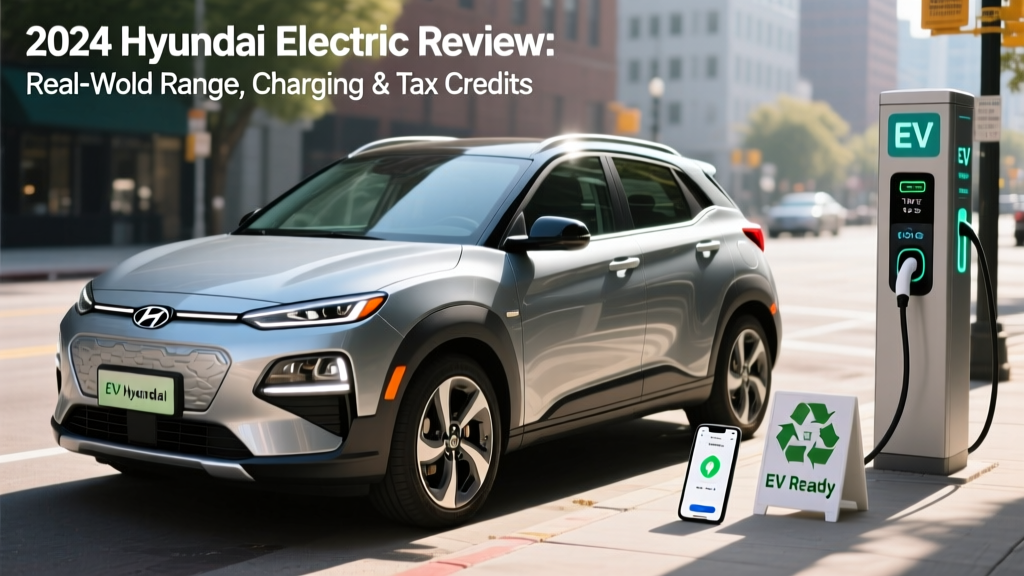
The redesigned 2024 Hyundai Kona Electric arrived with a larger footprint, a bigger battery, and a more mature personality than the first-generation model it replaced. For compact SUV shoppers who want an all-electric daily driver without the full-size price tag, this subcompact crossover hits a sweet spot: usable range, fast-enough charging, and one of the best warranty packages in the segment. But does it hold up against rivals like the Chevrolet Equinox EV, Nissan Ariya, and Kia EV6 in real-world driving? This review breaks down every number that matters.
2024 Kona Electric at a Glance: Full Spec Sheet
| Spec | Value |
|---|---|
| EPA Range | 261 miles (SEL Convenience / Limited) |
| Battery Capacity | 64.8 kWh usable (NMC chemistry) |
| Drivetrain | Front-wheel drive, single motor |
| Horsepower | 201 hp (150 kW) |
| Torque | 188 lb-ft |
| 0–60 mph | ~7.5 seconds |
| Max DC Fast Charge | ~100 kW peak |
| 10–80% DC Charge Time | ~43 minutes |
| Level 2 (AC) Charge Rate | 10.9 kW (approx. 36 mi/hr) |
| EPA Efficiency | 129 MPGe combined / 26 kWh/100 mi |
| Cargo Volume | 25.5 cu ft (rear seats up) / 63.7 cu ft (folded) |
| Rear Legroom | 38.2 inches |
| Battery Warranty | 10 years / 100,000 miles |
| Base MSRP (SE) | $32,675 |
| Top Trim MSRP (Limited) | $41,025 |
Range & Efficiency: EPA vs. Real-World Driving
The 2024 Kona Electric carries a 64.8 kWh usable battery pack using NMC (nickel-manganese-cobalt) chemistry, which offers higher energy density than LFP alternatives — critical for packaging 261 miles of range into a subcompact platform. The SEL Convenience and Limited trims earn the full 261-mile EPA estimate, while the base SE trim (with smaller 17-inch wheels and lighter weight) achieves up to 261 miles as well. The sporty N Line, with its 19-inch wheels, drops to approximately 245 miles.
EPA sticker: 261 miles. In practice:
- City/suburban commuting: 250–270 miles — regenerative braking in stop-and-go traffic recovers energy effectively.
- Sustained highway driving (70–80 mph): ~210–230 miles. The Kona's bluff-front crossover shape creates more aero drag than a sedan at speed.
- Cold weather (below 32°F): Expect a 20–30% reduction, yielding roughly 180–210 miles. The Kona Electric uses a heat pump on upper trims (Limited), which mitigates cabin-heating losses but does not eliminate cold-weather battery chemistry slowdown.
For a 30-mile round-trip commute with home charging, this range is more than sufficient year-round. Road trippers should plan DC fast-charge stops every 170–190 miles to stay in the battery's optimal charge-curve zone.
Efficiency is rated at 129 MPGe combined (26 kWh per 100 miles) per fueleconomy.gov. That translates to roughly 3.8 miles per kWh — competitive with the Nissan Ariya and slightly behind the more aerodynamic Hyundai Ioniq 6. In everyday terms, a full charge from empty costs about $7–$11 at residential electricity rates of $0.13–$0.17/kWh.
Charging Speed: DC Fast Charging and Home Level 2
Charging speed remains one of the Kona Electric's most debated specs. The 2024 model peaks at approximately 100 kW on DC fast charging — a meaningful improvement over the first-gen's 75 kW ceiling, but still behind the 150–240 kW rates offered by the Hyundai Ioniq 5, Kia EV6, and Tesla Model Y. On a 150 kW or higher station, the Kona will accept its max rate, but it won't utilize the headroom.
| Charging Level | Power (kW) | Miles Added per Hour | Typical Use Case |
|---|---|---|---|
| Level 1 (120V household) | ~1.4 kW | ~4–5 mi/hr | Overnight trickle / emergency |
| Level 2 (240V home / public) | 10.9 kW | ~36 mi/hr | Daily home charging (7–8 hrs for full) |
| DC Fast Charge | ~100 kW peak | ~250 mi/hr (peak) | Road trips; 10–80% in ~43 min |
The 10–80% DC fast-charge time of roughly 43 minutes is the number road trippers should internalize. The charge curve tapers significantly above 80% SoC (state of charge) — this is a battery-protection feature, not a malfunction. Charging from 80–100% can add another 25–30 minutes, so on road trips, plan to unplug at 80% and drive on. The Kona uses a standard CCS1 connector (Combined Charging System), compatible with Electrify America, EVgo, ChargePoint DC stations, and most non-Tesla networks. A NACS adapter will be needed for Tesla Supercharger access as Hyundai transitions to that standard in future model years.
For home Level 2 charging, the 10.9 kW onboard charger means a 48-amp hardwired wall unit will replenish the pack in roughly 7 hours — plug in after your evening commute and wake up to a full battery every morning. A licensed electrician will typically quote $800–$2,000 for a Level 2 home install depending on panel capacity and conduit runs.
Performance, Ride, and Daily Drivability
The 2024 Kona Electric's single front-mounted motor produces 201 horsepower and 188 lb-ft of torque, delivering a 0–60 mph time of approximately 7.5 seconds. That's brisk enough for confident highway merging and passing, though it won't match the thrill of dual-motor AWD crossovers. The instant torque from a standstill makes city driving feel quicker than the stopwatch suggests.
Ride quality has improved substantially over the first-generation Kona Electric, which rode on a shortened platform shared with the gas Kona. The 2024 model uses a dedicated EV architecture with a longer wheelbase (104.7 inches, up 2.4 inches from the prior generation). The result is noticeably improved rear-seat legroom (38.2 inches, competitive with compact SUVs a class above) and a more planted, less choppy ride over rough pavement.
The Kona Electric is front-wheel drive only. There is no AWD or dual-motor option, which limits its appeal in heavy-snow regions or for light off-pavement use. Ground clearance is approximately 6.7 inches — adequate for urban curbs and gravel driveways but not for trail driving. Towing capacity is not officially rated for the US market; Hyundai does not recommend towing with this model.
Pricing, Trims, and Federal Tax Credit Eligibility
Hyundai prices the 2024 Kona Electric across three main trims:
| Trim | MSRP (incl. destination) | Est. Price After §30D Credit* |
|---|---|---|
| SE | $32,675 | ~$25,175 |
| SEL Convenience | $36,175 | ~$28,675 |
| Limited | $41,025 | ~$33,525 |
*Estimated price assumes the buyer qualifies for the full $7,500 federal EV tax credit under IRS §30D and elects the point-of-sale transfer. Eligibility is not universal.
The 2024 Kona Electric qualifies for the $7,500 federal EV tax credit (IRC §30D) as of its launch, but several conditions must be met by the buyer:
- MSRP cap: The Kona Electric is classified as an SUV, so the MSRP cap is $80,000 — all trims pass easily.
- Buyer income cap: Adjusted gross income must not exceed $150,000 (single), $225,000 (head of household), or $300,000 (married filing jointly).
- Battery sourcing requirements: The credit is split into two halves — $3,750 for critical-minerals sourcing and $3,750 for battery-component manufacturing. Hyundai has confirmed the Kona Electric meets both requirements for the full $7,500, but buyers should verify at fueleconomy.gov at the time of purchase, as sourcing rules tighten annually.
- Point-of-sale transfer: Beginning in 2024, buyers can transfer the credit to the dealer at purchase, receiving the $7,500 as an immediate price reduction rather than waiting for a tax refund. This requires the dealer to be IRS-registered.
Consult a tax professional or review the latest guidance at IRS.gov before finalizing your purchase. State and local incentives may stack on top of the federal credit but vary widely by jurisdiction.
Interior, Cargo Space, and Technology
The 2024 redesign brought a generational leap in interior quality and space. The cabin features dual 12.3-inch panoramic displays (instrument cluster and infotainment) on upper trims, wireless Apple CarPlay and Android Auto across all trims, and Hyundai's latest Bluelink connected-car services. Physical climate-control buttons remain — a welcome choice for drivers tired of touchscreen-only HVAC menus.
Cargo volume stands at 25.5 cubic feet behind the rear seats and 63.7 cubic feet with the 60/40 split rear seats folded. That's competitive with the Kia Niro EV and meaningfully larger than the outgoing Kona Electric's 19.2 cu ft. A small front trunk (frunk) adds roughly 0.9 cu ft — enough for a charging cable bag, but don't expect to fit a carry-on.
The Hyundai SmartSense driver-assistance suite is standard on all trims and includes forward collision-avoidance assist with pedestrian and cyclist detection, lane-keeping assist, blind-spot collision warning, rear cross-traffic collision-avoidance assist, and highway driving assist (HDA). HDA combines adaptive cruise control with lane-centering on divided highways — this is an SAE Level 2 driver-assist system, meaning the driver must keep hands on the wheel and eyes on the road at all times. It is not autonomous driving.
Highway Driving Assist (HDA) on the 2024 Kona Electric is an SAE Level 2 system. It provides combined steering and speed assistance but requires continuous driver supervision. It does not navigate on-ramps, stoplights, or construction zones autonomously. The driver is legally and operationally responsible at all times.
Pros and Cons: Living with the 2024 Kona Electric
Pros
- 261-mile EPA range is genuinely sufficient for most daily needs and moderate road trips
- Class-leading 10-year / 100,000-mile battery warranty
- Spacious interior with 38.2 inches of rear legroom — punches above its subcompact class
- Wireless CarPlay/Android Auto standard on all trims
- Physical buttons for climate controls — usability win
- Qualifies for the $7,500 federal tax credit (when buyer meets requirements)
- Competitive starting price under $33,000 before incentives
Cons
- DC fast charging peaks at only ~100 kW — slower than Ioniq 5, EV6, and Model Y
- Front-wheel drive only; no AWD option for snow-belt buyers
- No official towing rating
- Frunk is tiny (0.9 cu ft) — barely fits the included charge cable
- Road-trip charging stops take longer than rivals with 150+ kW capability
- N Line trim sacrifices ~16 miles of range for sportier styling
Who Should Buy the 2024 Kona Electric?
Choose the Kona Electric if: You're a commuter or small household seeking an affordable, practical EV with strong warranty coverage, adequate daily range, and a comfortable, tech-forward interior — and you primarily charge at home. It excels as a first EV for someone transitioning from a gas compact SUV.
Look elsewhere if: You take frequent 400+ mile road trips (the 100 kW charge ceiling adds time), need AWD for heavy snow, want to tow, or prioritize the fastest possible public charging. In those cases, consider the Hyundai Ioniq 5, Tesla Model Y, or Kia EV6, all of which offer faster DC charging and available AWD — though at higher starting prices.
2024 Kona Electric FAQ
What is the real-world range of the 2024 Kona Electric?
The EPA rates it at 261 miles for the SEL Convenience and Limited trims. In real-world highway driving at 70–80 mph, expect approximately 210–230 miles. In cold weather below freezing, plan for 180–210 miles. City driving with regenerative braking can approach or slightly exceed the EPA number.
How fast does the 2024 Kona Electric charge?
On DC fast charging, it peaks at approximately 100 kW and charges from 10–80% in about 43 minutes. On a Level 2 home charger (10.9 kW), a full charge takes roughly 7 hours, adding about 36 miles of range per hour. Level 1 (120V) adds about 4–5 miles per hour — suitable only for overnight top-ups or emergencies.
How much does the 2024 Kona Electric cost after tax credits?
The base SE starts at $32,675 MSRP. If you qualify for the full $7,500 federal tax credit via point-of-sale transfer, the effective price drops to approximately $25,175. The Limited trim at $41,025 drops to roughly $33,525. Qualification depends on buyer income, battery sourcing compliance, and MSRP caps per IRS §30D.
Does the 2024 Kona Electric qualify for the $7,500 federal EV tax credit?
Yes — the 2024 Kona Electric qualifies for the full $7,500 credit as of its launch, provided the buyer meets IRS income limits ($150K single / $300K joint) and the vehicle's battery sourcing meets critical-mineral and component-manufacturing requirements. Verify current eligibility at fueleconomy.gov before purchasing, as rules tighten annually.
Is the 2024 Kona Electric worth buying vs. competitors?
It's one of the best value propositions in the subcompact EV SUV segment. Against the Chevrolet Equinox EV (315-mile range but higher starting price), the Kona is more affordable and available now. Against the Nissan Ariya (304-mile range, available AWD), the Kona trades range and AWD for a lower price and stronger warranty. Against the Kia EV6 (faster charging, sportier driving), the Kona wins on price and cargo practicality. For a home-charging commuter who road-trips occasionally, the Kona Electric is a strong, rational pick.
What is the battery warranty on the 2024 Kona Electric?
Hyundai covers the high-voltage battery for 10 years or 100,000 miles (whichever comes first), with a capacity-retention threshold typically set at 70% of original capacity. The basic vehicle warranty is 5 years / 60,000 miles, and the powertrain warranty is 10 years / 100,000 miles — among the most generous in the industry.
Can I charge the 2024 Kona Electric at Tesla Superchargers?
Not natively. The 2024 Kona Electric uses a CCS1 charge port. As Hyundai transitions to NACS (the Tesla connector standard) on future models, a CCS-to-NACS adapter will be needed for Supercharger access. Hyundai has indicated adapter compatibility for existing CCS vehicles, but confirm with your dealer for the latest approved adapter list.