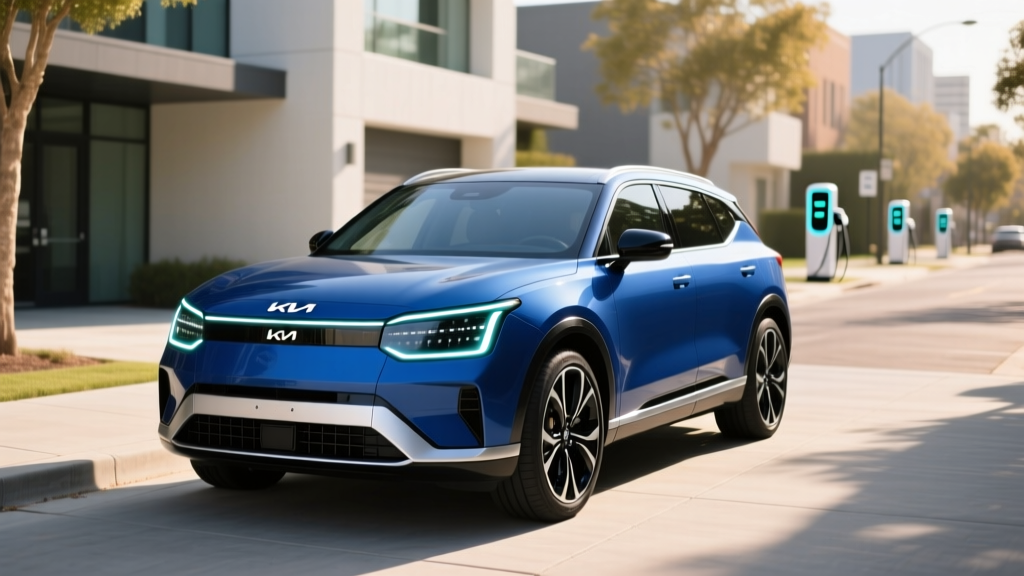
The 2024 Kia EV9 Wind occupies a rare position in the electric vehicle market: a genuinely usable three-row battery-electric SUV priced below $60,000 before incentives. While rivals like the Rivian R1S and Tesla Model X command significantly higher premiums, the EV9 Wind delivers 304 miles of EPA-estimated range, 201 kW DC fast-charging capability, and Kia's proven infotainment architecture — all in a package that seats seven. But does the real-world experience match the spec sheet? We break down every number that matters for buyers considering this electric family hauler.
Range and Efficiency: EPA vs. the Real World
The 2024 Kia EV9 Wind carries a 99.8 kWh usable battery (110.3 kWh gross) using NMC (nickel-manganese-cobalt) lithium-ion chemistry. This is a rear-wheel-drive, single-motor configuration, which maximizes efficiency compared to the dual-motor AWD trims.
Real-World Expectation: Expect 260–280 miles in mixed driving with moderate highway use. Sustained 75+ mph highway driving drops range to approximately 235–255 miles. In freezing temperatures (below 32°F), anticipate a 20–30% reduction, yielding roughly 210–245 miles per charge. The EV9's standard heat pump helps mitigate cold-weather losses compared to EVs without thermal management, but physics still applies to a 5,000+ lb SUV.
Efficiency is rated at 88 MPGe combined (84 city / 93 highway) or approximately 38 kWh per 100 miles according to fueleconomy.gov. For a vehicle of this size and weight, that's competitive — though smaller two-row crossovers like the Hyundai Ioniq 5 achieve over 110 MPGe. The Wind's single-motor RWD layout is the efficiency sweet spot in the EV9 lineup; stepping up to the dual-motor AWD Land or GT-Line drops range to 270–282 miles EPA.
Charging Speed: DC Fast, Level 2, and the 800V Advantage
Kia equips the EV9 Wind with an 800-volt electrical architecture, enabling significantly faster DC fast-charging than the 400V systems found in competitors like the Volkswagen ID.4 or Ford Explorer EV. Here's what the numbers look like across charging levels:
| Charging Level | Power / Rate | Speed / Time |
|---|---|---|
| Level 1 (120V household) | ~1.4 kW | ~3–4 miles per hour |
| Level 2 (240V home, 48A) | ~10.9 kW | ~29 miles per hour; 0–100% in ~9 hours |
| DC Fast Charge (peak) | 201 kW | 10–80% in ~24 minutes (optimal conditions) |
| DC Fast Charge (350 kW station) | ~201 kW peak | Sustains ~150–180 kW through 60% SoC, tapers to ~60 kW above 80% |
The 10–80% time of approximately 24 minutes is achievable at a 350 kW charger like an Electrify America or EVgo station, but only under ideal conditions: battery preconditioned to optimal temperature (the EV9 does this automatically when a DC fast charger is set as your navigation destination), and ambient temperatures above 60°F. In colder weather or without preconditioning, expect 10–80% times closer to 30–35 minutes.
The charge curve is strong through the mid-range but tapers noticeably past 80% State of Charge. Charging from 80–100% can take nearly as long as 10–80%, which is typical for NMC chemistry. For daily driving, we recommend setting a charge limit of 80% to preserve long-term battery health and only charging to 100% before long road trips.
The EV9 Wind uses the CCS1 (Combined Charging System) connector for DC fast charging and a J1772 inlet for Level 2. Kia has confirmed that future EV9 models will transition to the NACS (Tesla) connector, but the 2024 model year retains CCS. Tesla Supercharger access is available via an adapter for CCS-equipped vehicles at participating Supercharger stations.
Performance and Drivetrain
The EV9 Wind is a rear-wheel-drive, single-motor configuration producing 215 horsepower and 258 lb-ft of torque. The 0–60 mph time is approximately 7.8 seconds. That's adequate for highway merging and around-town driving, but noticeably slower than the dual-motor AWD EV9 GT-Line, which hits 60 in roughly 4.5 seconds with 379 hp (516 hp with the GT boost function).
The trade-off for the Wind's more modest output is range and price. RWD also provides a tighter turning circle and slightly more predictable handling for a vehicle with a 122.8-inch wheelbase. The EV9 Wind is not a performance SUV — it's a family cruiser, and the powertrain calibration reflects that. Regenerative braking offers multiple levels adjustable via steering wheel paddles, including an "auto" mode that uses radar to modulate regen based on traffic ahead, and a near-one-pedal-driving "i-Pedal" mode that brings the vehicle to a complete stop.
Interior Space, Cargo, and Practicality
Three-row EV SUVs are scarce, and the EV9 Wind delivers genuine adult-capable space in all three rows:
- Front row legroom: 41.5 inches
- Second row legroom: 42.8 inches
- Third row legroom: 29.9 inches (usable for adults on shorter trips; competitive with the Toyota Grand Highlander)
- Cargo behind 3rd row: 20.2 cu ft
- Cargo behind 2nd row: 43.5 cu ft
- Cargo behind 1st row (max): 81.7 cu ft
- Frunk (front trunk): 1.8 cu ft (small; accommodates a charging cable bag)
The Wind trim seats seven in a 2-3-2 configuration (second-row bench). The higher Land and GT-Line trims offer optional second-row captain's chairs, reducing capacity to six but improving third-row access via a walk-through gap. For families who regularly carry more than five passengers, the Wind's bench configuration is the practical choice.
Towing capacity for the RWD EV9 Wind is rated at 2,000 lbs (AWD models can tow up to 5,000 lbs). This is sufficient for a small utility trailer or a pair of dirt bikes, but not for a loaded camping trailer. If towing is a priority, the AWD trims are worth the range trade-off.
Pricing, Trims, and Federal Tax Credit Eligibility
The 2024 Kia EV9 Wind carries a base MSRP of $59,900 (including destination charge). This positions it between the base EV9 Light ($54,900, 230-mile range) and the AWD Land ($63,900).
| Item | Amount |
|---|---|
| Base MSRP (EV9 Wind RWD) | $59,900 |
| Typical options/packages | $500–$1,500 |
| Federal §30D EV Tax Credit (if eligible) | Up to $7,500 |
| Effective price after max credit | ~$52,400–$53,900 |
Federal tax credit eligibility for the 2024 EV9 Wind is nuanced. Under current IRS §30D rules (always verify at irs.gov before purchasing):
- MSRP cap: The EV9 qualifies — the $80,000 cap applies to SUVs, and the Wind is well under that limit.
- Buyer income caps: Modified AGI must not exceed $300,000 (joint filers), $225,000 (head of household), or $150,000 (single filers).
- Battery sourcing requirements: The $7,500 credit is split into two halves — $3,750 for critical minerals sourcing and $3,750 for battery component manufacturing. As of the 2024 model year, the EV9's battery is manufactured in Georgia (via the SK On/Hyundai JV plant), which satisfies the component requirement. Critical minerals sourcing compliance varies by production batch — confirm with your dealer at point of sale.
- Point-of-sale transfer: Beginning in 2024, buyers can transfer the credit to the dealer at purchase, receiving the $7,500 as an immediate price reduction rather than waiting to claim it on their tax return.
State and local incentives may stack on top of the federal credit. Check afdc.energy.gov for your jurisdiction's specific rebates.
Technology, Safety, and Driver Assistance
The EV9 Wind comes well-equipped with Kia's latest tech suite:
- Infotainment: Dual 12.3-inch displays (instrument cluster + touchscreen) running Kia's latest UI with wireless Apple CarPlay and Android Auto
- Driver assistance: Highway Driving Assist 2 (HDA2) — a Level 2 SAE system combining adaptive cruise control with lane centering, including lane-change assist when the turn signal is activated
- Safety: Forward collision-avoidance assist, blind-spot monitoring with rear cross-traffic avoidance, safe exit assist, and rear occupant alert are all standard
- Unique features: Digital Key 2 (use your smartphone as a key), vehicle-to-load (V2L) capability via an interior outlet and available exterior adapter (powers devices up to 3.68 kW — enough to run a campsite or emergency home appliances), augmented reality head-up display on select packages
Notable drawbacks include the absence of a traditional frunk (the front storage area is tiny), the Wind's lack of a 360-degree surround-view camera (reserved for the Land and above), and the touch-capacitive climate controls that some drivers find less intuitive than physical buttons.
Warranty and Long-Term Ownership
Kia backs the EV9 Wind with one of the strongest warranties in the EV segment:
- Limited vehicle warranty: 5 years / 60,000 miles
- Powertrain warranty: 10 years / 100,000 miles
- Battery warranty: 10 years / 100,000 miles (covers capacity below 70% of original)
The 70% battery capacity retention threshold is standard for the industry. Based on NMC degradation data from similar Hyundai/Kia platforms (Ioniq 5, EV6), owners can expect approximately 85–92% capacity retention after 5 years / 75,000 miles of typical use, with the rate of degradation slowing after the initial 1–2 year period. Following best practices — avoiding frequent DC fast-charging to 100%, minimizing extended storage at very high or very low State of Charge, and using Level 2 for daily charging — will help maximize long-term battery health.
Verdict: Who Should Buy the 2024 Kia EV9 Wind?
- You need genuine three-row seating in a battery-electric SUV
- Your budget caps around $55,000–$60,000 after incentives
- You prioritize range (304 miles) over AWD or max towing
- You charge primarily at home and take road trips 2–4 times per year
- You need AWD for snow/terrain or 5,000-lb towing (consider the EV9 Land AWD)
- You want hands-free Level 2+ driving (BlueCruise on Ford, Super Cruise on GM)
- Third-row use is daily — a minivan or the Rivian R1S offers more space
- 304-mile EPA range — best in the EV9 lineup
- 201 kW DC fast-charging via 800V architecture
- Class-leading 10-year/100,000-mile battery warranty
- Seven-passenger seating under $60K MSRP
- V2L capability for camping and backup power
- RWD only; 2,000-lb tow limit
- Third row tight for adults on long trips
- Tiny frunk (1.8 cu ft)
- CCS connector (not NACS — adapter needed for Superchargers)
- Full $7,500 tax credit depends on battery sourcing batch
Frequently Asked Questions
What is the real-world range of the 2024 Kia EV9 Wind?
Expect 260–280 miles in typical mixed driving. Highway-only trips at 75+ mph reduce that to roughly 235–255 miles. In freezing weather, plan for 210–245 miles. The 304-mile EPA figure is achievable in mild conditions with city-heavy driving and moderate speeds.
How fast does the EV9 Wind charge at home and on the road?
At home on a 48-amp Level 2 charger (240V), you'll add about 29 miles per hour, fully recharging in roughly 9 hours. On a DC fast charger, the EV9 Wind peaks at 201 kW and can go from 10–80% in approximately 24 minutes under ideal conditions (preconditioned battery, warm weather).
Does the 2024 Kia EV9 Wind qualify for the $7,500 federal EV tax credit?
It can, but eligibility depends on your income (must be under $300K joint / $150K single), and the specific vehicle's battery sourcing compliance at time of manufacture. The MSRP is under the $80,000 SUV cap. Always verify with your dealer and consult irs.gov or a tax professional before relying on the credit.
Is the EV9 Wind worth buying over the Rivian R1S or Tesla Model X?
If price is a primary factor, the EV9 Wind wins decisively — the R1S starts around $74,000 and the Model X over $79,000. However, the R1S offers superior off-road capability, AWD, and 5,000+ lb towing, while the Model X provides access to the Supercharger network natively and faster acceleration. The EV9 Wind is the value-oriented three-row EV for on-road family use.
What are the biggest drawbacks of the EV9 Wind?
RWD-only (no AWD option on this trim), a 2,000-lb tow rating, a very small frunk, CCS connector (requiring an adapter for Tesla Superchargers), and a third row that's best suited for children or shorter adults. The touch-sensitive climate controls are also a common complaint.
Can I tow with the EV9 Wind?
Yes, but the RWD Wind is limited to 2,000 lbs — enough for a small trailer, bike rack, or jet ski. If you need to tow a mid-size camper or boat, the AWD EV9 trims (Land, GT-Line) are rated for up to 5,000 lbs.