The three-row electric SUV segment was sparse before Kia dropped the EV9 into the US market. For families who need genuine third-row seating but aren't ready to spend six figures on a Rivian R1S or Tesla Model X, the 2024 Kia EV9 GT-Line emerged as one of the first mainstream contenders. With its boxy, utilitarian styling, available dual-motor all-wheel drive, and a starting price under $60,000 for base trims, it filled a gap that buyers had been vocal about for years.
But the EV9 GT-Line — the range-topping, sport-oriented trim — pushes closer to $74,000 before incentives. At that price, the questions get sharper: Does the real-world range hold up on highway road trips? How fast does it actually charge on a DC fast charger? And does it still qualify for the federal EV tax credit under current IRS §30D rules? This review puts the numbers front and center.
Range and Efficiency: EPA Sticker vs. Real-World Driving
The 2024 Kia EV9 GT-Line AWD carries an EPA-estimated range of 270 miles on its 99.8 kWh battery pack (usable capacity approximately 94.9 kWh). That battery uses NMC (nickel manganese cobalt) chemistry, which offers higher energy density than LFP but trades some long-term cycle life and thermal stability. The single-motor RWD version, available on lower trims, is rated at up to 304 miles — but the GT-Line is exclusively dual-motor AWD.
The 270-mile EPA figure is a combined city/highway estimate. In our experience and consistent with independent testing, expect approximately 235–250 miles on sustained highway driving at 70–75 mph. In cold weather (below 32°F), range can drop to 195–220 miles due to battery chemistry limitations and cabin heating demands, even with the EV9's standard heat pump. City driving with regenerative braking can push range closer to or slightly above the EPA estimate.
Efficiency lands at 85 MPGe combined (AWD GT-Line), which translates to roughly 39 kWh per 100 miles. That's respectable for a 5,000+ lb three-row SUV but noticeably thirstier than a midsize crossover like the Hyundai Ioniq 5 or Tesla Model Y. On long road trips, plan charging stops around every 200 miles to maintain a comfortable buffer — especially in winter or mountainous terrain.
| Spec | Value |
|---|---|
| EPA Range | 270 miles |
| Battery (Usable) | 99.8 kWh (94.9 kWh usable), NMC |
| Efficiency | 85 MPGe / 39 kWh/100mi |
| Drivetrain | Dual-motor AWD |
| Horsepower | 379 hp (boost mode) |
| 0–60 mph | 5.0 seconds |
| Max DC Fast Charge | 210 kW (peak) |
| 10–80% DCFC Time | ~24 minutes |
| Level 2 Home Charging | 10.9 kW (~33 mi/hr) |
| Towing Capacity | 5,000 lbs (with tow package) |
| Base MSRP (GT-Line) | $73,900 |
| Battery Warranty | 10 years / 100,000 miles |
Charging Speed: DC Fast Charging and Home Setup
The EV9 rides on Hyundai Motor Group's E-GMP 800-volt architecture, which enables DC fast charging at up to 210 kW peak. Kia estimates a 10–80% charge in approximately 24 minutes under optimal conditions — meaning a battery preconditioned to the right temperature and a charger capable of delivering the full rate.
Here's what that looks like in practice: on a 350 kW Electrify America or Tesla Supercharger (via adapter), you'll see peak rates around 200–210 kW between roughly 10–40% state of charge. Above 55%, the charge curve tapers significantly, dropping below 100 kW. By 80%, you're typically at 60–70 kW. This tapering is normal for NMC chemistry and thermal management, but it means the last 20% takes nearly as long as the first 50%. For road trips, the 10–80% window is where you want to operate.
| Charging Level | Power | Speed (Approx.) | Typical Use |
|---|---|---|---|
| Level 1 (120V) | 1.4 kW | ~4 miles/hour | Emergency / overnight trickle |
| Level 2 (240V, 48A) | 10.9 kW | ~33 miles/hour | Home daily charging |
| DC Fast Charge | 210 kW (peak) | 10–80% in ~24 min | Road trips / public stations |
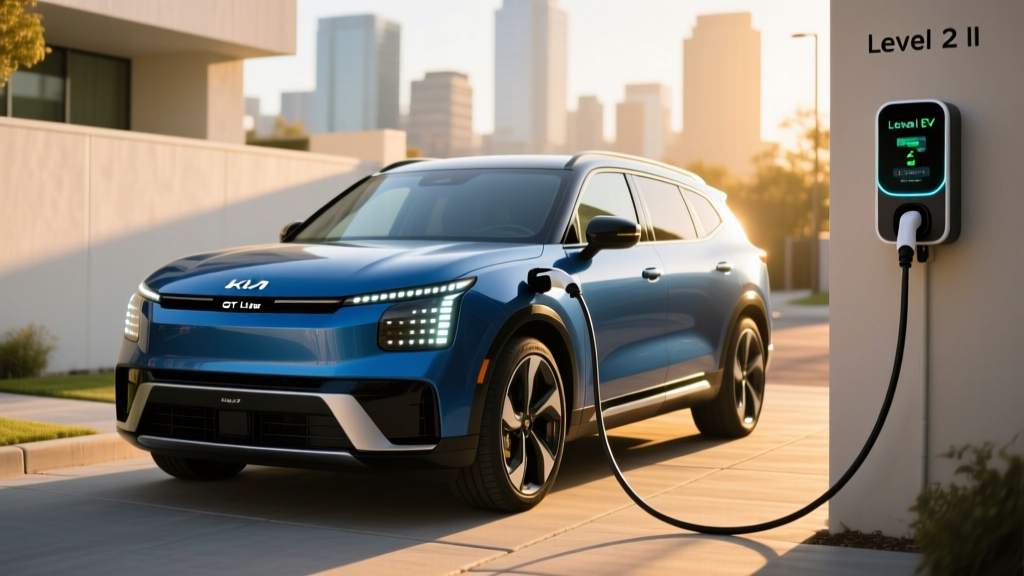
For home Level 2 charging, the EV9 accepts up to 10.9 kW on a 48-amp, 240-volt circuit. That adds roughly 33 miles of range per hour, meaning a full charge from 10% takes about 8–9 hours overnight. Most EV9 owners will want a hardwired Level 2 station (such as a ChargePoint Home Flex or Emporia Vue) installed on a 60-amp breaker. Budget $800–$1,500 for the charger hardware and $500–$2,000 for professional electrician installation, depending on panel proximity and local permit requirements. If your home has a 100-amp electrical panel, a panel upgrade to 200 amps could add $1,500–$3,000.
The EV9 uses a CCS1 connector for DC fast charging. Kia has confirmed that future model years will transition to NACS (Tesla's connector), but the 2024 model ships with CCS1. Tesla Supercharger access is available via a Kia-approved NACS adapter, though charge speeds may be slightly reduced compared to native CCS1 stations.
Performance and Driving Dynamics
The GT-Line's dual-motor AWD powertrain produces 379 horsepower (in boost mode) and a stout 516 lb-ft of torque. The 0–60 mph sprint takes 5.0 seconds, which is quick for a three-row family hauler but not in the same league as a Tesla Model X Plaid or even the lighter Ioniq 5 N. That's not the point of this vehicle.
Where the GT-Line earns its badge is in ride refinement. The adaptive suspension (standard on GT-Line) manages the EV9's considerable weight (approximately 5,100 lbs curb weight) well, keeping body roll controlled through corners without being harsh over expansion joints. Steering is weighted appropriately for highway cruising, though it lacks the precision feedback of performance-oriented SUVs. Regenerative braking offers multiple levels adjustable via steering-wheel paddles, including an i-Pedal one-pedal driving mode that brings the vehicle to a complete stop.
On the highway, cabin noise is impressively low — a benefit of Kia's acoustic laminated glass and the inherent quietness of electric drivetrains. At 75 mph, the EV9 is one of the quietest three-row SUVs on the market, rivaling vehicles costing $20,000 more.
Interior Space, Cargo, and Three-Row Practicality
This is where the EV9 makes its strongest case. The boxy exterior isn't just styling — it maximizes interior volume in a way that sloped-roof competitors can't match.
- Cargo (behind 3rd row): 20.2 cu ft
- Cargo (3rd row folded): 43.5 cu ft
- Cargo (all rear seats folded): 81.7 cu ft
- 2nd-row legroom: 42.8 inches
- 3rd-row legroom: 29.9 inches
- Front headroom: 40.3 inches
The third row is genuinely usable for adults on shorter trips — a rarity in this segment. Headroom is excellent thanks to the flat roofline, and the seat cushion is positioned high enough that occupants don't feel like they're sitting in a footwell. For families with older children or carpool duties, this is a legitimate seven-passenger vehicle.
The GT-Line comes standard with second-row captain's chairs (reducing seating to six), ventilated front and second-row seats, a heated steering wheel, and Kia's dual 12.3-inch panoramic display setup running the latest infotainment software. Wireless Apple CarPlay and Android Auto are standard. A notable tech feature is the Digital Key 2, which allows your smartphone to function as the key fob via NFC and UWB — handy for families sharing the vehicle.
One drawback: the EV9 lacks a front trunk (frunk). The space under the hood is occupied by power electronics and HVAC components, so there's no additional enclosed storage up front — a missed opportunity for an EV-native platform.
Pricing, Trims, and Federal Tax Credit Eligibility
The 2024 Kia EV9 lineup spans five trims, from the base Light RWD starting at $54,900 to the GT-Line AWD at $73,900. Add destination charges ($1,495) and common options, and a well-equipped GT-Line lands around $75,500–$77,000 out the door.
| Trim | Drivetrain | Base MSRP | Est. Federal Credit* |
|---|---|---|---|
| Light | RWD | $54,900 | Up to $7,500 |
| Wind | RWD | $59,900 | Up to $7,500 |
| Land | AWD | $63,900 | Up to $7,500 |
| GT-Line | AWD | $73,900 | Up to $7,500 |
| GT-Line (w/ Prestige Pkg) | AWD | $75,900 | Up to $7,500 |
*Federal tax credit eligibility under IRS §30D depends on multiple factors. Always verify with a tax professional.
- MSRP Cap: SUVs must have an MSRP at or below $80,000 (the EV9 qualifies on all trims)
- Buyer Income Cap: Modified AGI must not exceed $150,000 (single), $225,000 (head of household), or $300,000 (joint filing)
- Battery Sourcing: Critical minerals and battery components must meet phased percentage thresholds from US or FTA-partner countries — verify current-year compliance on IRS.gov
- Point-of-Sale Transfer: As of 2024, eligible buyers can transfer the credit to the dealer at purchase, receiving the benefit as an immediate price reduction rather than waiting for tax filing
- Assembly: Final assembly must occur in North America (the EV9 is assembled in West Point, Georgia — qualifying)
For the GT-Line specifically, the $73,900 MSRP sits comfortably under the $80,000 SUV cap. If your household income qualifies and the battery sourcing requirements are met for the specific VIN you're purchasing, the full $7,500 credit brings the effective price to approximately $66,400. With the point-of-sale transfer option, that reduction applies at the dealership, lowering your financed amount directly. Confirm eligibility for your specific vehicle and tax situation through the IRS New Clean Vehicle Credit page and your tax advisor.
Warranty Coverage and Long-Term Ownership
Kia backs the EV9 with one of the best warranty packages in the industry:
- Battery & Drive Unit: 10 years / 100,000 miles (capacity retention guaranteed above 70%)
- Limited Vehicle Warranty: 5 years / 60,000 miles
- Powertrain: 10 years / 100,000 miles
- Roadside Assistance: 5 years / 60,000 miles
The 10-year battery warranty is a significant confidence signal for a vehicle in this price range. The 70% capacity retention threshold is standard across Hyundai Motor Group and aligns with industry norms. NMC batteries in vehicles with active thermal management — which the EV9 has — typically degrade 1–2% per year under normal use, meaning most owners will see 85–90% state of health at the 100,000-mile mark.
Maintenance costs are minimal compared to ICE three-row SUVs. No oil changes, no transmission fluid, no spark plugs. Brake pad life is extended significantly by regenerative braking — many EV owners report 80,000+ miles on original pads. Budget for tire rotation every 7,500 miles and cabin air filter replacement annually. Expect insurance premiums to run 15–25% higher than a comparable gas SUV, reflecting the EV9's higher repair costs and parts pricing.
Driver Assistance and Safety Technology
The EV9 comes equipped with Kia's Highway Driving Assist 2 (HDA2), a Level 2 driver-assistance system per SAE classification. It combines adaptive cruise control with stop-and-go, lane-centering steering, and lane-change assist. On divided highways, it handles steering, acceleration, and braking competently, but the driver must keep hands on the wheel and remain fully engaged — this is not a hands-free or self-driving system.
HDA2 is a Level 2 driver-assistance system. The driver is responsible for all vehicle operation at all times. You must monitor the road, keep hands on the steering wheel, and be prepared to take over instantly. This is not autonomous driving.
Safety ratings are strong. The EV9 earned the IIHS Top Safety Pick+ designation (when equipped with specific headlights) and a 5-star overall rating from NHTSA. Standard safety equipment includes forward collision avoidance with pedestrian detection, blind-spot monitoring with rear cross-traffic alert, rear occupant alert, and safe-exit assist that warns passengers of approaching traffic before opening doors.
How the EV9 GT-Line Stacks Up Against Competitors
The three-row EV SUV segment has grown since the EV9's launch. Here's how it compares on key metrics:
| Spec | Kia EV9 GT-Line AWD | Rivian R1S Dual-Motor | Tesla Model X LR |
|---|---|---|---|
| EPA Range | 270 mi | 352 mi (Max Pack) | 348 mi |
| Starting MSRP | $73,900 | $79,900 | $79,990 |
| 0–60 mph | 5.0 sec | 5.0 sec | 3.8 sec |
| 3rd-Row Usability | Adult-capable | Tight (children) | Tight (children) |
| Max DCFC | 210 kW | 220 kW | 250 kW |
| Towing | 5,000 lbs | 7,700 lbs | 5,000 lbs |
| Federal Credit | Up to $7,500 | Up to $7,500 | Up to $7,500 |
The EV9's primary advantage is third-row space and value. If you regularly carry six or seven passengers, the EV9 is the most practical option under $80,000. The Rivian R1S offers superior range and off-road capability but at a higher price and with a cramped third row. The Tesla Model X is faster and charges quicker, but its falcon-wing doors are polarizing, its third row is best suited for children, and its starting price sits above the EV9's.
Choose the EV9 GT-Line if: You need genuine adult-capable third-row seating, want premium features (ventilated seats, adaptive suspension) without luxury-brand pricing, primarily drive in urban/suburban settings with access to home charging, and value a 10-year battery warranty.
Look elsewhere if: You regularly road-trip more than 300 miles between stops (range is the EV9's weakest point vs. rivals), need maximum towing capacity (Rivian R1S tows 7,700 lbs), or prioritize cutting-edge autonomous driving features (Tesla's FSD ecosystem is more mature, though still Level 2).
- Genuinely usable third row with adult-capable headroom and legroom
- Excellent ride quality with standard adaptive suspension on GT-Line
- 800V architecture enables competitive DC fast charging
- 10-year/100,000-mile battery warranty
- Qualifies for full $7,500 federal tax credit (income/sourcing permitting)
- Quiet highway cabin, strong build quality
- 270-mile EPA range is the shortest in its price class
- No front trunk (frunk) for additional cargo
- Third-row legroom tight for adults on long trips
- Infotainment can be sluggish compared to Tesla/Rivian
- CCS1 connector (not native NACS) limits Tesla Supercharger integration
- GT-Line pricing pushes near $77K before incentives
Frequently Asked Questions
What is the real-world range of the 2024 Kia EV9 GT-Line?
The EPA rates the EV9 GT-Line AWD at 270 miles combined. In real-world highway driving at 70–75 mph, expect 235–250 miles. In cold weather (below freezing), range drops to approximately 195–220 miles. City driving with regenerative braking can match or slightly exceed the EPA estimate.
How fast does the EV9 GT-Line charge?
On a DC fast charger, the EV9 peaks at 210 kW and can charge from 10–80% in approximately 24 minutes under optimal conditions. At home on a Level 2 (240V, 48A) charger, it adds about 33 miles of range per hour, fully charging overnight in 8–9 hours.
Does the 2024 Kia EV9 qualify for the federal EV tax credit?
Yes, the EV9 qualifies for up to $7,500 under IRS §30D, provided the buyer meets income caps ($300,000 joint / $150,000 single), the MSRP is under $80,000 (all trims qualify), battery sourcing requirements are met, and final assembly occurred in North America. The credit can be transferred to the dealer at point of sale for an immediate price reduction. Always verify eligibility for your specific VIN and tax situation at IRS.gov.
Is the EV9 GT-Line worth it vs. the Rivian R1S or Tesla Model X?
If third-row passenger space is your priority, the EV9 offers the most usable third row under $80,000. The Rivian R1S provides more range and towing but costs more and has a tighter third row. The Tesla Model X is faster and has a longer range but starts above $79,990 and its third row is best for children. The EV9 is the value-oriented family hauler in this segment.
What is the battery warranty on the Kia EV9?
Kia covers the EV9's battery and drive unit for 10 years or 100,000 miles, whichever comes first, with a capacity retention guarantee of 70% or above. The limited vehicle warranty covers 5 years/60,000 miles, and the powertrain warranty extends to 10 years/100,000 miles.
Can the EV9 tow, and how does range change while towing?
The EV9 AWD is rated to tow up to 5,000 pounds when equipped with the factory tow package. When towing near maximum capacity, expect range to drop by 40–50%, reducing effective range to approximately 135–160 miles. Plan charging stops accordingly.