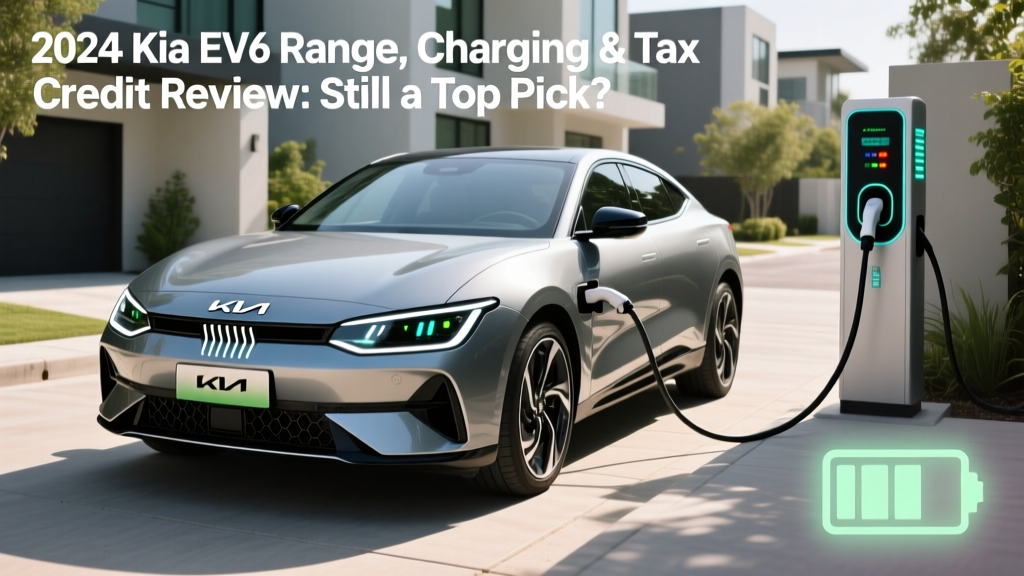
The 2024 Kia EV6 arrived at a pivotal moment for Kia's electric ambitions, riding the same E-GMP platform as the Hyundai Ioniq 5 but carving out a sportier, more driver-focused identity. Now that the EV6 has been on American roads for a full cycle and the refreshed 2025 model with NACS native charging has arrived, it's worth examining exactly what the 2024 Kia EV6 delivers in real-world ownership — from its actual highway range to its charging-curve behavior and whether it still qualifies for the federal tax credit under current IRS rules.
This review uses verified EPA data, manufacturer specifications, and real-world driving observations to give you the numbers that matter for a purchase decision.
2024 Kia EV6 Quick Specs at a Glance
| Specification | Light Range (RWD) | Wind / GT-Line (RWD) | Wind / GT-Line (AWD) | EV6 GT |
|---|---|---|---|---|
| EPA Range | 232 mi | 310 mi | 282 mi | 206 mi |
| Battery (usable) | 58.0 kWh | 77.4 kWh | 77.4 kWh | 77.4 kWh |
| Chemistry | NMC | NMC | NMC | NMC |
| Drivetrain | RWD | RWD | Dual-Motor AWD | Dual-Motor AWD |
| Horsepower | 167 hp | 225 hp | 320 hp | 576 hp |
| 0–60 mph | ~8.0 sec | ~7.2 sec | ~5.1 sec | ~3.4 sec |
| Peak DC Fast Charge | ~175 kW | ~239 kW | ~239 kW | ~239 kW |
| 10–80% DCFC Time | ~18 min | ~18 min | ~18 min | ~18 min |
| Level 2 Home Charge | 10.9 kW | 10.9 kW | 10.9 kW | 10.9 kW |
| MPGe (combined) | 117 MPGe | 117 MPGe | 106 MPGe | 85 MPGe |
| Base MSRP (2024) | $42,600 | $48,700 | $52,100 | $61,600 |
Sources: EPA Fueleconomy.gov, Kia.com specs
Real-World Range: What to Actually Expect
The 2024 Kia EV6 Wind RWD carries an EPA-estimated 310 miles of range. In real-world mixed driving, expect:
- City/suburban commuting (mild weather): 290–315 mi — regenerative braking in stop-and-go traffic helps you match or slightly exceed the EPA sticker.
- Highway cruising at 70–75 mph: 250–275 mi — aerodynamic drag cuts efficiency by roughly 12–18%.
- Cold weather (below 32°F): 220–260 mi — battery chemistry resistance and cabin heating reduce range 15–25%. The EV6 uses a heat pump on most trims, which mitigates some of this loss.
- EV6 GT (highway, spirited driving): As low as 160–175 mi — the GT's performance tires and aggressive power delivery demand frequent stops.
The 310-mile EPA figure on the Wind and GT-Line RWD is competitive with the segment, but the standard-range Light trim's 232 miles is harder to recommend for anyone regularly driving more than 40 miles round-trip. The AWD trims sacrifice roughly 28 miles of EPA range for all-weather traction — a worthwhile trade in snow-belt states.
One detail worth noting: the EV6's battery management system reserves a buffer at both the top and bottom of the 77.4 kWh pack (roughly 3–4 kWh is inaccessible). This protects long-term State of Health (SoH) but means you'll never see the full 77.4 kWh on the dash.
Charging Speed: DC Fast and Home Level 2
The 2024 EV6 uses a CCS1 connector (not the Tesla NACS standard that Kia adopted for the 2025 refresh). This matters for public charging access: you'll rely on Electrify America, EVgo, and ChargePoint networks rather than Tesla Superchargers, though CCS-to-NACS adapters are becoming available.
| Charging Level | Power / Voltage | Speed (77.4 kWh models) | Notes |
|---|---|---|---|
| Level 1 (120V household) | ~1.4 kW | ~3–4 mi/hr | Emergency/trickle only; ~80+ hr for full charge |
| Level 2 (240V home, 48A) | 10.9 kW | ~28–32 mi/hr (~7–8 hr full) | Requires 60A dedicated circuit |
| DC Fast (350 kW station) | Peak 239 kW (800V) | 10–80% in ~18 min | Curve tapers sharply above 80% |
| DC Fast (150 kW station) | ~150 kW sustained | 10–80% in ~25 min | More common; still effective |
The EV6's 800-volt architecture is its charging superpower. On a 350 kW Electrify America stall with proper preconditioning, the EV6 pulls close to 239 kW in the 10–55% SoC window. However, the charge curve tapers significantly above 65% — you'll see speeds drop to under 100 kW past 70% and below 50 kW past 85%. The 10–80% time of 18 minutes is achievable in ideal conditions (warm battery, preconditioned pack, functioning 350 kW charger), but plan for 22–25 minutes in real-world road trips.
Preconditioning tip: The EV6 will precondition the battery for faster charging when you navigate to a DC fast charger using the built-in navigation. This warms the pack to the optimal temperature for peak charge acceptance. Always use the nav-based preconditioning in cold weather — it can shave 5–8 minutes off your charge stop.
Performance, Efficiency, and Daily Drivability
The EV6's E-GMP platform delivers a low center of gravity and near 50/50 weight distribution. The RWD Wind trim's 225 hp feels more than adequate for highway merging and passing, while the AWD's 320 hp provides genuine thrust. The GT trim's 576 hp and 3.4-second 0–60 time puts it in supercar territory, though at the cost of range and ride comfort.
Efficiency figures from fueleconomy.gov:
- Wind RWD: 117 MPGe combined (29 kWh/100 mi)
- Wind AWD: 106 MPGe combined (32 kWh/100 mi)
- GT: 85 MPGe combined (40 kWh/100 mi)
At the US average electricity rate of ~$0.17/kWh, the Wind RWD costs roughly $4.93 per 100 miles to charge at home — compared to $12–14 per 100 miles in a comparable gas crossover averaging 28 MPG.
Interior Space, Cargo, and Tech
The EV6's crossover-coupe silhouette creates a surprisingly roomy cabin:
- Cargo behind rear seats: 24.4 cu ft
- Cargo with rear seats folded: 50.2 cu ft
- Front trunk (frunk): 0.7 cu ft (RWD) / 0.4 cu ft (AWD) — essentially a charging-cable cubby
- Rear legroom: 39.5 inches — generous for the segment, thanks to the flat floor
- Front legroom: 41.7 inches
The dual 12.3-inch curved display handles infotainment and the digital cluster. The EV6 supports wireless Apple CarPlay and Android Auto, which is a welcome feature. However, the touch-capacitive climate controls integrated below the main screen are a common complaint — they lack tactile feedback and require looking away from the road.
Driver assistance: The EV6 comes standard with Kia's Highway Driving Assist 2 (HDA2), which includes adaptive cruise control with stop-and-go, lane centering, and lane-change assist. This is an SAE Level 2 system — you must keep your hands on the wheel and eyes on the road at all times. It's competent for highway commuting but is not autonomous driving.
Vehicle-to-Load (V2L): A standout feature. The EV6 can output up to 3.6 kW of AC power through an adapter plugged into the charge port or a dedicated interior outlet (on select trims). This powers laptops, tools, or even a small window AC unit during outages or camping.
Pricing, Trims, and Federal Tax Credit Eligibility
The 2024 Kia EV6 lineup spans a wide price range:
| Trim | Base MSRP | Destination | Total Before Credit | Est. After §30D Credit* |
|---|---|---|---|---|
| Light (RWD, std range) | $42,600 | $1,375 | $43,975 | ~$36,475 |
| Wind (RWD, long range) | $48,700 | $1,375 | $50,075 | ~$42,575 |
| Wind (AWD) | $52,100 | $1,375 | $53,475 | ~$45,975 |
| GT-Line (RWD) | $53,500 | $1,375 | $54,875 | ~$47,375 |
| GT-Line (AWD) | $57,400 | $1,375 | $58,775 | ~$51,275 |
| GT (AWD) | $61,600 | $1,375 | $62,975 | ~$55,475 |
*Estimated prices assume full $7,500 credit eligibility. Actual credit varies. See IRS rules below.
Does the 2024 Kia EV6 Qualify for the Federal EV Tax Credit?
The 2024 Kia EV6 may qualify for up to $7,500 under IRS §30D, but eligibility depends on multiple factors that change periodically. As of current IRS guidance, here's what determines your credit:
- MSRP cap: The EV6 qualifies as an SUV (per IRS vehicle classification), so the cap is $80,000. All 2024 EV6 trims fall under this limit. ✓
- Buyer income cap: Modified AGI must not exceed $150,000 (single), $225,000 (head of household), or $300,000 (joint). ✓ if you meet this.
- Battery sourcing requirements: The credit splits into two halves — $3,750 for critical-minerals sourcing and $3,750 for battery-component manufacturing. The EV6's battery sourcing has been inconsistent across production batches. Some 2024 EV6s qualify for the full $7,500; others may only qualify for $3,750 or none, depending on when they were built and placed in service.
- Point-of-sale transfer: As of 2024, you can transfer the credit to the dealer at purchase for an immediate price reduction rather than waiting to claim it on your tax return.
Critical: Verify eligibility with your dealer at the time of purchase and consult IRS.gov §30D guidance for the latest battery-sourcing determinations. A tax professional can confirm your personal eligibility.
Warranty and Long-Term Ownership
Kia backs the EV6 with one of the strongest warranties in the segment:
- Battery & drive unit: 10 years / 100,000 miles — covers the traction battery if capacity drops below approximately 70% State of Health
- Basic vehicle: 5 years / 60,000 miles
- Powertrain: 10 years / 100,000 miles
- Roadside assistance: 5 years / 60,000 miles
The 10-year battery warranty is a significant ownership advantage, especially for buyers concerned about long-term degradation. NMC chemistry in the EV6 has shown approximately 8–12% capacity loss over the first 100,000 miles based on fleet data from similar E-GMP vehicles, keeping most packs well within the warranty threshold.
Pros, Cons, and Who Should Buy the 2024 Kia EV6
Pros
- 800V architecture delivers class-leading 239 kW DC charging (~18 min 10–80%)
- 310-mi EPA range on Wind RWD is segment-competitive
- 10-year/100,000-mile battery warranty among the best available
- V2L capability (3.6 kW) for camping, tools, or backup power
- Spacious rear seat (39.5" legroom) and 24.4 cu ft cargo
- Wireless CarPlay/Android Auto standard
- HDA2 driver assist is competent for daily highway use
Cons
- CCS1 connector (no native NACS) limits Supercharger access without adapter
- Touch-capacitive climate controls lack tactile feedback
- Small frunk (0.7 cu ft RWD) — mostly cable storage
- Standard-range Light trim's 232-mi range is limiting
- EV6 GT's 206-mi range is impractical for road trips
- Ride quality on 20" GT-Line wheels is firm over rough pavement
- Federal tax credit eligibility uncertain due to battery-sourcing rules
Who the 2024 EV6 Suits Best
- Daily commuters (30–60 mi round-trip): The Wind RWD handles a full work week on one charge with range to spare. Home Level 2 charging makes ownership effortless.
- Small families: Rear-seat space rivals midsize SUVs. Cargo room handles strollers and groceries. The flat floor keeps the middle seat usable.
- Road-trippers (with planning): 310-mi range and 18-minute DC fast charges make 500-mile trips manageable with one well-placed stop on the Electrify America network.
- Not ideal for: Heavy towing (1,650-lb max capacity), extreme cold climates without garage parking, or buyers who want Tesla Supercharger access without an adapter.
2024 Kia EV6 vs. Key Competitors
The EV6 competes directly with the Hyundai Ioniq 5, Ford Mustang Mach-E, and Tesla Model Y. Here's how it stacks up:
- vs. Hyundai Ioniq 5: Same platform, same battery, similar range. The EV6 is slightly sportier in tuning; the Ioniq 5 offers a more spacious cargo area (27.2 cu ft) and a more retro design. The Ioniq 5 also moved to NACS for 2025.
- vs. Ford Mustang Mach-E: The Mach-E Extended Range AWD offers 290 mi EPA and a larger 37.5 cu ft cargo area but charges slower (peak ~150 kW, 10–80% in ~33 min). The EV6 wins on charging speed.
- vs. Tesla Model Y Long Range: The Model Y delivers 310 mi EPA, Supercharger network access, and a more mature software ecosystem. The EV6 counters with V2L, a longer battery warranty (10 yr vs. 8 yr), and available physical controls. The Model Y's build quality remains inconsistent.
Frequently Asked Questions
What is the real-world range of the 2024 Kia EV6?
The Wind RWD trim's 310-mile EPA estimate translates to roughly 250–275 miles on highway road trips at 70–75 mph, and 220–260 miles in freezing temperatures. City commuters in mild weather can match or slightly exceed the EPA figure thanks to regenerative braking.
How fast does the 2024 EV6 charge at home and on DC fast chargers?
On a 350 kW DC fast charger, the EV6 peaks at 239 kW and charges from 10–80% in approximately 18 minutes under ideal conditions. At home on a 240V Level 2 charger (48A), it adds roughly 28–32 miles per hour, fully recharging the 77.4 kWh battery in 7–8 hours.
How much does the 2024 Kia EV6 cost after tax credits?
The Wind RWD starts at $50,075 including destination. If you qualify for the full $7,500 federal credit under IRS §30D, the effective price drops to approximately $42,575. However, battery-sourcing requirements mean not every 2024 EV6 qualifies for the full amount — verify with your dealer and the IRS before purchasing.
Is the 2024 Kia EV6 worth buying vs. the 2025 refresh?
The 2025 EV6 refresh adds a native NACS charge port (Tesla Supercharger access), a slightly larger battery, and updated styling. If Supercharger access is a priority, the 2025 is worth the wait or premium. If you're buying now and primarily use Electrify America or home charging, the 2024 offers excellent value, especially with dealer incentives on remaining inventory.
Does the 2024 EV6 qualify for the federal EV tax credit?
It depends. All trims fall under the $80,000 MSRP cap for SUVs. Buyer income must not exceed IRS thresholds ($150K single / $300K joint). The critical variable is battery sourcing — the EV6's eligibility for the full $7,500, partial $3,750, or no credit has varied by production batch. Check the DOE/FuelEconomy.gov credit tracker and confirm with your dealer at time of purchase.
Can the 2024 EV6 use Tesla Superchargers?
Not natively. The 2024 EV6 uses a CCS1 connector. Tesla Superchargers use the NACS connector. A CCS-to-NACS adapter may enable access to some Superchargers, but compatibility and charge speed are not guaranteed. The 2025 EV6 switched to native NACS.
Always verify specifications, pricing, and tax credit eligibility with Kia.com, fueleconomy.gov, and IRS.gov before making a purchase decision. Rules and availability change.