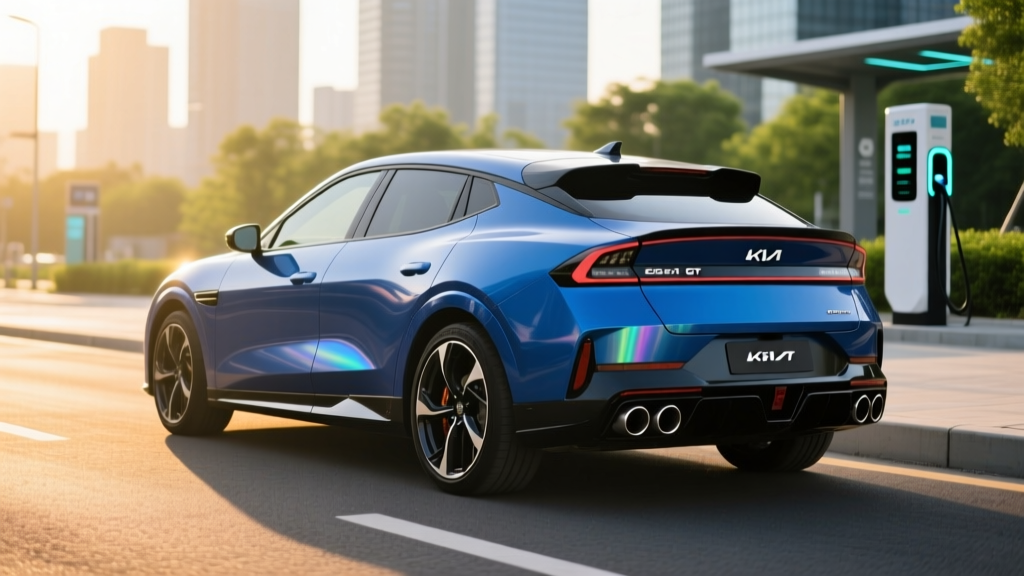
The 2024 Kia EV6 GT exists at an uncomfortable intersection: it's a 576-horsepower electric crossover that can embarrass a Porsche Taycan off the line, yet it carries just 206 miles of EPA-rated range. That trade-off defines the ownership experience more than any spec sheet can convey. After spending time with the EV6 GT on highway loops, fast-charger stops, and daily commutes, here's exactly what buyers need to know before signing the paperwork.
Quick Verdict: A Performance Bargain With a Range Caveat
The EV6 GT is the halo model of Kia's E-GMP platform, sharing its 800-volt architecture with the Hyundai Ioniq 5 N and Genesis GV60. At $62,900 (destination included), it undercuts comparable dual-motor performance EVs by $15,000 to $40,000 while delivering a 3.4-second 0-60 mph sprint. The catch is a smaller 77.4 kWh battery that prioritizes weight and discharge rate over capacity. For buyers who value acceleration, 800V charging speed, and Kia's generous warranty over 300+ mile range, the GT is arguably the best performance-per-dollar EV on the market. For road-trippers, the standard EV6 Long Range or a Tesla Model Y Performance will serve you better.
Range, Battery, and Efficiency: The Numbers That Matter
| Specification | 2024 Kia EV6 GT |
|---|---|
| EPA Range | 206 miles |
| Battery (Usable) | 77.4 kWh (NMC lithium-ion) |
| Battery Chemistry | NMC (Nickel Manganese Cobalt) |
| EPA Efficiency | 85 MPGe combined / 40 kWh/100mi |
| Drivetrain | Dual-motor AWD |
| 0-60 mph | 3.4 seconds |
| Horsepower | 576 hp (430 kW) |
| Torque | 545 lb-ft |
| Top Speed | 161 mph |
The 77.4 kWh battery uses NMC (nickel manganese cobalt) chemistry, which offers higher energy density than LFP (lithium iron phosphate) at the cost of slightly faster long-term degradation. Kia's battery management system maintains a top and bottom buffer to protect cell health, meaning you'll never see the full 77.4 kWh on the dash — usable capacity sits around 74 kWh. The 800V architecture allows the GT to sustain higher charge rates for longer than 400V competitors, which matters more than peak kW numbers suggest.
Efficiency at 85 MPGe combined trails the Long Range AWD EV6 (105 MPGe) and Tesla Model Y Performance (111 MPGe). The GT's wider 255/40R21 tires, sport-tuned suspension, and performance-oriented motor mapping all contribute to higher energy consumption. At the U.S. average electricity rate of $0.17/kWh, charging the GT costs roughly $6.80 per 100 miles — compared to about $12.50 per 100 miles for a 25 MPG gas car at $3.50/gallon.
Charging Speed: The 800-Volt Advantage in Practice
| Charging Level | Power / Rate | Time / Miles Added |
|---|---|---|
| Level 1 (120V household) | ~1.4 kW | ~3-4 miles per hour |
| Level 2 (240V, 48A home charger) | 10.9 kW | ~33 miles per hour; 0-100% in ~7.5 hours |
| DC Fast Charge (800V station, 350 kW capable) | Peak 217 kW | 10-80% in ~18 minutes |
| DC Fast Charge (50 kW station) | ~50 kW | 10-80% in ~65 minutes |
The EV6 GT's headline charging spec is 217 kW peak on a DC fast charger — but as with all EVs, peak rate is not sustained rate. Here's what the actual charge curve looks like in practice:
- 10-40% SoC: Sustains near peak 210-217 kW on a 350 kW-capable charger (Electrify America, EVgo 350kW)
- 40-65% SoC: Tapers to approximately 150-170 kW
- 65-80% SoC: Further taper to ~100-120 kW
- 80-100% SoC: Drops sharply to under 50 kW (avoid charging past 80% on road trips)
The 10-80% time of approximately 18 minutes is among the fastest in the segment, matched only by the Hyundai Ioniq 5 and Porsche Taycan on equivalent infrastructure. The 800V architecture means the GT pulls more power at higher states of charge than 400V competitors like the Ford Mustang Mach-E GT or Volkswagen ID.4, which begin tapering significantly above 50% SoC.
For home charging, the onboard charger accepts up to 10.9 kW on Level 2 (240V at 48 amps). A full charge from empty takes roughly 7.5 hours on a properly installed Level 2 home station. If your home charger is limited to 32 amps (7.7 kW), expect closer to 10.5 hours. Note: Always have a licensed electrician assess your panel capacity before installing a 48-amp charger — a 200-amp panel upgrade may be required in older homes.
Performance and Driving Dynamics
The GT's dual-motor AWD setup produces 576 horsepower and 545 lb-ft of torque, with a GT-exclusive rear motor making 362 hp alone. The 3.4-second 0-60 mph time puts it in supercar territory — Kia claims it beat a Lamborghini Urus and Porsche Taycan 4S in quarter-mile drag tests during development. In real-world driving, the instant torque delivery is relentless, with no lag or gear shifts to interrupt acceleration.
Beyond straight-line speed, the GT adds hardware the standard EV6 doesn't have:
- Electronically controlled sport suspension with adaptive damping
- Front and rear limited-slip differentials (e-LSD) for torque vectoring
- Upgraded brakes with larger rotors (though not the Ioniq 5 N's track-focused setup)
- GT-specific drive modes: Eco, Normal, Sport, GT, and GT Custom
- Drift Mode (yes, really — sends up to 100% of rear torque for controlled slides on closed courses)
- Virtual gear shifts in GT mode to simulate a dual-clutch transmission feel
The GT mode button on the steering wheel is the party trick: it stiffens the suspension, sharpens throttle response, activates synthetic engine sound through the speakers, and enables the virtual gearshift paddles. It transforms the car from a comfortable daily driver into something genuinely engaging on a canyon road. The trade-off is ride quality — even in Normal mode, the sport suspension and 21-inch wheels transmit more road imperfections than the standard EV6 Long Range.
Interior, Cargo, and Technology
The GT uses Kia's dual-screen layout: a 12.3-inch digital instrument cluster and a 12.3-inch infotainment touchscreen running the latest Kia Connect software. Wireless Apple CarPlay and Android Auto are standard. The GT-exclusive flat-bottom steering wheel, suede-and-leather sport seats with GT badging, and neon-green interior accents distinguish it from lesser trims.
Passenger and cargo dimensions:
- Front headroom: 38.4 inches
- Front legroom: 41.7 inches
- Rear headroom: 37.8 inches
- Rear legroom: 39.4 inches (generous for the segment)
- Cargo volume (rear seats up): 24.4 cu ft
- Cargo volume (rear seats folded): 50.2 cu ft
- Front trunk (frunk): 0.7 cu ft (essentially a cable storage cubby — the GT's larger front motor eliminates meaningful frunk space)
The rear seat space is a genuine strength: 39.4 inches of legroom beats the Tesla Model Y (41.6 inches front, but tighter rear) and matches midsize sedans. Two adults can sit comfortably on long trips. The 24.4 cu ft of cargo space is adequate for weekly groceries and two carry-on bags, but falls well short of the Model Y's 30.2 cu ft and the EV6 Long Range's identical 24.4 cu ft (cargo space is unchanged from non-GT trims).
Driver assistance (SAE Level 2): The EV6 GT includes Kia's Highway Driving Assist 2 (HDA2), which combines adaptive cruise control with lane centering on highways. It's a competent Level 2 system — meaning you must keep your hands on the wheel and eyes on the road at all times. It is not self-driving. The system handles lane changes when you activate the turn signal, and the navigation-based smart cruise control adjusts speed for upcoming curves. It's less aggressive than Tesla's Autopilot but more predictable and less prone to phantom braking events.
Pricing, Trims, and Federal Tax Credit Eligibility
| Detail | Amount |
|---|---|
| 2024 EV6 GT MSRP (only trim available) | $62,900 (incl. destination) |
| Federal §30D Tax Credit (if eligible) | Up to $7,500 |
| Effective Price After Max Credit | ~$55,400 |
The 2024 EV6 GT comes in a single, fully loaded trim — there are no options packages. The $62,900 MSRP includes the GT-exclusive performance hardware, 21-inch wheels, heads-up display, Meridian premium audio, Highway Driving Assist 2, and a panoramic sunroof. The only choice is paint color, with Runway Red and Matte Moab (matte finish) carrying a $695 premium.
Federal tax credit eligibility (§30D) requires meeting ALL of the following conditions:
- MSRP cap: SUVs/vans/pickups must be under $80,000; sedans under $55,000. The EV6 is classified as an SUV by the IRS, so the $62,900 GT clears the $80,000 cap. ✓
- Buyer income cap: Modified AGI must not exceed $300,000 (joint), $225,000 (head of household), or $150,000 (single). Verify against IRS §30D guidelines.
- Battery sourcing requirements: The vehicle must meet critical mineral and battery component sourcing thresholds that increase annually. As of the 2024 model year, the EV6 GT (built in South Korea) did NOT qualify for the full $7,500 credit due to battery component sourcing rules — it qualified for $3,750 (critical minerals requirement met, battery components requirement not met). Confirm current-year sourcing status with your dealer before purchase.
- Point-of-sale transfer: As of 2024, the credit can be transferred to the dealer at purchase for an immediate price reduction, rather than claimed on your tax return.
Important: Tax credit rules change frequently, and battery sourcing eligibility is updated throughout the year. Consult a tax professional and verify current eligibility on fueleconomy.gov before making a purchase decision.
Warranty and Long-Term Ownership
Kia's warranty coverage is among the strongest in the EV segment:
- Battery warranty: 10 years / 100,000 miles (capacity retention guaranteed above 70% of original capacity)
- Powertrain warranty: 10 years / 100,000 miles
- Bumper-to-bumper: 5 years / 60,000 miles
- Roadside assistance: 5 years / 60,000 miles
The 10-year battery warranty is double what Tesla, Ford, and Volkswagen offer (8 years / 100,000-120,000 miles). The 70% capacity retention threshold is industry-standard — if your 77.4 kWh battery drops below approximately 54 kWh of usable capacity within the warranty period, Kia will repair or replace it. Real-world degradation data for the E-GMP platform suggests most owners will see 5-8% capacity loss over the first 100,000 miles with normal charging habits, well within the warranty buffer.
Pros, Cons, and Who Should Buy the EV6 GT
- 3.4-second 0-60 mph at a $62,900 price point — unmatched performance-per-dollar
- 800V architecture enables 10-80% DC charging in ~18 minutes on 350 kW stations
- Industry-leading 10-year/100,000-mile battery and powertrain warranty
- Genuinely engaging drive modes including Drift Mode and virtual gearshifts
- Spacious rear seat (39.4 inches legroom) for a performance crossover
- Fully loaded single trim — no nickel-and-dime option packages
- 206-mile EPA range (140-160 real-world in cold weather) limits road-trip flexibility
- Only $3,750 federal tax credit due to battery component sourcing (as of 2024)
- Ride quality is firm, especially on 21-inch wheels over broken pavement
- Tiny 0.7 cu ft frunk — no meaningful front storage
- 85 MPGe efficiency trails Model Y Performance and EV6 Long Range significantly
- Highway Driving Assist 2 is competent but not class-leading vs. GM Super Cruise
Who should buy the 2024 Kia EV6 GT:
- Daily commuters with round trips under 120 miles who want weekend canyon-carving capability
- Home chargers who can wake up to a full battery every morning and rarely rely on public DC charging
- Performance enthusiasts who want supercar acceleration without a six-figure price tag
- Warranty-focused buyers who value Kia's 10-year coverage for long-term peace of mind
Who should look elsewhere:
- Road-trippers who regularly drive 250+ miles between stops — get the EV6 Long Range RWD (310 miles EPA) or a Tesla Model Y
- Efficiency maximizers — the GT's 85 MPGe costs roughly $400 more per year in electricity vs. the 111 MPGe Model Y Performance
- Track-day enthusiasts — the Hyundai Ioniq 5 N offers superior brake cooling, N-specific suspension, and sustained track performance the GT wasn't designed for
Frequently Asked Questions
What is the real-world range of the 2024 Kia EV6 GT?
The EPA rates the EV6 GT at 206 miles. In real-world highway driving at 70-75 mph in mild weather, expect 175-190 miles. Cold weather (below freezing) drops highway range to approximately 140-160 miles. City driving with regenerative braking can stretch range to 210-225 miles in ideal conditions.
How fast does the EV6 GT charge at home and on DC fast chargers?
On a 350 kW-capable DC fast charger, the GT peaks at 217 kW and charges from 10-80% in approximately 18 minutes. On a 48-amp Level 2 home charger (10.9 kW), a full charge takes about 7.5 hours, adding roughly 33 miles of range per hour.
Does the 2024 Kia EV6 GT qualify for the full $7,500 federal tax credit?
As of the 2024 model year, the EV6 GT qualifies for $3,750 of the $7,500 credit (meeting critical mineral requirements but not battery component sourcing thresholds, since the battery is manufactured in South Korea). Eligibility also depends on your income (must be under $300K joint / $150K single) and the vehicle's MSRP (under $80K for SUVs — the GT qualifies). Verify current rules at irs.gov before purchasing.
Is the EV6 GT worth buying over the Tesla Model Y Performance?
It depends on your priorities. The Model Y Performance offers 277 miles of EPA range, 111 MPGe efficiency, a more extensive Supercharger network, and OTA updates — but its $52,490 price (before credit) doesn't include the GT's adaptive suspension, drift mode, or 10-year warranty. The EV6 GT is the better driver's car; the Model Y is the better daily appliance. If range and charging convenience matter most, choose Tesla. If driving engagement and warranty matter most, choose the GT.
How does the EV6 GT compare to the Hyundai Ioniq 5 N?
The Ioniq 5 N shares the E-GMP platform but is purpose-built for track use: it has an 84 kWh battery, N-specific suspension, larger brakes with enhanced cooling, simulated gear shifts with torque interruption, and a higher 641 hp (with N Grin Boost). The Ioniq 5 N starts at $67,495 — about $4,600 more than the GT. If you plan to attend track days, the Ioniq 5 N is the better tool. For street performance and daily driving, the GT offers similar thrills at a lower price.
Will the EV6 GT's battery need replacement, and what does it cost?
Based on E-GMP platform degradation data, most EV6 batteries will retain 90-95% capacity after 100,000 miles with normal charging habits. Full battery replacement is rare and covered under the 10-year/100,000-mile warranty if capacity drops below 70%. Out-of-warranty replacement costs are estimated at $10,000-$15,000 (parts and labor), though this figure will likely decrease as battery costs continue to fall.