Quick Verdict: The 2024 Kia EV6 GT-Line in 2026
The 2024 Kia EV6 GT-Line remains one of the most compelling mid-size electric crossovers on the used and remaining-new market. Built on Hyundai Motor Group's E-GMP platform with an 800-volt electrical architecture, it delivers class-leading DC fast-charge speeds, a usable 310-mile EPA range (RWD), and a well-appointed cabin that punches above its price class. As a 2026 purchase — whether certified pre-owned or leftover new inventory — the GT-Line trim hits a sweet spot between the base Light/Wind trims and the performance-oriented GT, offering sport-tuned styling and all-wheel drive without the GT's range and ride-quality compromises.
This review breaks down the exact numbers that matter: real-world range expectations, charging-curve behavior, total cost after federal and state incentives, and how the EV6 GT-Line stacks up against the Hyundai Ioniq 5, Tesla Model Y, and Ford Mustang Mach-E in 2026.
Range, Efficiency, and the Real-World Reality Check
The 2024 EV6 GT-Line comes in two drivetrain configurations with distinct range profiles:
| Drivetrain | Battery (usable) | EPA Range | MPGe (combined) | kWh/100 mi |
|---|---|---|---|---|
| GT-Line RWD | 77.4 kWh (NMC) | 310 mi | 134 MPGe | 25 kWh/100 mi |
| GT-Line AWD | 77.4 kWh (NMC) | 282 mi | 117 MPGe | 29 kWh/100 mi |
The EPA sticker says 310 miles for RWD and 282 for AWD. In mixed real-world driving, expect:
- City/suburban (mild weather): 290–315 mi (RWD) — regen-heavy driving maximizes efficiency
- Highway (70–80 mph, 75°F): 245–270 mi (RWD), 220–245 mi (AWD) — EVs lose efficiency at sustained speed
- Cold weather (below 30°F, mixed driving): 210–240 mi (RWD), 190–215 mi (AWD) — expect 20–30% range reduction
The EV6's heat pump (standard on GT-Line trims) mitigates cold-weather cabin energy draw, but battery chemistry still loses output in freezing temps. Preconditioning the battery while plugged in helps recover some of this loss.
The 77.4 kWh usable battery uses NMC (nickel manganese cobalt) chemistry, which offers higher energy density than LFP but benefits from daily charge limits around 80–90% for long-term longevity. Kia's battery management system includes a buffer above and below the stated capacity to protect against deep cycling.
Charging Speed: 800-Volt Architecture Pays Off
The EV6's headline advantage over most competitors is its 800-volt electrical architecture (shared with the Hyundai Ioniq 5 and Genesis GV60). This enables dramatically faster DC fast charging on compatible stations compared to 400-volt rivals like the Tesla Model Y or Ford Mustang Mach-E.
| Charging Level | Max Rate | Speed / Time | Connector |
|---|---|---|---|
| Level 1 (120V household) | ~1.4 kW | ~4–5 mi/hr | J1772 adapter |
| Level 2 (240V home) | 10.9 kW | ~32–36 mi/hr; full charge in ~8 hrs | J1772 |
| DC Fast Charge (350 kW station) | 239 kW peak | 10–80% in ~18 min | CCS1 |
| DC Fast Charge (150 kW station) | ~150 kW sustained | 10–80% in ~28 min | CCS1 |
Charging-curve reality: The 239 kW peak rate is achievable only on a 350 kW-capable charger (like Electrify America's latest stalls) with a preconditioned battery at low state of charge. In practice, the EV6 sustains roughly 180–230 kW from 10–55% SoC, then tapers progressively. From 80–100%, charging slows dramatically to protect the battery — plan your road trips around 10–80% charges for optimal time efficiency.
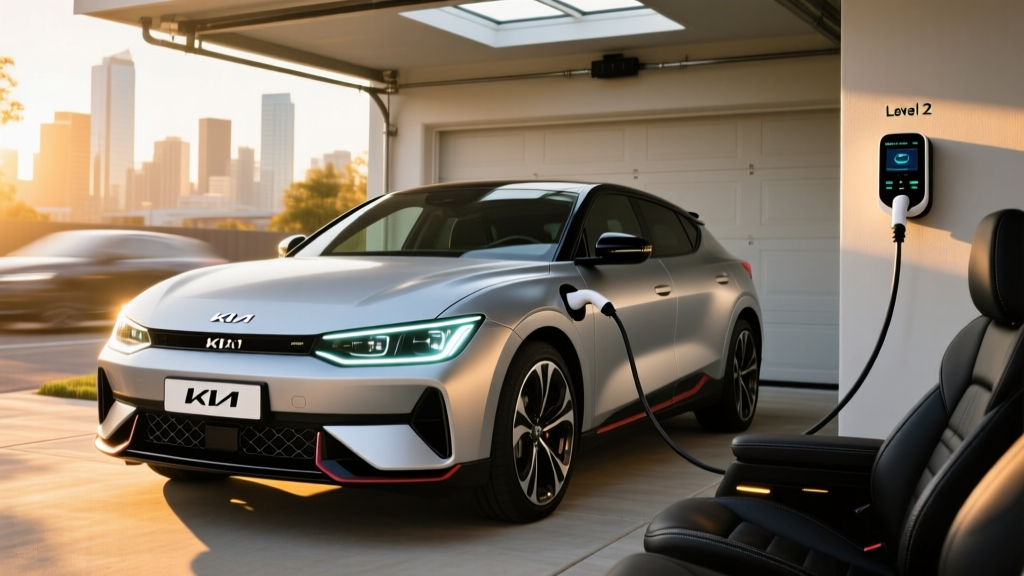
For home charging, the onboard 10.9 kW AC charger is competitive. On a 48-amp Level 2 circuit (hardwired, 60-amp breaker), you'll add roughly 32–36 miles of range per hour — enough to fully replenish overnight. If your home electrical panel only supports a 32-amp circuit, expect closer to 25 mi/hr. Per fueleconomy.gov, home electricity at the national average of $0.16/kWh translates to roughly $0.04 per mile — about one-third the fuel cost of a 25 MPG gas crossover.
Connector note: The 2024 EV6 uses the CCS1 connector. Kia has confirmed that 2025+ models will transition to NACS (Tesla's connector), and adapters are available for 2024 owners to access Tesla Supercharger V3 stalls. This adapter path is a practical solution, though native NACS remains the future standard.
Performance and Driving Dynamics
| Spec | GT-Line RWD | GT-Line AWD |
|---|---|---|
| Horsepower | 225 hp | 320 hp |
| Torque | 258 lb-ft | 446 lb-ft |
| 0–60 mph | 6.2 sec | 4.5 sec |
| Drivetrain | Rear motor, RWD | Dual motor, AWD |
| Towing capacity | 2,300 lb | 2,300 lb |
| Curb weight | ~4,502 lb | ~4,694 lb |
The AWD GT-Line's 4.5-second 0–60 time is genuinely quick for a family crossover — it outpaces the base Tesla Model Y Long Range and feels effortless in highway merging scenarios. The RWD version trades some thrust for an additional 28 miles of EPA range and a slightly lower price.
Ride quality on the GT-Line is firm but controlled. The sport-tuned suspension (standard on GT-Line) is stiffer than the Wind trim, which some buyers prefer for cornering confidence but may notice on rough pavement. Road noise is well-managed at highway speeds, aided by acoustic laminated front glass.
The EV6's regenerative braking system offers four levels selectable via steering-wheel paddles, from coasting (Level 0) to near-one-pedal driving (Level 3). Level 3 brings the car to a near-stop in most city scenarios, though it doesn't quite hold at a complete stop like some competitors' full one-pedal modes.
Interior, Cargo, and Technology
The EV6's cabin is one of its strongest selling points. The GT-Line trim adds sport seats with vegan leather and suede inserts, a flat-bottom steering wheel, and aluminum pedals over the standard trims.
Passenger and cargo dimensions:
- Front legroom: 42.4 inches
- Rear legroom: 39.4 inches — generous for the class, thanks to the E-GMP platform's flat floor
- Cargo behind rear seats: 24.4 cu ft
- Cargo with rear seats folded: 50.2 cu ft
- Frunk (front trunk): 0.7 cu ft (AWD) / 1.8 cu ft (RWD) — best for charging cables, not groceries
The rear seat space is a genuine advantage over the Tesla Model Y and comparable to the Hyundai Ioniq 5. The flat floor (no transmission tunnel) makes the middle seat actually usable for a passenger.
Tech highlights:
- Dual 12.3-inch curved displays: Instrument cluster and infotainment in a single panoramic unit
- Wireless Apple CarPlay and Android Auto: Standard across all trims
- Augmented-reality head-up display (AR HUD): Available on GT-Line (included in the GT-Line Prestige package)
- Highway Driving Assist 2 (HDA 2): SAE Level 2 driver assistance with lane-centering, adaptive cruise, and lane-change assist. This system requires hands on the wheel and full driver attention — it is not autonomous driving.
- Remote Smart Parking Assist: The EV6 can pull itself in and out of tight spaces via the key fob — useful in narrow garages.
- V2L (Vehicle-to-Load): The EV6 can supply up to 3.6 kW of AC power from its traction battery via an interior outlet or exterior adapter, enough to power camping equipment, a laptop workstation, or small appliances during an outage.
Notable drawbacks: The infotainment system relies on a mix of touch-capacitive buttons below the screen that can be finicky to use while driving. The native navigation is functional but not as polished as Tesla's or Google Built-in systems found in some GM EVs. Wireless phone charging pad placement is awkward on some trims, prone to phone sliding during cornering.
Pricing, Tax Credits, and Ownership Costs
| Trim | Base MSRP | As-Tested (typical options) | Federal Tax Credit Potential |
|---|---|---|---|
| GT-Line RWD | $48,700 | $49,500–$51,200 | Up to $7,500 (§30D) |
| GT-Line AWD | $52,300 | $53,800–$56,000 | Up to $7,500 (§30D) |
| GT-Line Prestige AWD | $56,900 | $57,500–$58,200 | Up to $7,500 (§30D) |
The 2024 Kia EV6 GT-Line may qualify for up to $7,500 under the federal Clean Vehicle Credit, but eligibility depends on several requirements that buyers must verify:
- MSRP cap: The EV6 qualifies as an SUV under IRS rules (MSRP cap: $80,000). All GT-Line trims fall under this cap.
- Buyer income cap: Adjusted gross income must not exceed $150,000 (single), $225,000 (head of household), or $300,000 (joint filing).
- Battery sourcing requirements: The $7,500 credit is split into $3,750 for critical minerals and $3,750 for battery component sourcing. The EV6's battery is manufactured in Georgia (via the Hyundai Motor Group Metaplant America), but critical-mineral sourcing compliance varies by production date. Verify with your dealer and consult IRS.gov §30D guidance before purchase.
- Point-of-sale transfer: As of 2024, qualified buyers can transfer the credit to the dealer at purchase, reducing the out-of-pocket price immediately rather than waiting for a tax refund.
Note: Tax rules are subject to change. Consult a tax professional for your specific situation. State incentives (e.g., California's CVRP, Colorado's $5,000 credit) may stack on top.
5-year ownership cost estimate (GT-Line AWD, 15,000 mi/year):
- Home charging (national avg $0.16/kWh): ~$1,800/year → $9,000 over 5 years
- Equivalent gas cost (25 MPG crossover at $3.50/gal): ~$2,100/year → $10,500 over 5 years
- Maintenance: Minimal — no oil changes, fewer brake replacements due to regen. Budget ~$300–500/year for cabin air filter, tire rotation, wiper fluid.
- Insurance: EV insurance premiums run 10–20% higher than comparable gas vehicles. Expect $1,800–2,400/year depending on state and driving record.
- Tires: The EV6's weight and instant torque wear tires faster than a gas equivalent. Budget for replacement at 30,000–40,000 miles (~$800–1,200 for a set of EV-rated tires).
Warranty Coverage
Kia's warranty is one of the strongest in the EV segment:
- Basic vehicle warranty: 5 years / 60,000 miles
- Powertrain warranty: 10 years / 100,000 miles
- EV battery warranty: 10 years / 100,000 miles (covers capacity loss below 70% of original)
- Roadside assistance: 5 years / 60,000 miles
The 70% capacity retention threshold over 10 years is standard for the industry. Real-world data from early E-GMP vehicles (2022–2023 Ioniq 5 and EV6) shows degradation in the 3–6% range over 30,000–50,000 miles — well within healthy parameters. NMC chemistry in these packs has held up well under Kia's conservative thermal management.
How the EV6 GT-Line Compares to Key Rivals
| Spec | Kia EV6 GT-Line AWD | Hyundai Ioniq 5 SEL AWD | Tesla Model Y LR AWD | Ford Mach-E Premium AWD |
|---|---|---|---|---|
| EPA Range | 282 mi | 266 mi | 303 mi | 290 mi |
| Battery (usable) | 77.4 kWh NMC | 77.4 kWh NMC | ~75 kWh NMC | 88 kWh NMC (Ext. Range) |
| Peak DC Fast Charge | 239 kW | 239 kW | ~170 kW | ~150 kW |
| 10–80% DCFC Time | ~18 min | ~18 min | ~28 min | ~38 min |
| 0–60 mph | 4.5 sec | 5.1 sec | 4.8 sec | 4.8 sec |
| Rear Legroom | 39.4 in | 39.4 in | 35.2 in | 38.9 in |
| Cargo (rear seats up) | 24.4 cu ft | 27.2 cu ft | 30.2 cu ft | 29.7 cu ft |
| Base MSRP (AWD) | $52,300 | $50,850 | $48,990 | $51,875 |
Where the EV6 GT-Line wins: DC fast-charge speed (tied with Ioniq 5, far ahead of Model Y and Mach-E), rear-seat legroom, warranty coverage, and V2L capability. The 800V architecture is a genuine road-trip advantage — 18-minute charging stops versus 28–38 minutes for rivals.
Where it loses: Cargo volume behind the rear seats is the smallest in this group. The Model Y offers 25% more cargo space. The Ioniq 5 also edges it out. If maximum cargo capacity is a priority, the EV6 is the compromise pick.
Charging network access: Tesla's Supercharger network remains the most reliable and widespread DC fast-charging network in the US. The EV6 relies on Electrify America, EVgo, and other CCS networks, which have improved significantly but still trail Tesla in uptime consistency. The CCS-to-NACS adapter helps bridge this gap for 2024 EV6 owners.
Pros and Cons
✓ Pros
- Class-leading 239 kW DC fast charging (10–80% in ~18 min)
- Spacious rear seat with flat floor (39.4 in legroom)
- Strong 10-year/100,000-mile battery and powertrain warranty
- V2L capability (3.6 kW output)
- Quick 4.5-second 0–60 in AWD form
- Attractive GT-Line styling with sport accents
- Competitive pricing with federal tax credit eligibility
✗ Cons
- Cargo volume (24.4 cu ft) trails Model Y, Ioniq 5, and Mach-E
- CCS1 connector requires adapter for Tesla Supercharger access
- Touch-capacitive dash controls can be distracting while driving
- Sport-tuned suspension firmness may not suit all buyers
- Native infotainment not as refined as Tesla or Google Built-in
- Small frunk (0.7 cu ft AWD) limits front storage utility
- Insurance premiums run 10–20% above gas equivalents
Who Should Buy the 2024 Kia EV6 GT-Line?
Decision Framework
Choose the EV6 GT-Line if:
- You take regular road trips and value the fastest DC charging in the segment
- Rear-seat passenger comfort is a priority (adults ride comfortably in back)
- You want strong warranty coverage and long-term battery protection
- You value distinctive styling that stands apart from the ubiquitous Model Y
- V2L capability matters for camping, tailgating, or backup power
Look elsewhere if:
- Maximum cargo volume is non-negotiable (consider Model Y or Ioniq 5)
- You depend heavily on Tesla Superchargers and don't want to use an adapter
- You prefer a softer ride (consider the Wind trim or Ioniq 5)
- You need the longest possible range above all else (consider the RWD trim or a Lucid Air)
Best use cases: The GT-Line AWD is ideal for suburban commuters who road-trip 4–6 times per year and want fast charging without sacrificing daily comfort. The RWD variant suits range-prioritized commuters in mild climates who rarely need AWD traction. Neither variant is ideal for heavy towing (2,300-lb limit rules out most boat or large camper trailers).
Frequently Asked Questions
What is the real-world range of the 2024 Kia EV6 GT-Line?
EPA estimates 310 miles (RWD) and 282 miles (AWD). In real-world highway driving at 75 mph, expect 245–270 miles (RWD) or 220–245 miles (AWD). In freezing winter weather, range drops to roughly 210–240 miles (RWD). These figures assume standard driving habits without aggressive acceleration or extreme climate control use.
How fast does the 2024 EV6 GT-Line charge?
On a 350 kW DC fast charger with a preconditioned battery, the EV6 peaks at 239 kW and charges from 10–80% in approximately 18 minutes. On a 150 kW station, expect roughly 28 minutes for the same 10–80% window. At home on a Level 2 (240V, 48-amp) charger, it adds roughly 32–36 miles of range per hour, reaching a full charge in about 8 hours.
Does the 2024 Kia EV6 qualify for the $7,500 federal tax credit?
The EV6 is potentially eligible for up to $7,500 under IRS §30D, but qualification depends on your income (capped at $150K single / $300K joint), battery-sourcing compliance at time of manufacture, and the vehicle's MSRP (all GT-Line trims fall under the $80,000 SUV cap). Verify eligibility with your dealer and consult IRS guidance. The credit can be transferred at point of sale to reduce your purchase price immediately.
Is the 2024 Kia EV6 GT-Line worth buying versus the Hyundai Ioniq 5?
The EV6 and Ioniq 5 share the same E-GMP platform, battery, and powertrain, so performance and charging are nearly identical. The EV6 offers sportier styling and a slightly more driver-focused interior, while the Ioniq 5 provides more cargo space (27.2 vs 24.4 cu ft) and a retro-modern design. Choose based on styling preference and cargo needs — mechanically, they are twins.
What is the battery warranty on the 2024 EV6?
Kia covers the EV6's high-voltage battery for 10 years or 100,000 miles, whichever comes first. The warranty covers capacity loss below 70% of original rated capacity. Early E-GMP battery data shows degradation of 3–6% over 30,000–50,000 miles, suggesting healthy long-term performance well within warranty thresholds.
Can the 2024 EV6 use Tesla Superchargers?
The 2024 EV6 uses the CCS1 connector natively. Kia offers a CCS-to-NACS adapter that allows access to Tesla Supercharger V3 stalls. Charging speed on Superchargers is limited by the adapter and station output (typically up to 150 kW at V3 stalls), which is below the EV6's native 239 kW capability but provides access to the most extensive charging network in the US.
Sources: fueleconomy.gov — 2024 Kia EV6, IRS.gov — Clean Vehicle Credits, Kia.com — 2024 EV6 Specifications