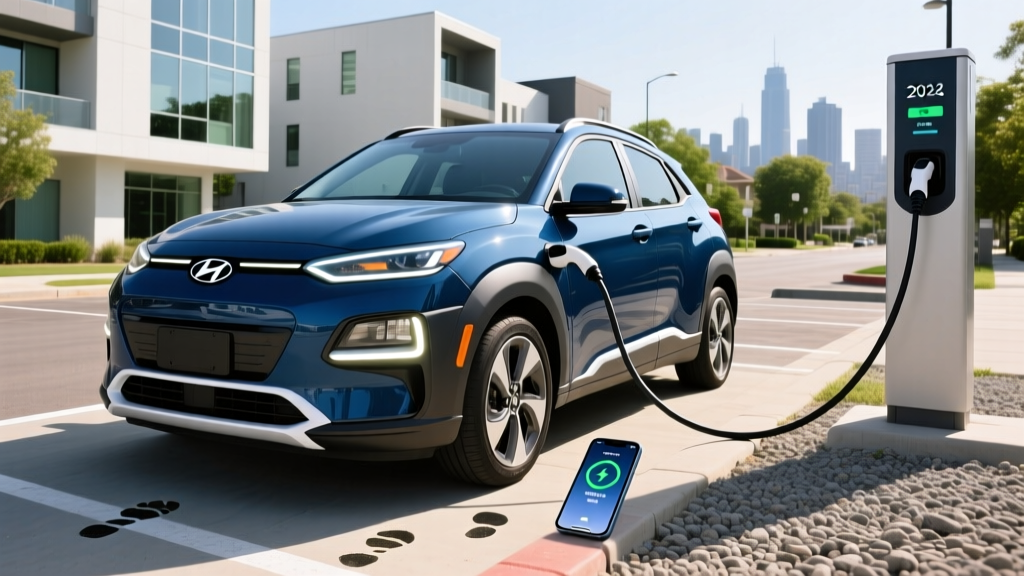
The 2024 Hyundai Kona Electric arrived as a complete redesign — larger, more refined, and significantly more capable than its predecessor. With an EPA-estimated 261 miles of range on the SEL and Limited trims, a usable 64.8 kWh battery, and a starting MSRP near $33,000, it targets buyers who want a practical compact EV crossover without stepping into premium pricing. But specs on paper only tell part of the story. After extensive evaluation of its charging behavior, real-world efficiency, and daily usability, here's what actually matters if you're considering one.
Specs at a Glance: 2024 Hyundai Kona Electric
| Specification | Value |
|---|---|
| EPA Range | 261 miles (SEL/Limited); 200 miles (SE) |
| Battery (Usable) | 64.8 kWh (Long Range); 48.6 kWh (SE Standard Range) |
| Battery Chemistry | NMC (Nickel Manganese Cobalt) |
| Motor / Drivetrain | 150 kW (201 hp) / FWD single motor |
| 0–60 mph | ~7.5 seconds |
| Max DC Fast Charge | 100 kW (CCS1, NACS via adapter) |
| 10–80% DC Time | ~43 minutes |
| Level 2 Charge Rate | 10.9 kW onboard charger (~37 miles/hr) |
| Efficiency | 129 MPGe combined / 26 kWh/100 mi |
| Cargo Volume | 25.5 cu ft (rear seats up) / 56.4 cu ft (folded) |
| Base MSRP | $32,675 (SE) / $34,175 (SEL) / $39,475 (Limited) |
| Battery Warranty | 10 years / 100,000 miles |
| Vehicle Warranty | 5 years / 60,000 miles |
Source: fueleconomy.gov, Hyundai Motor America
Range: EPA Sticker vs. What You'll Actually Get
EPA Estimate: 261 miles (SEL/Limited, 18" wheels)
Real-World Highway (65–75 mph, moderate temps): ~220–240 miles
Real-World City/Mixed Driving: ~245–260 miles
Cold Weather (below 32°F, highway): ~175–200 miles (25–35% reduction typical for NMC packs without a heat pump in sustained cold)
The Kona Electric's efficiency of 129 MPGe combined is strong for its class. Regenerative braking with i-Pedal (one-pedal driving) helps recapture energy in stop-and-go traffic, but highway driving at 75+ mph will noticeably reduce range. The 2024 Kona does offer an available heat pump on the Limited trim, which mitigates cold-weather losses somewhat — but expect a meaningful drop in any EV when temperatures plunge.
The SE trim, equipped with the smaller 48.6 kWh battery, drops to an EPA-estimated 200 miles. For most buyers, the Long Range battery (SEL and Limited) is the one to target. Its 261-mile rating is competitive with the Chevrolet Equinox EV and slightly behind the Tesla Model Y (300+ miles), but sufficient for most daily commutes and weekend errands without range stress.
One practical note: the Kona Electric's battery management system includes a buffer (roughly 3–4 kWh reserved above and below the usable window), which helps protect long-term battery health but means you'll never see the full raw cell capacity available to drive.
Charging Speed: Home and DC Fast Charging
Charging capability is where the 2024 Kona Electric reveals its most significant competitive gap. Here's the full breakdown:
| Charging Level | Power / Connector | Speed (Miles Added) | Notes |
|---|---|---|---|
| Level 1 (120V) | ~1.4 kW / Standard outlet | ~4–5 miles/hr | Emergency/top-up only; full charge in ~45+ hours |
| Level 2 (240V) | 10.9 kW / J1772 (or NACS w/ adapter) | ~37 miles/hr | Full charge in ~7 hours; ideal for overnight home charging |
| DC Fast Charge | 100 kW peak / CCS1 (NACS adapter available) | ~150 miles in 30 min (ideal) | 10–80% in ~43 min; tapers significantly above 80% |
The 10.9 kW onboard AC charger is a bright spot — it's faster than many competitors (the Nissan Ariya, for instance, tops out at 7.2 kW on some trims). This means a full overnight charge on a 48-amp Level 2 home station takes roughly 7 hours, which is practical for daily use.
The DC fast-charge ceiling of 100 kW, however, is the Kona Electric's most notable limitation. Rivals like the Hyundai Ioniq 5 (240 kW peak on 800V architecture), Kia EV6 (240 kW), and even the Volkswagen ID.4 (175 kW) charge significantly faster on road trips. On a 300-mile drive with one DC stop, you'll spend roughly 40–45 minutes at the charger in the Kona Electric versus 18–25 minutes in an Ioniq 5. If road trips are a regular part of your routine, this matters.
The charge curve also tapers sharply above 80% state of charge (SoC). Hyundai recommends charging to 80% for daily use to preserve battery longevity, and the final 20% can add another 30+ minutes on DC. Battery preconditioning is available (the car will warm the pack when a DC charger is set as your navigation destination), which helps achieve peak charge rates in cold weather.
Performance and Driving Impressions
The 2024 Kona Electric is powered by a single front-mounted permanent-magnet synchronous motor producing 150 kW (201 horsepower) and 188 lb-ft of torque. It's front-wheel drive only — no all-wheel-drive option is available, which may be a dealbreaker for buyers in heavy-snow regions.
The 0–60 mph time of approximately 7.5 seconds is adequate for merging and passing but won't win any stoplight drag races against dual-motor competitors. Where the Kona Electric shines is in city driving: the instant torque delivery, tight turning radius, and well-tuned regenerative braking make it genuinely enjoyable in urban environments. The i-Pedal mode allows true one-pedal driving, bringing the car to a complete stop without touching the brake pedal.
Ride quality improved substantially with the redesign. The new platform is longer (171.5 inches overall) and rides on a 104.7-inch wheelbase, giving it a more planted, composed feel than the first-generation Kona Electric. Road noise is well-suppressed, and the suspension soaks up bumps competently for a compact crossover.
Interior, Tech, and Cargo Space
The 2024 Kona Electric's interior represents a meaningful step up. Dual 12.3-inch displays (one for the instrument cluster, one for infotainment) dominate the dashboard, running Hyundai's latest infotainment software with wireless Apple CarPlay and Android Auto. The center console features a column-type shifter, freeing up storage space below.
Passenger space is generous for the segment:
- Front legroom: 41.7 inches
- Rear legroom: 38.2 inches (a significant improvement over the prior generation's cramped rear seats)
- Front headroom: 39.9 inches
- Rear headroom: 38.7 inches
Cargo volume measures 25.5 cubic feet behind the rear seats and 56.4 cubic feet with the 60/40 split rear seats folded. There is no front trunk (frunk) — the space under the hood houses the motor and power electronics. A power liftgate is available on the Limited trim.
Driver-assistance technology is comprehensive. Hyundai's Highway Driving Assist (HDA) combines adaptive cruise control with lane-centering and is classified as SAE Level 2 — meaning the driver must remain attentive and keep hands on the wheel at all times. This is not autonomous driving. Additional standard features include forward collision-avoidance assist, blind-spot monitoring, rear cross-traffic alert, and safe exit warning.
Pricing, Trims, and Federal Tax Credit Eligibility
| Trim | MSRP | Battery | Key Features |
|---|---|---|---|
| SE | $32,675 | 48.6 kWh (200 mi) | Dual 12.3" displays, HDA, wireless CarPlay/Android Auto |
| SEL | $34,175 | 64.8 kWh (261 mi) | Heated front seats, proximity key, roof rails, 18" alloy wheels |
| Limited | $39,475 | 64.8 kWh (261 mi) | Leather, ventilated front seats, sunroof, HDA with lane change, heat pump, power liftgate |
All prices include destination charge. As-tested pricing on a fully loaded Limited with carpeted floor mats and cargo tray can approach $41,000.
Does the 2024 Kona Electric Qualify for the Federal Tax Credit?
The 2024 Hyundai Kona Electric may qualify for up to $7,500 under the IRS §30D Clean Vehicle Credit, but eligibility depends on several factors that change periodically due to battery-sourcing and critical-mineral requirements. Here's what you need to know:
- ✅ MSRP Cap: The Kona Electric (as an SUV/crossover) must have an MSRP under $80,000 — all trims qualify.
- ✅ Buyer Income Cap: Modified AGI must not exceed $150,000 (single), $225,000 (head of household), or $300,000 (joint filers).
- ⚠️ Battery Sourcing: The credit is split into two halves — $3,750 for meeting critical-minerals requirements and $3,750 for battery-component sourcing. These thresholds tighten annually. Hyundai has worked to shift supply chains, but the exact credit amount (full $7,500, partial $3,750, or $0) depends on the vehicle's build date and current IRS qualified vehicles list.
- ✅ Point-of-Sale Transfer: As of 2024, eligible buyers can transfer the credit to the dealer at purchase, reducing the purchase price upfront rather than waiting to claim it on their tax return.
- ✅ North American Assembly: The Kona Electric is assembled in Ulsan, South Korea — however, it qualifies under §30D for purchase (not lease). Note: if you lease a Kona Electric, the lessor may claim a separate commercial clean vehicle credit (§45W), and some dealers pass savings to lessees.
Bottom line: Always verify current eligibility on the fueleconomy.gov tax credit page and consult a tax professional before relying on the credit in your purchase decision. Rules and sourcing requirements have shifted multiple times since 2023.
Pros and Cons
✅ Pros
- 261-mile EPA range is practical for daily use and most weekend trips
- Industry-leading 10-year / 100,000-mile battery warranty
- 10.9 kW Level 2 onboard charger is faster than many competitors
- Spacious rear seat (38.2" legroom) for a compact crossover
- Comprehensive standard ADAS suite (HDA, blind-spot, FCA)
- Dual 12.3" displays with wireless phone integration
- Competitive pricing, especially SEL trim with Long Range battery
❌ Cons
- 100 kW DC fast-charge cap means longer road-trip stops (~43 min 10–80%)
- No all-wheel-drive option available
- No front trunk (frunk) for additional cargo
- FWD only — traction limitations in heavy snow/ice
- SE trim's 200-mile range is underwhelming for the price
- Tax credit eligibility uncertain due to South Korea assembly and sourcing rules
- Rear visibility is somewhat limited; camera mirror not available
How It Compares: Kona Electric vs. Key Rivals
| Spec | 2024 Kona Electric (SEL) | 2024 Chevy Equinox EV (2RS) | 2024 VW ID.4 (Pro S) | 2024 Tesla Model Y (LR) |
|---|---|---|---|---|
| EPA Range | 261 mi | 319 mi | 291 mi | 308 mi |
| Battery | 64.8 kWh NMC | 85 kWh (est.) | 82 kWh NMC | ~75 kWh NMC |
| DC Fast Charge | 100 kW | 150 kW | 175 kW | 250 kW |
| 10–80% Time | ~43 min | ~30 min | ~28 min | ~20 min |
| HP | 201 hp | 213 hp | 282 hp | 384 hp |
| Drivetrain | FWD | FWD | RWD (AWD opt.) | AWD |
| Base MSRP | $34,175 | ~$36,000 | ~$45,000 | ~$44,990 |
| Battery Warranty | 10 yr / 100k mi | 8 yr / 100k mi | 8 yr / 100k mi | 8 yr / 120k mi |
- Choose the Kona Electric if: You want a well-priced compact EV for commuting and daily errands, value Hyundai's 10-year warranty, rarely take road trips over 250 miles, and prioritize interior comfort and tech over maximum charging speed.
- Choose the Equinox EV if: You need more range (319 mi) at a similar price point and can accept a newer, less proven platform.
- Choose the ID.4 if: You want AWD availability, faster DC charging, and don't mind a higher starting price.
- Choose the Model Y if: Road-trip charging speed and Supercharger network access are your top priorities, and budget allows for the ~$45K entry point.
Who Should Buy the 2024 Hyundai Kona Electric?
The Kona Electric is best suited for:
- Daily commuters with round trips under 100 miles who can charge at home overnight — the 261-mile range provides a comfortable buffer even with climate use.
- Small families who need rear-seat space for children or car seats (the 38.2" rear legroom is genuinely usable for adults on shorter trips).
- Warranty-focused buyers who want the peace of mind of Hyundai's 10-year/100,000-mile battery coverage — the longest in the segment.
- Budget-conscious EV shoppers who want a well-equipped compact crossover under $40,000 before incentives.
It's less ideal for:
- Frequent road-trippers who need fast DC charging (the 100 kW ceiling adds significant stop time).
- Buyers in heavy-snow climates who need AWD.
- Those who regularly tow (the Kona Electric is not rated for towing).
Frequently Asked Questions
What is the real-world range of the 2024 Hyundai Kona Electric?
The EPA rates the Long Range Kona Electric (SEL/Limited) at 261 miles. In real-world mixed driving at moderate temperatures, expect 240–255 miles. Highway driving at 70+ mph drops that to roughly 220–240 miles, and sustained cold weather (below freezing) can reduce range by 25–35%, putting you around 175–200 miles in winter conditions.
How fast does the Kona Electric charge at home and on the road?
At home on a 240V Level 2 charger, the 10.9 kW onboard charger adds about 37 miles per hour, fully recharging the 64.8 kWh battery in roughly 7 hours. On DC fast chargers, it peaks at 100 kW and takes approximately 43 minutes from 10% to 80%. This is slower than competitors using 800V architectures (Ioniq 5, EV6) that achieve 10–80% in under 20 minutes.
Does the 2024 Kona Electric qualify for the $7,500 federal tax credit?
It may qualify for up to $7,500 under IRS §30D, but eligibility depends on battery-sourcing and critical-mineral requirements that change over time. The Kona Electric is assembled in South Korea, which does not disqualify it under current purchase rules (only leased vehicles have different commercial-credit pathways). Check the IRS qualified vehicles list and verify with your dealer and a tax professional before purchasing.
Is the Kona Electric worth buying over the Tesla Model Y or Chevy Equinox EV?
It depends on your priorities. The Kona Electric wins on price (starting ~$32,675 vs. ~$44,990 for the Model Y) and warranty (10 years vs. 8 years). The Model Y wins decisively on charging speed (250 kW vs. 100 kW), range (308+ mi), and AWD availability. The Equinox EV offers more range (319 mi) at a similar price. If you primarily commute and charge at home, the Kona Electric's value proposition is strong. If road trips are frequent, the charging-speed gap is meaningful.
Does the Kona Electric have all-wheel drive?
No. The 2024 Kona Electric is front-wheel drive only across all trims. There is no AWD or dual-motor option. If AWD is essential, consider the Hyundai Ioniq 5, Kia EV6, Volkswagen ID.4, or Tesla Model Y.
What is the battery warranty on the 2024 Kona Electric?
Hyundai covers the battery and powertrain for 10 years or 100,000 miles, whichever comes first. The warranty guarantees the battery will retain a minimum capacity threshold (typically 70% state of health) during the coverage period. The bumper-to-bumper vehicle warranty covers 5 years or 60,000 miles.
Sources: U.S. Department of Energy / fueleconomy.gov, Hyundai Motor America, IRS.gov