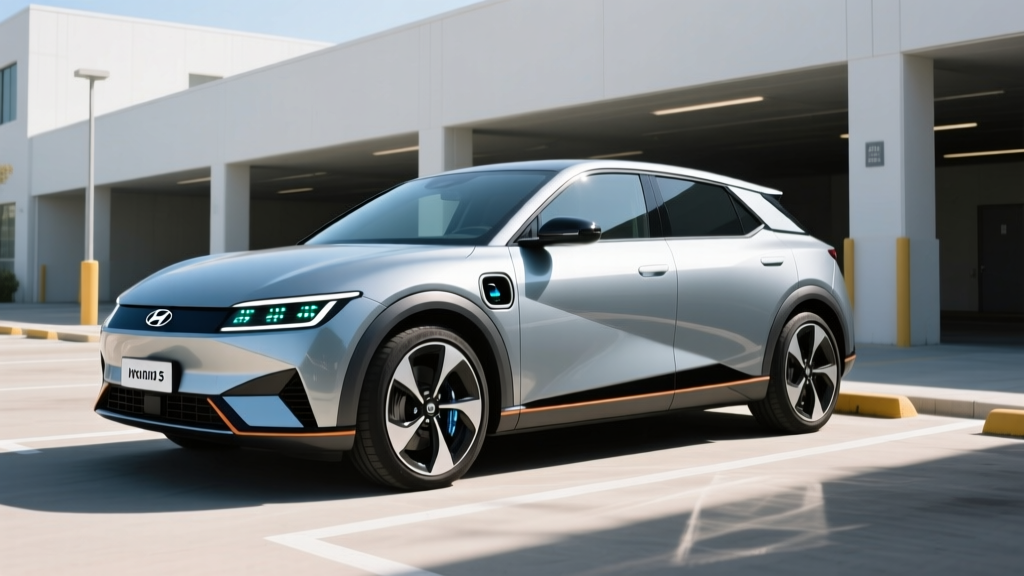
The 2024 Hyundai Ioniq 5 remains one of the most compelling electric crossovers on the market, blending retro-futuristic styling with genuine daily-driver practicality. But beyond the pixel-art headlights and concept-car silhouette, buyers searching for the 2024 Hyundai Ioniq 5 length, width, and height are often trying to answer a more practical question: will it actually fit my garage, my carport, my family? This review pairs those exact exterior dimensions with the data that matters just as much — real-world range, DC fast-charging speed, battery chemistry, federal tax credit eligibility, and total ownership cost — so you can evaluate the Ioniq 5 as a complete package, not a spec sheet.
2024 Hyundai Ioniq 5 Exterior Dimensions: Length, Width, and Height
Before diving into powertrain and battery data, let's address the keyword question directly. Here are the official exterior measurements for the 2024 Ioniq 5 across all trims (SE, SEL, Limited):
| Dimension | Measurement |
|---|---|
| Overall Length | 182.7 inches (4,640 mm) |
| Overall Width (without mirrors) | 74.4 inches (1,890 mm) |
| Overall Width (with mirrors) | 83.2 inches (2,113 mm) |
| Overall Height | 63.0 inches (1,600 mm) |
| Wheelbase | 118.1 inches (3,000 mm) |
| Ground Clearance | 6.1 inches (155 mm) |
| Curb Weight (RWD / AWD) | 4,255 lbs / 4,665 lbs |
For garage-fitment context, a standard single-car garage door is 8 to 9 feet wide (96–108 inches) and typically 7 feet tall (84 inches). The Ioniq 5 at 74.4 inches wide and 63.0 inches tall clears both easily with room to open doors. The 182.7-inch length is shorter than a Toyota RAV4 (180.9 in) — wait, actually slightly longer — and comparable to the Ford Mustang Mach-E (186.7 in) and Volkswagen ID.4 (180.5 in). The standout number is the 118.1-inch wheelbase, which is exceptionally long for the class. That stretched wheelbase — enabled by the dedicated E-GMP platform — is what gives the Ioniq 5 its limousine-like rear legroom despite a relatively compact footprint.
Interior Space: Cargo Volume, Legroom, and Passenger Comfort
The Ioniq 5's flat floor and long wheelbase translate into interior volume that punches above its exterior size class:
- Rear legroom: 39.4 inches — more than a Tesla Model Y (37.4 in) and comparable to a midsize sedan
- Front headroom: 39.8 inches (without panoramic roof); drops to ~38.5 in with the Vision Roof on Limited trim
- Rear headroom: 38.7 inches
- Cargo behind rear seats: 27.2 cubic feet
- Cargo with rear seats folded: 59.3 cubic feet
- Front trunk (frunk): 0.85 cu ft (RWD) / 0.68 cu ft (AWD) — enough for a charging cable bag, not a suitcase
The sliding center console (up to 5.5 inches of travel) is a practical touch for tight parking spaces, letting the driver exit through the passenger side. Rear seats recline and slide forward, offering flexibility for cargo vs. passenger priority.
Battery, Range, and Real-World Efficiency
The 2024 Ioniq 5 is offered with two battery packs:
- Standard Range (SE only): 58 kWh usable, NMC (nickel-manganese-cobalt) chemistry, RWD only
- Long Range (SE, SEL, Limited): 77.4 kWh usable, NMC chemistry, available in RWD or AWD
Hyundai does not use LFP (lithium iron phosphate) chemistry in the Ioniq 5. The NMC cells are supplied primarily by SK On and offer higher energy density, which is critical for fitting 77.4 kWh into the platform's footprint. The trade-off: NMC batteries are more sensitive to sustained high state-of-charge storage and benefit from daily charging limits around 80% for longevity.
| Trim / Drivetrain | EPA Range | Real-World Estimate |
|---|---|---|
| SE Standard Range RWD | 220 mi | ~180–195 mi highway; ~155 mi in cold weather |
| SE / SEL / Limited Long Range RWD | 303 mi | ~250–275 mi highway; ~210–230 mi in freezing temps |
| SEL / Limited Long Range AWD | 260 mi | ~215–235 mi highway; ~180–200 mi in freezing temps |
Source: fueleconomy.gov. Real-world estimates based on sustained 70+ mph highway driving and cold-weather testing at or below 32°F. City driving with regenerative braking typically matches or exceeds EPA figures.
Efficiency for the Long Range RWD is rated at 114 MPGe combined (132 city / 98 highway), translating to roughly 29 kWh per 100 miles. That's competitive with the Tesla Model Y Long Range (122 MPGe) and notably better than the Ford Mustang Mach-E Extended Range RWD (101 MPGe).
Charging Speed: DC Fast Charging and Home Level 2
The Ioniq 5's 800-volt E-GMP architecture is its single biggest technical advantage over most competitors, which still use 400V systems. Higher voltage allows faster charging at compatible DC fast chargers without requiring excessively high current (amps), which reduces heat and cable weight.
| Charging Level | Power / Rate | Time / Speed |
|---|---|---|
| Level 1 (120V household) | ~1.4 kW | ~3–4 miles per hour of charging |
| Level 2 (240V home, 48A) | 10.9 kW (max onboard) | ~35–39 miles per hour; full charge in ~7.5 hrs (Long Range) |
| DC Fast Charge (350 kW station) | Peak ~235 kW | 10–80% in approximately 18 minutes |
| DC Fast Charge (150 kW station) | ~130–145 kW sustained | 10–80% in approximately 28–32 minutes |
| DC Fast Charge (50 kW CHAdeMO/CCS) | ~48–50 kW | 10–80% in approximately 75–80 minutes |
Charging curve reality check: The Ioniq 5 peaks at roughly 235 kW between approximately 10–45% state of charge on a 350 kW charger, then tapers to ~175 kW through 65%, and drops further to ~90–100 kW approaching 80%. This means the advertised 18-minute 10–80% time is achievable only at chargers capable of delivering 350 kW (such as Electrify America's latest stalls or Tesla Superchargers with the NACS adapter). At a more common 150 kW station, expect 28–32 minutes — still excellent, but not the 18-minute headline.
The Ioniq 5 uses the CCS1 connector natively. Hyundai began offering a Tesla Supercharger NACS adapter for Ioniq 5 owners in late 2024, unlocking access to Tesla's 17,000+ Supercharger network — a significant practical advantage for road-trip charging reliability. Preconditioning the battery for DC fast charging activates automatically when a fast charger is set as the navigation destination.
Performance: 0-60, Horsepower, and Drivetrain
| Configuration | Horsepower | Torque | 0-60 mph | Drivetrain |
|---|---|---|---|---|
| Standard Range RWD | 168 hp | 258 lb-ft | ~7.0 sec | Rear-Wheel Drive |
| Long Range RWD | 225 hp | 258 lb-ft | ~5.1 sec | Rear-Wheel Drive |
| Long Range AWD | 320 hp | 446 lb-ft | ~4.5 sec | Dual-Motor AWD |
The AWD model's 320 hp and 4.5-second 0-60 time put it firmly in performance-crossover territory — comparable to a Volkswagen Golf R in straight-line acceleration, but with instant electric torque delivery. The RWD Long Range at 5.1 seconds is more than adequate for merging and passing, and its slightly lighter front end gives it marginally better efficiency.
Top speed is electronically limited to 115 mph across all trims. Towing capacity is rated at 1,650 lbs (braked) for AWD models — enough for a small utility trailer or a pair of dirt bikes, but not a camper. RWD models are not rated for towing.
Pricing, Trims, and Federal Tax Credit Eligibility
| Trim | Drivetrain | MSRP | Est. After §30D Credit |
|---|---|---|---|
| SE Standard Range | RWD | $41,800 | ~$34,300* |
| SE Long Range | RWD | $45,500 | ~$38,000* |
| SEL Long Range | RWD | $47,400 | ~$39,900* |
| SEL Long Range | AWD | $49,950 | ~$42,450* |
| Limited Long Range | AWD | $54,200 | ~$46,700* |
*Estimated after $7,500 federal tax credit. Actual credit eligibility depends on buyer income, battery sourcing, and point-of-sale transfer rules. Destination charge (~$1,195) not included. Source: IRS §30D guidelines.
- MSRP cap: SUVs/crossovers must be under $80,000 — all Ioniq 5 trims qualify.
- Buyer income cap: Modified AGI ≤ $150,000 (single) / $300,000 (joint) / $225,000 (head of household).
- Battery sourcing: Must meet critical minerals and battery component requirements, which phase up annually. The Ioniq 5's SK On cells have faced sourcing scrutiny — verify current-year eligibility on the IRS clean vehicle credit page or with your Hyundai dealer before purchase.
- Point-of-sale transfer: As of 2024, eligible buyers can transfer the credit to the dealer at purchase, receiving the $7,500 as a price reduction rather than waiting for a tax refund.
- New vehicle requirement: Must be purchased new; used EVs have a separate credit (§25E, up to $4,000).
Technology, Safety, and Driver Assistance
The Ioniq 5's tech suite is comprehensive across all trims, with meaningful upgrades at SEL and Limited:
- Infotainment: Dual 12.3-inch displays (instrument cluster + touchscreen), wireless Apple CarPlay and Android Auto, Bluelink connected services
- Hyundai SmartSense (standard): Forward collision-avoidance assist with pedestrian/cyclist detection, blind-spot collision-avoidance, rear cross-traffic collision-avoidance, lane-keeping assist, highway driving assist (HDA — adaptive cruise + lane centering)
- Limited trim adds: Highway Driving Assist 2 (HDA2 with lane-change assist), remote smart parking assist, surround-view monitor, blind-spot view monitor
- V2L (Vehicle-to-Load): Standard interior 120V outlet (1.9 kW output) — can power a laptop, mini-fridge, or power tools. An external V2L adapter is available for the charge port.
- Heat pump: Standard on all trims — significantly reduces cold-weather range loss compared to EVs without thermal management
Highway Driving Assist (HDA/HDA2) is an SAE Level 2 driver-assistance system. The driver must keep hands on the wheel (or demonstrate attentiveness with HDA2) and eyes on the road at all times. This is not autonomous or self-driving capability. The system does not handle construction zones, unmapped roads, or complex urban intersections without driver intervention.
Safety ratings are strong: the Ioniq 5 earned an IIHS Top Safety Pick+ award (with specific headlight trims) and a 5-star overall rating from NHTSA.
Warranty Coverage
| Coverage Type | Term |
|---|---|
| New Vehicle Limited | 5 years / 60,000 miles |
| Powertrain (incl. drive motors) | 10 years / 100,000 miles |
| EV Battery Capacity | 10 years / 100,000 miles (retains ≥70% of original capacity) |
| Corrosion Perforation | 7 years / unlimited miles |
| Roadside Assistance | 5 years / unlimited miles |
Hyundai's 10-year/100,000-mile battery warranty with a 70% capacity retention guarantee is among the strongest in the industry. For context, Tesla's Model Y battery warranty is 8 years / 120,000 miles at the same 70% threshold. Real-world degradation data from early Ioniq 5 owners (2022–2023 models) suggests NMC pack degradation is tracking at approximately 5–8% loss after 30,000–40,000 miles — well within warranty tolerance and consistent with industry norms.
Pros and Cons
- Class-leading 235 kW DC fast charging (10–80% in ~18 min at 350 kW)
- Spacious rear seat (39.4 in legroom) on a compact exterior footprint
- Standard heat pump minimizes cold-weather range loss
- V2L capability for camping, tailgating, and emergency power
- 10-year / 100,000-mile battery and powertrain warranty
- NACS adapter unlocks Tesla Supercharger network access
- Strong IIHS Top Safety Pick+ and 5-star NHTSA ratings
- Frunk is essentially useless (under 1 cu ft) — charging cables only
- No Apple CarPlay/Android Auto over wireless at launch (wired only on some early builds; wireless standard on 2024)
- Rear wiper absent — a frequent complaint in rain and snow
- AWD towing limited to 1,650 lbs; RWD not rated for towing
- NMC battery requires more careful SoC management vs. LFP alternatives
- Some DC fast chargers don't deliver 350 kW — real-world charge times often 28–32 min
- §30D tax credit eligibility depends on battery sourcing rules that may shift
Who Should Buy the 2024 Hyundai Ioniq 5?
- Choose the Ioniq 5 if: You prioritize fast DC charging for road trips, need generous rear-seat space for family use, value a strong warranty, and want access to the Tesla Supercharger network via adapter.
- Look elsewhere if: You need a large frunk or maximum cargo volume (the Kia EV6, which shares the E-GMP platform, has slightly more cargo space). If you tow more than 1,650 lbs, the Ford F-150 Lightning or Rivian R1S are better fits. If you want LFP battery chemistry for worry-free 100% daily charging, the Tesla Model Y RWD (LFP pack) is the alternative.
- Best trim for most buyers: SEL Long Range RWD at ~$47,400 MSRP (~$39,900 after credit). It includes the 303-mile EPA range, HDA, heated seats, and power liftgate without the AWD efficiency penalty.
Frequently Asked Questions
What is the real-world range of the 2024 Hyundai Ioniq 5?
The Long Range RWD is EPA-rated at 303 miles, but expect 250–275 miles on sustained highway driving at 70+ mph, and 210–230 miles in freezing temperatures. The AWD model drops to 260 EPA / ~215–235 real-world highway miles. City driving with regenerative braking often matches or slightly exceeds the EPA sticker.
How fast does the Ioniq 5 charge at home and on the road?
On a Level 2 home charger (240V, 48A), the Ioniq 5 charges at up to 10.9 kW, adding roughly 35–39 miles of range per hour — a full charge overnight in about 7.5 hours. On a 350 kW DC fast charger, it peaks at ~235 kW and reaches 10–80% in approximately 18 minutes. At more common 150 kW stations, expect 28–32 minutes for 10–80%.
How much does the 2024 Ioniq 5 cost after the federal tax credit?
If you qualify for the full $7,500 §30D credit, prices start around $34,300 for the SE Standard Range and ~$42,450 for the popular SEL AWD. Eligibility depends on income caps ($150K single / $300K joint), the MSRP cap (all trims qualify at under $80K), and current-year battery sourcing requirements. The credit can be applied at the point of sale as a price reduction. Always verify eligibility on irs.gov or with a tax professional.
Is the 2024 Ioniq 5 worth buying vs. the Tesla Model Y and Ford Mach-E?
The Ioniq 5's key advantages are faster DC charging (235 kW peak vs. ~250 kW for Model Y but at broader station compatibility), a more comfortable ride quality, and a stronger warranty. The Model Y wins on Supercharger network seamlessness (no adapter needed), slightly higher efficiency (122 vs. 114 MPGe), and a more mature software ecosystem. The Mach-E offers sportier handling but trails on charging speed and rear-seat space. For buyers who value charge speed, ride comfort, and warranty, the Ioniq 5 is the stronger pick.
Does the Ioniq 5 have a heat pump?
Yes — a heat pump is standard on all 2024 Ioniq 5 trims. This is significant for cold-climate owners, as heat pumps use roughly 30–50% less energy for cabin heating compared to resistive heaters, directly preserving range in winter conditions.
What connector does the Ioniq 5 use, and can it charge at Tesla Superchargers?
The Ioniq 5 has a native CCS1 charge port. Hyundai offers a NACS adapter that enables charging at Tesla Superchargers (V3 and V4 stalls). This adapter was made available to Ioniq 5 owners starting in late 2024, significantly expanding the available fast-charging network for road trips.