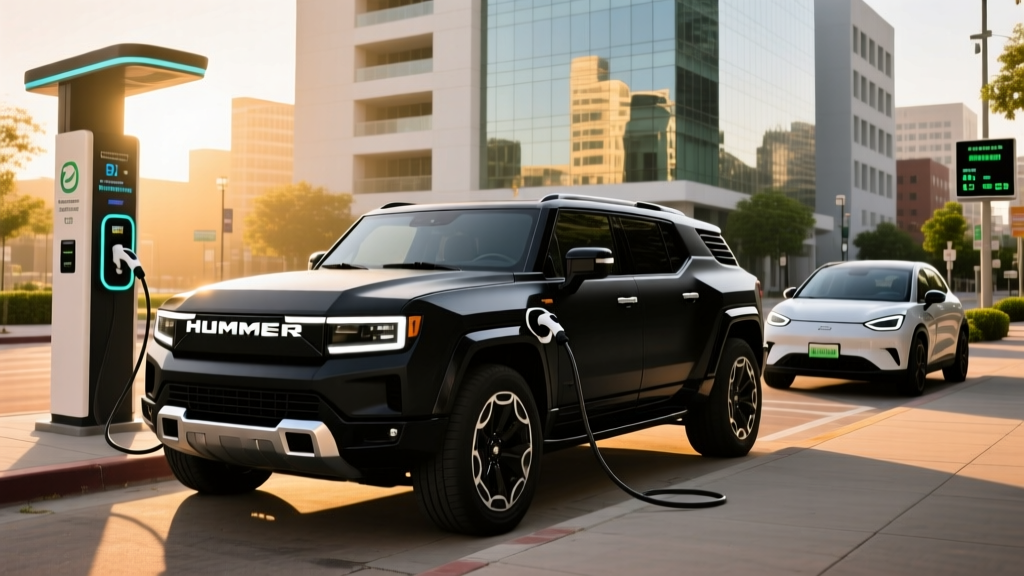
The GMC Hummer EV remains one of the most polarizing electric vehicles on the road — a 9,000-pound supertruck that sprints to 60 mph faster than a Porsche 911 while offering over 300 miles of EPA-estimated range. For the 2024 model year, GMC expanded the lineup with the more accessible 2X trim and a standard-range battery option on the SUV variant, broadening the Hummer EV's appeal beyond early adopters with deep pockets. But does a battery-electric behemoth this large actually make sense as a daily driver? We break down every spec that matters — from real-world range expectations and charging-curve realities to federal tax credit eligibility under current IRS §30D rules.
Range, Battery, and Real-World Efficiency
The 2024 Hummer EV Pickup in 3X trim (with the large 24-module battery pack) carries an EPA-estimated range of 329 miles. The 2X trim with the smaller 20-module pack drops to an EPA-estimated 303 miles. The Hummer EV SUV variants, which are heavier and less aerodynamic, rate at 314 miles (3X) and 298 miles (2X). These figures come from the larger 212.7 kWh (usable) Ultium battery pack on 3X models and a ~170 kWh usable pack on 2X trims, both using GM's nickel-cobalt-manganese-aluminum (NCMA) chemistry — a variant of NMC optimized for energy density and longevity.
The EPA sticker tells only part of the story. In mixed highway driving at 70-75 mph, expect the 3X Pickup to deliver roughly 270–290 miles before needing a charge. The Hummer EV's massive frontal area and 9,000+ lb curb weight punish highway efficiency — you'll see consumption climb to 55–65 kWh/100 mi on flat interstate runs. In cold weather (below 30°F), range can drop an additional 15–25% depending on cabin heating demands and whether you precondition the battery. City driving with regenerative braking engaged recovers meaningful energy, and some owners report exceeding EPA estimates in stop-and-go traffic. Plan conservatively: 250 miles is a safe real-world highway buffer in moderate conditions, less in winter.
Efficiency is rated at approximately 47 MPGe combined (Pickup 3X), translating to roughly 71 kWh per 100 miles in mixed driving per fueleconomy.gov. That's thirsty by EV standards — roughly three times the energy consumption of a Tesla Model Y — but expected given the physics of moving this much mass.
Charging Speed: DC Fast Charge and Home Level 2
The Hummer EV supports a peak DC fast-charge rate of 350 kW on 3X trims equipped with the large battery pack, making it one of the fastest-charging EVs available when paired with a capable 350 kW station (such as Electrify America's latest hardware). GMC quotes a 10–80% charge time of approximately 35 minutes under optimal conditions. However, real-world charging curves tell a more nuanced story: the pack sustains peak power through roughly 30–40% state of charge before tapering progressively. If you arrive at a charger at 10% SoC with a properly preconditioned battery (use the navigation-routed preconditioning feature), you'll see the fastest fills. Arrive cold-soaked or above 40% SoC, and expect significantly longer sessions.
The 2X trim with the smaller battery maxes out at approximately 300 kW DC fast charging, with a similar 10–80% time of roughly 30 minutes.
| Charging Level | Power | Rate / Time | Notes |
|---|---|---|---|
| Level 1 (120V) | ~1.4 kW | ~2 mi/hr | Emergency/trickle only; full charge takes days |
| Level 2 (240V, 48A) | 11.5 kW | ~17 mi/hr | Overnight home charging; 0–100% in ~19 hrs (3X) |
| Level 2 (240V, 80A) | 19.2 kW | ~28 mi/hr | Requires upgraded home charger + 100A circuit |
| DC Fast (3X) | Up to 350 kW | 10–80% in ~35 min | Peak rate; tapers above 50% SoC |
| DC Fast (2X) | Up to 300 kW | 10–80% in ~30 min | Smaller pack charges slightly faster proportionally |
Home charging is a critical consideration. The Hummer EV's onboard charger accepts up to 11.5 kW on a standard 48-amp Level 2 circuit (common for residential installs). That means a full charge from empty on the 3X's 212.7 kWh pack takes roughly 19 hours — effectively requiring two nights for a 0–100% fill. For daily use, most owners charge from 20–80% overnight, which takes about 10–11 hours and adds roughly 200 miles of range. If your electrical panel supports an 80-amp circuit and you install a 19.2 kW charger (such as the ChargePoint Home Flex configured for 80A), you can cut that time significantly. Budget $1,500–$3,500 for a professional Level 2 installation depending on panel capacity and run distance — and confirm with a licensed electrician whether your home's 200A service can handle the additional load.
Performance: Watts to Freedom and Then Some
The Hummer EV's performance figures border on absurd for a vehicle this size. The top-spec 3X Pickup with the available Watts to Freedom (WTF) mode — which lowers the adaptive air suspension, preconditions the battery, and primes the powertrain — delivers 1,000 horsepower and an estimated 1,200 lb-ft of torque from its tri-motor AWD system (one front, two rear). The result: a 0–60 mph time of approximately 3.0 seconds, verified by multiple independent tests. That puts the Hummer EV in supercar acceleration territory while weighing over four tons.
The 2X dual-motor AWD trim produces 625 horsepower and achieves a 0–60 time of approximately 5.5 seconds — still brisk for a full-size truck. Both trims feature torque vectoring on the rear axle, enabling a rear-axle "crab walk" mode (Hummer EV's diagonal driving feature, marketed as CrabWalk) that steers the rear wheels up to 10 degrees in phase with the fronts for sideways maneuvering in tight off-road situations.
| Specification | Hummer EV Pickup 2X | Hummer EV Pickup 3X |
|---|---|---|
| EPA Range | 303 mi | 329 mi |
| Battery (usable) | ~170 kWh (NCMA) | 212.7 kWh (NCMA) |
| Drivetrain | Dual-motor AWD | Tri-motor AWD |
| Horsepower | 625 hp | 1,000 hp |
| 0–60 mph | ~5.5 sec | ~3.0 sec |
| Max DC Fast Charge | 300 kW | 350 kW |
| Level 2 Onboard Charger | 11.5 kW | 11.5 kW |
| Towing Capacity | 7,500 lbs | 7,500 lbs |
| Base MSRP | $98,845 | $106,445 |
Pricing, Trims, and Federal Tax Credit Eligibility
The 2024 Hummer EV Pickup starts at $98,845 (including destination) for the 2X trim and climbs to $106,445 for the 3X. The Hummer EV SUV is priced slightly lower, starting at $98,845 (2X) and $106,445 (3X). The Edition 1 launch model — fully loaded with the Extreme Off-Road package — originally carried an MSRP above $112,000, though most allocations were spoken for during the reservation period. Options such as the Extreme Off-Road package (adding underbody armor, 35-inch Goodyear Wrangler Territory MT tires, and front/rear e-lockers) add approximately $5,000–$12,000 depending on configuration.
The 2024 Hummer EV does not qualify for the full $7,500 federal tax credit under current IRS §30D rules. Here's why:
- MSRP Cap: The §30D credit caps eligibility at $80,000 MSRP for trucks, vans, and SUVs. Every 2024 Hummer EV trim exceeds this threshold, disqualifying it entirely from the new-vehicle credit.
- Buyer Income Cap: Even if it qualified on price, buyers must fall under modified AGI limits ($150,000 single / $300,000 joint) — many Hummer EV buyers exceed these thresholds.
- Battery Sourcing: The Ultium battery pack's critical mineral and component sourcing has been evolving; however, the MSRP cap renders this point moot for this vehicle.
Bottom line: Budget the full MSRP. No federal purchase incentive applies. Some state-level incentives (e.g., Colorado's innovative motor vehicle credit) may partially offset cost — check your state's current programs. If purchasing used (model year 2022+), the Used Clean Vehicle Credit (§25E) may offer up to $4,000, subject to a $25,000 sale price cap — which also excludes most Hummer EV listings.
Cargo, Passenger Space, and Daily Practicality
The Hummer EV Pickup offers a 5-foot bed (shorter than a standard full-size truck's 6.5-foot bed) with a powered multi-pro tailgate. Cargo volume behind the rear seats is limited by the vehicle's cab-forward proportions, but the bed accommodates standard 4×8 sheets of plywood with the tailgate down. The front trunk (frunk) provides approximately 11.3 cubic feet of lockable, weather-sealed storage — useful for charging cables and gear you want to keep separate from the bed.
Interior passenger space is generous. Front legroom measures approximately 45.6 inches, with rear legroom at 38.9 inches — comfortable for full-size adults on long trips. Headroom is excellent front and rear thanks to the tall roofline. The cabin seats five, though the wide center console makes the rear middle seat best suited for shorter trips.
The Hummer EV SUV swaps the bed for an enclosed cargo area with approximately 35.9 cubic feet behind the second row and 81.8 cubic feet with the rear seats folded. The SUV's power-folding soft rear window and available infinity roof (removable transparent panels) add open-air versatility.
One practical note: at 81.4 inches wide (excluding mirrors), the Hummer EV is too wide for many older parking structures and tight urban garages. Measure your home garage opening carefully — you'll need at least a 9-foot-wide bay for comfortable entry and exit.
Technology, Driver Assists, and Standout Features
The Hummer EV runs GM's UltraVision infotainment system on a 13.4-inch diagonal touchscreen, supplemented by a 12.3-inch driver information cluster. The system supports wireless Apple CarPlay and Android Auto, over-the-air updates, and up to 18 camera views (including underbody cameras for off-road trail navigation). The interface is responsive, though the sheer number of submenus for off-road settings, drive modes, and energy management can overwhelm first-time users.
Driver assistance comes via GM's Super Cruise — a Level 2 hands-free driving system operational on over 750,000 miles of compatible divided highways in the U.S. and Canada. Super Cruise uses a driver-attention camera to monitor eye gaze and allows true hands-off operation on mapped routes. It's one of the most polished Level 2 systems available, though it requires the driver to remain engaged and ready to resume control at all times.
Super Cruise is an SAE Level 2 driver-assistance system — not self-driving. The driver must remain attentive, keep eyes on the road, and be prepared to take over steering and braking at any moment. The system will issue escalating alerts and eventually bring the vehicle to a stop if driver attention is not confirmed. This is fundamentally different from Level 4 robotaxi services (Waymo, Zoox) that operate without a human driver in geofenced areas.
Standout features include the CrabWalk four-wheel steering system (diagonal movement at low speeds), Extract Mode (air suspension raises the vehicle 5.8 inches for extreme ground clearance), adaptive air ride suspension with multiple height settings, and an available power-retractable roof on the Pickup (Infinity Roof with removable sky panels). The Hummer EV also supports ProGrade trailering with integrated trailer brake controller and hitch-view cameras.
Notable drawbacks: the sheer weight (over 9,000 lbs for the Pickup 3X) means tire wear is aggressive — budget for replacement rubber every 20,000–30,000 miles. The regenerative braking system, while effective, does not offer true one-pedal driving to a complete stop in all modes. And the 5-foot bed, while practical for most uses, limits utility compared to a conventional full-size truck for buyers who regularly haul long cargo.
Warranty and Long-Term Ownership
GMC backs the Hummer EV with a competitive warranty package:
- Battery Pack: 8 years / 100,000 miles (whichever comes first), covering defects and capacity loss below a specified threshold (typically 60–70% of original capacity, per GM's Ultium warranty terms)
- Powertrain (motors, inverters, reduction gears): 5 years / 60,000 miles
- Bumper-to-Bumper: 3 years / 36,000 miles
- Corrosion: 6 years / 100,000 miles
The NCMA battery chemistry in the Ultium platform has shown promising early degradation data from GM's fleet testing, though long-term (10+ year) real-world data on the Hummer EV specifically is still accumulating. Given the pack's massive capacity, even a 10–15% degradation over a decade would leave 280+ miles of range — still highly usable. Replacement cost for the full 212.7 kWh pack, should it ever be needed out of warranty, is estimated in the $25,000–$35,000 range based on current Ultium module pricing, though individual module replacement (the pack uses 24 modules in the 3X) would be significantly less.
Who Should Buy the 2024 Hummer EV?
Best For:
- Off-road enthusiasts who want silent, torque-rich trail capability with Extract Mode and CrabWalk
- Truck buyers who want supercar acceleration and don't need a long bed
- Home-charging-capable owners with 240V/48A+ circuits and daily commutes under 200 miles
- Tech-forward buyers who value Super Cruise for highway road trips
- Statement-vehicle shoppers who want maximum presence and conversation-starting design
Skip If:
- You need best-in-class efficiency — the Rivian R1T and Tesla Cybertruck deliver more miles per kWh
- Your garage or parking situation can't accommodate an 81.4-inch-wide, 9,000-lb vehicle
- You're counting on the federal tax credit — the MSRP cap disqualifies every trim
- You need a 6.5-foot+ bed for regular cargo hauling
- You live in an apartment or lack reliable home charging access — public-charging-only ownership with a 212 kWh pack is painful
Pros
- 329-mile EPA range (3X) is excellent for a vehicle this size
- 350 kW peak DC charging enables ~35-min road-trip stops
- Super Cruise hands-free highway driving is top-tier
- CrabWalk and Extract Mode are genuinely useful off-road
- 3.0-second 0–60 is astonishing at 9,000+ lbs
- 11.3 cu-ft frunk adds practical sealed storage
Cons
- No federal tax credit eligibility (MSRP exceeds $80K cap)
- Highway efficiency is poor (~55–65 kWh/100 mi)
- 5-foot bed limits utility vs. conventional trucks
- Home charging from empty takes ~19 hours (11.5 kW)
- 81.4" width won't fit many urban garages
- Aggressive tire wear due to extreme weight
2024 Hummer EV vs. Key Competitors
The Hummer EV competes in the premium electric truck/SUV segment against the Rivian R1T, Tesla Cybertruck, and Ford F-150 Lightning. The Rivian R1T offers a more practical quad-motor system, a longer bed option, and better efficiency — though it can't match the Hummer's range or raw power. The Cybertruck undercuts on price and offers comparable performance in Cyberbeast trim, but its stainless-steel exoskeleton and polarizing design aren't for everyone. The F-150 Lightning remains the value champion, starting well under $60,000 and qualifying for the full $7,500 credit, but offers less range and none of the Hummer's off-road theatrics.
The Hummer EV's unique selling proposition is clear: it's the only EV that combines 300+ mile range, 1,000 hp, serious off-road hardware, and Super Cruise in a single package. If that combination resonates and the six-figure price doesn't deter you, nothing else quite replicates the experience.
Frequently Asked Questions
What is the real-world range of the 2024 Hummer EV?
The EPA estimates 329 miles for the 3X Pickup and 303 miles for the 2X. In real-world highway driving at 70+ mph, expect 270–290 miles (3X) and 250–270 miles (2X). Cold weather (below 30°F) can reduce range an additional 15–25%. For trip planning, 250 miles is a conservative safe buffer in moderate conditions.
How fast does the Hummer EV charge at home and on the road?
At home on a 240V/48A Level 2 circuit, the Hummer EV charges at 11.5 kW, adding roughly 17 miles of range per hour. A full charge takes approximately 19 hours. On a 350 kW DC fast charger, the 3X can go from 10–80% in about 35 minutes under optimal conditions with a preconditioned battery.
Does the 2024 Hummer EV qualify for the $7,500 federal tax credit?
No. Under IRS §30D rules, the new-vehicle EV tax credit caps eligibility at $80,000 MSRP for trucks and SUVs. Every 2024 Hummer EV trim starts above $98,000, disqualifying it from the credit entirely. Check irs.gov for current rules, as legislation can change.
Is the Hummer EV worth buying over the Rivian R1T or Tesla Cybertruck?
If you prioritize maximum range, off-road capability (Extract Mode, CrabWalk), Super Cruise, and sheer presence, the Hummer EV has no equal. If efficiency, a longer bed, or lower pricing matters more, the Rivian R1T or Ford F-150 Lightning may be better fits. The Cybertruck competes on price and performance but offers a very different design philosophy.
How much does it cost to charge a Hummer EV?
At the U.S. average residential electricity rate of ~$0.17/kWh, fully charging the 212.7 kWh 3X pack at home costs approximately $36. On public DC fast chargers at $0.40–$0.50/kWh, a 10–80% session (roughly 150 kWh) costs $60–$75. Per-mile energy cost is roughly $0.12 at home — significantly more than a compact EV but competitive with a gas truck getting 15–18 mpg.
Can the Hummer EV tow, and how does towing affect range?
The Hummer EV is rated to tow 7,500 pounds. However, towing a heavy trailer (5,000+ lbs) can reduce range by 40–50%, dropping effective range to 150–180 miles. Plan charging stops accordingly and use the integrated ProGrade trailering system with trailer brake controller for safe operation.
Sources: fueleconomy.gov (EPA range and efficiency data), IRS §30D Clean Vehicle Credit guidelines, GMC official specifications. Pricing reflects 2024 model year MSRP as published by GMC; verify with your local dealer for current availability and any mid-year adjustments. Tax credit eligibility rules are subject to legislative change — consult a tax professional for personalized guidance.