Quick Verdict: Honda's First EV Is a Solid, If Conservative, Family Crossover
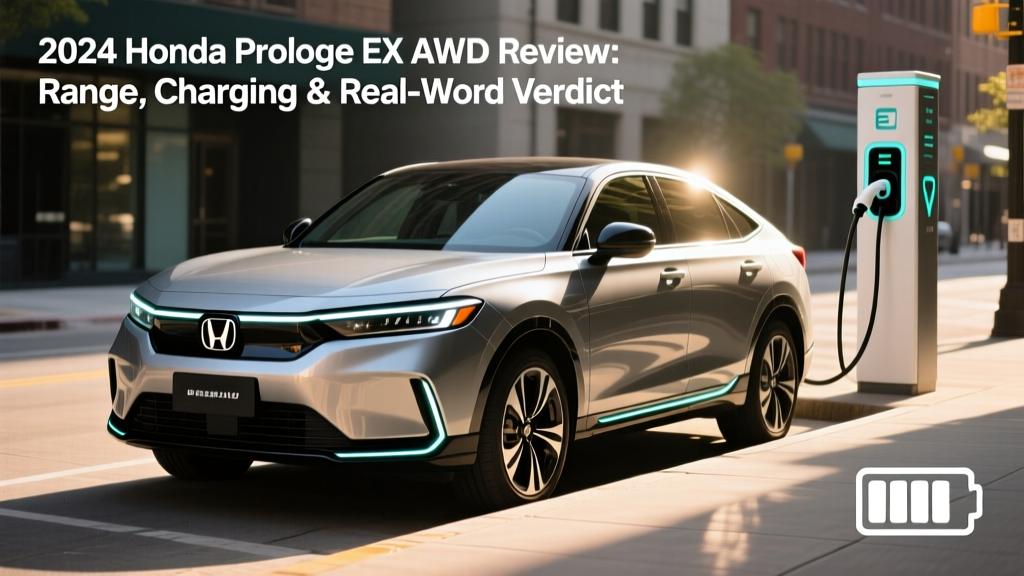
The 2024 Honda Prologue EX AWD is Honda's first mass-market battery-electric vehicle, and it arrives with the pragmatic sensibility you'd expect from the brand that gave us the Civic and CR-V. Built on General Motors' Ultium platform (the same architecture underpinning the Chevrolet Blazer EV and Cadillac Lyriq), the Prologue EX AWD delivers a competitive 281 miles of EPA-estimated range, dual-motor all-wheel drive with 288 horsepower, and a starting MSRP of $51,500 before destination. It's a roomy, comfortable, and tech-forward midsize SUV that prioritizes daily usability over performance theatrics.
But how does it stack up when you look past the brochure? We break down real-world range expectations, charging curve behavior, tax credit eligibility, and ownership economics so you can decide whether the Prologue EX AWD earns a spot in your driveway — or whether a Hyundai Ioniq 5, Ford Mustang Mach-E, or Tesla Model Y makes more sense for your needs.
| Spec | Value |
|---|---|
| EPA Range | 281 miles |
| Battery (usable) | 85 kWh, NMC (nickel manganese cobalt) chemistry |
| Drivetrain | Dual-motor AWD |
| Horsepower / Torque | 288 hp / 325 lb-ft |
| 0–60 mph | ~5.9 seconds |
| Max DC Fast Charge | 150 kW peak |
| 10–80% DC Charge Time | ~32 minutes (estimated) |
| Level 2 Home Charge Rate | 11.5 kW (~34 miles/hr) |
| EPA Efficiency | 95 MPGe combined / 35 kWh per 100 miles |
| Cargo Volume (rear seats up / down) | 25.2 cu ft / 57.7 cu ft |
| Rear Legroom | 38.8 inches |
| Base MSRP (EX AWD) | $51,500 (+ $1,350 destination) |
| Battery/Powertrain Warranty | 8 years / 100,000 miles |
Range and Efficiency: 281 Miles EPA, but What Will You Actually See?
The 2024 Prologue EX AWD carries an EPA-estimated 281 miles of range, putting it squarely in the competitive middle of the midsize electric SUV segment. The front-wheel-drive EX trim squeezes out 296 miles, but the AWD version's dual motors and added weight trim that figure by 15 miles — a modest penalty for year-round traction confidence.
EPA sticker: 281 miles. In real-world mixed driving (suburban errands, moderate highway speeds around 65–70 mph, mild weather), expect roughly 250–265 miles before needing to plug in. Sustained highway driving at 75+ mph can drop that to 230–245 miles. In cold weather (below 32°F), cabin heating and battery thermal management can reduce range by 20–30%, putting winter highway range in the 190–210 mile band. The Prologue uses a heat pump for cabin heating, which mitigates some cold-weather loss compared to resistive heaters, but physics still wins in deep freezes.
Efficiency lands at 95 MPGe combined, which translates to roughly 35 kWh per 100 miles. That's average for the class — the Hyundai Ioniq 5 AWD achieves about 98 MPGe combined, while the heavier Ford Mustang Mach-E AWD Extended Range sits around 91 MPGe. The Prologue's boxy SUV proportions and 4,800-pound curb weight work against efficiency at highway speeds, where aerodynamic drag dominates.
Charging Speed: 150 kW Peak, but the Curve Tells the Real Story
Honda rates the Prologue for a 150 kW peak DC fast-charge rate on a CCS1 connector. On a compatible 150+ kW station (Electrify America, EVgo, or a Tesla Supercharger with the included NACS adapter for 2025+ models), you'll see the battery ramp quickly from a low state of charge — but as with all EVs, that peak number is only sustained briefly.
| Charging Level | Power | Speed / Time |
|---|---|---|
| Level 1 (120V household outlet) | ~1.4 kW | ~3–4 miles of range per hour |
| Level 2 (240V home / public) | Up to 11.5 kW | ~34 miles per hour; full charge in ~9 hours |
| DC Fast Charge (CCS1) | 150 kW peak | 10–80% in ~32 minutes; tapers significantly above 80% |
The 10–80% charge time of approximately 32 minutes is adequate for road-trip stops but trails the segment leaders. The Hyundai Ioniq 5 and Kia EV6, with their 800-volt architectures, can hit 10–80% in roughly 18 minutes at a 350 kW charger. The Prologue's 400-volt Ultium architecture limits its ceiling here. If your typical driving is commute-and-errands with home charging, this won't matter — you'll wake up to a full battery every morning on Level 2. But if you plan regular 400+ mile road trips, the slower charge curve means longer stops.
Home charging note: The Prologue's onboard charger accepts up to 11.5 kW on Level 2, which requires a 48-amp dedicated circuit (typically a 60-amp breaker). A full Level 2 home installation — charger unit, wiring, permit, and electrician labor — runs $800–$2,000 depending on your panel proximity and local rates. If your electrical panel is at capacity, a panel upgrade can add $1,500–$3,000. Always get a quote from a licensed electrician before committing.
Performance and Driving Impressions
The dual-motor AWD powertrain produces 288 horsepower and 325 lb-ft of torque, launching the Prologue from 0 to 60 mph in roughly 5.9 seconds. That's brisk enough for confident highway merging and passing, though it won't pin you to the seat like a Tesla Model Y Long Range (4.8 seconds) or a Mach-E GT (3.5 seconds). The instant torque delivery typical of electric motors makes the Prologue feel quicker in city driving than the 0–60 time alone suggests.
Ride quality is where the Prologue earns its Honda badge. The suspension tuning leans comfort-oriented, absorbing potholes and expansion joints with a composure that rivals the more expensive Cadillac Lyriq (its Ultium-platform cousin). Steering is light and precise, if a bit numb at highway speeds — exactly what most family-SUV buyers want. The cabin stays impressively quiet at speed, with minimal wind and road noise intrusion.
One-pedal driving is available through Honda's selectable regen modes, though the maximum regen level doesn't quite bring the SUV to a full stop as aggressively as some competitors. You'll still use the brake pedal for final stops in most scenarios. The brake blending between regenerative and friction braking is smooth — no jarring transitions that plague some early EVs.
Interior, Tech, and Cargo Space
Honda kept the Prologue's interior layout clean and functional, avoiding the touchscreen-only minimalism that frustrates some EV buyers. A 11.3-inch touchscreen runs Google Built-In (Google Maps, Google Assistant, and the Play Store), paired with an 11-inch digital instrument cluster. Physical knobs for climate control and volume remain — a welcome choice for anyone who's fumbled with a touchscreen while driving.
The EX AWD trim includes heated front seats, a heated steering wheel, wireless Apple CarPlay and Android Auto, a 10-speaker Bose audio system, and a panoramic sunroof. The center console offers a deep storage bin and a wireless charging pad. Rear-seat passengers get 38.8 inches of legroom — competitive with the Toyota RAV4 and significantly more than the Hyundai Ioniq 5's 36.9 inches — along with USB-C ports and rear air vents.
Cargo volume measures 25.2 cubic feet behind the second row and 57.7 cubic feet with the rear seats folded. There is no front trunk (frunk); the space under the hood houses EV drivetrain components. A power liftgate is standard on the EX trim. For context, the Model Y offers 30.2 cu ft rear / 72.1 cu ft total (including the frunk), so if maximum cargo capacity is your priority, the Tesla still leads.
Honda Sensing ADAS Suite
Every Prologue comes with Honda Sensing, which includes adaptive cruise control with low-speed follow, lane-keeping assist, lane-departure warning, forward collision warning with automatic emergency braking, and traffic-sign recognition. This is a SAE Level 2 driver-assist system — it can manage steering, acceleration, and braking under certain conditions, but the driver must remain fully engaged with hands on the wheel and eyes on the road. It is not self-driving. The system works well on well-marked highways but can be conservative in lane-centering and occasionally hesitates during cut-in scenarios in heavy traffic.
Pricing, Trims, and Federal Tax Credit Eligibility
The 2024 Honda Prologue is offered in three trims, all available with either FWD or AWD:
| Trim | MSRP (AWD) | With Destination | Potential §30D Credit | Effective Price |
|---|---|---|---|---|
| EX AWD | $51,500 | $52,850 | Up to $7,500 | ~$45,350* |
| Touring AWD | $55,500 | $56,850 | Up to $7,500 | ~$49,350* |
| Elite AWD | $58,500 | $59,850 | Up to $7,500 | ~$52,350* |
*Effective price assumes full $7,500 federal tax credit. Actual eligibility depends on income, tax liability, and battery-sourcing compliance. See details below.
Does the Prologue EX AWD Qualify for the $7,500 Federal EV Tax Credit?
Under current IRS §30D rules, the Prologue's eligibility is nuanced. Because it is built on GM's Ultium platform at a U.S. assembly plant (Spring Hill, Tennessee), it clears the North American final-assembly requirement. However, the battery's critical-mineral and component sourcing must meet phased thresholds that tighten each year. Honda has worked to qualify the Prologue under these rules, and many buyers have successfully claimed the credit — but eligibility is not guaranteed for every buyer in every tax year.
Key §30D requirements to verify before purchase:
- Buyer income caps: Modified AGI must not exceed $150,000 (single), $225,000 (head of household), or $300,000 (married filing jointly).
- MSRP cap: The vehicle's MSRP must not exceed $80,000 for SUVs (the Prologue clears this easily at $51,500–$58,500).
- Battery sourcing: Critical minerals and battery components must meet escalating domestic/free-trade-partner thresholds. Verify current-year compliance on fueleconomy.gov before purchasing.
- Point-of-sale transfer: As of 2024, you can transfer the credit to the dealer at purchase, reducing your out-of-pocket cost immediately rather than waiting to claim it on your tax return.
- Tax liability: The credit is non-refundable — you need sufficient federal tax liability to absorb it (unless using the point-of-sale transfer option).
Always confirm eligibility with a tax professional and check the latest sourcing determinations on the IRS and DOE websites before finalizing your purchase. Rules have shifted multiple times since 2023 and may continue to evolve.
Pros, Cons, and How It Compares
- Spacious rear seat (38.8" legroom) and competitive cargo volume
- Comfortable, quiet ride quality that exceeds its price class
- Physical climate controls and intuitive Google Built-In infotainment
- 281-mile EPA range is sufficient for most daily and weekend needs
- Honda Sensing ADAS standard on all trims
- U.S.-built, with strong §30D tax credit potential
- 8-year/100,000-mile battery and powertrain warranty
- 150 kW peak DC charge rate trails 800V rivals (Ioniq 5, EV6)
- No front trunk (frunk) for additional cargo
- 0–60 in 5.9 seconds — adequate but not exciting for the price
- Efficiency (95 MPGe) is middling; rivals like the Ioniq 5 do better
- Starting price ($51,500) is steep before incentives vs. some competitors
- Regen braking doesn't achieve full one-pedal driving
Prologue EX AWD vs. Key Competitors
Against the Hyundai Ioniq 5 AWD ($52,600, 260-mile range, 10–80% in ~18 min at 350 kW): The Ioniq 5 charges dramatically faster and offers a more futuristic design, but its rear seat is tighter and its cargo area slightly smaller. If road-trip charging speed is a priority, the Ioniq 5 wins. If passenger comfort and traditional SUV ergonomics matter more, the Prologue has the edge.
Against the Ford Mustang Mach-E AWD Extended Range ($52,995, 290-mile range, 150 kW peak): The Mach-E is sportier to drive with sharper handling, but its ride is firmer and its rear seat less roomy. The Prologue trades driving engagement for comfort.
Against the Tesla Model Y Long Range AWD ($48,990 after recent price adjustments, 310-mile range, 250 kW peak): The Model Y leads in range, efficiency, charging speed, and cargo volume, but its minimalist interior, panel-gap inconsistency, and lack of Apple CarPlay deter some buyers. The Prologue offers a more traditional, higher-quality cabin experience at a higher starting price.
Who Should Buy the 2024 Honda Prologue EX AWD?
Choose the Prologue EX AWD if: You want a comfortable, spacious, and quiet family SUV with Honda's reputation for reliability, you charge primarily at home, your daily commute is under 60 miles round-trip, and you value physical controls and Google-based infotainment over maximum performance or fastest DC charging.
Look elsewhere if: You take frequent 400+ mile road trips and need the fastest possible DC charging (consider the Ioniq 5 or EV6), you prioritize maximum cargo space (the Model Y leads), or you want a sporty, engaging drive (the Mach-E GT or Model Y Performance delivers more thrills).
The Prologue EX AWD is best understood as Honda's measured, well-executed entry into the EV space — not a segment disruptor, but a credible, comfortable, and practical electric SUV that will serve a family well for years. If that's what you're shopping for, it deserves a serious test drive.
Frequently Asked Questions
What is the real-world range of the 2024 Honda Prologue EX AWD?
The EPA rates it at 281 miles. In real-world mixed driving at moderate speeds and temperatures, expect 250–265 miles. Sustained highway driving at 75+ mph drops that to roughly 230–245 miles. In cold weather below freezing, plan for 190–210 miles of usable range. The onboard heat pump helps mitigate winter losses but cannot eliminate them entirely.
How fast does the Prologue charge at home and on DC fast chargers?
On a Level 2 home charger (240V, 48-amp circuit), the Prologue charges at up to 11.5 kW, adding roughly 34 miles of range per hour and reaching a full charge in about 9 hours. On a DC fast charger, it peaks at 150 kW, reaching 10–80% in approximately 32 minutes. Charging slows substantially above 80% to protect battery health — expect an 80–100% top-off to add another 20–25 minutes.
How much does the Prologue EX AWD cost after the federal tax credit?
The MSRP is $51,500 plus $1,350 destination, totaling $52,850. If you qualify for the full $7,500 §30D federal tax credit (meeting income caps, tax liability, and battery-sourcing requirements), the effective price drops to approximately $45,350. You can also transfer the credit to the dealer at the point of sale for an immediate price reduction. State and local incentives may reduce the cost further — check your state's energy office for details.
Does the 2024 Honda Prologue qualify for the federal EV tax credit?
The Prologue is assembled in Tennessee on GM's Ultium platform and meets the North American final-assembly requirement. Battery-sourcing compliance for the critical-minerals and battery-component thresholds has been confirmed for many configurations, but rules tighten annually. Verify current eligibility on fueleconomy.gov and consult a tax professional before purchase. Buyer income caps ($150K single / $300K joint) and the $80K SUV MSRP cap also apply.
Is the Prologue EX AWD worth buying over a Tesla Model Y or Hyundai Ioniq 5?
It depends on your priorities. The Prologue wins on ride comfort, cabin quietness, physical controls, and traditional SUV ergonomics. The Model Y leads in range (310 mi), efficiency, charging speed (250 kW), and cargo space. The Ioniq 5 dominates DC charging speed (18-minute 10–80%) but has a tighter rear seat. If comfort and Honda's dealer network matter most, the Prologue is a strong pick. If you road-trip frequently and want the fastest charging, the Ioniq 5 or Model Y may serve you better.
What is the battery warranty on the Honda Prologue?
Honda provides an 8-year / 100,000-mile limited warranty on the high-voltage battery and electric powertrain components. The warranty covers defects and excessive capacity loss (typically defined as dropping below 70% of original capacity, though confirm exact terms with your dealer). This is standard for the segment and matches the coverage offered by most competitors including Hyundai, Ford, and Tesla.