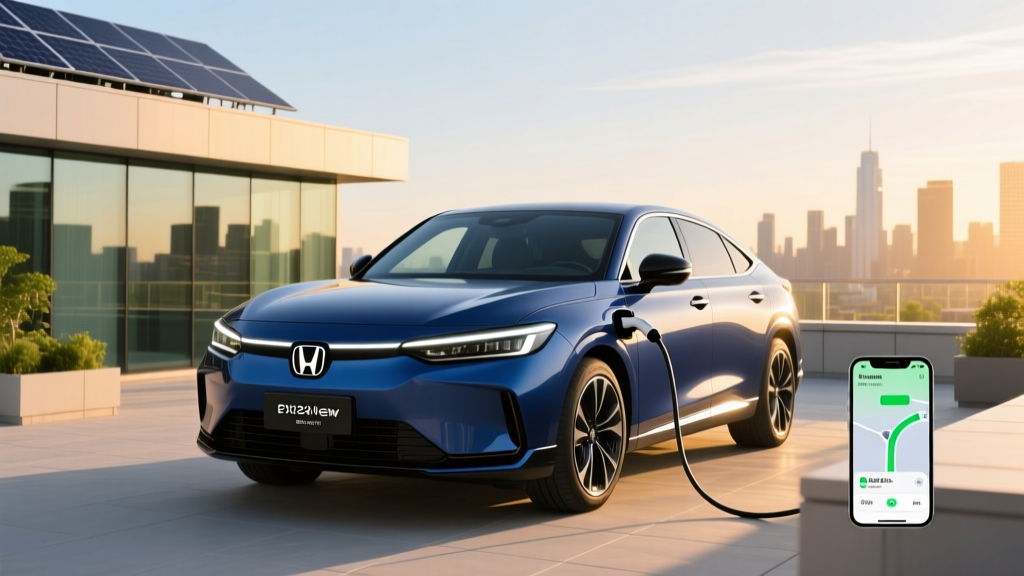
Honda's first mass-market battery-electric vehicle arrived with an unusual pedigree: the 2024 Honda Prologue EV rides on General Motors' Ultium platform and BEV3 architecture, making it a mechanical cousin to the Chevrolet Blazer EV and Cadillac Lyriq. But Honda tuned the suspension, designed the interior, and layered on its own Honda Sensing ADAS suite. The result is a midsize electric SUV that feels distinctly Honda in execution while borrowing GM's proven electric bones. For buyers who trust the Honda brand but want a spacious, practical EV with competitive range, the Prologue demands a serious look — though its pricing and charging profile tell a nuanced story.
Quick Specs: 2024 Honda Prologue at a Glance
| Specification | EX (FWD) | Touring (FWD) | Elite (AWD) |
|---|---|---|---|
| EPA Range | 296 mi | 296 mi | 273 mi |
| Battery (usable) | 85 kWh, NMC lithium-ion | ||
| Horsepower | 212 hp | 212 hp | 288 hp |
| Torque | 236 lb-ft | 236 lb-ft | 332 lb-ft |
| 0-60 mph | ~7.8 sec | ~7.8 sec | ~6.2 sec |
| Drivetrain | FWD, single motor | FWD, single motor | AWD, dual motor |
| Max DC Fast Charge | 150 kW peak | ||
| 10-80% DCFC Time | ~34 minutes | ||
| Level 2 Home Charge | 11.5 kW (~31 mi/hr) | ||
| MPGe (combined) | 95 MPGe | 95 MPGe | 87 MPGe |
| Efficiency | 35 kWh/100mi | 35 kWh/100mi | 39 kWh/100mi |
| Base MSRP | $47,400 | $53,400 | $57,900 |
| Battery Warranty | 8 years / 100,000 miles | ||
Real-World Range: What to Actually Expect
Real-World Highway (70-75 mph): ~240-260 miles
Cold Weather (below 30°F): ~200-230 miles
Mixed Commute (city/suburban): ~270-290 miles
The FWD trims' 296-mile EPA rating is competitive in the midsize electric SUV segment, landing between the Hyundai Ioniq 5 (303 mi Long Range) and the Ford Mustang Mach-E Extended Range (~310 mi). However, the EPA cycle favors lower-speed, stop-and-go driving with generous regenerative braking recovery. On sustained highway trips at 70-75 mph — where most range-anxiety scenarios actually occur — expect the FWD Prologue to deliver roughly 240 to 260 miles before needing a charge stop. The AWD Elite, with its dual-motor drag and stickier 21-inch tires, drops further to around 225-245 highway miles.
Cold weather compounds the loss. The Prologue uses a heat pump for cabin heating (a welcome inclusion), but lithium-ion chemistry inherently loses capacity in freezing temperatures. Plan for 20-25% range reduction in sustained sub-30°F conditions. A Wisconsin winter commute that easily covers 280 miles in July may shrink to 215 miles in January. This isn't a Honda-specific problem — it's physics — but it's essential to budget for if you live north of the Sun Belt.
One positive note from fueleconomy.gov: the FWD Prologue's 95 MPGe combined rating translates to roughly 35 kWh per 100 miles, which is average efficiency for a vehicle of this weight (~4,700 lbs). You won't set efficiency records, but you won't be bleeding energy either.
Charging Speed: DC Fast and Home Level 2
| Charging Level | Power / Rate | Time / Miles Added | Connector |
|---|---|---|---|
| Level 1 (120V outlet) | ~1.4 kW | ~4 miles per hour | J1772 / NACS |
| Level 2 (240V home) | 11.5 kW (48A) | ~31 miles per hour; full charge ~9 hrs | J1772 or NACS |
| DC Fast Charge | 150 kW peak | 10-80% in ~34 min | CCS1 or NACS |
The Prologue's 150 kW peak DC fast-charging rate is the spec that requires the most context. At 150 kW, the 85 kWh battery can theoretically add significant range quickly, but like all EVs, the Prologue does not sustain peak rate throughout the session. The charge curve tapers meaningfully above 60% State of Charge (SoC). In practice, a 10-80% session takes approximately 34 minutes at a capable 150+ kW station, but an 80-100% top-off can add another 30-40 minutes. For road-trip planning, budget 35-40 minutes per stop when charging from roughly 10% to 80%.
For 2024, Honda equipped the Prologue with a CCS1 connector on most units, though Honda has confirmed a transition to the North American Charging Standard (NACS) for future model years. Honda also partnered with GM to provide Prologue buyers access to the Tesla Supercharger network via an included adapter (or native NACS port on later builds). This is a significant practical advantage — the Supercharger network remains the most reliable DC fast-charging infrastructure in North America.
At home, the onboard charger accepts up to 11.5 kW on a 48-amp Level 2 circuit, which translates to roughly 31 miles of range per hour of charging. A full overnight charge from 10% takes about 9 hours — easily achievable with a standard nighttime plug-in routine. A 240V / 60A circuit installation typically costs $800-$2,000 depending on your electrical panel's proximity to the garage and whether a panel upgrade is needed.
Performance and Driving Dynamics
The single-motor FWD Prologue produces 212 horsepower and 236 lb-ft of torque, delivering a 0-60 mph time of approximately 7.8 seconds. This is adequate for merging and passing but won't pin you to the seat. The dual-motor AWD Elite bumps output to 288 hp and 332 lb-ft, cutting the 0-60 sprint to roughly 6.2 seconds — a meaningful improvement that makes the Elite feel genuinely quick off the line.
Ride quality is where Honda's tuning shines. The Prologue's front struts and rear five-link suspension deliver a composed, slightly firm ride that absorbs highway imperfections without floating. Steering is direct if not particularly communicative — typical Honda. The low center of gravity from the floor-mounted battery pack keeps body roll well-controlled in corners, and the 4,700-lb curb weight (FWD) feels manageable rather than ponderous.
Regenerative braking offers multiple levels selectable via steering-wheel paddles. The strongest setting enables near one-pedal driving in city traffic, though it doesn't quite bring the vehicle to a complete stop — you'll still need the friction brake for the final few mph. Honda Sensing comes standard across all trims and includes adaptive cruise control with low-speed follow, lane-keeping assist, collision mitigation braking, and traffic sign recognition. This is an SAE Level 2 driver-assistance system, meaning the driver must remain actively engaged with hands on the wheel and eyes on the road at all times.
Interior, Cargo, and Technology
The Prologue's cabin is clean, well-organized, and uses quality materials appropriate for its price class. A 11.3-inch touchscreen infotainment display dominates the center stack, running Google built-in (Google Maps navigation, Google Assistant, Play Store apps). Wireless Apple CarPlay and Android Auto are standard. An 11-inch digital instrument cluster sits behind the wheel, and a head-up display is included on Touring and Elite trims.
Passenger space is generous, befitting the Prologue's midsize two-row SUV positioning:
- Front legroom: 41.4 inches
- Rear legroom: 38.6 inches
- Front headroom: 39.6 inches
- Rear headroom: 38.2 inches
- Cargo behind rear seats: 25.2 cu ft
- Cargo with rear seats folded: 57.7 cu ft
The 25.2 cu ft of rear cargo space is competitive with the Blazer EV and slightly behind the Ioniq 5's 27.2 cu ft. There is no front trunk (frunk) — the space under the hood houses drive components and ancillary systems. This is a notable omission in a segment where competitors like the Ford Mustang Mach-E and Rivian R1S offer usable frunk storage.
Notable tech drawbacks: the Prologue lacks a vehicle-to-load (V2L) feature, meaning you can't power external devices or your home from the battery. The infotainment system, while responsive, relies heavily on touchscreen controls — physical knobs for volume and climate would improve usability while driving.
Pricing, Trims, and Federal Tax Credit Eligibility
| Trim | Base MSRP | Destination | Total Before Credit | Est. After §30D Credit |
|---|---|---|---|---|
| EX (FWD) | $47,400 | $1,395 | $48,795 | ~$41,295* |
| Touring (FWD) | $53,400 | $1,395 | $54,795 | ~$47,295* |
| Elite (AWD) | $57,900 | $1,395 | $59,295 | ~$51,795* |
*Estimated pricing assumes full $7,500 federal tax credit eligibility. Actual credit depends on buyer income, battery sourcing, and MSRP compliance. See details below.
The Prologue's starting price of $47,400 for the EX FWD positions it above the Hyundai Ioniq 5 (~$42,000) and the Tesla Model Y (~$44,000 before credits) but below the Ford Mustang Mach-E Premium and the Cadillac Lyriq. The Elite AWD at $57,900 enters luxury-adjacent territory.
Federal EV Tax Credit (§30D): The Prologue is assembled at GM's Spring Hill, Tennessee plant, which satisfies the North American final assembly requirement. However, the full $7,500 credit under IRS §30D rules depends on two separate $3,750 components: critical minerals sourcing and battery component manufacturing. Because the Prologue uses GM's Ultium battery platform with supply chains that have been evolving to meet domestic-content requirements, credit eligibility has varied by model year and production batch. Buyers must also meet income caps: adjusted gross income cannot exceed $150,000 (single), $225,000 (head of household), or $300,000 (joint filers). The MSRP cap for SUVs is $80,000, which all Prologue trims clear comfortably.
As of the current tax year, the credit can be transferred to the dealer at the point of sale, effectively reducing the purchase price on the spot rather than waiting for a tax refund. Confirm eligibility with your dealer and a tax professional before finalizing a purchase, as battery-sourcing compliance is subject to periodic Treasury Department updates.
Who Should Buy the Honda Prologue?
Choose the Prologue if:
- You're a loyal Honda buyer who wants a spacious two-row EV SUV with a trusted dealer network
- You value ride comfort and composed handling over maximum performance or cutting-edge tech
- Your daily commute is under 80 miles round-trip and you have reliable home Level 2 charging
- You want Supercharger network access for road trips without relying solely on Electrify America or EVgo
Look elsewhere if:
- You prioritize maximum range per dollar — the Ioniq 5 Long Range or Tesla Model Y deliver more miles at similar or lower prices
- You need a third row or maximum cargo volume (consider the Kia EV9 or Rivian R1S)
- You want the fastest DC charging in the segment — the Ioniq 5 and EV6 charge at up to 350 kW (10-80% in ~18 min)
- You need V2L capability for camping or emergency backup power
Pros and Cons
Pros
- Comfortable, well-tuned ride quality with minimal road noise
- Spacious cabin with excellent rear-seat legroom (38.6 in)
- Google built-in infotainment is fast and intuitive
- Access to Tesla Supercharger network via adapter/NACS
- Honda Sensing ADAS suite is standard on all trims
- Competitive 296-mile EPA range on FWD models
- Strong dealer and service network across the US
Cons
- 150 kW peak DC charging is slower than key rivals (Ioniq 5: 350 kW)
- No front trunk (frunk) for additional storage
- No V2L (vehicle-to-load) capability
- Higher starting price than Ioniq 5 and Model Y
- AWD Elite's range drops to 273 miles EPA
- Touchscreen-heavy climate controls lack physical knobs
- Regen braking doesn't bring vehicle to a complete stop
Warranty and Long-Term Ownership
Honda covers the Prologue's battery pack and electric drive components for 8 years or 100,000 miles, whichever comes first. This warranty guarantees the battery will retain a minimum percentage of its original capacity (typically 70% is the industry threshold, though confirm exact terms with your dealer). The limited vehicle warranty is 3 years / 36,000 miles bumper-to-bumper, which is standard for the segment.
The Ultium platform underneath the Prologue has been in production since 2022 (Cadillac Lyriq, GMC Hummer EV), giving it a growing track record. Early data suggests NMC Ultium packs are degrading within expected norms, though long-term 5-10 year data is still accumulating. The 85 kWh NMC pack prioritizes energy density over the extreme cycle life of LFP chemistry — a trade-off that favors range but means the battery may show more capacity loss over 150,000+ miles compared to an LFP-equipped vehicle.
Frequently Asked Questions
What is the real-world range of the 2024 Honda Prologue EV?
The FWD Prologue carries a 296-mile EPA rating, but real-world highway driving at 70-75 mph typically yields 240-260 miles. In cold weather below 30°F, expect 200-230 miles. The AWD Elite is rated at 273 miles EPA and delivers roughly 225-245 highway miles in practice.
How fast does the Prologue charge at home and on the road?
At home on a 240V Level 2 charger, the Prologue accepts up to 11.5 kW, adding about 31 miles of range per hour (full charge in ~9 hours). On DC fast chargers, it peaks at 150 kW, reaching 10-80% in approximately 34 minutes. Charging slows significantly above 80% SoC.
Does the 2024 Honda Prologue qualify for the federal EV tax credit?
The Prologue is assembled in Tennessee, meeting the North American assembly requirement. Full $7,500 credit eligibility under IRS §30D depends on battery critical-mineral and component sourcing compliance, which has varied. Buyers must also meet income caps ($150K single / $300K joint). The MSRP cap for SUVs is $80,000, which all trims satisfy. Confirm with your dealer and consult IRS guidelines before purchasing.
Is the Honda Prologue worth buying over the Hyundai Ioniq 5 or Tesla Model Y?
It depends on priorities. The Prologue wins on ride comfort, cabin quietness, and Honda's dealer-service network. The Ioniq 5 offers faster 350 kW charging and a lower starting price. The Model Y provides more range, Supercharger-native access, and over-the-air updates but a firmer ride. If comfort and brand trust matter most, the Prologue is compelling. If charging speed and value are paramount, the Ioniq 5 is the stronger pick.
What is the Prologue's towing capacity?
The AWD Elite is rated to tow up to 1,500 pounds when properly equipped. The FWD models are not rated for towing. This is light-duty only — suitable for a small utility trailer or a couple of dirt bikes, but not a boat or camper.
Does the Prologue have a front trunk (frunk)?
No. The Prologue does not include a front trunk. The under-hood area houses the electric drive unit and ancillary components. Competitors like the Mustang Mach-E and Rivian R1S offer usable frunk storage.