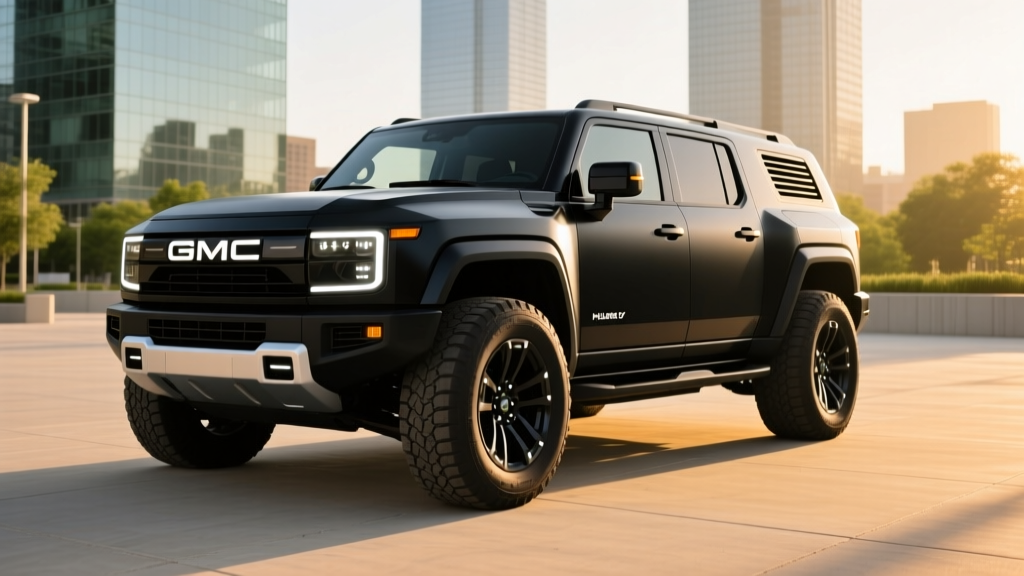
The GMC Hummer EV is an exercise in excess — 1,000 horsepower, crab-walk steering, and a curb weight that rivals commercial trucks. For buyers researching the 2024 GMC Hummer EV weight, the numbers tell a story about what happens when physics meets a 24-module Ultium battery pack. At roughly 9,046 pounds for the Pickup 3X and climbing past 9,500 pounds for the SUV Edition 1, this is the heaviest light-duty vehicle GMC has ever sold. That mass shapes everything: range, efficiency, tire wear, charging behavior, and the kind of driving this truck actually rewards.
Two years after its launch, we have enough real-world data to separate marketing from ownership reality. Here is every number that matters.
2024 GMC Hummer EV Core Specifications
| Spec | Value |
|---|---|
| Curb Weight (Pickup 3X) | ~9,046 lbs |
| Curb Weight (SUV Edition 1) | ~9,500+ lbs |
| GVWR | 10,400 lbs (Pickup) |
| Battery Usable Capacity | ~212 kWh (NMC, 24 modules) |
| EPA Range (Pickup 3X) | 314 miles |
| EPA Range (SUV Edition 1) | 314 miles |
| Efficiency | 47 MPGe combined / 72 kWh/100 mi |
| Peak DC Fast Charge | 350 kW (800V architecture) |
| 10–80% DC Fast Charge | ~34 minutes (est.) |
| Level 2 Home Charge Rate | 11.5 kW (~13 mi/hr) |
| Horsepower (Watts to Freedom) | 830 hp (Pickup) / 1,000 hp (Edition 1 SUV tri-motor) |
| 0–60 mph | ~3.0 sec (WTF mode, Pickup) |
| Drivetrain | Tri-motor AWD (e4WD) |
| Towing Capacity | 7,500 lbs (Pickup) |
| Payload | ~1,300 lbs |
| Base MSRP (Pickup 2X) | $99,995 |
| As-Tested (Pickup 3X Extreme) | ~$120,000+ |
| Battery/Powertrain Warranty | 8 years / 100,000 miles |
Why the 2024 GMC Hummer EV Weight Matters for Real-World Range
Real-World Expectation: 240–270 miles at 70 mph highway; 200–230 miles in sub-30°F weather; 280+ miles in mild city driving with regen.
Why: At 9,046 lbs, the Hummer EV requires enormous energy to accelerate and sustain highway speed. Aerodynamic drag on a flat-faced truck this size compounds above 65 mph. Cold weather adds cabin-heating load and reduces battery discharge efficiency.
The 2024 Hummer EV's weight is not a trivia stat — it is the single largest factor in its efficiency profile. At 72 kWh per 100 miles (per fueleconomy.gov), the Hummer EV consumes roughly twice the electricity per mile of a Tesla Model Y or Hyundai Ioniq 5. That means every mile costs more, every charge takes longer, and range anxiety is more than theoretical on remote highways.
Owners who drive primarily in city and suburban settings see numbers closer to the EPA sticker, because regenerative braking recovers energy from the truck's massive momentum. Highway drivers and those in mountainous terrain should budget 240 miles between charges as a practical floor, especially when towing. Speaking of towing: hook up a 5,000-lb trailer and expect effective range to drop to roughly 150–170 miles. The Hummer EV is rated to tow 7,500 lbs, but the energy cost is brutal.
Battery Chemistry, Capacity, and the 212 kWh Ultium Pack
GMC uses General Motors' Ultium platform with a 24-module, double-stacked battery pack rated at approximately 212 kWh of usable capacity. The chemistry is NMC (nickel manganese cobalt), chosen for its high energy density — necessary when you need to push 9,000+ pounds down the road. NMC offers more range per pound than LFP (lithium iron phosphate), but it comes with trade-offs: slightly faster long-term degradation if routinely charged to 100%, and a more complex thermal management requirement.
GMC's battery warranty covers 8 years or 100,000 miles against capacity loss below 60% of original — a relatively generous retention threshold compared to some competitors who warrant to 70%. For a truck this expensive, buyers should monitor State of Health (SoH) through the myGMC app and avoid habitual 100% charges unless a long trip demands it. The massive pack actually works in the Hummer's favor for longevity: because daily driving uses a small fraction of total capacity, cycle counts stay low.
Charging Speed: 350 kW Peak, But Read the Fine Print
| Level | Power | Speed / Notes |
|---|---|---|
| Level 1 (120V) | ~1.4 kW | ~2 mi/hr — impractical for daily use on a 212 kWh pack |
| Level 2 (240V home) | 11.5 kW | ~13 mi/hr — full charge in ~18 hours |
| DC Fast Charge (peak) | 350 kW | Requires 800V-capable station (EA, select Tesla Superchargers with NACS adapter) |
| DC Fast 10–80% | — | ~34 minutes (sustained average well below peak) |
The 800V architecture is legitimate — on a 350 kW Electrify America stall with preconditioning enabled, the Hummer EV can pull over 300 kW in the low state-of-charge window. But physics intervenes: the 212 kWh battery has a relatively low C-rate at peak, and the charge curve tapers noticeably above 55–60% SoC. Expect the 10–80% session to take roughly 34 minutes, not the 20 minutes some marketing materials imply for smaller-pack EVs.
Home charging is the real bottleneck. At 11.5 kW, a full 0–100% session takes approximately 18 hours. Most owners will plug in nightly and rarely need a full charge, but if you arrive home near-empty, plan on an overnight-plus session. A 48-amp or 60-amp dedicated Level 2 circuit (requiring a 60A or 80A breaker, respectively) is effectively mandatory — a standard 30A dryer circuit will not cut it. Budget $1,200–$2,500 for a quality Level 2 EVSE and professional installation, potentially more if your panel needs a 200A service upgrade.
Performance: Watts to Freedom and the 3-Second 0–60
The tri-motor powertrain (one front, two rear) delivers up to 830 hp in the Pickup 3X and a claimed 1,000 hp in the Edition 1 SUV with Watts to Freedom (WTF) mode engaged. WTF preconditions the battery, stiffens the adaptive air suspension, and unlocks maximum torque delivery. The result: 0–60 mph in roughly 3.0 seconds for a truck that weighs as much as two Ford F-150s. It is genuinely startling the first time.
Beyond straight-line speed, the Hummer EV's four-wheel steering enables CrabWalk (diagonal movement at low speed) and a turning circle tighter than many midsize sedans despite the truck's 217-inch overall length. The adaptive air suspension offers 6 inches of travel, with Extract Mode lifting the body nearly 6 inches for off-road clearance. Ground clearance peaks at approximately 16 inches — competitive with body-on-frame off-roaders.
The trade-off for all this capability is tire wear. At 9,000+ lbs with instant torque, owners report burning through the 35-inch Goodyear Wrangler Territory MT tires faster than expected. Budget for replacement sets at $2,000–$2,800.
Interior, Cargo, and Standout Technology
The cabin is dominated by a 13.4-inch infotainment touchscreen running GM's Ultifi platform with Google Built-In (Maps, Assistant, Play Store). A 12.3-inch driver cluster handles gauges and off-road telemetry. The SUV variant offers 81.8 cu ft of cargo space with rear seats folded; the Pickup's 5-foot bed includes a MultiPro tailgate with six configurations and a powered tonneau cover. The frunk (front trunk) is modest — roughly 5.7 cu ft — because the massive battery and power electronics consume most of the nose.
Driver assistance comes via GM's Super Cruise on pre-mapped divided highways. Super Cruise is a Level 2 system per SAE definitions: it handles steering, acceleration, and braking, but the driver must remain attentive. The system uses a driver-facing camera to verify eye engagement and works on over 750,000 miles of compatible roads in the US and Canada as of 2026. It is one of the best hands-free highway systems available, but it is not autonomous — keep your eyes on the road.
Unique tech includes underbody cameras (UltraVision) for rock-crawling visibility, an 800A energy export feature (ProGrade) capable of powering tools or a campsite, and an available removable roof panel system on the SUV. The infotainment is responsive but the UI is dense — some owners report a learning curve for off-road telemetry menus.
Pricing, Trims, and Federal Tax Credit Eligibility
| Trim | Body Style | Base MSRP |
|---|---|---|
| 2X | Pickup | $99,995 |
| 3X | Pickup | $107,995 |
| 3X + Extreme Off-Road | Pickup | ~$120,000+ |
| 2X | SUV | $100,395 |
| 3X | SUV | $108,395 |
| Edition 1 (sold out) | Pickup/SUV | $112,595+ |
The federal EV tax credit (IRS §30D) is a complicated story for the Hummer EV. As of 2026, the §30D credit offers up to $7,500 for qualifying new EVs, but eligibility hinges on three gates: buyer income caps ($300,000 MFJ / $225,000 HoH / $150,000 single), vehicle MSRP caps ($80,000 for trucks, SUVs, and vans), and battery critical-mineral and component sourcing requirements verified by the manufacturer. Because every Hummer EV trim exceeds the $80,000 MSRP cap, the Hummer EV does not qualify for the new-vehicle §30D federal tax credit. Always confirm current rules at irs.gov, as legislation can shift.
For used Hummer EVs entering the secondary market, the §25E used clean vehicle credit (up to $4,000 or 30% of sale price, whichever is lower) may apply if the used sale price is $25,000 or less — effectively impossible for this truck in 2026 given residual values. State incentives vary widely; consult your state's energy office or a tax professional for local credits.
Who Should Buy the Hummer EV (And Who Should Look Elsewhere)
- Unmatched presence and off-road capability in an EV
- 314-mile EPA range is genuinely useful for a truck this size
- 350 kW peak DC charging on 800V architecture
- Super Cruise hands-free highway driving included
- Four-wheel steering makes it surprisingly maneuverable
- 8-yr/100,000-mi battery warranty
- 9,000+ lb weight crushes efficiency (47 MPGe combined)
- $100,000+ price with no federal tax credit eligibility
- 18-hour Level 2 home charge from empty
- Real-world highway range closer to 240–270 miles
- High tire wear cost from mass + instant torque
- Towing range drops below 170 miles at moderate loads
The Hummer EV is the right truck for a narrow buyer: someone who wants a statement vehicle with genuine off-road chops, has reliable home Level 2 charging, drives primarily in suburban or rural settings where its size is manageable, and views efficiency as a secondary concern. It is not a road-trip optimizer — the combination of heavy weight, long charge times, and highway range drop-off means planning stops carefully on routes beyond 200 miles.
Compared to the Rivian R1T (lighter, more efficient, ~$75,000–$95,000, eligible for the tax credit on qualifying trims), the Hummer EV trades practicality for spectacle. The Ford F-150 Lightning offers more conventional truck utility at a fraction of the price. If you need a daily-driver electric truck for commuting and towing, the R1T or F-150 Lightning are more rational. If you want the most extreme electric vehicle on the road and can absorb the running costs, nothing else looks or performs like the Hummer EV.
Frequently Asked Questions
What is the real-world range of the 2024 GMC Hummer EV?
The EPA rates the Pickup 3X at 314 miles. In real-world highway driving at 70 mph, expect 240–270 miles. In cold weather (below 30°F), plan for 200–230 miles. City driving with regenerative braking can approach or exceed the EPA number.
How fast does the Hummer EV charge at home and on the road?
On a 350 kW DC fast charger, the Hummer EV peaks at over 300 kW and reaches 10–80% in roughly 34 minutes. At home on a Level 2 (11.5 kW) charger, expect about 13 miles of range per hour, with a full charge taking approximately 18 hours from empty.
Does the 2024 GMC Hummer EV qualify for the federal EV tax credit?
No. Every Hummer EV trim exceeds the $80,000 MSRP cap set by IRS §30D for trucks and SUVs, making it ineligible for the new-vehicle federal tax credit. Confirm current rules at irs.gov, as legislation can change.
Is the Hummer EV worth buying versus the Rivian R1T or F-150 Lightning?
If you prioritize off-road spectacle, four-wheel steering, and 1,000-hp bragging rights, yes. If you prioritize efficiency, tax-credit eligibility, towing range, or daily-driver practicality, the Rivian R1T or Ford F-150 Lightning are stronger choices at lower prices.
What is the biggest drawback of the Hummer EV's weight?
At 9,000+ lbs, the weight drives poor efficiency (72 kWh/100 mi), accelerated tire wear, reduced towing range, and long home charging sessions. It also limits the truck to roads and bridges without weight restrictions — some rural bridges and parking structures post limits the Hummer EV approaches or exceeds.