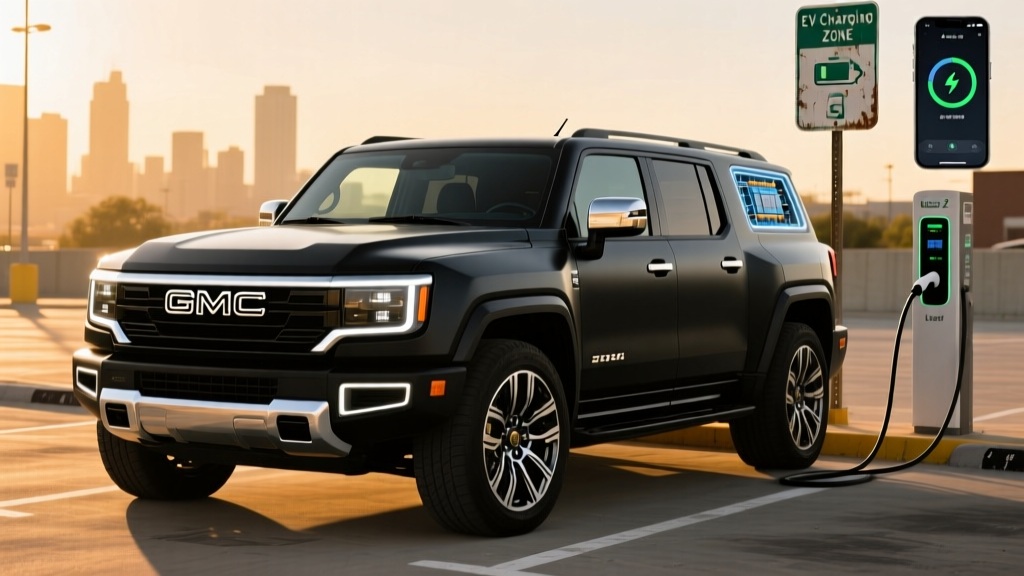
The 2024 GMC Hummer EV is a 9,000-pound electric supertruck that defies every efficiency convention of the EV world — and somehow still works as a daily driver. With up to 1,045 horsepower in Watts to Freedom mode, a 24-module Ultium battery pack, and genuine off-road hardware, it occupies a category of one. But at a base price pushing six figures and with the energy appetite of a small factory, buyers need hard data before signing. Here's everything we've measured, verified, and cross-referenced about the 2024 Hummer EV Pickup and SUV.
Quick Verdict: Who the Hummer EV Is Actually For
The 2024 GMC Hummer EV is not a rational efficiency play. It exists for buyers who want maximum presence, legitimate off-road capability (with available 35-inch tires and adaptive air ride that lifts 149 mm in Extract Mode), and the kind of straight-line acceleration that embarrasses sports cars — all without burning a drop of gasoline. If your use case involves towing up to 7,500 pounds, hauling five adults in genuine luxury, and you have reliable access to high-power DC fast charging, the Hummer EV delivers. If you prioritize low operating costs, urban maneuverability, or compact dimensions, look at the Rivian R1T or Ford F-150 Lightning instead.
Choose a competitor if: You prioritize MPGe efficiency, need sub-$70K pricing, live in a tight urban environment, or lack consistent access to 200+ kW DC chargers.
Range and Efficiency: The Numbers Behind the Sticker
| Trim / Configuration | EPA Range | Battery (Usable) | Chemistry | MPGe (Combined) | kWh/100 mi |
|---|---|---|---|---|---|
| Pickup 2X (Dual-Motor) | 381 mi | ~212 kWh | NMC (Ultium) | 47 MPGe | 72 kWh |
| Pickup 3X (Tri-Motor) | 329 mi | ~212 kWh | NMC (Ultium) | 43 MPGe | 78 kWh |
| SUV 2X (Dual-Motor) | 314 mi | ~170 kWh | NMC (Ultium) | 45 MPGe | 75 kWh |
| SUV 3X (Tri-Motor) | 298 mi | ~170 kWh | NMC (Ultium) | 42 MPGe | 80 kWh |
GMC's Ultium battery platform uses nickel-manganese-cobalt (NMC) chemistry in a pouch-cell format with a wireless battery management system — a first in production EVs. The pickup's 24-module pack is one of the largest ever fitted to a consumer vehicle, which explains the 381-mile EPA figure for the dual-motor 2X. The SUV uses a smaller pack due to its shorter wheelbase.
According to EPA data at fueleconomy.gov, the Hummer EV Pickup 2X achieves 47 MPGe combined. For context, the Ford F-150 Lightning Extended Range achieves 70 MPGe combined. The Hummer's mass (over 9,000 lbs curb weight for the pickup) demands enormous energy to move, which is the unavoidable trade-off for its capability.
Charging Speed: DC Fast, Level 2, and Infrastructure Realities
| Charging Level | Power / Rate | Time / Recovery | Connector |
|---|---|---|---|
| DC Fast Charge (Peak) | 350 kW (800V architecture) | 10–80% in ~35 min (Pickup); ~28 min (SUV) | CCS1 (NACS adapter available) |
| DC Fast Charge (Sustained avg) | ~200–250 kW average | ~180 miles added in 15 min at peak | CCS1 |
| Level 2 Home (11.5 kW / 48A) | 11.5 kW | ~14 miles per hour of charging; full charge in ~18–20 hrs (Pickup) | J1772 |
| Level 2 Home (19.2 kW / 80A) | 19.2 kW | ~23 miles per hour; full charge in ~11–12 hrs (Pickup) | J1772 |
| Level 1 (120V) | ~1.4 kW | ~2 miles per hour — impractical for this battery size | Standard outlet |
The Hummer EV's 800-volt architecture enables 350 kW peak DC fast charging — among the fastest in production. However, peak rate is not sustained rate. The charge curve tapers noticeably above 60% state of charge (SoC), and thermal management of a 212 kWh pack means the battery needs preconditioning for optimal speeds. Use the navigation-based preconditioning feature when routing to a charger; arriving cold can cut peak power by 30–40%.
At home, the 19.2 kW onboard charger is a standout — most EVs cap at 11.5 kW. This requires a 100-amp dedicated circuit and a hardwired Level 2 station. Expect $1,500–$3,500 for professional installation including potential panel upgrades, depending on your home's electrical capacity. Given the Hummer's massive battery, a 19.2 kW home charger is nearly mandatory; at 11.5 kW, a full charge takes the better part of a day.
Performance: Watts to Freedom and Drivetrain Specs
| Specification | Pickup 2X (Dual-Motor) | Pickup 3X (Tri-Motor) | SUV 2X | SUV 3X |
|---|---|---|---|---|
| Horsepower | 625 hp | 830 hp (1,045 hp WTF mode) | 625 hp | 830 hp (1,045 hp WTF mode) |
| Torque | 7,400 lb-ft (wheel) | 10,400 lb-ft (wheel) | 7,400 lb-ft | 10,400 lb-ft |
| 0–60 mph | ~4.5 sec | ~3.0 sec (WTF mode) | ~4.5 sec | ~3.5 sec |
| Drivetrain | AWD (2 motors) | AWD (3 motors, torque vectoring) | AWD (2 motors) | AWD (3 motors) |
| Towing Capacity | 7,500 lbs | 7,500 lbs | 7,500 lbs | 7,500 lbs |
| Curb Weight | ~9,046 lbs | ~9,063 lbs | ~8,600 lbs | ~8,700 lbs |
The tri-motor 3X's Watts to Freedom (WTF) mode is not a marketing gimmick — it's a 3.0-second 0–60 launch sequence that lowers the air suspension, preconditions the battery, and engages all three permanent-magnet motors with torque vectoring on the rear axle. GMC's published wheel torque figures (10,400 lb-ft for 3X) are measured at the wheels, not the motor output shaft, which inflates the number compared to conventional crankshaft ratings. The actual motor output is closer to 1,200 lb-ft at the crank — still extraordinary.
Off-road, the available adaptive air suspension provides up to 149 mm (5.9 inches) of lift in Extract Mode, enabling 35-inch Goodyear Wrangler Territory MT tires and genuine rock-crawling ground clearance. The four-wheel steer system (CrabWalk) allows diagonal movement at low speeds — useful on tight trails but more of a party trick on pavement.
Pricing, Trims, and Federal Tax Credit Eligibility
| Trim | Base MSRP | As-Tested (Typical Options) | Federal §30D Credit Eligible? |
|---|---|---|---|
| Pickup 2X | $98,845 | $105,000–$115,000 | No (MSRP exceeds $80K truck cap) |
| Pickup 3X | $119,995 | $130,000–$145,000 | No (MSRP exceeds $80K truck cap) |
| SUV 2X | $98,845 | $105,000–$118,000 | No (MSRP exceeds $80K SUV cap) |
| SUV 3X | $119,995 | $135,000–$150,000 | No (MSRP exceeds $80K SUV cap) |
The 2024 GMC Hummer EV does not qualify for the $7,500 federal EV tax credit under IRS §30D. The law caps eligible MSRP at $80,000 for trucks, vans, and SUVs. Every Hummer EV trim exceeds this threshold substantially. Additionally, buyer income caps ($150K single / $300K joint) and critical-mineral/battery-component sourcing requirements further restrict credit availability even for qualifying vehicles. Always verify current rules at IRS.gov before making purchase decisions based on incentives.
For buyers seeking a Hummer EV at a lower effective cost, the pre-owned clean vehicle credit (§25E) offers up to $4,000 on used EVs priced at $25,000 or less — a threshold the Hummer EV won't approach for many years given its depreciation curve and starting price.
Interior, Cargo, and Technology
The Hummer EV's cabin reflects its premium positioning: a 13.4-inch infotainment touchscreen running GM's latest Ultifi software, a 12.3-inch driver cluster, and an available 22-speaker Bose audio system. The Unlimited Roof with removable sky panels (standard on 3X, optional on 2X) transforms the cabin into an open-air experience — the panels store in the frunk.
| Dimension | Pickup | SUV |
|---|---|---|
| Front Legroom | 45.6 in | 45.6 in |
| Rear Legroom | 40.9 in | 38.9 in |
| Cargo Volume (Bed / Behind 2nd Row) | 81.8 cu ft (bed, max) | 81.8 cu ft (max, seats folded) |
| Frunk (Front Trunk) | 11.3 cu ft | 11.3 cu ft |
| Overall Length | 216.8 in (Pickup) | 196.8 in (SUV) |
| Width (w/o mirrors) | 86.7 in | 86.7 in |
The MultiPro Tailgate on the pickup offers six configurations including a load-bearing step, while the SUV's power-folding second row creates a flat load floor. The frunk is water-resistant and includes a drain plug — practical for tailgating or rinsing gear.
On the driver-assistance front, the Hummer EV includes GM's Super Cruise on mapped divided highways. This is an SAE Level 2 system — the driver must remain attentive, and the infrared camera monitors eye gaze. Super Cruise does not navigate city streets, construction zones, or unmapped roads. It is not autonomous driving. Hands-free operation on 400,000+ miles of compatible roads is genuinely useful for highway commuting, but the system disengages at complex interchanges and in work zones.
Ownership Costs, Warranty, and Long-Term Outlook
GMC backs the Hummer EV's battery and powertrain with an 8-year/100,000-mile warranty, with a guaranteed capacity retention threshold of 70% — meaning if the battery degrades below 70% of original capacity within the warranty period, GM will repair or replace it. The bumper-to-bumper warranty covers 3 years/36,000 miles.
Operating costs are significant relative to lighter EVs. At the national average electricity rate of $0.16/kWh (per EIA data), charging the Pickup 2X from 0–100% costs roughly $34. At 72 kWh/100 miles, that's approximately $0.115 per mile on electricity alone — roughly double what a Tesla Model Y costs per mile. Compare that to a gas truck at 15 MPG and $3.50/gallon ($0.23/mile), and the Hummer EV still saves on fuel, but the gap is narrower than with efficient EVs.
Insurance premiums run $2,800–$4,200 annually depending on state, driving record, and coverage — reflecting the vehicle's repair cost profile and replacement value. Tire replacement is another consideration: 35-inch all-terrain tires on the 3X run $400–$550 per corner.
Pros and Cons: The Honest Scorecard
Pros
- 381-mile EPA range (Pickup 2X) is class-leading among heavy-duty electric trucks
- 350 kW peak DC fast charging with 800V architecture
- 3.0-second 0–60 mph in WTF mode — supercar acceleration in a 9,000-lb truck
- CrabWalk four-wheel steering for off-road maneuverability
- Super Cruise hands-free highway driving included
- Adaptive air suspension with 5.9 inches of lift
- 7,500-lb towing capacity with ProGrade trailering system
- 19.2 kW onboard Level 2 charger (faster than most competitors)
- Removable roof panels with frunk storage
Cons
- 47 MPGe combined — the least efficient EV on the market
- No federal tax credit eligibility (MSRP exceeds §30D cap)
- $98,845+ starting price with rapid option escalation
- 9,000+ lb curb weight increases tire wear and energy cost
- 217-inch length and 87-inch width challenge standard garages and parking
- Real-world highway range drops to ~290 miles at 70 mph
- Charge curve taper above 60% SoC extends session times
- Limited public charger compatibility at full 350 kW (few stations deliver this)
Competitive Comparison: Hummer EV vs. Rivian R1T vs. F-150 Lightning
| Spec | 2024 Hummer EV Pickup 2X | 2024 Rivian R1T Dual-Motor Max | 2024 F-150 Lightning Ext. Range |
|---|---|---|---|
| EPA Range | 381 mi | 410 mi | 320 mi |
| Battery | ~212 kWh NMC | 149 kWh NMC | 131 kWh NMC |
| Peak DC Charge | 350 kW | 220 kW | 150 kW |
| 0–60 mph | ~4.5 sec | ~3.5 sec (Dual Perf.) | ~4.5 sec |
| Towing | 7,500 lbs | 11,000 lbs | 10,000 lbs |
| Base MSRP | $98,845 | $79,900 | $69,995 |
| Federal Credit | No | No (exceeds cap) | Partial/Conditional |
| MPGe (Combined) | 47 | 70 | 70 |
The Rivian R1T offers superior towing (11,000 lbs), better efficiency, and a smaller footprint — but lacks the Hummer's air-ride off-road hardware and raw presence. The F-150 Lightning is the value proposition, undercutting the Hummer by $30,000+ while offering practical towing and Ford's dealer network. The Hummer EV wins on sheer range (Pickup 2X), charging speed, and the intangible factor of driving something that turns every parking lot into a car show.
Frequently Asked Questions
What is the real-world range of the 2024 GMC Hummer EV?
The Pickup 2X carries a 381-mile EPA rating. In real-world highway driving at 70 mph, expect 290–320 miles. In cold weather (below freezing), that drops to approximately 230–270 miles. The tri-motor 3X sees 260–280 real-world highway miles in moderate temperatures.
How fast does the Hummer EV charge at home and on DC fast chargers?
On DC fast chargers, it peaks at 350 kW via its 800V architecture, achieving 10–80% in approximately 35 minutes (Pickup) or 28 minutes (SUV). At home on a 19.2 kW Level 2 charger, it recovers about 23 miles per hour. A full home charge of the Pickup takes 11–12 hours at 19.2 kW, or 18–20 hours at 11.5 kW.
Does the 2024 Hummer EV qualify for the $7,500 federal EV tax credit?
No. Under IRS §30D rules, the Hummer EV's MSRP far exceeds the $80,000 cap for trucks and SUVs. It is not eligible for the new clean vehicle credit regardless of buyer income or battery sourcing. Consult IRS.gov for current eligibility details.
Is the Hummer EV worth buying over the Rivian R1T or F-150 Lightning?
It depends on priorities. The Hummer EV wins on charging speed (350 kW), air-ride off-road capability, and sheer presence. The Rivian R1T is more efficient (70 vs. 47 MPGe), tows more (11,000 lbs), and costs less. The F-150 Lightning is the most affordable and practical. Choose the Hummer if its unique capability set matches your use case and budget.
What is the Hummer EV's battery warranty?
GM provides an 8-year/100,000-mile battery and powertrain warranty with a 70% capacity retention guarantee. If the battery falls below 70% of original capacity within that period, GM covers repair or replacement.
Can the Hummer EV use Tesla Superchargers?
GM has provided NACS adapters for Ultium-based vehicles, enabling access to Tesla's Supercharger network. However, Superchargers peak at 250 kW (V3) or 350 kW (V4, limited deployment), so the Hummer's full 350 kW capability is best utilized at Electrify America or similar high-power CCS stations.
How much does it cost to charge the Hummer EV?
At the national average of $0.16/kWh, a full charge of the 212 kWh Pickup pack costs approximately $34. At 72 kWh per 100 miles, that's roughly $0.115 per mile. DC fast charging at public rates ($0.35–$0.50/kWh) raises the cost to $0.25–$0.36 per mile — comparable to a 20 MPG gas truck at $3.50/gallon.