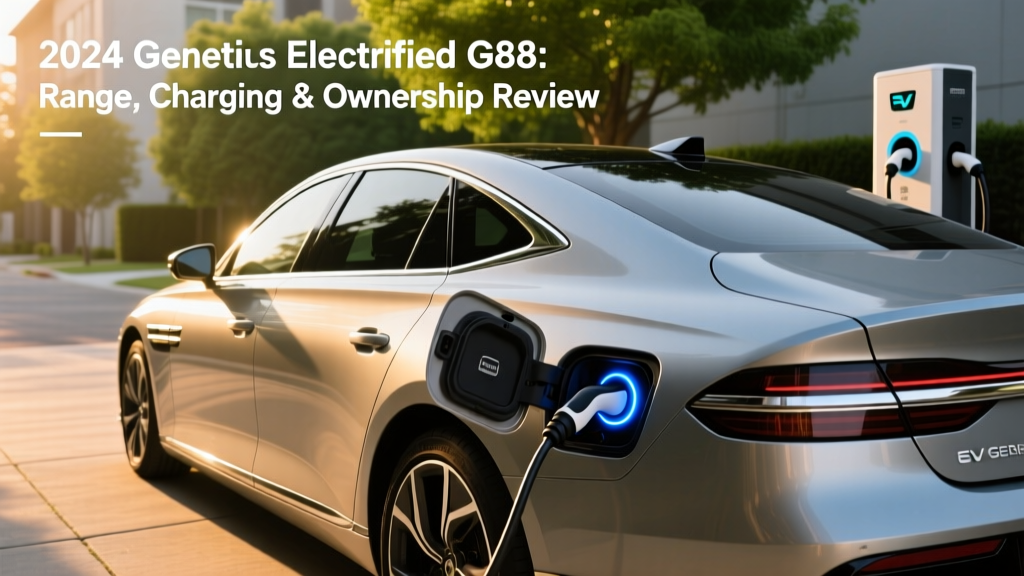
The 2024 Genesis Electrified G80 occupies a narrow but compelling niche: a midsize luxury sedan that trades the combustion G80's powertrain for dual electric motors without compromising the cabin refinement, ride quality, or design language that defines the brand. Built on Hyundai Motor Group's E-GMP platform — the same architecture underpinning the Ioniq 5 and GV60 — the Electrified G80 pairs an 87.2 kWh NMC (nickel-manganese-cobalt) battery with a 365-horsepower dual-motor all-wheel-drive system. The result is a luxury EV that prioritizes comfort over sportiness, range efficiency over raw acceleration, and old-world materials over touchscreen minimalism.
But the luxury EV sedan segment is crowded and unforgiving. The Tesla Model S, BMW i5, Mercedes-Benz EQE, and Lucid Air all compete for the same buyer — each with different trade-offs in range, charging speed, tech, and prestige. This review breaks down the exact numbers that matter: real-world range versus the EPA sticker, DC fast-charging behavior and taper, home charging economics, federal tax credit eligibility under current IRS §30D rules, and the ownership realities that spec sheets don't reveal.
Range, Efficiency, and Real-World Expectations
The EPA rates the 2024 Genesis Electrified G80 at 282 miles of combined range on a full charge, with an efficiency rating of 91 MPGe combined (roughly 37 kWh per 100 miles). That places it solidly in the middle of the luxury EV sedan pack — behind the Lucid Air's class-leading efficiency but ahead of heavier competitors like the Mercedes EQE 350 4MATIC.
EPA sticker: 282 miles combined
Real-world highway (70-75 mph): ~235–255 miles
Real-world city/mixed driving: ~260–280 miles
Cold weather (below 32°F): ~195–230 miles (15–30% reduction depending on cabin heat usage and preconditioning)
The Electrified G80's efficiency suffers most at sustained highway speeds, where its 4,960-pound curb weight and sedan aerodynamics work against it. Regenerative braking in city driving partially offsets this, but expect a meaningful gap between the EPA figure and what you'll see on a road trip. Genesis includes a heat pump as standard equipment, which mitigates cold-weather range loss compared to EVs using resistive heating, but the laws of battery chemistry still apply in deep winter.
The 87.2 kWh battery uses NMC chemistry, which offers higher energy density than LFP (lithium iron phosphate) alternatives — important in a sedan where packaging space is limited. The trade-off is that NMC batteries are more sensitive to sustained high state-of-charge and extreme heat over long periods. Genesis recommends charging to 80% for daily use and reserving 100% charges for road trips, a practice that preserves long-term battery health.
Charging Performance: DC Fast and Level 2
Charging speed is where the E-GMP platform's 800-volt architecture pays dividends. The Electrified G80 supports up to 350 kW peak DC fast charging via its CCS1 connector, placing it among the fastest-charging luxury sedans available. On a compatible 350 kW station (such as Electrify America's newest stalls), Genesis claims a 10–80% charge in approximately 22 minutes.
| Charging Level | Power / Voltage | Speed / Time | Notes |
|---|---|---|---|
| DC Fast Charge (peak) | 350 kW / 800V | 10–80% in ~22 min | Requires CCS 350 kW station; peak rate tapers above 60% SoC |
| DC Fast Charge (typical) | 150 kW / 400V | 10–80% in ~35 min | Most common public fast-charger type |
| Level 2 (home/public AC) | 10.9 kW / 240V | ~26 mi/hr of range; full charge in ~8.5 hr | Requires 48-amp dedicated circuit (60-amp breaker) |
| Level 1 (120V outlet) | ~1.4 kW | ~3–4 mi/hr of range | Emergency/trickle only; impractical for daily use |
The charging curve matters more than the peak number. In practice, the Electrified G80 sustains above 200 kW from roughly 10% to 55% state of charge, then begins a gradual taper. From 80% to 100%, the rate drops significantly — as it does with all lithium-ion batteries — which is why DC fast charging to 100% is rarely time-efficient. For road trips, the 10–80% window is your practical charging envelope, and 22 minutes in that window is competitive with the Porsche Taycan and significantly faster than the BMW i5 xDrive40.
At home on a Level 2 charger, the 10.9 kW onboard charger adds roughly 26 miles of range per hour of charging. A full overnight charge from near-empty is easily achievable, which is how most EV owners charge daily. Installation of a 48-amp home charger typically costs between $800 and $2,000 depending on electrical panel capacity and conduit runs — budget for a licensed electrician to assess your panel before purchase.
Performance, Drivetrain, and Ride Quality
| Specification | Value |
|---|---|
| Drivetrain | Dual-motor AWD |
| Horsepower | 365 hp combined |
| Torque | 516 lb-ft combined |
| 0–60 mph | 4.9 seconds (manufacturer) |
| Battery Capacity | 87.2 kWh usable (NMC) |
| EPA Range | 282 miles |
| Efficiency | 91 MPGe combined / 37 kWh/100 mi |
| Curb Weight | 4,960 lbs |
| Towing Capacity | Not rated |
| Base MSRP | $79,825 (including destination) |
The dual-motor all-wheel-drive powertrain delivers 365 horsepower and 516 lb-ft of torque to all four wheels. The 4.9-second 0–60 mph time is brisk but not brutal — Genesis has tuned this sedan for composed acceleration rather than the neck-snapping launches of a Tesla Model S Plaid or Lucid Air Sapphire. The instantaneous torque delivery makes highway merging effortless, and the powertrain remains whisper-quiet even under hard acceleration.
Ride quality is the Electrified G80's strongest dynamic attribute. The multi-link suspension with electronically controlled dampers absorbs road imperfections with a maturity that the sportier GV60 and Ioniq 5 N cannot match. The steering is light and isolated — a deliberate choice for luxury cruising rather than canyon carving. If you prioritize engagement, the BMW i5 or Porsche Taycan will feel more connected. If you prioritize serenity, the Genesis wins.
One notable omission: the Electrified G80 is not rated for towing. If you need to pull a trailer, look to the GV70 Electrified or a competitor like the Rivian R1S.
Interior, Cargo, and Technology
The cabin is where Genesis justifies its pricing. Nappa leather, real wood trim, knurled metal rotary controls, and available quilted seat upholstery create an interior that rivals the Mercedes E-Class and surpasses the Tesla Model S in material quality. The 12.3-inch digital instrument cluster and 14.5-inch widescreen infotainment display are integrated cleanly into the dashboard rather than floating above it.
Passenger space:
- Front headroom: 39.5 inches
- Front legroom: 41.1 inches
- Rear headroom: 37.4 inches
- Rear legroom: 35.4 inches
Rear-seat comfort is adequate for adults on shorter trips, though the floor-mounted battery raises the floor height slightly, creating a knees-up seating position that tall passengers will notice on longer journeys. The transmission tunnel hump — a carryover from the combustion G80 platform adaptation — further limits middle-seat usability.
Cargo: The trunk offers 12.5 cubic feet of space, which is modest for a midsize sedan. The Electrified G80 does not have a front trunk (frunk), unlike the E-GMP-based Ioniq 5 and GV60, because the G80's architecture was adapted from the combustion platform rather than designed EV-first. This is a practical limitation for buyers who value cargo versatility.
The infotainment system runs Genesis's latest software with native navigation, wireless Apple CarPlay and Android Auto, and over-the-air update capability. The 21-speaker Lexicon audio system (standard on the Electrified G80) is one of the best factory audio setups in the segment. Driver assistance features include Highway Driving Assist II (a Level 2 SAE system combining adaptive cruise control with lane-centering), remote smart parking assist, and a surround-view monitor. Highway Driving Assist II requires hands on the wheel at all times — this is a driver-assist system, not autonomous driving.
Pricing, Trims, and Federal Tax Credit Eligibility
The 2024 Genesis Electrified G80 is offered in a single, well-equipped trim level:
| Item | Amount |
|---|---|
| Base MSRP (single Advanced trim) | $79,825 |
| Destination charge | Included |
| Available packages | None — single trim strategy |
| As-tested price (with options) | ~$79,825–$81,500 (dealer accessories) |
| Federal tax credit (§30D) eligibility | See eligibility checklist below |
Genesis's single-trim approach simplifies the buying process: every Electrified G80 comes loaded with the features that would be options on competitors. The trade-off is that buyers who want a lower entry price cannot strip the car down.
The Electrified G80 may qualify for up to $7,500 in federal tax credits, but eligibility depends on multiple IRS rules that change periodically. As of current IRS §30D guidelines, the following must ALL be met:
- MSRP cap: Vehicle MSRP must not exceed $55,000 for sedans. The Electrified G80's $79,825 MSRP exceeds this cap, making it ineligible for the new-vehicle §30D credit.
- Buyer income cap: Modified AGI must not exceed $150,000 (single) / $300,000 (joint).
- Battery sourcing: Critical minerals and battery components must meet phased-in domestic/F TA content thresholds.
- Point-of-sale transfer: Eligible credits can be transferred to the dealer at purchase for an immediate price reduction.
Bottom line: The 2024 Electrified G80's MSRP exceeds the $55,000 sedan cap, meaning it does not qualify for the federal new-vehicle tax credit. Some state-level incentives (such as California's CVRP or Colorado's state credit) may still apply — check your state's energy office for current programs. Consult a tax professional for personalized advice.
Warranty and Long-Term Ownership
Genesis backs the Electrified G80 with one of the most comprehensive warranty packages in the luxury segment:
- New vehicle limited warranty: 5 years / 60,000 miles
- Powertrain warranty: 10 years / 100,000 miles
- Battery warranty: 10 years / 100,000 miles (covers capacity below 70% of original)
- Complimentary maintenance: 3 years / 36,000 miles
- Roadside assistance: 5 years / unlimited miles
The 10-year battery warranty with a 70% capacity retention threshold is competitive with Hyundai/Kia's industry-leading coverage. Based on DOE data on lithium-ion battery degradation, NMC batteries in thermally managed systems like the G80's typically retain 85–92% capacity after 100,000 miles under normal use. The 70% threshold is a worst-case guarantee, not an expected outcome.
Insurance costs for the Electrified G80 tend to run 15–25% higher than the combustion G80, reflecting the vehicle's repair costs and parts pricing. Expect annual premiums in the $2,800–$3,600 range depending on your profile and state. Always get a quote before purchasing.
How It Compares: Electrified G80 vs. Key Rivals
| Attribute | Genesis Electrified G80 | BMW i5 xDrive40 | Tesla Model S LR | Mercedes EQE 350 4MATIC |
|---|---|---|---|---|
| EPA Range | 282 mi | 266 mi | 402 mi | 254 mi |
| Battery (kWh) | 87.2 (NMC) | 84.3 (NMC) | ~100 (NMC) | 90.6 (NMC) |
| Peak DC Charge | 350 kW | 205 kW | 250 kW | 170 kW |
| 10–80% DC Time | ~22 min | ~30 min | ~27 min | ~32 min |
| 0–60 mph | 4.9 sec | 5.3 sec | 3.1 sec | 5.2 sec |
| Horsepower | 365 hp | 389 hp | 670 hp | 288 hp |
| Base MSRP | $79,825 | $70,200 | $74,990 | $77,900 |
| Federal Credit | No (MSRP cap) | No (MSRP cap) | Yes (if eligible) | No (MSRP cap) |
| Cargo (cu ft) | 12.5 | 17.3 | 28.0 (hatch+lift) | 15.0 |
The Electrified G80's primary advantage is charging speed — its 800V architecture and 350 kW peak rate are unmatched in this comparison. Its weakness is cargo space and rear-seat packaging, both constrained by the adapted platform. The Tesla Model S wins on range and performance; the BMW i5 wins on driving dynamics and cargo; the Mercedes EQE wins on rear-seat comfort. The Genesis wins on cabin materials, charging speed, and warranty coverage.
- Class-leading 350 kW DC fast charging with 800V architecture
- Exceptional cabin materials and build quality
- Whisper-quiet ride with composed, comfortable suspension tuning
- Comprehensive 10-year / 100,000-mile battery and powertrain warranty
- Single-trim, fully loaded pricing eliminates upsell confusion
- Standard heat pump for improved cold-weather efficiency
- No federal tax credit eligibility due to MSRP cap
- Modest 12.5 cu ft trunk with no frunk — adapted platform limitation
- Rear floor hump and raised floor reduce middle-seat and legroom comfort
- 282-mile EPA range trails the Model S and Lucid Air significantly
- Single trim means no lower-price entry point
- Not rated for towing
Who Should Buy the Electrified G80?
Choose the Electrified G80 if: You prioritize cabin serenity, premium materials, and the fastest DC charging in the segment over maximum range and cargo space. You mostly drive in urban and suburban settings with occasional highway trips under 250 miles. You value a 10-year warranty and don't need the federal tax credit to justify the purchase.
Look elsewhere if: You need maximum range for frequent road trips (consider the Lucid Air Pure or Model S Long Range). You need cargo versatility or a frunk (consider the BMW i5). You want sporty handling (consider the Porsche Taycan). You need the $7,500 federal credit to fit your budget (consider the Tesla Model S, which may still qualify depending on battery sourcing and your income).
Frequently Asked Questions
What is the real-world range of the 2024 Genesis Electrified G80?
The EPA rates it at 282 miles combined. In real-world highway driving at 70–75 mph, expect roughly 235–255 miles. In cold weather below freezing, range can drop to 195–230 miles depending on preconditioning and cabin heat usage. The standard heat pump helps but cannot eliminate winter range loss entirely.
How fast does the Electrified G80 charge?
On a 350 kW DC fast charger, it charges from 10–80% in approximately 22 minutes, with peak rates sustained through about 55% state of charge before tapering. At home on a Level 2 charger (10.9 kW / 48 amps), it adds about 26 miles of range per hour, completing a full charge in roughly 8.5 hours.
Does the 2024 Electrified G80 qualify for the federal EV tax credit?
No. Under current IRS §30D rules, new EV sedans must have an MSRP at or below $55,000 to qualify. The Electrified G80's $79,825 MSRP exceeds this cap. State-level incentives may still apply. Always consult a tax professional and check fueleconomy.gov for the latest eligibility data.
Is the Electrified G80 worth buying versus competitors?
It depends on your priorities. If cabin luxury, charging speed, and warranty coverage top your list, the G80 is a strong choice. If you need more range, cargo space, or federal tax credit eligibility, the Tesla Model S Long Range or BMW i5 may be better fits. The G80 trades versatility for refinement — a deliberate choice that suits some buyers perfectly and disqualifies it for others.
What battery chemistry does the Electrified G80 use, and how long will it last?
The 87.2 kWh battery uses NMC (nickel-manganese-cobalt) chemistry, which provides high energy density at the cost of slightly more sensitivity to heat and high state-of-charge compared to LFP. With proper care (daily charging to 80%, avoiding prolonged 100% storage), NMC batteries in thermally managed systems typically retain 85–92% capacity after 100,000 miles. Genesis warranties the battery for 10 years / 100,000 miles against dropping below 70% capacity.
Does the Electrified G80 have a frunk (front trunk)?
No. Because the G80 was adapted from the combustion platform rather than designed as an EV from the ground up, the space under the hood houses ancillary components rather than offering cargo storage. The trunk provides 12.5 cubic feet of rear cargo space.
Is Highway Driving Assist II self-driving?
No. Highway Driving Assist II is an SAE Level 2 driver-assistance system. It combines adaptive cruise control with lane-centering to reduce fatigue on highways, but the driver must keep hands on the wheel and remain fully engaged at all times. It does not navigate autonomously, handle all road scenarios, or replace driver attention.