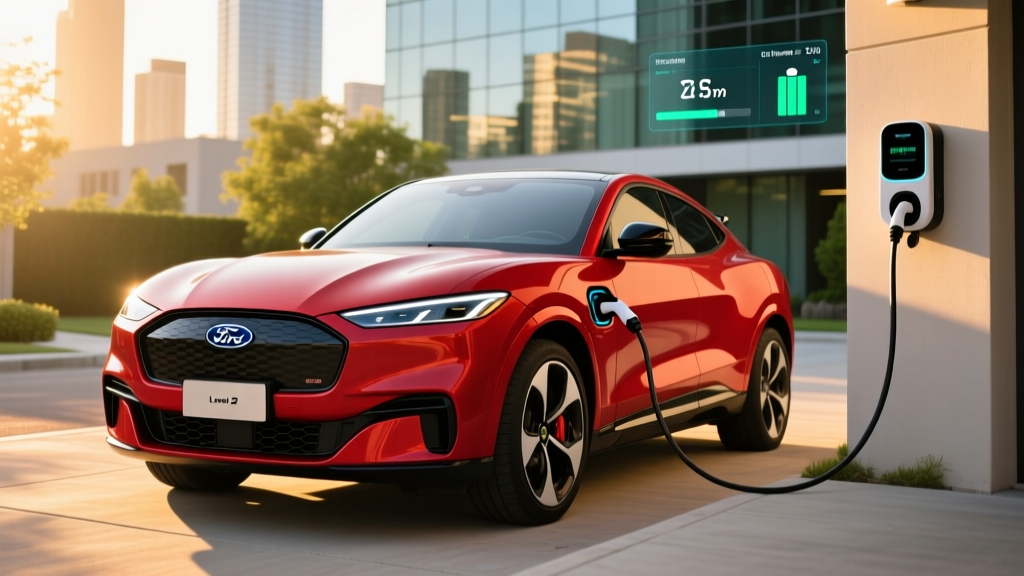
If you're searching for the 2024 electric Mustang, you're looking at the Ford Mustang Mach-E — a battery-electric crossover that borrows the Mustang nameplate but delivers a distinctly different ownership experience than its gas-powered stablemate. Here's the quick answer buyers need:
Quick Answer: 2024 Ford Mustang Mach-E at a Glance
- EPA Range: 250 mi (Standard Range) to 320 mi (Extended RWD) — expect 10–15% less on highway or in cold weather
- Battery: 70 kWh usable (Standard) / 91 kWh usable (Extended), NMC chemistry
- DC Fast Charging: Up to 150 kW peak; 10–80% in ~41 minutes (Extended RWD)
- Base MSRP: ~$39,995 (Select SR RWD) before incentives
- Federal Tax Credit (§30D): Up to $7,500 if battery-sourcing and income requirements are met; point-of-sale transfer available
- Best For: Buyers wanting Mustang-badged EV performance with crossover practicality and home-charging access
Now let's break down whether the Mach-E actually saves you money, how it stacks up against the gas Mustang and competing EVs, and what first-time EV buyers need to know before signing.
Range, Battery, and Charging: The Numbers That Matter
The 2024 Mustang Mach-E is offered with two battery packs and multiple drivetrain configurations. Understanding the difference between kWh (kilowatt-hours, the energy stored in the battery) and kW (kilowatts, the rate of charging power) is essential for evaluating any EV.
| Spec | Select SR RWD | Premium ER RWD | GT ER AWD |
|---|---|---|---|
| EPA Range | 250 mi | 320 mi | 280 mi |
| Battery (usable) | 70 kWh (NMC) | 91 kWh (NMC) | 91 kWh (NMC) |
| Horsepower | 266 hp | 290 hp | 480 hp |
| 0–60 mph | ~5.8 sec | ~5.5 sec | ~3.5 sec |
| Peak DC Charge Rate | 115 kW | 150 kW | 150 kW |
| 10–80% DC Time | ~36 min | ~41 min | ~41 min |
| Level 2 Rate (240V) | 10.5 kW | 10.5 kW | 10.5 kW |
| MPGe (combined) | 101 MPGe | 104 MPGe | 84 MPGe |
| Base MSRP | $39,995 | $48,995 | $59,995 |
| Battery Warranty | 8 years / 100,000 miles (≥70% capacity retention) | ||
Real-World Range Reality Check
The EPA sticker says 320 miles for the Extended Range RWD. In practice, expect ~270–290 miles on a mixed highway trip at 70 mph, and ~230–250 miles in sub-freezing temperatures. EV batteries lose efficiency in cold weather because energy is diverted to cabin and battery heating. If your daily commute is under 60 miles round-trip, even the Standard Range model covers a full week between charges with home Level 2 charging.
On the charging side, the Mach-E's 150 kW peak rate is competitive but not class-leading. The Hyundai Ioniq 5 peaks at 240 kW on 800V architecture, hitting 10–80% in roughly 18 minutes. The Mach-E's ~41-minute fast-charge window means you'll want to plan road-trip stops around meals or rest breaks. According to fueleconomy.gov, the Mach-E Premium ER RWD achieves 104 MPGe combined, translating to roughly 3.0–3.2 kWh per mile depending on driving style.
Electric Mustang vs. Gas Mustang: A Cost & Performance Showdown
The 2024 Mach-E shares a badge with the gas Mustang, but they serve different purposes. Here's how the EV stacks up against the gasoline EcoBoost Mustang on the metrics buyers actually care about:
| Metric | Mach-E Premium ER RWD | Mustang EcoBoost Coupe |
|---|---|---|
| Base MSRP | $48,995 | $32,515 |
| Federal Tax Credit (potential) | Up to $7,500 (§30D) | $0 |
| Effective Starting Price | ~$41,495 | $32,515 |
| 0–60 mph | ~5.5 sec | ~5.1 sec |
| Horsepower | 290 hp | 315 hp |
| Annual Fuel/Energy Cost | ~$600–$750 (home charging) | ~$2,000–$2,400 (gas, 25 MPG comb.) |
| Annual Maintenance | ~$200–$350 | ~$600–$900 |
| Cargo Space | 29.7 cu ft (rear) + 4.7 cu ft (frunk) | 13.5 cu ft (trunk) |
| Drivetrain | Single motor RWD / Dual AWD | RWD |
The gas Mustang is cheaper at the dealership and marginally quicker in the EcoBoost trim. But the Mach-E wins on operating costs, cargo utility, and available all-wheel drive. Over five years, the fuel and maintenance savings alone can exceed $8,000–$10,000, narrowing the effective price gap significantly.
The Real Cost of Ownership: 5-Year Breakdown
Purchase price is only part of the equation. Let's model a realistic 5-year / 60,000-mile ownership scenario for the Mach-E Premium ER RWD, assuming 12,000 miles driven annually.
| Cost Category | Mach-E Premium ER RWD | Mustang EcoBoost |
|---|---|---|
| Purchase Price (after credit) | $41,495 | $32,515 |
| Energy/Fuel (60k mi) | $3,250 (home L2 @ $0.14/kWh) | $11,000 ($3.50/gal, 25 MPG) |
| Maintenance (5 yr) | $1,200 | $3,800 |
| Insurance (5 yr avg.) | $8,500 | $6,500 |
| Depreciation (est. 5 yr) | $22,000 | $14,000 |
| Estimated Total | $76,445 | $67,815 |
Key takeaways from this breakdown:
- Energy savings are massive. Charging at home at the national average of ~$0.14/kWh saves roughly $7,750 over five years versus gasoline at $3.50/gallon. Public DC fast charging at $0.35–$0.48/kWh narrows this gap, which is why home charging access is critical.
- Insurance runs higher on EVs. The Mach-E typically costs 15–30% more to insure than the gas Mustang due to higher repair costs and battery replacement risk. Get quotes before buying.
- Depreciation is the wild card. EV depreciation has been steeper than gas cars in recent years, driven by Tesla price cuts and rapid technology turnover. The Mach-E has held value reasonably well compared to some competitors, but expect a larger percentage loss than the gas Mustang.
- Maintenance is genuinely cheaper. No oil changes, no spark plugs, no transmission fluid. Brake pad life extends significantly thanks to regenerative braking. Expect tire rotations and cabin air filter replacements as your primary service items.
Federal Tax Credit: What You Actually Qualify For
The IRS §30D Clean Vehicle Credit offers up to $7,500 for qualifying new EVs, but eligibility depends on several moving targets:
- MSRP Cap: SUVs/crossovers (which includes the Mach-E) must have an MSRP at or below $80,000. All Mach-E trims qualify.
- Buyer Income Limits: Modified AGI must not exceed $300,000 (married filing jointly), $225,000 (head of household), or $150,000 (single).
- Battery Sourcing: The $7,500 credit splits into two halves — $3,750 for critical-minerals sourcing and $3,750 for battery-component manufacturing. Sourcing requirements tighten annually. Check fueleconomy.gov for the Mach-E's current credit status, as Ford's supply chain adjustments can shift eligibility.
- Point-of-Sale Transfer: As of 2024, you can transfer the credit to the dealer at purchase, reducing your out-of-pocket cost immediately rather than waiting for a tax refund.
Note: Tax credit rules change frequently. Always verify current eligibility with a tax professional and the IRS before relying on the credit in your purchase budget.
First-Time EV Buyer Checklist: What to Know Before You Buy
If the Mach-E would be your first electric vehicle, these practical considerations will determine whether ownership is seamless or frustrating:
Home Charging Access Is Non-Negotiable (Almost)
Over 80% of EV charging happens at home. Without access to a Level 2 (240V) home charger, you'll rely on public infrastructure, which costs 2–3× more per kWh and requires time planning. A home Level 2 installation typically costs $800–$2,500 total (charger + electrician + permit), assuming your electrical panel has capacity. If you need a panel upgrade from 100A to 200A, add $1,500–$3,000. At 10.5 kW, the Mach-E adds roughly 30–32 miles of range per hour of Level 2 charging — a full overnight session easily replenishes a day's driving.
Cold Climate Buyers: Budget for Range Loss
In sustained temperatures below 30°F, expect 20–30% range reduction compared to the EPA sticker. The Mach-E includes a battery preconditioning feature that warms the pack when you navigate to a DC fast charger, improving charge speeds in cold weather. Use it. If you live in Minnesota or Maine and your commute is over 80 miles one-way, the Extended Range battery is strongly recommended.
Public Charging Network Realities
The Mach-E uses the CCS1 connector natively. Ford has secured Tesla Supercharger network access for Mach-E owners via a NACS adapter (included or available through Ford). This dramatically expands your fast-charging options on road trips. According to Ford, the adapter enables access to over 15,000 Supercharger stalls. Outside the Tesla network, Electrify America and EVgo remain the primary DC fast-charging providers — reliability varies by location, so download their apps and check stall availability on routes you'll travel regularly.
Common Mach-E Misconceptions, Corrected
| Myth | Fact |
|---|---|
| "The battery will need replacing in 5 years." | Ford warranties the battery for 8 years/100,000 miles at ≥70% capacity. Real-world NMC degradation data from similar packs shows 8–12% loss over 100,000 miles — far from needing replacement. |
| "It's not a real Mustang." | It doesn't share the gas Mustang's platform, but the GT trim hits 0–60 in 3.5 seconds with 480 hp. The badge is marketing; the performance is legitimate. |
| "EVs are worse for the environment because of electricity." | Even on coal-heavy grids, lifecycle emissions for EVs are lower than gas cars per EPA analysis. As grids decarbonize, the advantage widens. |
| "I'll be stranded without charging stations." | The U.S. now has over 60,000 public charging ports. With home charging and Supercharger adapter access, range anxiety is manageable for 95%+ of drivers. |
Decision Framework: Is the 2024 Electric Mustang Mach-E Right for You?
Choose the Mach-E If:
- You have (or can install) Level 2 home charging
- Your daily driving is under 150 miles round-trip
- You want crossover utility with EV operating-cost savings
- You value AWD availability and strong acceleration without a V8
- You qualify for the §30D tax credit (check income and sourcing rules)
Look Elsewhere If:
- You lack home or workplace charging access and can't install it
- You regularly tow over 3,500 lbs (the F-150 Lightning or Rivian R1T are better options)
- You need the fastest possible DC charging — consider the Ioniq 5 or EV6 with 800V architecture
- Your budget is firmly under $35,000 — look at the Chevy Equinox EV or used Mach-E market
- You want a traditional sports coupe experience — the gas Mustang GT is purpose-built for that
Frequently Asked Questions
How long does it take to charge the 2024 Mustang Mach-E at home?
On a Level 2 (240V) home charger at 10.5 kW, a full charge from 0–100% takes roughly 9–10 hours for the Extended Range battery. Most owners plug in overnight and wake up with a full charge. Level 1 (120V standard outlet) adds only about 3–4 miles per hour and is best used as a trickle-charge supplement, not a primary strategy.
Can the Mach-E use Tesla Superchargers?
Yes. Ford provides a NACS adapter that allows Mach-E owners to access Tesla's Supercharger network, which has the most reliable and widespread DC fast-charging infrastructure in the U.S. The adapter connects to the Mach-E's CCS port. Future Mach-E model years are expected to ship with a native NACS port.
What happens if the battery degrades significantly?
Ford's battery warranty guarantees at least 70% capacity retention for 8 years or 100,000 miles. If degradation falls below that threshold within the warranty period, Ford will repair or replace the battery at no cost. Real-world data from similar NMC packs suggests you'll retain roughly 88–92% capacity at 100,000 miles under normal use.
Is the Mach-E cheaper to own than a gas Mustang over 5 years?
On pure operating costs (fuel + maintenance), yes — by $8,000–$10,000. On total cost of ownership (including depreciation, insurance, and purchase price), the gas Mustang may still edge out the Mach-E depending on how EV resale values trend. The tax credit narrows the gap substantially at purchase.
Does the Mach-E qualify for the full $7,500 federal tax credit?
Credit eligibility depends on battery-sourcing compliance, which shifts as supply chains adjust. Some Mach-E configurations have qualified for the full $7,500, while others may qualify for $3,750. Always verify the current status on fueleconomy.gov before purchasing, and confirm your income falls within IRS limits.