Quick Verdict: The Compact EV Bargain That Keeps Selling
The 2024 Chevrolet Bolt EV remains one of the most affordable new electric vehicles on the U.S. market, and its compact dimensions are a core part of its appeal — and its limitation. At 163.2 inches in overall length, the Bolt EV slots firmly into the subcompact hatchback segment, making it a city-friendly commuter with a surprisingly usable interior. But if you're searching for "2024 Chevrolet Bolt EV length inches" because you're weighing cargo space, garage fit, or how it compares to the larger Bolt EUV, you need the full dimensional picture alongside the powertrain data that actually determines whether this car fits your life.
This review covers every critical spec — from exact exterior and interior measurements to real-world range, charging behavior, and 2024 federal tax credit eligibility under IRS §30D rules — so you can make a data-driven decision.
Exterior Dimensions: 2024 Chevrolet Bolt EV Length in Inches
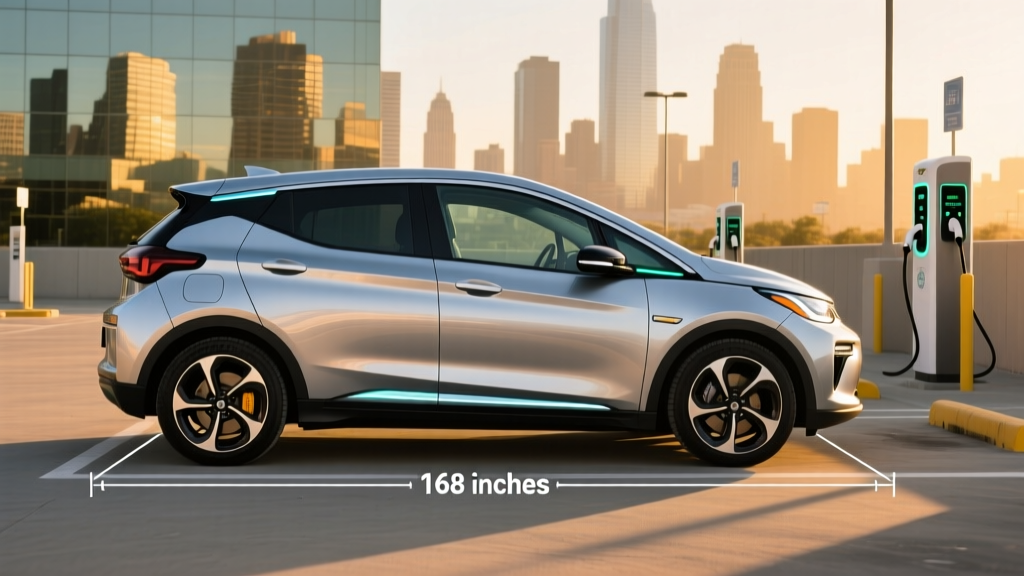
Let's address the core search query directly. The 2024 Chevrolet Bolt EV measures 163.2 inches long, 69.5 inches wide (without mirrors), and 62.8 inches tall. Its wheelbase spans 102.4 inches. These numbers make it roughly 10 inches shorter than the Bolt EUV (169.5 in.) and nearly two feet shorter than a Tesla Model Y.
| Dimension | Measurement |
|---|---|
| Overall Length | 163.2 in. |
| Overall Width (no mirrors) | 69.5 in. |
| Overall Height | 62.8 in. |
| Wheelbase | 102.4 in. |
| Ground Clearance | 5.6 in. |
| Curb Weight | ~3,563 lbs |
| Turning Circle | 36.4 ft |
That 36.4-foot turning circle and short overhangs make the Bolt EV genuinely easy to park in tight urban spaces. The 5.6 inches of ground clearance is typical for a hatchback — adequate for speed bumps and light snow, but this is not a crossover with raised ride height.
Interior Space and Cargo Volume
Despite the compact 163.2-inch exterior, Chevrolet packaged the Bolt EV's interior efficiently. Front-seat passengers get 42.1 inches of legroom and 39.7 inches of headroom. The rear seat offers 36.5 inches of legroom — adequate for adults on shorter trips, though taller riders will notice the tight knee clearance on longer drives.
| Measurement | Front | Rear |
|---|---|---|
| Headroom | 39.7 in. | 37.9 in. |
| Legroom | 42.1 in. | 36.5 in. |
| Shoulder Room | 54.6 in. | 52.8 in. |
| Hip Room | 51.4 in. | 50.8 in. |
Cargo volume behind the rear seats is 16.9 cubic feet, expanding to 56.6 cubic feet with the 60/40 rear seats folded. That's competitive with the Honda HR-V and significantly more than a Mazda MX-30, but less than the Hyundai Kona Electric (19.2 cu ft behind rear seats). There is no front trunk (frunk) — the space under the hood houses the motor and power electronics.
Range, Battery, and Efficiency
The 2024 Bolt EV carries a 65 kWh (usable capacity) lithium-ion NMC (nickel manganese cobalt) battery pack. The EPA rates it at 259 miles of range across all trims (1LT and 2LT), and its combined efficiency is 120 MPGe, or approximately 28 kWh per 100 miles.
The 259-mile EPA figure is achievable in mixed city/suburban driving at moderate temperatures — the Bolt EV's efficiency shines in stop-and-go traffic where regenerative braking recaptures energy. However, expect the following reductions:
- Highway driving (70-75 mph): ~210–230 miles. The Bolt's aerodynamics and single-speed reduction gear don't favor sustained high speeds.
- Cold weather (below 32°F): ~170–200 miles. The Bolt EV lacks a heat pump, relying on resistive cabin heating that draws directly from the battery.
- Worst-case (highway + cold + hills): ~150–170 miles. Plan charging stops accordingly on winter road trips.
For daily commuting under 60 miles round-trip, even worst-case range is more than sufficient. But if you regularly drive 150+ miles one-way, the Bolt EV's range and charging speed (detailed below) will require careful planning.
Charging Speed: DC Fast Charge and Home Level 2
Charging remains the Bolt EV's most debated characteristic. The 2024 model retains the same charging hardware as the refreshed 2022–2023 versions.
| Charging Level | Power | Speed / Time |
|---|---|---|
| Level 1 (120V household) | ~1.4 kW | ~4 miles of range per hour |
| Level 2 (240V home/public) | 11.5 kW (max) | ~39 mi/hr; full charge in ~7 hours |
| DC Fast Charge (CCS) | 55 kW (peak) | 10–80% in ~50 minutes |
The 55 kW peak DC fast-charge rate is the Bolt EV's most significant limitation for road-trip use. While competitors like the Hyundai Kona Electric (peak ~75 kW) and the Kia Niro EV (peak ~85 kW) charge noticeably faster, the Bolt's 10–80% time of roughly 50 minutes means you'll spend more time at charging stations on long drives. The charge curve is relatively flat — it sustains near 50 kW through about 60% SoC before tapering — but the peak is simply modest by 2024 standards.
For home Level 2 charging, the Bolt EV's onboard charger accepts up to 11.5 kW on a 48-amp Level 2 circuit. This is actually excellent — a full overnight charge from empty takes about 7 hours, meaning most owners will wake up to a full battery every morning with a standard 240V home charger installation. Chevrolet also includes a dual-level charging cord with the vehicle that can plug into either a 120V or 240V outlet (with the appropriate adapter), providing flexibility for renters or those without a dedicated Level 2 station.
Performance and Drivetrain
The 2024 Bolt EV is powered by a single permanent-magnet electric motor driving the front wheels. Output is 200 horsepower and 266 lb-ft of torque, available from zero RPM. Chevrolet quotes a 0–60 mph time of approximately 6.5 seconds.
That torque figure makes the Bolt EV genuinely quick off the line — it will out-accelerate most compact crossovers at city speeds and merge onto highways with confidence. The single-speed transmission means smooth, linear power delivery with no shift interruptions. However, there's no all-wheel-drive option, and the front-wheel-drive layout can struggle for traction on wet or icy surfaces when you apply full torque from a stop.
Ride quality is composed for the price point, though the 3,563-lb curb weight (heavy for a subcompact) and firm suspension tuning mean you'll feel sharper road imperfections. Road noise at highway speeds is noticeable — this is an economy-grade cabin in terms of sound insulation.
Pricing, Trims, and Federal Tax Credit Eligibility
Chevrolet simplified the 2024 Bolt EV lineup to two trims, both sharing the same 65 kWh battery and 259-mile range.
| Trim | MSRP (incl. destination) | Key Features |
|---|---|---|
| 1LT | $27,495 | 10.2" touchscreen, wireless CarPlay/Android Auto, heated front seats, 17" alloy wheels |
| 2LT | $30,695 | Adds leatherette, Bose 7-speaker audio, 360° camera, adaptive cruise, EV route planning |
The 2024 Chevrolet Bolt EV qualifies for up to $7,500 in federal tax credits under IRS §30D, subject to the following requirements (per IRS guidelines):
- MSRP cap: The Bolt EV (hatchback, classified as a sedan/hatchback) must have an MSRP at or below $55,000 — both trims qualify easily.
- Buyer income cap: Modified AGI must not exceed $150,000 (single), $225,000 (head of household), or $300,000 (joint filers).
- Battery sourcing: The Bolt EV's battery components and critical minerals must meet phase-in percentage thresholds that tighten annually. For 2024, the $7,500 credit splits into two halves — $3,750 for battery components and $3,750 for critical minerals. GM has confirmed the Bolt EV meets both thresholds for 2024.
- Point-of-sale transfer: Beginning in 2024, buyers can transfer the credit to the dealer for an immediate price reduction at purchase rather than claiming it on their tax return.
Always verify eligibility with your tax professional and check the latest IRS guidance, as sourcing requirements tighten each model year.
With the full $7,500 credit applied, the 1LT effectively starts at approximately $19,995 — making it the least expensive new EV available in the U.S. market. Even the 2LT drops to roughly $23,195, undercutting most used EVs.
Tech, Safety, and Driver Assistance
The 2024 Bolt EV's infotainment centers on a 10.2-inch diagonal touchscreen running Chevrolet's latest interface with wireless Apple CarPlay and Android Auto. An 8-inch digital driver cluster provides speed, range, and energy-flow information. Built-in EV route planning on the 2LT trim can suggest charging stops for longer trips, though the system relies on third-party charging data and is less sophisticated than Tesla's or Rivian's native navigation.
Standard driver-assistance features under the Chevy Safety Assist suite include:
- Automatic emergency braking with pedestrian detection
- Lane-keeping assist with lane departure warning
- Forward collision alert
- Following distance indicator
- IntelliBeam automatic high beams
The 2LT adds adaptive cruise control and a surround-view (360°) camera. Notably, the Bolt EV does not offer GM's Super Cruise hands-free driving system — that's reserved for higher-priced models. This is a SAE Level 1–2 driver-assistance suite, meaning you must keep your hands on the wheel and eyes on the road at all times.
The NHTSA awarded the 2024 Bolt EV a 5-star overall safety rating (NHTSA). The IIHS has not recently tested the Bolt EV as of this writing.
Warranty and Battery Longevity
Chevrolet backs the 2024 Bolt EV with the following warranty coverage:
| Coverage | Term |
|---|---|
| Bumper-to-Bumper | 3 years / 36,000 miles |
| Powertrain | 5 years / 60,000 miles |
| Battery & EV Components | 8 years / 100,000 miles (capacity retention ≥ 60%) |
The 8-year/100,000-mile battery warranty guarantees that the pack will retain at least 60% of its original capacity. In practice, GM's NMC packs in the Bolt platform have shown strong longevity — multiple high-mileage Bolt owners report 5–8% degradation at 60,000–80,000 miles, well within the warranty threshold. The Bolt EV's liquid-cooled battery thermal management system is a key factor in sustained health, especially in hot climates where passively cooled packs degrade faster.
A full out-of-warranty battery replacement, should it ever be needed, is estimated at $14,000–$16,000 based on current GM parts pricing — a significant cost, but one that very few owners will face given the warranty coverage and observed degradation curves.
Pros and Cons
- Lowest-priced new EV in the U.S. after tax credit (~$19,995 effective)
- Strong 259-mile EPA range for the price point
- Excellent 11.5 kW Level 2 home charging speed
- Peppy 266 lb-ft torque, quick city acceleration
- Compact 163.2-in. length ideal for urban parking
- 5-star NHTSA safety rating
- Generous 8-yr/100,000-mi battery warranty
- 55 kW DC fast charging is slow — ~50 min for 10–80%
- No heat pump — significant range loss in cold weather
- Rear legroom is tight at 36.5 inches
- No frunk; limited cargo versatility vs. crossovers
- No Super Cruise or advanced hands-free driving option
- Road noise and ride firmness at highway speeds
- FWD only — no AWD option for snow-belt buyers
Who Should Buy the 2024 Chevrolet Bolt EV?
Choose the Bolt EV if: You want the most affordable new EV available, your daily commute is under 80 miles round-trip, you can charge at home, and you prioritize value over road-trip charging speed.
Look elsewhere if: You regularly take 200+ mile road trips (the 55 kW DC charging will frustrate you), you need AWD for harsh winters, or you frequently carry rear-seat passengers who need generous legroom.
Consider the Bolt EUV instead if: You want 3.3 extra inches of rear legroom and a slightly longer wheelbase, and are willing to accept 247 miles of EPA range and a $28,895 starting price for the added space.
The Bolt EV is, at its core, a commuter appliance that happens to be electric — and it excels in that role. The 163.2-inch length keeps it nimble in the city, the 259-mile range eliminates daily range anxiety, and the sub-$20,000 effective price (after the federal credit) is unmatched. Just don't expect it to be a road-trip champion.
Frequently Asked Questions
What is the exact length of the 2024 Chevrolet Bolt EV in inches?
The 2024 Chevrolet Bolt EV is 163.2 inches long overall. For comparison, the larger Bolt EUV measures 169.5 inches, and the Hyundai Kona Electric is 165.6 inches.
What is the real-world range of the 2024 Bolt EV?
The EPA rates the Bolt EV at 259 miles. In real-world highway driving at 70 mph, expect approximately 210–230 miles. In cold weather (below freezing), range drops to roughly 170–200 miles due to resistive cabin heating and reduced battery efficiency. City driving with regenerative braking can match or slightly exceed the EPA figure.
How fast does the 2024 Bolt EV charge?
On a DC fast charger, the Bolt EV peaks at 55 kW, reaching 10–80% in approximately 50 minutes. On a 240V Level 2 home charger, it accepts up to 11.5 kW, adding roughly 39 miles of range per hour and fully charging in about 7 hours. A standard 120V outlet provides about 4 miles per hour.
Does the 2024 Bolt EV qualify for the $7,500 federal tax credit?
Yes, the 2024 Bolt EV qualifies for the full $7,500 federal EV tax credit under IRS §30D, provided the buyer meets income limits ($150K single / $300K joint MAGI) and the vehicle's battery sourcing meets the applicable thresholds (which GM has confirmed for 2024). The credit can be transferred to the dealer at point of sale for an immediate price reduction.
How much does the 2024 Bolt EV cost after tax credits?
The 1LT trim starts at $27,495 MSRP. With the full $7,500 federal credit applied, the effective price drops to approximately $19,995. The 2LT trim starts at $30,695, falling to roughly $23,195 after the credit. State and local incentives may reduce the price further — check your jurisdiction's programs.
Is the 2024 Bolt EV worth buying vs. competitors?
If lowest price and adequate range are your priorities, the Bolt EV is hard to beat — no new EV undercuts its post-credit price. The Hyundai Kona Electric ($32,675 base, faster DC charging, slightly more cargo) and Nissan Leaf ($28,140 base, but shorter range on the S trim) are the closest alternatives. If road-trip charging speed matters, the Kona Electric's ~75 kW peak is meaningfully faster. If budget is paramount, the Bolt EV wins decisively.
Does the 2024 Bolt EV have a heat pump?
No. The 2024 Bolt EV uses resistive (PTC) cabin heating, which draws significantly more energy from the battery than a heat pump would. This is the primary reason for its pronounced cold-weather range reduction. If you live in a cold climate and want a heat pump, consider the Hyundai Kona Electric or the Nissan Ariya.