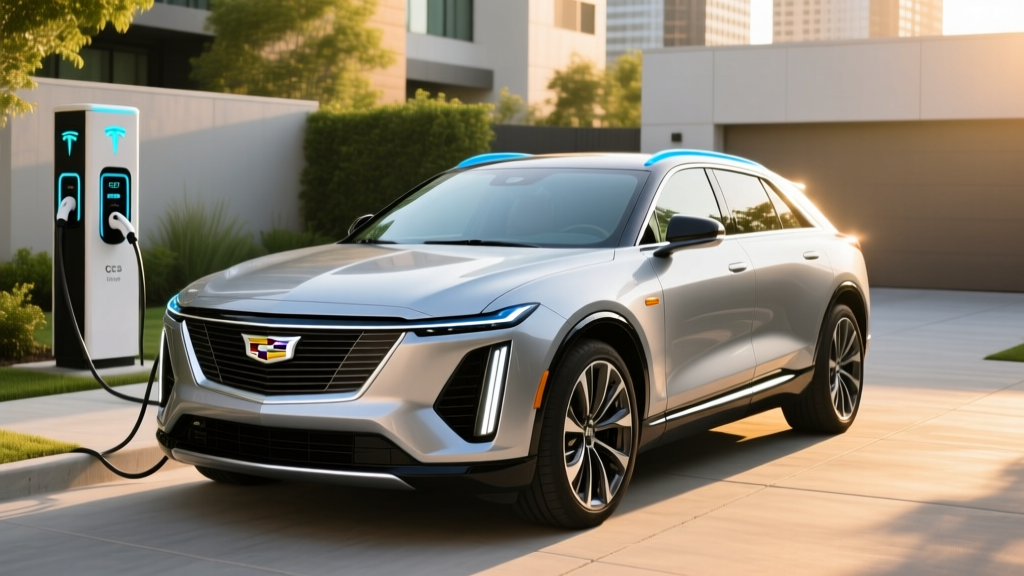
The 2024 Cadillac Lyriq was GM's opening move in the luxury electric SUV segment, built on the Ultium platform that underpins everything from the Chevy Equinox EV to the GMC Hummer EV. Now that it has been on sale for over a year, we have enough real-world data — from owner-reported range to DC fast-charging curves — to evaluate it beyond the press-release numbers. Here is everything a buyer or current owner needs to know about the 2024 Lyriq's range, charging behavior, pricing, and where it stands against rivals like the BMW iX, Genesis Electrified GV70, and Tesla Model X.
2024 Cadillac Lyriq Specifications at a Glance
| Specification | Value |
|---|---|
| EPA Range | 314 miles (RWD) / 307 miles (AWD Sport) |
| Battery (Usable) | 102 kWh, NMC (nickel-manganese-cobalt) Ultium |
| Peak DC Fast Charge | 190 kW |
| 10–80% DC Charge Time | ~34 minutes (Cadillac est.) |
| Level 2 Home Charge Rate | 19.2 kW (52 miles of range per hour) |
| Motor Output (RWD) | 340 hp / 325 lb-ft torque |
| Motor Output (AWD) | 500 hp / 450 lb-ft torque |
| 0–60 mph | 6.0 sec (RWD) / 4.6 sec (AWD) |
| Efficiency (RWD) | 89 MPGe combined (38 kWh/100 mi) |
| Cargo Volume | 28.0 cu ft (rear seats up) / 60.9 cu ft (folded) |
| Base MSRP (Luxury RWD) | $58,590 (incl. destination) |
| Battery/Powertrain Warranty | 8 years / 100,000 miles |
Real-World Range: What the EPA Sticker Doesn't Tell You
The Lyriq's 102 kWh usable battery is among the largest in its class, and that capacity gives it a buffer that smaller-battery competitors lack. However, the vehicle's curb weight — approximately 5,700 lbs for the RWD — works against efficiency at sustained highway speeds. According to fueleconomy.gov, the RWD model achieves 89 MPGe combined (38 kWh per 100 miles), which is competitive but not class-leading. The BMW iX xDrive50, for comparison, achieves 86 MPGe combined with a smaller battery but more aggressive efficiency tuning.
One factor working in the Lyriq's favor is its heat pump, which is standard across all trims. Heat pumps significantly reduce cabin-heating energy draw in cold weather compared to resistive heaters, partially offsetting winter range loss. Owners in moderate climates (Pacific Northwest, Southeast) report range figures very close to EPA estimates during spring and fall.
Charging Speed and Infrastructure Compatibility
Charging speed is where the Lyriq's Ultium architecture shows both its strengths and its limitations relative to 800-volt competitors like the Hyundai Ioniq 5 and Kia EV6.
| Charge Level | Power / Rate | Range Added | Notes |
|---|---|---|---|
| Level 1 (120V) | ~1.4 kW | ~4 mi/hr | Emergency / trickle only |
| Level 2 (240V, 19.2 kW) | 19.2 kW | 52 mi/hr | Full charge in ~6 hours; requires 100A circuit |
| Level 2 (240V, 11.5 kW) | 11.5 kW | 31 mi/hr | Standard home setup (48A circuit) |
| DC Fast Charge | 190 kW peak | ~76 mi in 10 min | 10–80% in ~34 min; tapers above 80% |
The Lyriq's onboard charger supports up to 19.2 kW on Level 2 AC — one of the fastest in the luxury EV SUV segment. This means that with a properly spec'd home wall connector on a dedicated 100-amp circuit, you can add 52 miles of range per hour. Most homes will need an electrical panel assessment before installing a circuit this large; a standard 48-amp Level 2 setup delivers 11.5 kW (31 mi/hr), which is still sufficient for overnight replenishment.
On DC fast charging, the Lyriq peaks at 190 kW on a CCS1 connector. The charge curve is relatively flat through 50% State of Charge (SoC), then begins tapering. The 10–80% charge takes approximately 34 minutes under ideal conditions (warm battery, preconditioned). This is slower than the Ioniq 5's 18-minute 10–80% on 350 kW chargers, but competitive with the BMW iX and Genesis Electrified GV70.
Charging preconditioning note: The Lyriq will automatically precondition its battery when you navigate to a DC fast charger via the built-in navigation. This is essential for achieving peak charge rates, especially in cold weather. If you pull up to a charger without preconditioning, expect significantly slower speeds until the battery warms.
For the 2025 model year, GM began transitioning to the NACS (Tesla Supercharger) connector. The 2024 Lyriq ships with CCS1, but GM has confirmed a NACS adapter will be available, granting access to Tesla's Supercharger network — a significant practical advantage for road-trip charging reliability.
Performance, Drivetrain, and Driving Dynamics
The 2024 Lyriq offers two powertrain configurations:
- RWD (Luxury trim): A single rear-mounted motor producing 340 hp and 325 lb-ft of torque. 0–60 mph in approximately 6.0 seconds. This is the range-maximizing configuration at 314 miles EPA.
- AWD (Sport and Luxury AWD trims): Dual motors combining for 500 hp and 450 lb-ft. 0–60 mph in 4.6 seconds. The AWD drops EPA range to 307 miles (Sport) or 314 miles (Luxury AWD, which uses slightly different tuning).
The RWD Lyriq is not a performance SUV in the Model X Plaid sense, but its rear-biased torque delivery and low center of gravity (courtesy of the floor-mounted battery pack) give it confident, composed handling. The steering is weighted appropriately for a luxury cruiser, and the regenerative braking system offers a one-pedal driving mode with adjustable intensity via steering-wheel paddles — a feature Cadillac calls "Regen on Demand."
Ride quality is a standout. The Lyriq's five-link rear suspension and available air suspension (standard on Sport trim) absorb road imperfections with the isolation expected of a Cadillac. Cabin noise levels at highway speeds are exceptionally low, aided by acoustic laminated glass and the absence of engine noise.
Interior, Technology, and Driver Assistance
The Lyriq's cabin is dominated by a 33-inch LED advanced display that spans the instrument cluster and infotainment screen in a single curved panel running Google Built-In. This includes Google Maps navigation, Google Assistant voice control, and access to the Google Play Store for apps. Wireless Apple CarPlay and Android Auto are standard.
Notable technology features include:
- Super Cruise: GM's hands-free Level 2 driver-assistance system, available on over 400,000 miles of mapped highways in the US and Canada. This is a standout feature — it genuinely reduces highway fatigue on long trips, though the driver must remain attentive (eye-tracking monitors engagement).
- AKG 19-speaker audio system: Standard across all trims, tuned specifically for the Lyriq's cabin acoustics.
- Head-up display: Augmented-reality HUD projects navigation and speed onto the windshield.
- Proximity-based power door handles: Flush-mounted handles present automatically as you approach.
On the drawback side, the Lyriq lacks a front trunk (frunk) — the space under the hood houses HVAC components and power electronics. Rear-seat legroom (39.6 inches) is adequate but not generous for the class; the BMW iX offers more. The panoramic glass roof is fixed with no shade, which some owners find contributes to cabin heat on sunny days despite UV-tinting treatment.
Pricing, Trims, and Federal Tax Credit Eligibility
The 2024 Lyriq launched with aggressive pricing for a luxury EV, undercutting the BMW iX and Mercedes EQE SUV significantly at the base level.
| Trim | Drivetrain | MSRP | Est. After §30D Credit* |
|---|---|---|---|
| Luxury | RWD | $58,590 | $51,090 |
| Luxury | AWD | $62,590 | $55,090 |
| Sport | RWD | $60,090 | $52,590 |
| Sport | AWD | $64,090 | $56,590 |
*Federal tax credit estimate assumes full §30D eligibility. Actual credit depends on battery sourcing, buyer income, and tax liability. See checklist below.
Fully loaded Sport AWD models with premium packages can push past $70,000 before incentives. For context, a comparably equipped BMW iX xDrive50 starts above $87,000, making the Lyriq a relative value in the luxury EV SUV space.
Does the 2024 Lyriq Qualify for the Federal EV Tax Credit?
- MSRP Cap: The Lyriq is classified as an SUV, so the MSRP cap under IRS §30D is $80,000. All 2024 Lyriq trims fall under this cap. ✓
- Buyer Income Limits: Modified Adjusted Gross Income (MAGI) must not exceed $150,000 (single), $225,000 (head of household), or $300,000 (married filing jointly).
- Battery Sourcing: The §30D credit is split into two $3,750 halves — one for critical minerals and one for battery component assembly. GM has stated the Lyriq's Ultium battery cells are manufactured in the US (at the Ultium Cells plants in Ohio and Tennessee), but critical-mineral sourcing requirements have tightened under current IRS rules. Verify current eligibility on the IRS qualified vehicles list before purchase.
- Point-of-Sale Transfer: Under current rules, buyers can transfer the credit to the dealer at purchase, receiving the benefit as an immediate price reduction rather than waiting to claim it on their tax return.
- Assembly: The Lyriq is assembled at GM's Spring Hill, Tennessee plant — meeting the North American final assembly requirement. ✓
Bottom line: Most 2024 Lyriq trims are eligible for at least a partial federal credit, but the exact amount depends on current battery-sourcing determinations. Always check the IRS qualified clean vehicles list for the specific VIN before committing. State and local incentives may stack on top — consult your state energy office or a tax professional for specifics.
Lyriq vs. the Competition: Where It Wins and Loses
The Lyriq competes in a segment with several strong alternatives. Here is how it stacks up on the metrics that matter most:
- vs. BMW iX xDrive50: The iX offers more rear-seat space, slightly quicker DC charging (up to 200 kW), and AWD standard. But it starts at $87,250 — nearly $29,000 more than the base Lyriq. The Lyriq wins on value; the iX wins on driving dynamics and interior room.
- vs. Genesis Electrified GV70: The GV70 has a smaller 77.4 kWh battery and just 236 miles of EPA range, making the Lyriq far more practical for road trips. The Genesis charges faster (up to 240 kW on 800V architecture) but range is its Achilles' heel.
- vs. Tesla Model X: The Model X offers more range (up to 335 miles), faster Supercharger access, and optional third-row seating. But its interior quality and panel-gap consistency fall short of the Lyriq's luxury execution, and the Model X starts significantly higher at ~$79,990.
Look elsewhere if: You need third-row seating (check the Model X or the three-row Cadillac Optiq/Escalade IQ), you prioritize the fastest possible DC charging (Hyundai Ioniq 5 or Kia EV6 on 800V), or you want maximum rear-seat legroom for tall passengers (BMW iX).
Pros and Cons
✓ Pros
- 314-mile EPA range is competitive and achievable in moderate conditions
- 19.2 kW Level 2 onboard charger is best-in-class for home charging speed
- Super Cruise hands-free driving on 400,000+ miles of mapped highways
- Sub-$59K starting price undercuts European luxury EV SUVs by $25K+
- Quiet, refined ride quality with excellent cabin isolation
- Google Built-In infotainment is responsive and feature-rich
- Standard heat pump reduces cold-weather range loss
✗ Cons
- No front trunk (frunk) — lost cargo opportunity
- 190 kW peak DC charging is slower than 800V competitors
- Rear-seat legroom is average for the class
- Fixed glass roof lacks a retractable shade
- CCS1 connector on 2024 models requires an adapter for Tesla Superchargers
- One-pedal driving mode requires manual activation (not default)
- Heavy at ~5,700 lbs — affects tire wear and efficiency at speed
Ownership Costs and Warranty Coverage
Cadillac backs the Lyriq's battery and powertrain with an 8-year / 100,000-mile warranty, with a capacity retention threshold of 70% — meaning GM will repair or replace the battery if it degrades below 70% of original capacity within that period. The bumper-to-bumper warranty is 4 years / 50,000 miles, which is standard for the luxury segment.
On the cost side, electricity for the Lyriq at the US average rate of ~$0.16/kWh works out to roughly $6.08 per 100 miles (at 38 kWh/100 mi). A comparable gas SUV getting 22 MPG at $3.50/gallon costs about $15.91 per 100 miles. Over 15,000 miles per year, that is an annual fuel savings of approximately $1,475 — before accounting for reduced maintenance (no oil changes, fewer brake replacements thanks to regenerative braking).
Insurance premiums for the Lyriq tend to run 10–20% higher than a comparable gas-powered Cadillac XT5, reflecting the higher repair costs associated with EV battery packs and specialized body panels. Get quotes before purchasing to budget accurately.
Frequently Asked Questions
What is the real-world range of the 2024 Cadillac Lyriq?
Owners report 270–295 miles in mixed driving on the 314-mile EPA-rated RWD model. Highway driving at 75+ mph reduces that to approximately 245–265 miles. Cold weather (below freezing) can drop range by 15–25%, yielding roughly 235–265 miles depending on conditions and use of cabin heating.
How fast does the Lyriq charge at home and on road trips?
At home on a 19.2 kW Level 2 charger (requiring a 100A circuit), the Lyriq adds 52 miles of range per hour — a full charge in about 6 hours. On a standard 48A Level 2 setup, expect 31 mi/hr. On DC fast chargers, it peaks at 190 kW, achieving a 10–80% charge in approximately 34 minutes.
Does the 2024 Lyriq qualify for the $7,500 federal EV tax credit?
The Lyriq meets the MSRP cap ($80,000 for SUVs), North American assembly requirement, and is on the IRS qualified vehicles list. However, the full $7,500 depends on battery critical-mineral and component sourcing rules that shift periodically. Buyers must also meet income caps ($150K single / $300K joint). Verify eligibility for your specific VIN on irs.gov before purchase.
Is the Cadillac Lyriq worth buying over a BMW iX or Tesla Model X?
If value is a priority, yes. The Lyriq starts at $58,590 — nearly $29,000 below the BMW iX and $21,000 below the Model X — while offering comparable range, a premium interior, and Super Cruise. It sacrifices some rear-seat space and peak DC charging speed. For buyers who prioritize luxury-per-dollar and highway comfort, the Lyriq is the strongest choice in this segment.
Can I use Tesla Superchargers with the 2024 Lyriq?
The 2024 Lyriq ships with a CCS1 charge port. GM has confirmed that a NACS adapter will be provided to enable access to Tesla Superchargers. Starting with the 2025 model year, the Lyriq has a native NACS port. If buying a 2024 model used or from remaining stock, confirm adapter availability with your dealer.
How long will the Lyriq's Ultium battery last?
GM warrants the battery for 8 years / 100,000 miles at 70% capacity retention. The Ultium NMC chemistry is designed for long cycle life, and early data from high-mileage GM Ultium vehicles (Hummer EV, Lyriq fleet units) suggests degradation in the 5–8% range over the first 50,000 miles — well within warranty thresholds. Proper care (avoiding frequent 100% charges, using preconditioning) will extend longevity.