Quick Verdict: A Rear-Wheel-Drive Flagship That Prioritizes Comfort Over Chaos
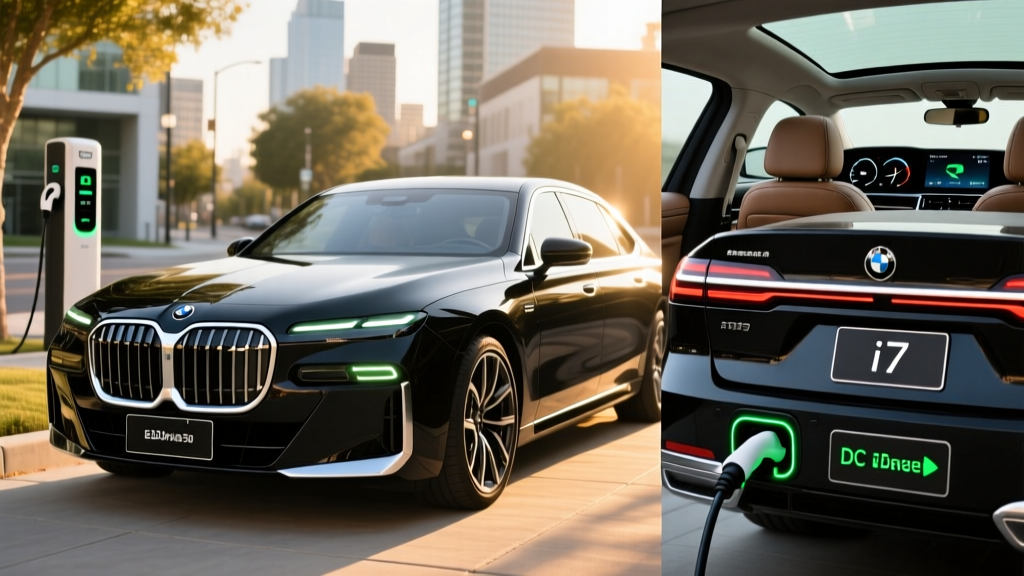
The 2024 BMW i7 eDrive50 occupies a specific niche in the luxury EV sedan segment: it's the entry point into BMW's all-electric 7 Series lineup, trading the dual-motor xDrive variants' brute acceleration for a longer EPA-estimated range and a lower starting price. With 318 miles of EPA-estimated range, a single rear-mounted electric motor producing 449 horsepower, and BMW's latest iDrive 8.5 infotainment system, the eDrive50 makes a compelling case for buyers who value refinement and distance over 0-60 bragging rights.
But at a base MSRP of $105,700 (before destination), the i7 eDrive50 competes against the Tesla Model S, Mercedes-Benz EQS 450+, and Lucid Air Pure — each with distinct range, charging, and technology trade-offs. This review breaks down the exact numbers that matter for real ownership.
| Spec | 2024 BMW i7 eDrive50 |
|---|---|
| EPA Range | 318 miles |
| Battery (Usable) | 101.7 kWh (NMC) |
| Drivetrain | RWD, single motor |
| Horsepower | 449 hp |
| 0-60 mph | 5.5 seconds |
| Max DC Fast Charge | 195 kW |
| 10-80% DC Charge | ~34 minutes |
| Level 2 Charge Rate | 11 kW (~30 mi/hr) |
| EPA Efficiency | 82 MPGe (combined) |
| Base MSRP | $105,700 |
| Battery Warranty | 8 years / 100,000 miles |
Range and Efficiency: 318 Miles on Paper, Less on the Interstate
The i7 eDrive50's 101.7 kWh usable battery pack uses NMC (nickel-manganese-cobalt) chemistry, which BMW has favored across its iX and i4 lineups for its energy density and cold-weather discharge characteristics. The EPA rates the eDrive50 at 318 miles of combined range, with a combined efficiency of 82 MPGe — or roughly 41 kWh per 100 miles.
- City/suburban driving (mild weather): ~300-320 miles — regenerative braking recovers energy in stop-and-go traffic, often matching or exceeding the EPA sticker.
- Highway cruising (70-75 mph, 65°F): ~260-280 miles — aerodynamic drag dominates at speed, and the i7's 5,700-pound curb weight works against it.
- Cold weather (below 32°F, mixed driving): ~220-250 miles — the heat pump helps, but battery chemistry slows and cabin heating draws significant energy. Expect a 20-25% range reduction in sustained sub-freezing conditions.
The i7's thermal management system includes a heat pump as standard equipment, which improves cold-weather efficiency compared to resistive heating. However, the large cabin volume still demands substantial energy to warm in winter.
For context, the dual-motor i7 xDrive60 sacrifices roughly 20 miles of EPA range (298 miles) for all-wheel-drive traction and a 4.5-second 0-60 time. The range gap narrows further in real-world highway driving, where both variants face similar aerodynamic penalties.
Charging Speed: Adequate but Not Class-Leading
The i7 eDrive50 peaks at 195 kW on a DC fast charger using its CCS1 connector (with NACS adapter availability for Tesla Supercharger access starting in 2025 via BMW's adapter program). BMW quotes a 10-80% charge time of approximately 34 minutes under optimal conditions — meaning a pre-conditioned battery and a charger capable of sustaining the full power curve.
| Charging Level | Power / Rate | Time / Miles Added |
|---|---|---|
| Level 1 (120V, 12A) | ~1.4 kW | ~4 miles per hour |
| Level 2 (240V, 48A) | 11 kW | ~30 miles per hour; full charge in ~10 hours |
| DC Fast Charge (peak) | 195 kW | 10-80% in ~34 min; ~130 miles in 15 min |
The charging curve reality: The 195 kW peak is not sustained across the entire session. In typical DC fast-charging behavior, the i7 holds near peak power from roughly 10-40% state of charge, then tapers progressively. From 60-80%, expect speeds closer to 80-100 kW. This is why the 10-80% time is 34 minutes rather than a theoretical ~25 minutes at sustained peak power. If you frequently road-trip, plan for 35-40 minute stops rather than 20-minute dashes.
At home on a Level 2 charger (such as a BMW Wallbox or third-party 48-amp unit on a 60-amp circuit), the i7 replenishes roughly 30 miles of range per hour. A full overnight charge from 20% to 100% takes approximately 8-10 hours — easily manageable for daily driving routines. Installation costs for a dedicated 240V/60A circuit typically range from $800 to $2,500 depending on panel proximity and local permitting, according to Energy.gov estimates.
Performance: Single-Motor Smoothness Over Raw Acceleration
The eDrive50's single rear-mounted electric motor produces 449 horsepower and 479 lb-ft of torque, delivering a BMW-tested 0-60 mph time of 5.5 seconds. That's comfortably quick for a 5,700-pound luxury sedan — roughly equivalent to a well-optioned BMW 540i from the previous generation — but it's not in the same league as the 660-hp xDrive60 (4.5 seconds) or the M70 (3.5 seconds).
What the eDrive50 offers instead is seamless, linear power delivery with zero drivetrain lash. The rear-wheel-drive layout gives the i7 a slightly more traditional BMW character compared to the xDrive variants, with a natural weight distribution bias that the chassis engineers have tuned for stability rather than sportiness. The adaptive air suspension (standard on all i7 trims) absorbs road imperfections with the composure expected of a flagship sedan, and the available rear-axle steering (Integral Active Steering) shrinks the car's effective wheelbase at low speeds for tighter urban maneuvering.
Towing is not a primary use case here: the i7 is rated for a maximum of 4,400 pounds when properly equipped — sufficient for a light utility trailer but not a boat or camper.
Interior, Tech, and Daily Livability
The i7's cabin is where BMW justifies the six-figure price tag. The centerpiece is the BMW Curved Display — a 12.3-inch instrument cluster merged with a 14.9-inch touchscreen running iDrive 8.5. The system supports wireless Apple CarPlay and Android Auto, over-the-air updates, and BMW's latest voice assistant ("Hey BMW").
The available 31-inch BMW Theater Screen — an 8K resolution display that drops from the ceiling for rear passengers — is the i7's most visually arresting feature, though it's a $3,000+ standalone option and primarily useful for parked entertainment or chauffeured scenarios.
Passenger and cargo dimensions:
- Front headroom: 39.8 inches
- Rear headroom: 38.6 inches
- Front legroom: 41.2 inches
- Rear legroom: 43.0 inches
- Trunk cargo volume: 17.7 cu ft (competitive with the Mercedes EQS's 22 cu ft but less than the Lucid Air's 32 cu ft combined)
The trunk is a conventional sedan layout — no hatchback or frunk. The 17.7 cu ft is adequate for luggage for four on a week-long trip but limits bulkier cargo compared to SUV alternatives like the BMW iX or Rivian R1S.
Driver assistance: The i7 comes standard with BMW's Driving Assistant Professional, which includes adaptive cruise control with stop-and-go, lane-keeping assist, and automatic lane-change capability on divided highways. This is an SAE Level 2 system — the driver must remain attentive and keep hands on or near the wheel at all times. It is not autonomous driving. The available Highway Assistant (part of the Driving Assistant Professional package) allows hands-off driving at speeds up to 85 mph on compatible divided highways, but the driver's eyes must remain on the road, monitored by an infrared camera.
Pricing, Trims, and Federal Tax Credit Eligibility
The 2024 BMW i7 eDrive50 starts at a base MSRP of $105,700, plus a $995 destination charge, bringing the sticker to $106,695 before options. Key options that significantly affect the price include the Executive Package ($3,900, adding ventilated/massaging seats, soft-close doors), the Theater Screen ($3,100), and the M Sport Package ($4,500, cosmetic and suspension tuning).
A well-optioned i7 eDrive50 with the Executive and Premium packages typically lands between $115,000 and $125,000 before incentives.
| Item | Amount |
|---|---|
| Base MSRP (eDrive50) | $105,700 |
| Destination Charge | $995 |
| As-Tested Price (w/ Executive + Premium Pkgs) | ~$118,500 |
| Federal Tax Credit (§30D) | See eligibility note below |
The i7 eDrive50 faces significant hurdles for the full $7,500 federal tax credit under current IRS rules:
- MSRP cap: Sedans must have a base MSRP under $55,000 to qualify. The i7 eDrive50 at $105,700 exceeds this cap and does not qualify for the new-vehicle credit under §30D.
- Buyer income cap: Even if the MSRP cap were met, adjusted gross income must be below $150,000 (single) or $300,000 (joint) — relevant for buyers cross-shopping with lower-priced EVs.
- Battery sourcing and critical minerals: The i7's battery components and critical minerals must meet phased-in domestic-content thresholds. BMW has not publicly confirmed full compliance for the i7's supply chain.
- Point-of-sale transfer: Eligible buyers can transfer the credit to the dealer at purchase for an immediate price reduction — but this is moot if the vehicle doesn't qualify.
Bottom line: The 2024 i7 eDrive50 does not qualify for the $7,500 federal new-vehicle tax credit due to its MSRP. Buyers should consult IRS.gov §30D guidance and a tax professional for their specific situation. Some state and local incentives (such as California's CVRP or utility rebates) may still apply — check your jurisdiction.
How It Stacks Up: i7 eDrive50 vs. the Competition
The i7 eDrive50 competes in a narrow band of six-figure electric luxury sedans. Here's how the key rivals compare on the specs that matter most:
| Spec | 2024 BMW i7 eDrive50 | 2024 Mercedes EQS 450+ | 2024 Lucid Air Pure | 2024 Tesla Model S LR |
|---|---|---|---|---|
| EPA Range | 318 mi | 352 mi | 419 mi | 402 mi |
| Battery (kWh usable) | 101.7 | 108.4 | 88.0 | ~100 |
| Max DC Charge (kW) | 195 | 200 | 220+ | 250 |
| 0-60 mph | 5.5 sec | 5.9 sec | 5.2 sec | 3.1 sec (AWD) |
| Base MSRP | $105,700 | $104,400 | $87,400 | $74,990 |
| Cargo (cu ft) | 17.7 | 22.0 | 32.0 (frunk+trunk) | 28.0 (hatch+frunk) |
The Lucid Air Pure offers dramatically more range (419 miles EPA) at a significantly lower price, though its service center network and long-term reliability track record are far less established than BMW's. The Mercedes EQS 450+ is the closest direct competitor in philosophy — a comfort-focused, rear-drive luxury sedan — and edges the i7 on range and cargo space. The Tesla Model S remains the performance and charging-speed benchmark but can't match the i7's interior material quality or ride refinement.
Who Should Buy the i7 eDrive50
This EV is best suited for:
- Existing BMW 7 Series or 5 Series owners transitioning to electric who value brand continuity, dealer service relationships, and the iDrive ecosystem.
- Chauffeur-driven or executive commuters who prioritize rear-seat comfort, cabin quietness, and ride quality over sporty dynamics.
- Daily drivers with home charging access who cover 50-150 miles per day and want to charge overnight without relying on public fast-charging infrastructure.
It's less ideal for:
- Buyers who need maximum range for frequent 300+ mile road trips (the Lucid Air Pure or Tesla Model S are stronger here).
- Those who need hatchback or frunk cargo flexibility.
- Buyers seeking federal tax credit eligibility — the i7's MSRP disqualifies it.
Choose a competitor if: Range is your top priority (Lucid Air Pure), you want a hatchback for cargo (Tesla Model S, Mercedes EQS with SUV variant), or you need the tax credit to justify the purchase (consider the BMW i5 eDrive40 at ~$66,000 MSRP — though still above the $55K sedan cap).
Warranty and Long-Term Ownership
BMW covers the i7's high-voltage battery with an 8-year / 100,000-mile warranty, guaranteeing a minimum of 70% capacity retention over that period. If the battery degrades below 70% of its original capacity within the warranty window, BMW will repair or replace it to bring it above that threshold. This is consistent with industry standards (Tesla, Mercedes, and Hyundai offer similar 8-year terms, though Hyundai's 100,000-mile limit is matched by most competitors).
The basic vehicle warranty is 4 years / 50,000 miles, and BMW includes 3 years / 36,000 miles of complimentary scheduled maintenance — a meaningful perk for a vehicle with complex thermal management and suspension systems.
Long-term battery replacement costs for the i7 are not yet publicly available from BMW (the model launched in 2023), but based on comparable large-pack replacements (the iX's 111.5 kWh pack), expect estimates in the $18,000-$25,000 range out of warranty, including labor. This is a worst-case scenario; most NMC packs from major manufacturers are showing degradation rates of 5-10% over the first 100,000 miles based on fleet data from Recurrent Auto.
- Exceptional ride quality and cabin isolation — among the quietest EVs at highway speed
- 318-mile EPA range is competitive for the luxury sedan class
- Rear-wheel-drive efficiency advantage over AWD variants
- Standard heat pump improves cold-weather usability
- iDrive 8.5 is responsive with strong voice control and OTA update capability
- Complimentary maintenance for 3 years reduces early ownership costs
- Does not qualify for $7,500 federal tax credit (MSRP exceeds $55K cap)
- 195 kW DC fast-charge peak is slower than Tesla (250 kW) and Lucid (220+ kW)
- 17.7 cu ft trunk is modest; no hatchback or frunk
- Theater Screen is an expensive option with limited practical use for most owners
- Heavy curb weight (5,700+ lbs) impacts real-world highway efficiency
- ADAS is capable but not class-leading vs. Tesla FSD or GM Super Cruise on mapped highways
Frequently Asked Questions
What is the real-world range of the 2024 BMW i7 eDrive50?
The EPA rates it at 318 miles combined. In real-world driving, expect roughly 300-320 miles in city conditions with mild weather, 260-280 miles at sustained highway speeds (70-75 mph), and 220-250 miles in sustained sub-freezing temperatures with cabin heating active. The standard heat pump mitigates some cold-weather loss compared to vehicles with resistive heating.
How fast does the i7 eDrive50 charge at home and on DC fast chargers?
On a DC fast charger, it peaks at 195 kW and charges from 10-80% in approximately 34 minutes under optimal conditions (preconditioned battery, capable charger). At home on a Level 2 charger (240V, 48 amps), it charges at 11 kW, adding roughly 30 miles of range per hour. A full charge from near-empty takes about 10 hours.
Does the 2024 BMW i7 eDrive50 qualify for the federal EV tax credit?
No. Under current IRS §30D rules, new sedans must have a base MSRP below $55,000 to qualify for the up-to-$7,500 federal tax credit. The i7 eDrive50 starts at $105,700, well above the cap. State and local incentives may still apply — check your jurisdiction's EV rebate programs and consult a tax professional.
Is the i7 eDrive50 worth buying over the Tesla Model S or Lucid Air?
It depends on your priorities. The i7 wins on interior material quality, ride comfort, and BMW dealer network support. The Lucid Air Pure offers 100+ more miles of EPA range at a lower price. The Tesla Model S offers superior charging speed, hatchback practicality, and a more established Supercharger network. If cabin refinement and brand loyalty matter most, the i7 is a strong choice. If range-per-dollar or cargo flexibility lead your decision, look elsewhere.
What are the biggest drawbacks of the i7 eDrive50?
The most significant are: (1) no federal tax credit eligibility due to MSRP, (2) DC fast-charging speed (195 kW peak) that trails Tesla and Lucid, (3) a modest 17.7 cu ft trunk with no hatchback or frunk, and (4) a heavy curb weight that reduces real-world highway efficiency below the EPA sticker. The high-voltage battery replacement cost (estimated $18K-$25K out of warranty) is a long-term financial consideration, though the 8-year/100,000-mile warranty provides substantial coverage.
Can I use Tesla Superchargers with the BMW i7?
Starting in 2025, BMW is offering a NACS adapter that allows i7 owners to access Tesla's Supercharger network. The i7 ships with a CCS1 inlet natively. Until the adapter is widely available, the i7 relies on Electrify America, EVgo, ChargePoint, and other CCS-compatible networks. Plan road trips around PlugShare or your preferred network app to verify charger availability and reliability.