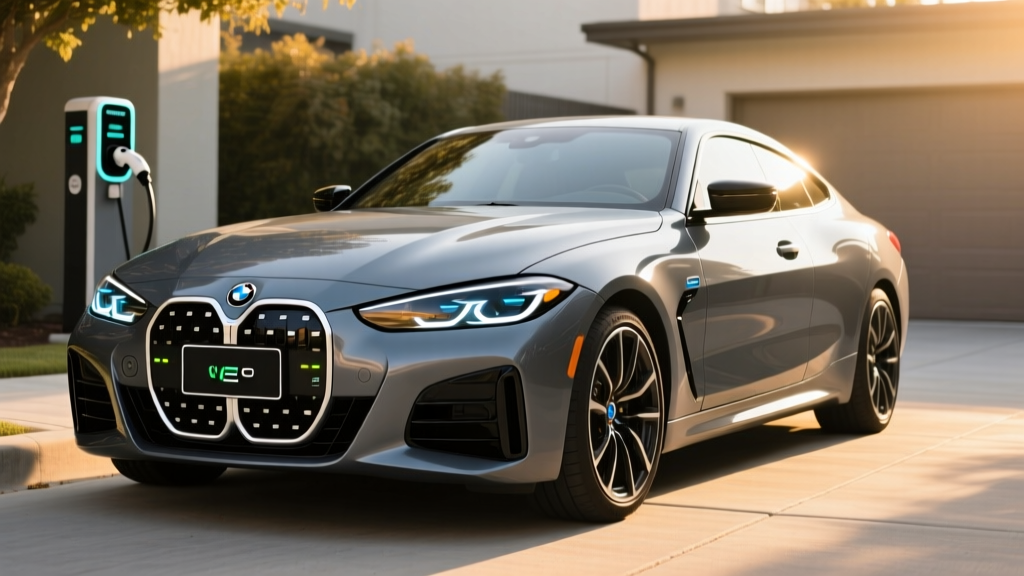
The 2024 BMW i4 eDrive35 is the entry point into BMW's electric Gran Coupe lineup — a single-motor, rear-wheel-drive sedan that trades the top-spec M50's brute force for a lower sticker price and slightly more range. For buyers who want BMW's driving dynamics, build quality, and iDrive 8.5 infotainment without crossing $55,000 before incentives, the eDrive35 is the model to examine. But with a smaller 70.2 kWh battery and a single rear motor, it makes distinct trade-offs that matter for real-world ownership. This review breaks down the exact numbers — EPA range versus what you'll actually see, charging curves at DC fast chargers, tax credit math, and whether this trim is the right call versus stepping up to the eDrive40 or looking at a Tesla Model 3, Hyundai Ioniq 6, or Genesis Electrified G80.
2024 BMW i4 eDrive35 Specs at a Glance
| Specification | 2024 BMW i4 eDrive35 |
|---|---|
| EPA Range | 260 miles (18" wheels) / 256 miles (19" wheels) |
| Battery (Usable) | 70.2 kWh (NMC chemistry) |
| Drivetrain | Rear-wheel drive (single motor) |
| Horsepower | 281 hp |
| Torque | 295 lb-ft |
| 0–60 mph | 5.8 seconds |
| EPA Efficiency | 99 MPGe combined (29 kWh/100 mi) |
| Max DC Fast Charge | 182 kW (CCS1) |
| 10–80% DC Charge Time | ~31 minutes |
| Level 2 Charge Rate | 11 kW (~35 miles/hr) |
| Cargo Volume | 16.6 cu ft (rear seats up) / 45.2 cu ft (folded) |
| Base MSRP | $52,200 (excl. $995 destination) |
| Battery Warranty | 8 years / 100,000 miles |
Range and Efficiency: EPA vs. Real World
EPA Sticker: 260 miles (with standard 18" alloy wheels)
Real-World Expectation: Expect 220–240 miles in mixed highway driving at 70–75 mph. In cold weather (below 35°F), plan for 185–210 miles depending on cabin heating demands and whether you precondition the battery.
The eDrive35's 70.2 kWh usable battery is the smallest in the i4 lineup — the eDrive40 and M50 use an 81.5 kWh pack. That smaller battery directly limits range but also reduces weight (the eDrive35 is roughly 150 lbs lighter than the eDrive40), which helps efficiency. According to fueleconomy.gov, the eDrive35 achieves 99 MPGe combined, translating to 29 kWh per 100 miles — respectable for a 4,600-lb luxury sedan.
In our experience, the i4's efficiency is highly speed-sensitive. Around town at 30–45 mph, you'll regularly beat the EPA combined figure and could stretch toward 270 miles on a charge. But at sustained 80 mph interstate speeds, efficiency drops to roughly 33–35 kWh/100 mi, cutting effective range to around 200–215 miles. The Gran Coupe's aerodynamics are good (Cd of 0.24), but it's still a larger, heavier sedan than a Tesla Model 3.
Cold-weather performance is where NMC chemistry shows a mild disadvantage versus LFP packs in terms of range retention. The i4 uses a heat pump (standard on all 2024 i4 trims), which helps limit the hit — but you should still budget a 20–30% range reduction in freezing conditions. Preconditioning the battery while plugged in is essential to minimize losses and ensure fast-charging speeds when you hit a DC station.
Charging Speed and Infrastructure
| Charging Level | Power | Speed (Approx.) | Use Case |
|---|---|---|---|
| Level 1 (120V) | ~1.4 kW | ~5 miles per hour | Emergency / overnight trickle |
| Level 2 (240V, home) | 11 kW (max onboard) | ~35 miles per hour | Daily home charging; 0–100% in ~7.5 hrs |
| DC Fast Charge | Peak 182 kW | 10–80% in ~31 min | Road trips, Electrify America / EA CCS |
The eDrive35 uses the CCS1 connector standard on most non-Tesla EVs sold in North America. BMW quotes a peak DC fast-charge rate of 182 kW — adequate but not class-leading. For context, the Hyundai Ioniq 6 peaks at 239 kW on its 800V architecture, and the Tesla Model 3 Highland peaks around 250 kW.
Charging curves matter more than peak numbers. The i4 eDrive35 sustains roughly 150–170 kW between 10–50% state of charge, then tapers progressively. By 70% SoC, you're looking at roughly 90–100 kW, and above 85% the rate drops below 40 kW. This is why BMW quotes 31 minutes for 10–80% — the final 10% above 80% can add another 15–20 minutes. On a road trip, the practical strategy is to charge to 80% and move on, which gives you roughly 175–185 real-world miles of range.
At home on a Level 2 wallbox or ChargePoint Home Flex running at 48 amps (11.5 kW), the eDrive35's 11 kW onboard charger limits intake to about 35 miles of range per hour. A full 0–100% charge takes roughly 7.5 hours — easily achievable overnight on a standard 240V/50A circuit. Most owners will plug in nightly and never dip below 40% SoC, making home charging the primary refueling method.
One practical note: BMW includes the BMW Charging program, which provides either complimentary Electrify America charging credits or a home charging wallbox credit for new i4 buyers. Confirm current program terms with your dealer, as these offers change annually.
Performance and Driving Dynamics
The single rear-mounted motor produces 281 hp and 295 lb-ft of torque, delivering a 5.8-second 0–60 mph time. That's quick by any conventional sedan standard — a base BMW 330i does the same sprint in about 5.6 seconds — but it trails the dual-motor i4 M50 (3.7 seconds) and the Tesla Model 3 Long Range AWD (4.2 seconds).
Where the eDrive35 earns its BMW badge is in chassis tuning and steering feel. The adaptive M suspension (available via the Premium Package) manages body roll through corners better than most EV sedans in this price range. The steering is weighted appropriately for a grand touring sedan — not as sharp as an E46 3 Series, but far more communicative than the numb electric-assist racks in many competitors.
Regenerative braking offers three levels (low, medium, high) plus an adaptive mode that uses radar and navigation data to modulate regen based on traffic ahead. There is no true one-pedal driving mode in the BMW sense — the car will not come to a complete stop via regen alone at very low speeds, unlike a Nissan Leaf or Tesla. This frustrates some EV converts but feels natural to BMW traditionalists who prefer blending into the friction brakes.
Pricing, Trims, and Federal Tax Credit
| Item | Amount |
|---|---|
| Base MSRP (eDrive35) | $52,200 |
| Destination Charge | $995 |
| Typical As-Tested (with Premium + Driver Assistance) | $57,000–$60,000 |
| Federal Tax Credit (§30D) | Up to $7,500 (see eligibility below) |
| Point-of-Sale Transfer | Available — applied as dealer discount |
| Effective Price After Full Credit | ~$45,695 (base, before options) |
The 2024 BMW i4 eDrive35 starts at $52,200 before destination. Most buyers add the Premium Package ($2,750 — includes heated seats, head-up display, and Harman Kardon audio) and the Driving Assistance Professional Package ($1,700 — adds adaptive cruise with stop-and-go and lane-centering). A well-equipped eDrive35 typically lands between $57,000 and $60,000 before incentives.
Federal Tax Credit Eligibility (§30D)
The 2024 i4 eDrive35 is eligible for up to $7,500 in federal tax credits under IRS §30D, but you must meet all of the following criteria per IRS guidelines:
- MSRP Cap: The vehicle's MSRP must not exceed $55,000 for sedans. The base eDrive35 at $52,200 qualifies, but adding options that push the sticker above $55,000 may disqualify you. Check the Monroney label carefully.
- Buyer Income Cap: Adjusted gross income must be ≤ $150,000 (single), ≤ $225,000 (head of household), or ≤ $300,000 (joint filers).
- Battery Sourcing: The credit splits into $3,750 for critical minerals and $3,750 for battery components — each with separate sourcing requirements that tighten annually. For 2024, many BMWs qualify for the full $7,500, but confirm with your dealer's EV credit documentation.
- Point-of-Sale Transfer: As of 2024, you can transfer the credit to the dealer at purchase, reducing your out-of-pocket cost immediately rather than waiting to claim it on your tax return.
Important: Tax credit rules are subject to change. Consult a tax professional and verify eligibility on IRS.gov before purchasing.
Interior, Tech, and Practicality
The i4's cabin uses BMW's Curved Display — a 12.3" instrument cluster merged with a 14.9" touchscreen running iDrive 8.5. The system supports wireless Apple CarPlay and Android Auto, over-the-air updates, and BMW's Intelligent Personal Assistant voice control. The interface is among the best in the luxury EV segment — responsive, logically structured, and backed by physical shortcut buttons below the screen.
The Driving Assistance Professional Package brings BMW's highway assistant, which combines adaptive cruise control with lane-centering steering. This is a SAE Level 2 system — you must keep hands on the wheel and remain fully engaged. It is not autonomous driving. The system works well on divided highways but will disengage on sharp curves or faded lane markings, requiring immediate driver takeover.
Practicality is where the Gran Coupe body style shows its limits. Rear legroom is 35.3 inches — adequate for adults on shorter trips but tight compared to a Hyundai Ioniq 5 or Tesla Model 3 (both over 38 inches). The 16.6 cu ft trunk is a liftback design, which helps with loading bulky items, and folds to 45.2 cu ft. There is no front trunk (frunk) — the space is occupied by drive electronics and the HVAC system.
Pros and Cons
Pros
- BMW driving dynamics — adaptive suspension, communicative steering, balanced chassis
- Premium cabin with iDrive 8.5, excellent 14.9" curved display
- Eligible for full $7,500 federal tax credit at base MSRP
- Heat pump standard — better cold-weather efficiency than many competitors
- Liftback cargo design — 16.6 cu ft with easy loading
- Quiet cabin at highway speeds, strong NVH isolation
Cons
- 260-mile EPA range trails key rivals (Model 3 LR: 341 mi, Ioniq 6: 361 mi)
- 182 kW peak DC charge rate is mid-pack; 31-min 10–80% lags 800V competitors
- Rear seat legroom (35.3") is tight for a $52K+ sedan
- No frunk — lost cargo opportunity
- $55K MSRP cap means optioned-up eDrive35 may lose tax credit eligibility
- No one-pedal driving to a complete stop
Who Should Buy the 2024 BMW i4 eDrive35?
Choose the i4 eDrive35 if: You want a premium driving experience from a legacy luxury brand, your daily commute is under 100 miles round-trip, you have reliable home Level 2 charging, and you value build quality and cabin refinement over maximum range.
Look elsewhere if: You regularly drive 200+ miles between charges, need maximum rear-seat space for car seats or tall passengers, want the fastest DC charging available, or require AWD for snowy climates (consider the i4 xDrive40 or a Tesla Model 3 Long Range AWD instead).
The eDrive35 is best suited as a luxury commuter and weekend cruiser for singles or couples without heavy rear-seat demands. It excels as a daily driver in metro areas with decent charging infrastructure. For road-trip-heavy buyers, the range and charging-speed limitations versus an Ioniq 6 or Model 3 Long Range are real trade-offs — not dealbreakers, but factors that add 10–15 minutes to each DC charging stop on long highway runs.
Frequently Asked Questions
What is the real-world range of the 2024 BMW i4 eDrive35?
The EPA rates the eDrive35 at 260 miles with 18" wheels. In mixed highway driving at 70–75 mph, expect 220–240 miles. In freezing weather, range can drop to 185–210 miles. City driving at lower speeds may approach or slightly exceed the EPA figure.
How fast does the i4 eDrive35 charge at home and on DC fast chargers?
On a DC fast charger, the eDrive35 peaks at 182 kW and charges from 10–80% in approximately 31 minutes. At home on a Level 2 (240V) charger, it draws up to 11 kW, adding roughly 35 miles of range per hour and completing a full charge in about 7.5 hours.
Does the 2024 BMW i4 eDrive35 qualify for the $7,500 federal tax credit?
Yes — the base eDrive35 at $52,200 MSRP qualifies for up to $7,500 under IRS §30D, provided the buyer meets income caps ($150K single / $300K joint) and the vehicle's battery meets critical-mineral and component sourcing requirements. However, adding options that push the MSRP above the $55,000 sedan cap can disqualify the vehicle. Confirm with your dealer and consult IRS.gov before purchasing.
Is the BMW i4 eDrive35 worth buying versus the Tesla Model 3 or Hyundai Ioniq 6?
It depends on your priorities. The i4 eDrive35 wins on cabin luxury, build quality, dealer service network, and driving refinement. The Model 3 Long Range wins on range (341 mi), charging speed (250 kW), and Supercharger access. The Ioniq 6 wins on range (361 mi), DC charge speed (239 kW / 18 min 10–80%), and value. If brand prestige and driving feel matter most, the i4 is compelling. If range and charging speed dominate your decision, the alternatives lead.
What is the battery warranty on the 2024 i4 eDrive35?
BMW covers the high-voltage battery for 8 years or 100,000 miles (whichever comes first), guaranteeing a minimum of 70% capacity retention. The basic vehicle warranty is 4 years / 50,000 miles. BMW also includes 3 years of complimentary scheduled maintenance.
Does the i4 eDrive35 have all-wheel drive?
No. The eDrive35 is rear-wheel drive only. If you need AWD, look at the i4 xDrive40 (dual-motor, 396 hp, 282 mi EPA range) starting around $57,200, or consider a Tesla Model 3 Long Range AWD.