Quick Verdict: The 2024 Audi Q8 e-tron at a Glance
The 2024 Audi Q8 e-tron is Audi's mid-cycle refresh of its flagship electric SUV, replacing the original e-tron nameplate with sharper styling, a larger battery, and modestly improved range. It competes in the luxury midsize EV SUV segment against the BMW iX, Mercedes EQE SUV, and Tesla Model X. While it doesn't lead the pack in range or charging speed, it delivers a refined driving experience, a genuinely quiet cabin, and Audi's trademark build quality. For buyers who prioritize comfort and brand cachet over maximum efficiency, the Q8 e-tron makes a compelling case — but its pricing and tax-credit limitations require careful consideration.
| Spec | Q8 e-tron (SUV) | Q8 Sportback e-tron |
|---|---|---|
| EPA Range | 285 miles | 300 miles |
| Battery (usable) | 106 kWh (NMC) | 106 kWh (NMC) |
| Peak DC Fast Charge | 170 kW | 170 kW |
| 10–80% DC Charge Time | ~31 minutes | ~31 minutes |
| Level 2 Home Charging | 19.2 kW (up to ~52 mi/hr) | 19.2 kW (up to ~52 mi/hr) |
| 0–60 mph | 5.5 seconds | 5.5 seconds |
| Horsepower | 402 hp | 402 hp |
| Drivetrain | Dual-motor AWD (quattro) | Dual-motor AWD (quattro) |
| MPGe (combined) | 83 MPGe | 87 MPGe |
| Base MSRP | $74,400 | $77,400 |
Real-World Range: What the EPA Sticker Doesn't Tell You
The 2024 Audi Q8 e-tron carries an EPA-estimated range of 285 miles for the standard SUV body and 300 miles for the Sportback variant. These figures come from a 114 kWh gross / 106 kWh usable lithium-ion battery pack using NMC (nickel-manganese-cobalt) chemistry — a significant upgrade from the original e-tron's 71 kWh usable pack.
EPA Sticker: 285 miles (SUV) / 300 miles (Sportback)
Highway driving (70–80 mph): Expect approximately 240–260 miles. The Q8 e-tron's boxy SUV shape and 5,600+ lb curb weight penalize it at sustained highway speeds.
Cold weather (below 32°F): Plan for 195–230 miles depending on cabin heating demands. The heat pump (standard on Premium Plus and above) mitigates some loss, but NMC chemistry still suffers in freezing temperatures.
Mixed commuting: 260–280 miles is realistic for suburban and city driving with regenerative braking active.
According to fueleconomy.gov, the Q8 e-tron SUV achieves 83 MPGe combined (city/highway), translating to roughly 41 kWh per 100 miles. That efficiency figure trails rivals like the BMW iX xDrive50 (86 MPGe combined) and significantly lags the Tesla Model X (102 MPGe). The Q8 e-tron's heft and aero profile are the primary culprits — this is a comfort-oriented cruiser, not an efficiency champion.
Charging Speed and Home Setup
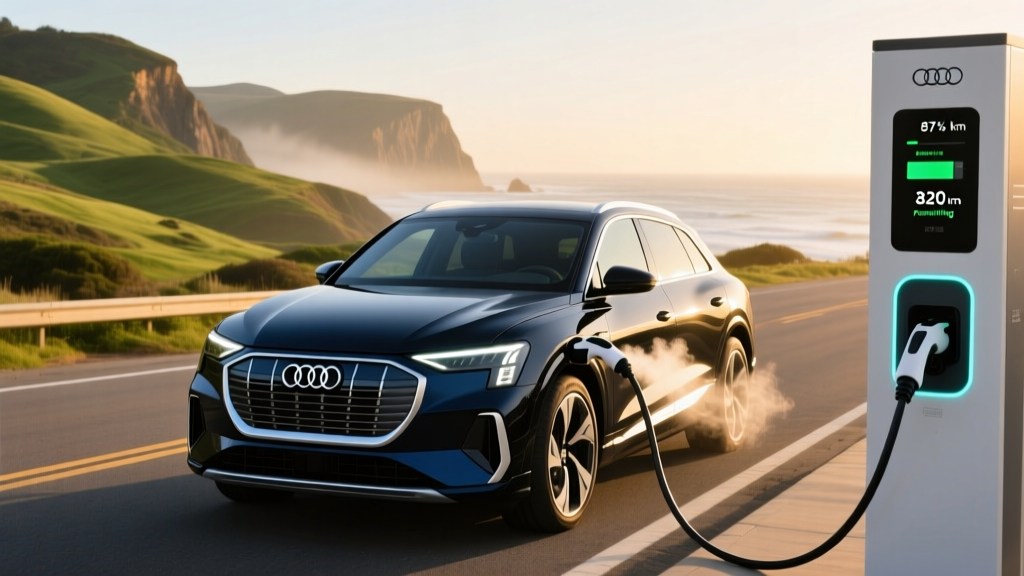
Audi equips the Q8 e-tron with a 170 kW peak DC fast-charge capability on CCS1-equipped vehicles (or NACS on models ordered with the Tesla Supercharger adapter that Audi began offering for 2024+ models). Here's what that means in practice:
| Charging Level | Power (kW) | Miles Added per Hour | Notes |
|---|---|---|---|
| Level 1 (120V household) | 1.4 kW | ~3–4 miles/hr | Emergency/trickle only; full charge takes days |
| Level 2 (240V, 48A) | 11.5 kW | ~31 miles/hr | Standard home wallbox; overnight full charge (~10 hrs) |
| Level 2 (240V, 80A) | 19.2 kW | ~52 miles/hr | Requires 100A circuit; full charge in ~6 hours |
| DC Fast Charge (peak) | 170 kW | — | 10–80% in ~31 min; tapers sharply above 80% |
Charging curve reality: The Q8 e-tron hits its 170 kW peak between roughly 10–30% state of charge (SoC), then progressively tapers. From 50–80%, expect sustained rates closer to 100–120 kW. This means the published 31-minute 10–80% time is accurate under optimal conditions (preconditioned battery, warm ambient temps, functioning 350 kW station), but real-world sessions on Electrify America or EVgo hardware often stretch to 35–40 minutes when accounting for ramp-up and taper.
Home charging setup: The Q8 e-tron's onboard charger supports up to 19.2 kW on Level 2, but achieving that requires a hardwired 100-amp dedicated circuit and a compatible Level 2 station (such as the ChargePoint Home Flex or Emporia Vue configured for 80A). Most homes will need an electrical panel assessment — older 100A or 150A main panels may require a $1,500–$3,000 service upgrade to 200A. Budget $500–$1,200 for a quality Level 2 EVSE and $800–$2,500 for electrician labor and permitting, depending on run length from your panel to the garage.
Performance, Ride Quality, and Drivetrain
Every 2024 Q8 e-tron uses a dual-motor quattro all-wheel-drive system producing 402 horsepower and 490 lb-ft of torque. The 0–60 mph sprint takes 5.5 seconds — respectable for a 5,644-pound SUV, but not quick by EV standards (the Tesla Model X Plaid dispatches it in 2.5 seconds, and even the BMW iX M60 hits 60 in 3.6 seconds).
Where the Q8 e-tron excels is ride refinement. The standard adaptive air suspension smooths over road imperfections with a plushness that few rivals match. Cabin isolation is exceptional — wind noise, tire noise, and road harshness are all filtered out to a degree that makes this one of the quietest EVs on the market. The steering is light and accurate if not particularly engaging, and the regenerative braking system offers three levels of recuperation (including a one-pedal-like mode, though not a full one-pedal stop-and-hold like some competitors).
Towing capacity is rated at 4,000 pounds with the factory towing package — adequate for a small boat or light utility trailer, but below the Rivian R1S (7,700 lbs) and Tesla Model X (5,000 lbs).
Interior Space, Cargo, and Technology
The Q8 e-tron's cabin seats five across two rows. Rear legroom measures 38.0 inches, which is generous for the segment, and headroom benefits from the flat EV floor. The Sportback's sloping roofline trims rear headroom slightly but remains livable for adults under 6'2".
Cargo volume:
- Behind rear seats (SUV): 28.5 cu ft
- Rear seats folded (SUV): 56.4 cu ft
- Behind rear seats (Sportback): 27.2 cu ft
- Rear seats folded (Sportback): 54.6 cu ft
- Front trunk (frunk): Not available — the space houses electronics and the HVAC system
The absence of a frunk is a notable omission at this price point. Competitors like the BMW iX and Rivian R1S offer front storage, and the Tesla Model X provides a substantial frunk.
Infotainment: Audi's dual-touchscreen MMI system (10.1-inch upper, 8.6-inch lower) is visually sleek and responsive, with haptic feedback on presses. Wireless Apple CarPlay and Android Auto are standard. The 12.3-inch Virtual Cockit digital instrument cluster is among the best in the industry. However, the touchscreen-heavy climate and seat controls lack physical buttons, which frustrates some drivers during everyday use.
Driver assistance: The Q8 e-tron comes standard with Audi pre sense basic/city (automatic emergency braking, lane departure warning) and available Adaptive Cruise Assist with lane centering. This is an SAE Level 2 system — the driver must remain attentive with hands on the wheel at all times. It is not self-driving. Audi does not currently offer a hands-free highway system like GM's Super Cruise or Ford's BlueCruise on this model.
Pricing, Trim Levels, and Federal Tax Credit
The 2024 Q8 e-tron lineup spans three trims for both the SUV and Sportback body styles:
| Trim | Body Style | MSRP | Est. After §30D Credit* |
|---|---|---|---|
| Premium | SUV | $74,400 | $66,900 |
| Premium Plus | SUV | $79,100 | $71,600 |
| Prestige | SUV | $84,900 | $77,400 |
| Premium | Sportback | $77,400 | $69,900 |
| Premium Plus | Sportback | $82,100 | $74,600 |
| Prestige | Sportback | $87,900 | $80,400 |
*Tax credit estimate assumes full $7,500 §30D credit eligibility. Actual eligibility depends on multiple factors — see below.
Federal EV Tax Credit (§30D) Eligibility: The 2024 Q8 e-tron may qualify for up to $7,500 under IRS §30D, but eligibility is not guaranteed and depends on several criteria per current IRS rules:
- MSRP cap: The Q8 e-tron must have an MSRP at or below $80,000 for SUVs. Premium and Premium Plus trims qualify; the Prestige trim ($84,900 SUV, $87,900 Sportback) exceeds the cap and is ineligible.
- Buyer income limits: Modified adjusted gross income (AGI) must not exceed $300,000 (joint filers), $225,000 (head of household), or $150,000 (single filers).
- Battery sourcing requirements: The vehicle must meet critical minerals and battery component sourcing thresholds that phase up annually. For 2024, at least 50% of battery components must be manufactured or assembled in North America, and at least 40% of critical minerals must be sourced from the U.S. or FTA partners. Verify current eligibility on the IRS qualified vehicles list before purchasing.
- Point-of-sale transfer: As of 2024, buyers can transfer the credit to the dealer at purchase for an immediate price reduction rather than waiting to claim it on their tax return.
Important: Always confirm the specific VIN's eligibility with your dealer and consult a tax professional. Battery sourcing compliance can change mid-year, and the IRS maintains an updated list of qualifying vehicles. This analysis reflects rules as of the 2024 model year.
Warranty and Long-Term Ownership Costs
Audi backs the Q8 e-tron with the following warranty coverage:
- New vehicle limited warranty: 4 years / 50,000 miles
- Battery pack warranty: 8 years / 100,000 miles (covers defects and capacity loss below 70% of original capacity)
- Powertrain warranty: 4 years / 50,000 miles (electric motors, power electronics)
- Corrosion perforation: 12 years, unlimited miles
The 8-year/100,000-mile battery warranty is standard for the segment and matches BMW, Mercedes, and Tesla. The 70% capacity retention threshold is also industry-typical. Real-world NMC battery degradation data from earlier Audi e-tron owners suggests roughly 5–8% capacity loss over the first 100,000 miles under normal charging habits — well within warranty coverage.
Insurance and maintenance: Expect insurance premiums in the $2,400–$3,200/year range depending on your profile and state. Maintenance costs are lower than gas equivalents (no oil changes, fewer brake replacements due to regen), but Audi dealership labor rates and proprietary parts keep costs above mainstream brands. Budget roughly $400–$600/year for cabin air filter replacement, tire rotation, and fluid top-offs.
Pros
- Exceptionally quiet and refined cabin — best-in-class noise isolation
- Air suspension delivers a plush, controlled ride over rough pavement
- High-quality interior materials and fit-and-finish
- Strong 19.2 kW Level 2 onboard charger for fast home charging
- 300-mile EPA range (Sportback) is adequate for most daily needs
- Eligible for up to $7,500 federal tax credit on qualifying trims
Cons
- 83 MPGe combined trails segment leaders significantly
- No frunk — wasted space in a large EV
- 170 kW peak DC charging is slow for a 2024 luxury EV
- Prestige trims exceed the $80,000 MSRP cap for the federal tax credit
- Heavy curb weight (5,600+ lbs) hurts efficiency and tire wear
- Touchscreen-only climate controls frustrate during daily use
- No hands-free highway driving assist (Level 2 only)
How It Stacks Up Against Key Competitors
The 2024 Q8 e-tron faces stiff competition in the $75,000–$90,000 luxury EV SUV segment. Here's how it compares to the most relevant rivals:
| Spec | Audi Q8 e-tron | BMW iX xDrive50 | Mercedes EQE 350+ SUV | Tesla Model X LR |
|---|---|---|---|---|
| EPA Range | 285 mi | 324 mi | 303 mi | 335 mi |
| Battery (usable) | 106 kWh | 105.2 kWh | 90.6 kWh | 100 kWh |
| Peak DC Charge | 170 kW | 195 kW | 170 kW | 250 kW |
| 0–60 mph | 5.5 sec | 4.4 sec | 6.2 sec | 3.8 sec |
| MPGe (combined) | 83 | 86 | 82 | 102 |
| Base MSRP | $74,400 | $87,100 | $77,900 | $79,990 |
| Cargo (rear seats up) | 28.5 cu ft | 35.5 cu ft | 14.0 cu ft | 44.1 cu ft (+ frunk) |
Key takeaways: The BMW iX offers more range, faster charging, and significantly more cargo space — but starts $12,700 higher. The Tesla Model X leads in range, efficiency, and charging speed, plus offers a frunk and falcon-wing doors, but its interior quality doesn't match Audi's. The Mercedes EQE SUV underwhelms in cargo space and acceleration. The Q8 e-tron's advantage is ride comfort and cabin quietness — if those are your top priorities, it has no direct equal.
Who Should Buy the 2024 Audi Q8 e-tron?
Choose the Q8 e-tron if:
- You prioritize ride comfort and cabin silence over maximum range
- Your daily commute is under 80 miles round-trip and you charge at home nightly
- You want a luxury badge with traditional dealer service infrastructure
- You find a Premium or Premium Plus trim eligible for the $7,500 federal credit
- You rarely take road trips exceeding 250 miles between charging stops
Look elsewhere if:
- Maximum range and road-trip efficiency are top priorities (consider the BMW iX or Tesla Model X)
- You need maximum cargo space or a frunk for gear (Rivian R1S, Tesla Model X)
- You want hands-free highway driving capability (GM Super Cruise on the Cadillac Lyriq, Ford BlueCruise on the Mustang Mach-E)
- You frequently tow heavy loads (Rivian R1S at 7,700 lbs)
- Your budget is firm below $70,000 after incentives (consider the Genesis GV60 or Volvo EX30)
Frequently Asked Questions
What is the real-world range of the 2024 Audi Q8 e-tron?
The EPA rates the Q8 e-tron SUV at 285 miles and the Sportback at 300 miles. In real-world highway driving at 70–80 mph, expect 240–260 miles. In cold weather (below freezing), plan for 195–230 miles. For mixed suburban commuting, 260–280 miles is typical.
How fast does the Q8 e-tron charge at home and on the road?
On DC fast charging, the Q8 e-tron peaks at 170 kW and charges from 10–80% in approximately 31 minutes under optimal conditions. At home on Level 2 (240V), it supports up to 19.2 kW with an 80A circuit, adding roughly 52 miles of range per hour — a full charge in about 6 hours. On a standard 48A Level 2 circuit (11.5 kW), expect about 31 miles per hour and a full overnight charge in roughly 10 hours.
How much does the 2024 Q8 e-tron cost after the federal tax credit?
The base Premium SUV starts at $74,400 and drops to approximately $66,900 after the full $7,500 §30D credit — if you qualify. Premium Plus ($79,100) falls to about $71,600. The Prestige trim ($84,900) exceeds the IRS MSRP cap for SUVs and does not qualify for the federal credit. Eligibility also depends on buyer income limits and battery-sourcing compliance — always verify with your dealer and a tax professional.
Does the 2024 Q8 e-tron qualify for the federal EV tax credit?
Potentially. The Premium and Premium Plus trims fall under the $80,000 MSRP cap for SUVs and may qualify for up to $7,500 under IRS §30D. However, eligibility also requires the buyer's income to be within limits ($300,000 joint / $150,000 single) and the vehicle's battery to meet critical minerals and component sourcing requirements. The Prestige trim exceeds the MSRP cap and is ineligible. Check the IRS qualified vehicle list for the specific VIN before purchasing.
Is the 2024 Q8 e-tron worth buying over the BMW iX or Tesla Model X?
It depends on your priorities. The Q8 e-tron wins on ride comfort, cabin quietness, and interior build quality. The BMW iX offers more range (324 miles), faster charging (195 kW), and substantially more cargo space, but starts at $87,100. The Tesla Model X leads in range (335 miles), efficiency (102 MPGe), and charging speed (250 kW) with a practical frunk, but its interior doesn't match Audi's luxury standard. If comfort and refinement matter most, the Q8 e-tron is worth a serious test drive.
What battery chemistry does the Q8 e-tron use, and how long will it last?
The Q8 e-tron uses an NMC (nickel-manganese-cobalt) lithium-ion battery with 106 kWh of usable capacity. NMC offers high energy density but is more sensitive to extreme temperatures than LFP chemistry. Audi warrants the battery for 8 years or 100,000 miles against defects and capacity loss below 70%. Based on data from earlier e-tron models, expect 5–8% degradation over the first 100,000 miles with normal charging habits — meaning roughly 265–270 miles of range remaining at that point for the SUV variant.
Does the Q8 e-tron have a frunk (front trunk)?
No. The space under the hood houses power electronics, the HVAC compressor, and the air suspension components. This is a notable drawback at this price point, as most competitors (BMW iX, Tesla Model X, Rivian R1S) offer front cargo storage.
Is Audi's Adaptive Cruise Assist self-driving?
No. Audi's Adaptive Cruise Assist with lane centering is an SAE Level 2 driver-assistance system. The driver must keep hands on the steering wheel and remain fully attentive at all times. It can manage speed, following distance, and lane positioning on highways, but it does not handle complex urban environments, construction zones, or adverse weather autonomously. It is not a self-driving system.